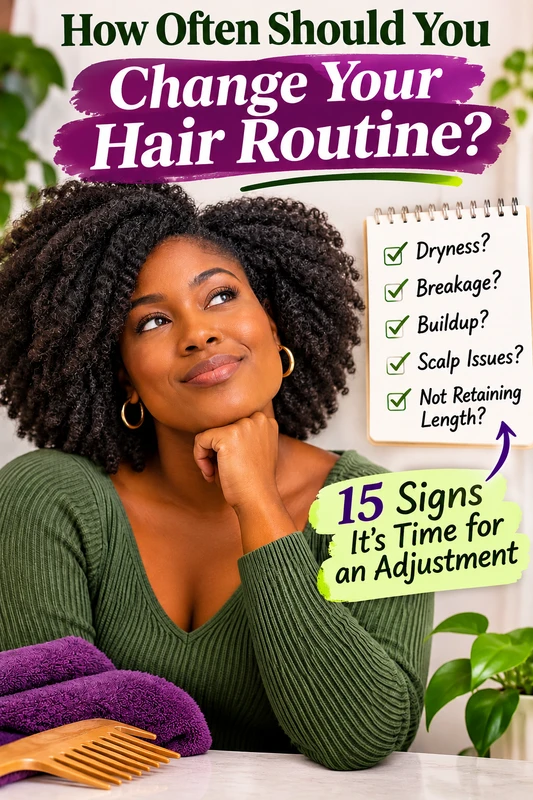
Have you ever followed the same natural hair routine for months, only to discover that your hair no longer feels as soft, moisturized, or manageable as it once did?
Perhaps your favorite moisturizer suddenly seems ineffective. Your hair may be breaking more frequently, your scalp may feel uncomfortable, or your curls may no longer respond to your usual styling products.
These changes can leave you wondering: How often should you change your hair routine?
For most people with natural hair, evaluating your hair routine every four to eight weeks and making small adjustments when necessary is a practical approach. However, you do not need to completely replace your products simply because a certain amount of time has passed.
Your natural hair routine should evolve according to your hair's condition, lifestyle, environment, scalp health, and styling habits.
Whether you have 3C, 4A, 4B, or 4C natural hair, understanding when to adjust your routine can help reduce unnecessary breakage, improve moisture retention, simplify styling, and support healthier-looking hair.
In this comprehensive guide, we will explore how often you should change your natural hair routine, the warning signs that your current regimen needs improvement, and how to make effective adjustments without overwhelming your hair.
How Often Should You Change Your Natural Hair Routine?
There is no universal schedule for changing your natural hair routine. Some people successfully use the same products for years, while others benefit from seasonal adjustments.
A reasonable schedule is:
-
Weekly: Check moisture levels and scalp condition.
-
Monthly: Evaluate product performance and breakage.
-
Every four to eight weeks: Consider minor routine adjustments.
-
Every three to four months: Review seasonal hair-care needs.
-
Every six months: Evaluate your overall hair goals and progress.
These intervals are opportunities to assess your routine, not deadlines for purchasing new products.
If your hair remains soft, manageable, and relatively free from excessive breakage, your current routine may already be working well.
Consistency is often more valuable than constantly experimenting with new products.
If you are unsure where to begin, read our guide on the best natural hair routine for beginners to establish a reliable foundation.
Can Your Hair Get Used to Hair Products?
One of the most common beliefs in natural hair care is that hair eventually becomes immune to shampoos, conditioners, oils, and moisturizers.
However, hair strands are primarily composed of keratin and do not develop immunity to cosmetic products.
When a product appears to stop working, another factor may be responsible.
Possible explanations include:
-
Product buildup.
-
Changes in weather.
-
Increased hair length.
-
Heat damage.
-
Changes in water quality.
-
Different styling habits.
-
Insufficient cleansing.
-
Changes in scalp condition.
-
Excessive product application.
For example, a rich moisturizer that performs beautifully during winter may feel too heavy during humid summer months.
The product has not necessarily stopped working. Your hair's needs may simply have changed.
Understanding the difference can prevent unnecessary spending and frequent product switching.
15 Signs You Should Change Your Hair Routine
1. Your Natural Hair Feels Constantly Dry
Persistent dryness is one of the clearest indications that your moisturizing routine deserves attention.
If your hair feels dry shortly after applying products, you may need to examine your cleansing, conditioning, and moisturizing methods.
Common causes include inadequate conditioning, frequent heat styling, environmental exposure, excessive shampooing, and product buildup.
Instead of repeatedly applying heavy oils, consider whether your routine includes sufficient water-based conditioning.
The Hairobics Leave-In Treatment combines water-based and botanical conditioning ingredients to help improve the softness and manageability of dry natural hair.
Apply an appropriate amount according to your hair's needs rather than continuously layering products throughout the day.
2. You Are Experiencing More Hair Breakage
Finding an increasing number of short, broken hairs on your clothing, bathroom counter, pillow, or comb may indicate that your routine is placing too much stress on your strands.
Hair breakage can result from:
-
Rough detangling.
-
Tight hairstyles.
-
Excessive brushing.
-
Frequent heat styling.
-
Insufficient conditioning.
-
Damaged ends.
-
Repeated friction.
If breakage is increasing, evaluate how you handle your hair before purchasing additional treatments.
Reducing mechanical damage can be one of the most important steps toward improving length retention.
Learn more about protecting your strands in our guide to low-manipulation hair care.
3. Your Scalp Frequently Feels Uncomfortable
A healthy hair-care routine should include appropriate scalp maintenance.
Persistent itching, flaking, tenderness, excessive oiliness, or visible residue can indicate that your scalp needs a different approach.
You may be applying too many products, washing too infrequently, or reacting to an ingredient.
Avoid automatically treating every scalp concern with additional oils.
If discomfort continues despite routine changes, consult a dermatologist. Conditions such as eczema, seborrheic dermatitis, and scalp psoriasis may require specialized treatment.
4. Your Hair Develops Excessive Product Buildup
Does your hair feel sticky, greasy, waxy, or coated even after moisturizing?
Product buildup may be interfering with your routine.
Layering multiple creams, gels, oils, butters, and sprays without adequate cleansing can leave residue on your strands.
This may make your hair feel heavy or difficult to style.
Consider reducing the number of products you apply and using an appropriate clarifying shampoo when necessary.
A simpler routine may deliver better results than adding another product.
5. Your Hair Is Becoming More Difficult to Detangle
Detangling should not become progressively more challenging every wash day.
If you notice more knots, matting, or resistance when separating your strands, examine your current methods.
You may need to use smaller sections, improve conditioning, reduce manipulation, protect your ends, or change how you prepare your hair for washing.
Damaged or split ends can also increase tangling.
Making these adjustments may reduce the amount of time you spend detangling and help prevent unnecessary breakage.
6. Your Hair Feels Unusually Hard or Stiff
Natural hair should generally feel flexible rather than excessively rigid.
If your strands feel stiff, brittle, or unusually rough, consider whether you are using too much styling gel, protein-containing treatments, or heavy products.
Frequent heat exposure and chemical damage may also change how your hair feels.
Try simplifying your routine and concentrating on gentle conditioning.
Avoid assuming that every instance of stiffness requires a specific protein or moisture treatment. Evaluate your overall hair-care practices first.
7. Your Hair Is No Longer Retaining Length
Your hair may continue growing from the roots while breaking at the ends.
This can create the appearance that your natural hair has stopped growing altogether.
If your hair remains at approximately the same length for several months, pay attention to your ends and daily styling habits.
Consider reducing heat exposure, protecting your ends, avoiding tight hairstyles, and detangling more carefully.
Documenting your progress with photographs every few months can help distinguish actual length retention from changes caused by shrinkage.
Remember that cosmetic hair-care products cannot guarantee faster growth.
8. Your Hair Becomes Greasy Too Quickly
Using too much product can be just as problematic as using too little.
If your roots become oily or your strands feel greasy shortly after styling, your routine may be too heavy.
Fine natural hair can be particularly sensitive to excessive oils and butters.
Try reducing the amount of product used, focusing application on areas that need conditioning, and adjusting your cleansing frequency.
Your hair does not need to remain heavily coated to be adequately conditioned.
9. Your Favorite Hairstyles No Longer Last
If twist-outs, braid-outs, wash-and-go styles, or other natural hairstyles consistently lose their shape sooner than expected, your routine may need adjustment.
Changes in humidity, hair length, product quantity, and styling technique can all influence how long a hairstyle lasts.
Before replacing your entire product collection, try changing one factor.
You might use a different amount of styling product, allow your hair to dry more thoroughly, or improve your nighttime protection.
Small changes can sometimes produce noticeable improvements.
10. Your Hair Has Grown Significantly Longer
Longer natural hair often requires different maintenance techniques than shorter natural hair.
As your hair grows, your ends become older and accumulate more environmental and mechanical wear.
Longer hair may require additional sectioning, more careful detangling, improved nighttime protection, and greater attention to the ends.
You may also need to adjust how much conditioner you use.
Do not assume the routine that worked for your short afro will meet every need once your hair reaches shoulder length.
11. You Have Recently Changed Your Hairstyle
Switching from loose natural hair to braids, twists, cornrows, or locs can significantly change your maintenance needs.
Protective hairstyles may reduce daily manipulation, but they do not eliminate the need for cleansing and scalp care.
You may need to adjust how you distribute products, wash your scalp, dry your hair, and protect your hairline.
Avoid excessively tight installations and heavy product accumulation around the roots.
A protective style should protect your hair rather than create additional damage.
12. Your Environment Has Changed
Moving to a different climate, traveling frequently, or spending more time indoors can affect your hair.
Cold temperatures, dry indoor air, humidity, wind, and sun exposure may influence styling performance and moisture retention.
If your environment changes, your natural hair routine may need to change with it.
For example, a lightweight summer regimen may require more conditioning during winter.
Monitor how your hair responds rather than following the same schedule regardless of environmental conditions.
13. Your Wash Day Takes Too Long
A routine that requires several hours of unnecessary steps may eventually become difficult to maintain.
If you regularly postpone washing because your routine feels overwhelming, consider simplifying it.
You may not need multiple shampoos, several conditioning treatments, numerous styling products, or lengthy detangling sessions every wash day.
Our 30-minute natural hair routine offers ideas for building a more efficient maintenance schedule.
The best routine is one that you can realistically maintain.
14. Your Hair Density or Texture Appears Different
Hair can change throughout life.
Aging, hormonal changes, pregnancy, postpartum shedding, menopause, medications, and medical conditions may influence hair density and growth patterns.
These changes may require adjustments to your usual hair-care practices.
For example, hair that has become finer may respond better to lighter products and gentler styling.
However, sudden thinning, widening parts, bald patches, or persistent excessive shedding should not be treated as ordinary cosmetic concerns.
A dermatologist can help identify the cause and recommend appropriate care.
15. Your Hair Routine Is Becoming Too Expensive
Healthy-looking natural hair does not require an unlimited collection of expensive products.
If you constantly purchase new shampoos, conditioners, oils, masks, and growth treatments without seeing meaningful improvements, it may be time to simplify.
Identify which products provide measurable benefits and remove unnecessary duplicates.
Read our guide on how to simplify your natural hair routine for practical ways to reduce unnecessary steps and spending.
Should You Change Your Hair Routine Every Season?
Seasonal adjustments can be beneficial, particularly for people with tightly curled and coily natural hair.
However, you do not necessarily need an entirely different product collection for every season.
Spring Natural Hair Routine
Spring temperatures and humidity levels can fluctuate considerably.
During this season, consider adjusting your product quantities, maintaining regular cleansing, and choosing hairstyles that accommodate changing weather conditions.
If your hair becomes weighed down as temperatures increase, experiment with lighter conditioning products.
Summer Natural Hair Routine
Summer often brings increased sweating, humidity, sun exposure, swimming, and outdoor activities.
You may need to cleanse more frequently and avoid heavy product accumulation.
If you swim regularly, rinse your hair with fresh water after swimming and follow with appropriate conditioning.
Protect your hair from unnecessary friction and prolonged environmental exposure.
Fall Natural Hair Routine
As temperatures decrease, some people notice that their hair feels drier or becomes more difficult to manage.
Fall is a useful time to evaluate your moisturizing products, conditioning schedule, and protective styling habits.
Pay particular attention to your ends and areas that experience frequent friction from clothing.
Winter Natural Hair Routine
Winter weather and indoor heating can contribute to dry-feeling hair.
Consider using richer conditioning products when needed, reducing unnecessary heat styling, and protecting your hair from rough hat and scarf materials.
Use satin-lined accessories when possible.
Maintain regular scalp cleansing rather than allowing heavy products to accumulate throughout the season.
How Often Should You Change a 4C Hair Routine?
Type 4C hair often experiences significant shrinkage and may be particularly vulnerable to tangling and mechanical breakage.
For many people, reviewing a 4C hair routine approximately once a month is a useful starting point.
However, the foundation of your routine can remain consistent:
-
Regular scalp cleansing.
-
Thorough conditioning.
-
Gentle detangling.
-
Water-based moisturizing.
-
Additional conditioning when necessary.
-
Low-tension styling.
-
Nighttime protection.
If your 4C hair responds well to this approach, there is no reason to replace every product.
Instead, adjust the amount, frequency, or application technique as your hair's needs change.
For detailed cleansing instructions, explore our guide on how to wash 4C hair properly.
How Hair Porosity Influences Routine Changes
Hair porosity describes how readily hair absorbs and releases water.
Understanding your hair's behavior can help you identify more appropriate products and maintenance techniques.
Low-Porosity Hair
Hair with relatively low porosity may be more susceptible to feeling coated when heavy products are used excessively.
Consider lighter formulations, thorough rinsing, and careful product distribution.
Avoid repeatedly adding products to hair that already feels weighed down.
High-Porosity Hair
More porous hair may lose moisture relatively quickly, especially when it has been damaged by heat, chemicals, or environmental exposure.
Consistent conditioning and gentle handling may improve manageability.
Some people benefit from richer conditioning products, while others prefer lighter products applied more frequently.
Mixed-Porosity Hair
Different areas of your head may respond differently to the same products.
Your ends may require additional conditioning while your roots remain relatively easy to moisturize.
Instead of changing your entire routine, consider treating individual sections according to their needs.
Discover more in our complete guide to caring for mixed-porosity hair.
How Long Should You Give a New Hair Product to Work?
The amount of time needed to evaluate a product depends on its purpose.
A shampoo can often be assessed after one or several uses based on how effectively it cleanses without causing excessive dryness.
A conditioner may provide noticeable changes in softness and manageability after the first application.
A leave-in treatment may require several applications to determine the ideal quantity and frequency.
Changes in breakage and length retention generally require longer observation.
As a practical approach:
| Product or routine change | Suggested evaluation period |
|---|---|
| Shampoo | 1–3 washes |
| Rinse-out conditioner | 1–3 washes |
| Leave-in conditioner | 2–4 weeks |
| Hair oil or conditioning butter | 2–4 weeks |
| Styling product | 1–3 styling sessions |
| Low-manipulation routine | 4–8 weeks |
| Length-retention routine | 3–6 months |
These are suggested observation periods, not guaranteed result timelines.
Do not continue using a product that causes burning, swelling, redness, or persistent irritation simply because you have not completed the evaluation period.
Can Changing Hair Products Too Often Damage Your Hair?
Switching between suitable products does not automatically damage natural hair.
However, frequent experimentation can make it difficult to identify which products or techniques are helping.
Introducing multiple new treatments simultaneously may increase your exposure to irritating ingredients or lead to excessive manipulation.
Constant experimentation can also encourage unnecessary washing, styling, and detangling.
Whenever possible, introduce one major change at a time.
This makes it easier to recognize whether a specific adjustment improves your hair's condition.
Should You Change Your Wash-Day Schedule?
Your cleansing schedule should reflect your scalp condition, lifestyle, hairstyle, and product use.
Many people with natural hair find that washing every seven to fourteen days is a reasonable starting point.
However, you may need more frequent cleansing if you exercise regularly, sweat heavily, use substantial styling products, or experience rapid buildup.
Other people may comfortably maintain a longer interval.
Read our complete guide to how often you should wash natural hair to develop a schedule suited to your individual needs.
How to Build a Natural Hair Routine That Adapts to Your Needs
The secret to maintaining healthier-looking natural hair is not constantly replacing your products.
It is developing a dependable routine that allows you to make informed adjustments.
Step 1: Cleanse Regularly
Use a shampoo appropriate for your scalp and hair condition.
Remove accumulated sweat, oils, and styling residue without unnecessarily rough handling.
Step 2: Condition Your Hair
Use a suitable conditioner after cleansing.
Concentrate on the lengths and ends, particularly areas that feel rough or become tangled easily.
Step 3: Add Water-Based Conditioning
Apply a suitable leave-in treatment according to your hair's needs.
Work in sections when necessary to improve product distribution.
Step 4: Provide Additional Conditioning Where Needed
If certain areas require additional softness or conditioning, consider incorporating the Hairobics Hair & Scalp Booster.
This botanical oil-based conditioning product contains ingredients including coconut oil, jojoba oil, rosemary oil, and vitamin E oil.
It can complement a water-based moisturizing routine and provide targeted conditioning for dry areas.
Begin with a small amount, perform a patch test, and avoid excessive application.
Step 5: Reduce Unnecessary Manipulation
Choose hairstyles that do not require constant brushing, combing, or restyling.
Loose twists and other gentle hairstyles can help reduce repeated mechanical stress.
Step 6: Protect Your Hair Overnight
Use a satin bonnet, scarf, or pillowcase to minimize friction while sleeping.
Avoid securing your hair so tightly that it places tension on your edges.
Step 7: Monitor Your Progress
Pay attention to softness, manageability, scalp comfort, tangling, and breakage.
Adjust your routine based on these observations.
For additional guidance, explore our article on how to build a simple natural hair routine for healthy, moisturized hair.
A 30-Day Plan for Changing Your Natural Hair Routine
If your current routine is not delivering satisfactory results, use this simple four-week approach.
Week 1: Evaluate Your Current Routine
Write down every product you use and how frequently you apply it.
Identify your primary concern, whether it is dryness, buildup, breakage, difficult detangling, or scalp discomfort.
Avoid introducing several new products immediately.
Week 2: Simplify Your Products
Remove unnecessary duplicate products.
Maintain your essential cleansing, conditioning, and moisturizing steps.
Observe whether your hair feels lighter or becomes easier to manage.
Week 3: Make One Targeted Adjustment
Choose one major change based on your primary concern.
For example, you might adjust your wash frequency, change your leave-in conditioner, or reduce heat styling.
Give yourself enough time to observe the effects.
Week 4: Review Your Results
Compare your hair's current condition with how it felt at the beginning of the month.
Ask yourself:
-
Is my hair easier to detangle?
-
Are my ends less brittle?
-
Does my scalp feel comfortable?
-
Am I experiencing less breakage?
-
Is wash day easier?
-
Am I spending less money on unnecessary products?
Maintain the changes that provide meaningful improvements.
Common Mistakes When Changing Your Hair Routine
Avoid these common natural hair-care mistakes:
-
Purchasing new products every week.
-
Changing several products simultaneously.
-
Ignoring persistent scalp irritation.
-
Applying additional oils whenever hair feels dry.
-
Following another person's routine without considering your own hair.
-
Using excessive amounts of styling products.
-
Expecting immediate improvements in hair growth.
-
Neglecting damaged ends.
-
Wearing excessively tight protective hairstyles.
-
Continuing to use products that cause irritation.
A successful routine should prioritize consistency, comfort, and gentle maintenance rather than complicated product combinations.
Frequently Asked Questions
How often should you change your natural hair routine?
Evaluate your routine every four to eight weeks and adjust individual steps when your hair's needs change. There is no requirement to replace products that continue working well.
Should you switch shampoos every month?
No. A suitable shampoo can remain part of your routine for years. Consider changing it if your scalp becomes uncomfortable or your cleansing needs change.
Does natural hair become immune to hair products?
No. Hair fibers do not develop immunity to cosmetic products. Buildup, weather, damage, and changing styling habits can influence product performance.
Should you change your hair routine during winter?
You may benefit from additional conditioning and environmental protection during winter, particularly if indoor heating or cold weather makes your hair feel dry.
How often should you change your 4C hair products?
Review product performance monthly, but only replace products when necessary. Consistent care is generally more beneficial than frequent switching.
Can using too many hair products cause breakage?
Excessive product use may contribute to buildup and difficult detangling, which can indirectly increase mechanical breakage. Simplifying your routine may help.
Should you moisturize natural hair every day?
Not necessarily. Moisturize when your hair needs it rather than automatically applying products every day.
How do you know if your hair routine is working?
Look for manageable strands, improved softness, a comfortable scalp, fewer tangles, reduced breakage, and gradual length retention.
Can I use the same hair oil for years?
Yes. If an oil remains suitable for your hair and does not cause irritation or excessive buildup, you do not need to replace it periodically.
Should I change my hair routine if my hair stops growing?
First, determine whether breakage is preventing length retention. Persistent thinning, bald patches, or unusual shedding should be evaluated by a healthcare professional.
Is it better to have a simple natural hair routine?
For many people, yes. A simpler routine makes consistency easier and helps identify which products provide meaningful benefits.
How long does it take for a new hair routine to work?
Softness and manageability may improve within a few applications. Changes in breakage and length retention may take several weeks or months to evaluate.
Final Thoughts: How Often Should You Change Your Hair Routine?
The best natural hair routine is not necessarily the most expensive, complicated, or frequently updated routine.
It is the routine that consistently meets your hair's individual needs.
Evaluate your natural hair routine every four to eight weeks, pay attention to seasonal changes, and make targeted adjustments when necessary.
Focus on regular cleansing, effective conditioning, gentle detangling, appropriate moisturizing, low-tension hairstyles, and protection from unnecessary damage.
Whether you wear your natural hair in curls, coils, braids, twists, locs, or a short natural hairstyle, consistency remains one of the most important elements of successful hair care.
Listen to your hair, protect your ends, care for your scalp, and give reasonable routine changes enough time to demonstrate their benefits.
Healthy-looking natural hair is built through consistent care rather than constantly chasing the next trending product.
Give your natural hair the care it deserves with Hairobics All Natural.
Explore our botanical hair and scalp conditioning products at HairobicsAllNatural.com and build a routine that works for your individual hair-care needs.