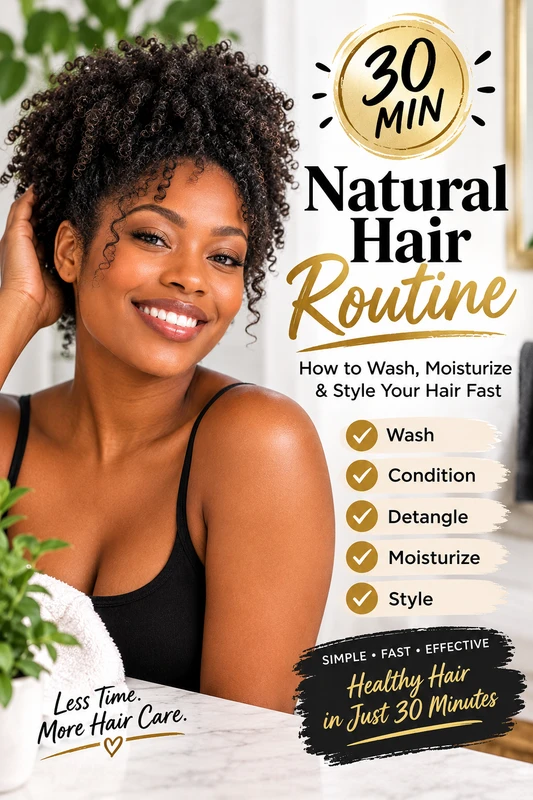
Taking care of natural hair doesn't have to take hours every day. Whether you have thick 4C coils, soft 4A curls, high-density natural hair, or shoulder-length twists, maintaining healthy hair can become much easier when you follow a simple, organized routine.
For many Black women with natural hair, one of the biggest challenges is finding enough time to wash, detangle, moisturize, and style their hair while balancing work, family, and everyday responsibilities.
You may love your natural hair but feel frustrated by routines that require several hours of washing, conditioning, stretching, twisting, and styling.
The good news is that you don't always need an elaborate routine to maintain healthy-looking natural hair.
With the right preparation, gentle techniques, and appropriate products, some people can complete a basic natural hair wash-and-style routine in approximately 30 minutes.
The secret isn't rushing through important steps. It's eliminating unnecessary manipulation, simplifying your products, and focusing on what your hair actually needs.
In this complete guide, you'll learn how to create a 30-minute natural hair routine, how to moisturize 4C hair quickly, how to reduce detangling time, and how to choose simple hairstyles that support length retention.
You'll also discover how to build a manageable weekly schedule that keeps your curls and coils looking beautiful without spending your entire weekend doing your hair.
Can You Really Complete a Natural Hair Routine in 30 Minutes?
Yes, a 30-minute natural hair routine is possible for some people, especially when the hair is already reasonably detangled and the goal is basic cleansing, conditioning, moisturizing, and simple styling.
However, the amount of time required depends on several factors:
-
Hair length and density
-
Curl pattern and shrinkage
-
How easily the hair tangles
-
Whether the hair is already stretched
-
Product buildup
-
The condition of the ends
-
Your chosen hairstyle
-
Whether you need additional treatments
Someone with short, low-density natural hair may complete the entire process in less than 30 minutes.
Someone with long, high-density 4C hair may require considerably more time, especially when detangling is necessary.
The important thing is understanding that 30 minutes is a practical goal, not a strict deadline.
If your hair requires additional time to prevent unnecessary pulling or breakage, take that time.
For a more detailed explanation, read our guide on how long natural hair wash day should take.
The Complete 30-Minute Natural Hair Routine
Here is a simple schedule you can follow when your hair is relatively manageable and doesn't require extensive detangling.
| Step | Time |
|---|---|
| Prepare and section hair | 3 minutes |
| Shampoo and rinse | 7 minutes |
| Condition and gently detangle | 8 minutes |
| Final rinse and apply leave-in | 5 minutes |
| Moisturize and create a simple hairstyle | 7 minutes |
| Total | 30 minutes |
This schedule focuses on the essential steps.
It doesn't include extensive deep conditioning, complicated braiding, heat styling, or complete drying.
Those activities can be added when necessary, but they aren't required during every basic wash day.
Let's examine each step.
Step 1: Prepare and Section Your Hair — 3 Minutes
One of the easiest ways to make natural hair care faster is to prepare everything before starting.
Searching for your shampoo, conditioner, hair clips, and styling products while your hair is wet wastes valuable time.
Instead, create a simple wash-day station.
Gather Your Essential Products
You'll need:
-
Gentle shampoo
-
Rinse-out conditioner with good slip
-
Wide-tooth comb or detangling brush
-
Four to six hair clips
-
Microfiber towel or soft cotton T-shirt
-
Leave-in treatment
-
Optional scalp oil or conditioning product
-
Satin scrunchie or other gentle styling accessory
You don't need fifteen different products to maintain healthy natural hair.
Choose products that serve a specific purpose.
Divide Your Hair Into Sections
Start by separating your hair into four manageable sections.
Create a center part from your forehead to your nape, then another part from ear to ear.
Secure each section loosely.
If your hair is extremely thick, divide the larger sections further.
Sectioning helps prevent different areas of your hair from becoming intertwined during washing.
It also makes it easier to distribute shampoo and conditioner.
For more detailed advice, read how many sections you should use on wash day.
Time-Saving Tip
Don't spend several minutes creating perfectly straight parts.
Your sections only need to be manageable.
The goal is organization, not precision.
Step 2: Shampoo Your Natural Hair — 7 Minutes
A clean scalp is an important foundation for healthy natural hair maintenance.
Sweat, styling products, oils, and environmental debris can accumulate on your scalp over time.
Regular cleansing helps remove buildup and keeps your hair feeling refreshed.
How to Shampoo Natural Hair Quickly
Begin by thoroughly wetting your hair with comfortably warm water.
Allow the water to reach your scalp underneath the curls and coils.
Next, apply shampoo according to the product directions.
Focus on your scalp rather than aggressively rubbing the entire length of your hair.
Use the pads of your fingertips to massage gently.
Avoid scratching with your nails.
Work through your sections in a consistent order.
As you rinse, allow the shampoo and water to travel through the lengths of your hair.
Make sure all shampoo is thoroughly removed.
Avoid Piling Your Hair on Top of Your Head
One common mistake is gathering all your hair into a large pile while shampooing.
This can encourage tangling, especially with tightly coiled natural hair.
Instead, keep your sections organized and avoid unnecessary circular rubbing of the strands.
Should You Shampoo Twice?
Not necessarily.
If your scalp and hair are adequately clean after one wash, a second shampoo may not be needed.
However, heavy buildup, excessive oil, or certain styling products may require additional cleansing.
Don't sacrifice cleanliness just to meet a time limit.
A properly cleansed scalp is more important than finishing exactly on schedule.
Step 3: Condition and Detangle — 8 Minutes
For many women with natural hair, detangling is the most time-consuming part of wash day.
This is especially true for tightly coiled 4B and 4C hair.
Fortunately, combining conditioning and detangling can make the process more efficient.
Apply Conditioner in Sections
After shampooing, apply your rinse-out conditioner throughout the lengths and ends.
Work through your existing sections.
Choose a conditioner that provides enough slip for your hair.
Slip describes how easily strands glide past one another during detangling.
When hair has adequate slip, separating tangles may require less pulling.
Detangle From the Ends Upward
Begin near the ends of each section.
Use your fingers to separate obvious tangles.
Then gradually work upward toward the roots with your fingers or a suitable detangling tool.
Hold the section above the area you're detangling to reduce pulling at the scalp.
Never force a comb through stubborn knots.
If you encounter resistance, add more conditioner or water as appropriate and work through the knot gently.
Twist Each Completed Section
Once a section is detangled, loosely twist or clip it.
This keeps it separate from the remaining hair.
It also reduces the likelihood that previously detangled strands will become tangled again.
What If Eight Minutes Isn't Enough?
Take additional time.
The eight-minute estimate is best suited to hair that has been maintained regularly and doesn't contain severe tangles.
Long, dense, or heavily tangled hair may require twenty minutes or more.
Gentle handling is more important than speed.
Step 4: Rinse and Apply Leave-In Treatment — 5 Minutes
Once you've finished conditioning and detangling, rinse your hair thoroughly according to the conditioner directions.
Keep your sections organized.
Gently squeeze out excess water instead of rubbing your hair aggressively with a towel.
A microfiber towel or soft cotton T-shirt can help absorb water while minimizing friction.
Your hair can remain damp when you begin post-wash care.
Why Leave-In Care Matters
After shampooing and conditioning, leave-in products can help support softness and manageability between washes.
Natural hair may become dry-feeling because of environmental conditions, styling practices, friction, and individual hair characteristics.
A suitable leave-in treatment can make the hair easier to maintain.
Try Hairobics Leave-In Treatment
Hairobics Leave-In Treatment is a botanical-based hair and scalp treatment formulated with ingredients including aloe vera, jojoba oil, avocado oil, rosemary oil, and other plant-derived ingredients.
It can be incorporated into a simplified post-wash routine.
Follow the product directions, including testing a small area before broader application.
Working through your existing sections helps you apply the product consistently without repeatedly manipulating your hair.
Shop Now: Hairobics Leave-In Treatment
Avoid Overloading Your Hair
Using several different leave-ins, creams, butters, and oils at once doesn't automatically improve moisture retention.
Excessive layering can leave hair feeling coated and contribute to buildup.
Start with an appropriate amount and adjust based on how your hair responds.
Step 5: Moisturize and Style — 7 Minutes
The final step is choosing a simple hairstyle that doesn't require extensive manipulation.
This is where you can save a considerable amount of time.
Instead of attempting a complicated twist-out or elaborate braid pattern, choose a style that works with your hair's current condition.
Option 1: Large Two-Strand Twists
Large twists are a practical choice for medium-length and longer natural hair.
Divide your hair into several manageable sections.
Apply any additional styling product you need.
Create large two-strand twists without pulling tightly.
You don't need perfectly straight parts.
Large twists can help keep strands organized and may reduce daily manipulation.
Option 2: Simple Natural Puff
A puff can be a quick hairstyle for hair that is long enough to gather comfortably.
Use your fingers to arrange your hair.
Secure it with a soft, gentle accessory.
Avoid pulling tightly around your edges or temples.
If your hairline feels uncomfortable, loosen the style.
Option 3: Wash-and-Go
For some curl patterns and styling preferences, a wash-and-go can be relatively quick.
Apply an appropriate styling product to damp hair.
Distribute it gently and arrange your curls.
Allow your hair to dry thoroughly.
Remember that styling may take only a few minutes, but drying can take considerably longer.
Option 4: Loose Bun
A loose bun can work well for longer natural hair.
Gather the hair without excessive tension.
Secure it gently and avoid repeatedly brushing the hairline.
If your hair is very wet, consider allowing it to dry more before keeping it tightly gathered for extended periods.
Option 5: Chunky Braids
Large braids are another low-manipulation option.
They can keep your hair organized while providing a relatively simple finished look.
Choose the number of braids based on your hair's density and length.
The goal is to create a comfortable hairstyle without spending another hour styling.
How to Make a 30-Minute Routine Work for 4C Natural Hair
Many women with 4C natural hair wonder whether a 30-minute routine is realistic.
The answer depends more on density, length, tangling, and maintenance habits than curl pattern alone.
4C hair typically has tightly coiled strands and can experience significant shrinkage.
These characteristics may make detangling and styling more time-consuming.
However, a streamlined routine can still help.
1. Keep Your Hair Organized Between Washes
If your hair becomes severely tangled during the week, detangling will take longer.
Consider loose twists, braids, or another comfortable low-manipulation style.
2. Don't Wait Until Your Hair Is Extremely Tangled
Regular maintenance can help prevent small tangles from becoming larger knots.
Avoid repeatedly combing your hair when it doesn't need it.
3. Use Enough Conditioner
Tightly coiled hair may benefit from conditioner with sufficient slip during detangling.
Work through small sections when necessary.
4. Choose a Simple Finished Style
Large twists, chunky braids, and other easy hairstyles may require less time than intricate styles.
5. Don't Force Your Hair Into a Deadline
Some people with 4C hair can complete basic care in 30 minutes.
Others may need 45 to 90 minutes or longer.
Both are normal.
A successful routine should leave your scalp clean and your hair manageable without unnecessary breakage.
How to Keep Natural Hair Moisturized Without Spending Hours
Moisture management is an important part of maintaining natural hair.
Dry-feeling hair may become more difficult to detangle and style.
However, moisturizing doesn't need to involve several complicated steps.
Start With Water-Based Care
Water is an important component of hair hydration.
A suitable water-based leave-in can help provide conditioning benefits after washing.
Apply according to directions.
Add Oil-Based Conditioning When Needed
Some people prefer an additional oil-based product for dry-feeling hair or scalp areas.
Oil-based products can provide lubrication and help reduce moisture loss in some circumstances, but oils don't replace water or proper conditioning.
Consider Hairobics Hair & Scalp Booster
Hairobics Hair & Scalp Booster contains a blend of ingredients including coconut oil, olive oil, jojoba oil, aloe vera, wheat germ oil, rosemary oil, and vitamin E oil.
It can complement a regular hair and scalp-conditioning routine.
Apply a small, appropriate amount according to the product directions.
Avoid applying excessive quantities, particularly when your hair already feels coated.
Shop Now: Hairobics Hair & Scalp Booster
Pay Attention to Your Ends
The ends are the oldest portion of your hair.
They've experienced more washing, brushing, styling, and environmental exposure than newer growth.
Handle them gently.
Avoid excessive friction and unnecessary manipulation.
Maintaining the condition of your ends can help support length retention.
The 30-Minute Natural Hair Routine for Busy Mornings
Not every 30-minute hair routine needs to include shampooing.
In fact, many people can maintain their existing hairstyle in considerably less time.
If your hair was washed recently and your scalp is clean, focus on refreshing and maintaining your style.
Minutes 0–5: Check Your Hair and Scalp
Remove your satin bonnet or scarf.
Examine your hair for dryness, tangling, flattened sections, or areas that need attention.
Don't automatically apply more products.
Minutes 5–10: Refresh Dry Areas
If your hair feels dry, lightly refresh the sections that need it.
Use an appropriate moisturizing product.
Avoid soaking your entire head unnecessarily.
Minutes 10–15: Gentle Scalp Care
Check whether your scalp feels comfortable.
If your scalp needs additional conditioning, you may choose an appropriate product.
For example, Hairobics Scalp Rejuvenator is a botanical oil blend formulated for scalp care.
Follow the directions, including patch-testing before broader use.
Avoid applying scalp oils over heavy buildup or irritated skin.
Shop Now: Hairobics Scalp Rejuvenator
Minutes 15–25: Refresh Your Hairstyle
Retwist a few loose sections if necessary.
Reshape your puff.
Smooth your bun gently.
Adjust your braids or twists.
Focus only on the areas that need attention rather than completely restyling your hair.
Minutes 25–30: Finish and Protect
Check your ends and hairline.
Make sure your hairstyle isn't pulling tightly.
Allow any damp sections to dry adequately.
You're ready to continue your day.
For many people, this maintenance routine may take only five to fifteen minutes.
How to Reduce Natural Hair Breakage During a Quick Routine
One concern about shorter hair routines is whether moving quickly will cause damage.
The answer depends on your technique.
A simplified routine can reduce unnecessary manipulation, but rushing aggressively through tangles can increase breakage.
Avoid Rough Detangling
Never force a brush or comb through resistant hair.
Use enough slip and work gently.
Reduce Repeated Combing
Once a section is detangled, you generally don't need to comb through it repeatedly.
Excessive manipulation can increase friction.
Avoid Tight Hairstyles
Tight buns, braids, ponytails, and puffs can place stress on the hairline.
Choose comfortable styles that don't cause pain or pulling.
Limit Unnecessary Heat
Heat styling can add time and may damage hair when temperatures are excessive.
You don't need to straighten your hair every wash day.
If you use heat, choose appropriate temperature settings and heat protection.
Keep Your Ends Protected
Avoid rough towel drying, aggressive brushing, and unnecessary pulling.
For more tips, read how to reduce breakage while shampooing.
Best Products for a Simple 30-Minute Natural Hair Routine
A fast natural hair routine works best when every product has a clear purpose.
At Hairobics All Natural, we believe a consistent routine should be manageable and focused on caring for the hair and scalp.
Here are three products that can complement your regular routine.
1. Hairobics Leave-In Treatment
Best suited for incorporating botanical-based leave-in care into your post-wash routine.
This treatment contains a blend of plant-derived ingredients and can be used according to its directions as part of regular hair and scalp maintenance.
2. Hairobics Hair & Scalp Booster
An option for people who prefer additional oil-based conditioning.
Its blend of botanical oils can complement a routine focused on maintaining soft, manageable hair.
3. Hairobics Scalp Rejuvenator
An option for incorporating scalp-conditioning oil into your routine.
Use sparingly and according to directions.
You don't need to apply all three products every time you style your hair.
Choose products according to your hair's condition and needs.
A simple, consistent approach is often easier to maintain than a complicated product routine.
Common Mistakes That Make Natural Hair Routines Take Too Long
Mistake 1: Using Too Many Products
Layering several products can make styling more complicated and increase buildup.
Choose only what your hair needs.
Mistake 2: Detangling Repeatedly
Some people detangle before shampooing, during conditioning, after rinsing, and again while styling.
This may be unnecessary.
Choose the detangling stage that works best for your hair.
Mistake 3: Creating Too Many Sections
Sections are helpful, but excessive sectioning can increase handling time.
Use enough sections to manage your hair comfortably.
Mistake 4: Attempting Complicated Styles Every Wash Day
Intricate styles can be beautiful, but they require time.
Save them for occasions when you have a longer styling window.
Mistake 5: Ignoring Hair Maintenance Between Washes
Hair that becomes severely tangled may require much longer to detangle.
Regular, gentle maintenance can help keep future wash days manageable.
Mistake 6: Skipping Necessary Cleansing
Trying to save time by continually applying products without cleansing can contribute to buildup.
Wash your hair and scalp according to their needs.
Mistake 7: Rushing Through Knots
Forcing a comb through tangled hair may cause unnecessary breakage.
Slow down whenever you encounter resistance.
The purpose of a faster routine is efficiency, not aggressive handling.
A Simple Weekly Natural Hair Schedule
You don't need to complete a full wash-day routine every morning.
Instead, create a schedule that separates cleansing from everyday maintenance.
Sunday: Wash and Style
Shampoo and condition your hair.
Detangle gently.
Apply your leave-in care.
Choose a low-manipulation hairstyle.
Monday: Minimal Maintenance
Check your hair and scalp.
Adjust your hairstyle if necessary.
Avoid unnecessary combing.
Tuesday: Moisture Check
Examine your ends and dry-feeling areas.
Apply a suitable product only when needed.
Wednesday: Scalp Check
Look for buildup, irritation, or tightness around your hairline.
Make gentle styling adjustments.
Thursday: Refresh Your Style
Refresh loose twists or flattened areas if necessary.
Avoid completely restyling your hair without a reason.
Friday: Low-Manipulation Day
Keep your hairstyle simple.
Protect your ends and avoid unnecessary pulling.
Saturday: Prepare for Wash Day
Check for tangles.
Gather your products.
Decide whether your hair needs a regular wash or a more extensive treatment.
Your washing frequency may need to change based on exercise, sweating, buildup, scalp condition, and styling habits.
For additional ideas, explore our guide to building a simple natural hair routine.
How to Make Your Natural Hair Routine Even Faster
Once you've established a basic routine, look for opportunities to save time without sacrificing care.
Keep Your Products Together
Store your essential wash-day products in one convenient location.
This eliminates searching for supplies.
Choose Your Hairstyle Before Washing
Deciding what to do with your hair after shampooing can save time.
If you know you'll wear large twists, prepare your clips and styling products beforehand.
Maintain Your Hair Between Washes
Regular maintenance can reduce the amount of tangling you encounter.
Combine Compatible Steps
Conditioning and detangling can often be performed together.
Avoid repeating steps unnecessarily.
Use a Simple Styling Method
Choose styles that work with your natural texture rather than requiring extensive manipulation.
Protect Your Hair at Night
A satin bonnet, scarf, or pillowcase can help reduce friction while sleeping.
This may make your morning routine easier.
Know When You Need More Time
Some wash days require extra attention.
If your hair is heavily tangled, contains significant buildup, or needs a treatment, adjust your schedule.
For additional techniques, read how to reduce wash day time for natural hair.
Frequently Asked Questions About a 30-Minute Natural Hair Routine
Can I wash 4C natural hair in 30 minutes?
Yes, some people can wash, condition, and complete basic styling of 4C hair in approximately 30 minutes.
However, longer, denser, or heavily tangled hair may require additional time.
What is the fastest natural hair routine?
A basic routine includes cleansing when needed, conditioning, gentle detangling, leave-in care, and simple styling.
On non-wash days, a quick refresh may be sufficient.
How often should I moisturize natural hair?
Moisturize according to how your hair feels and responds.
Some people need more frequent refreshing than others.
Avoid applying products automatically when your hair already feels adequately conditioned.
Can I skip deep conditioning?
Not every wash day requires an extended deep-conditioning treatment.
Choose conditioning treatments based on your hair's condition and the product directions.
Regular rinse-out conditioning remains important.
What is the easiest hairstyle for busy mornings?
Large twists, simple puffs, loose buns, chunky braids, and some wash-and-go styles can be convenient options.
Choose a style that suits your hair length and texture.
Can a simple routine help with hair growth?
A consistent routine that maintains scalp cleanliness and reduces unnecessary breakage can support length retention.
However, shortening your routine doesn't directly increase the biological rate of hair growth.
Is a 30-minute routine enough for long natural hair?
It may be enough for basic maintenance, but washing and detangling long or high-density hair often takes longer.
Adjust the routine to your hair's needs.
Should I use oil every day?
Not necessarily.
Daily oil application isn't required for everyone.
Excessive use may contribute to buildup.
Follow product directions and pay attention to how your scalp responds.
How can I stop my hair from tangling during wash day?
Keep your hair organized in sections, avoid aggressive rubbing, use conditioner with adequate slip, and secure completed sections.
Does a faster routine mean less healthy hair?
No.
A shorter routine can still provide appropriate care when it includes the steps your hair needs.
The important factors are consistency, proper cleansing, conditioning, and gentle handling.
Final Thoughts: Healthy Natural Hair Doesn't Have to Take All Day
Creating a 30-minute natural hair routine is about making your hair care more efficient, not sacrificing healthy hair practices.
You don't need an elaborate collection of products or several hours of styling every time you wash your hair.
For some people, a simple routine of sectioning, shampooing, conditioning, detangling, moisturizing, and easy styling can fit into approximately 30 minutes.
For others, the same routine may require more time.
Both approaches can support healthy natural hair maintenance.
The most important thing is choosing a routine that works for your individual hair.
Keep your scalp clean, condition your strands, minimize unnecessary manipulation, and protect your ends.
When you simplify your routine and remain consistent, caring for natural hair can become easier, more manageable, and less stressful.
Ready to simplify your natural hair routine?
Discover botanical-based hair and scalp care products at Hairobics All Natural and build a routine that works for your lifestyle.
Healthy natural hair care doesn't have to be complicated. Sometimes, thirty focused minutes are all you need.