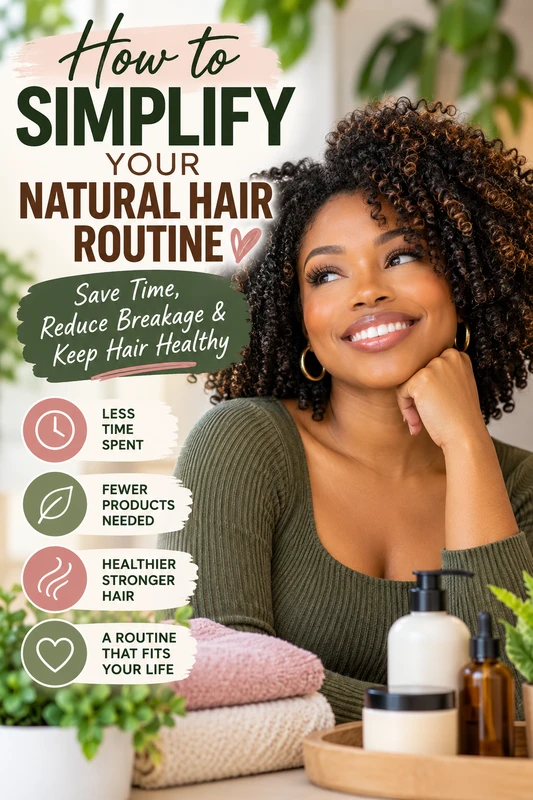
Taking care of natural hair shouldn't feel like a second full-time job. Between washing, conditioning, detangling, moisturizing, styling, and protecting your hair at night, it's easy to spend hours every week trying to maintain healthy curls and coils.
But here's something every natural hair enthusiast should understand: a complicated hair routine doesn't automatically produce healthier hair.
In fact, using too many products, constantly manipulating your strands, and following unnecessary hair care steps can sometimes make maintaining natural hair more difficult.
Whether you have 3C curls, 4A coils, 4B hair, or tightly coiled 4C natural hair, learning how to simplify your natural hair routine can help you save time, reduce unnecessary breakage, maintain moisture, and make your hair easier to manage.
The secret isn't neglecting your hair. It's identifying which steps actually benefit your strands and eliminating everything else.
In this guide, we'll explain how to create a low-maintenance natural hair routine, reduce wash day time, choose essential hair products, maintain moisture with less effort, and protect your hair without spending hours styling it.
Why Your Natural Hair Routine Might Be Too Complicated
The natural hair community offers countless techniques, products, and styling methods.
You might see someone recommend pre-pooing before every wash, deep conditioning weekly, using multiple leave-in products, applying three different oils, and refreshing curls every morning.
While some of these techniques can be helpful, your hair doesn't necessarily need all of them.
Every person's natural hair is different.
Factors that influence your ideal routine include:
-
Hair density and strand thickness
-
Curl pattern and shrinkage
-
Hair porosity
-
Scalp condition
-
Lifestyle and physical activity
-
Climate and humidity
-
Product buildup
-
Hair length and styling preferences
-
How frequently your hair becomes dry or tangled
For example, someone with fine, low-density natural hair may find that heavy creams and multiple oils leave their hair greasy and flat.
Someone with thick, tightly coiled hair may prefer a richer leave-in conditioner and a protective hairstyle that minimizes daily manipulation.
Neither person needs to follow the same routine.
The goal is to discover what works for your hair rather than copying every new trend.
If you're just beginning your natural hair journey, our Best Natural Hair Routine for Beginners explains the essential foundations of natural hair care.
1. Identify the Five Essentials Your Natural Hair Actually Needs
One of the easiest ways to simplify your routine is to stop thinking about individual products and start thinking about your hair's basic needs.
Most natural hair routines can be organized around five essential functions.
Cleansing
Your scalp needs regular cleansing to remove sweat, excess oil, dirt, and styling product residue.
A suitable shampoo helps maintain scalp hygiene without unnecessarily stripping your hair.
Conditioning
Conditioner helps improve manageability, reduce friction between strands, and make detangling easier.
This is particularly important for tightly coiled hair that tends to develop knots.
Moisturizing
Natural hair benefits from adequate hydration and conditioning.
A water-based leave-in conditioner or moisturizer can help improve softness and manageability between wash days.
Gentle Styling
Your hairstyle should allow you to look and feel good without requiring excessive pulling, brushing, combing, or tension.
Nighttime Protection
Protecting your hair while sleeping can help minimize friction, tangling, and unnecessary manipulation the following morning.
These five categories provide a foundation for a manageable routine.
You may occasionally need additional treatments, but they don't have to become permanent steps.
2. Reduce the Number of Hair Products You Use
If your bathroom contains dozens of half-used hair products, simplifying your collection may be one of the most effective changes you can make.
Natural hair doesn't automatically need separate products for every possible concern.
For many people, a basic collection includes:
-
A suitable shampoo
-
A rinse-out conditioner
-
A leave-in conditioner or moisturizer
-
One styling product, if needed
-
An optional oil or scalp product for a specific purpose
That's enough to create a functional starting routine.
You don't necessarily need several different curl creams, multiple oils, three leave-in conditioners, and a separate moisturizer for every day of the week.
How to Decide Which Products to Keep
Evaluate your existing products by asking:
Does this product solve a specific problem?
If your leave-in conditioner already makes your hair soft and manageable, adding two more moisturizing products might not provide additional benefits.
Does it work consistently?
A product that performs well repeatedly is usually more valuable than something you purchased because it became popular online.
Does it create buildup?
If your hair feels coated, sticky, or unusually heavy after applying several products, your routine may contain unnecessary layers.
Can one product perform multiple functions?
Some leave-in conditioners provide enough softness and manageability that a separate moisturizing cream becomes optional.
Start with fewer products and introduce additional items only when you identify a clear need.
3. Simplify Wash Day Without Sacrificing Hair Health
Wash day is often the most time-consuming part of maintaining natural hair.
Depending on hair length, density, and styling preferences, washing and detangling can take considerable time.
However, your wash day doesn't need to include every treatment available.
A Simple Natural Hair Wash Day
Step 1: Divide your hair into sections.
Separate your hair into four to eight manageable sections if needed.
Sectioning helps prevent tangles and makes cleansing easier.
Step 2: Shampoo your scalp.
Wet your hair thoroughly, apply shampoo, and gently massage your scalp with your fingertips.
Rinse completely.
Step 3: Condition and detangle.
Apply conditioner to your strands, concentrating on areas that need additional softness.
Detangle gently while your hair has enough slip.
Step 4: Apply leave-in conditioner.
After rinsing, distribute a suitable leave-in treatment through damp hair.
Step 5: Style your hair.
Choose a comfortable hairstyle that doesn't require excessive manipulation.
That's your basic wash day.
You can add a deep conditioner, clarifying shampoo, or other treatment when your hair genuinely needs it.
Stop Performing Every Treatment During Every Wash
A common mistake is believing that more treatments automatically lead to healthier hair.
For example, you may not need to use a protein treatment, hot oil treatment, deep conditioner, and scalp treatment during the same wash.
Instead, evaluate your hair's current condition.
If your hair feels soft and manageable after regular conditioning, an additional mask may be unnecessary.
If heavy products have accumulated, occasional clarifying may be helpful.
For more practical time-saving techniques, read How to Reduce Wash Day Time.
4. Stop Moisturizing Your Hair More Often Than Necessary
Many people believe natural hair must be moisturized every single day.
However, moisturizing frequency depends on your hair's condition, environment, hairstyle, and products.
Some people benefit from refreshing their hair every day or two.
Others may maintain comfortable, manageable hair for several days without adding more products.
Applying moisturizer unnecessarily can contribute to buildup and leave hair feeling sticky or weighed down.
How to Know When Your Hair Needs Moisture
Pay attention to signs such as:
-
Hair feeling noticeably dry
-
Increased roughness
-
Reduced manageability
-
Ends becoming difficult to separate
-
Hair feeling less flexible during styling
Before adding more product, examine whether your hair is actually dry or simply coated with residue.
A Simple Moisturizing Method
Start with slightly damp hair when appropriate.
Apply a small amount of water-based leave-in conditioner or moisturizer.
Distribute the product gently through your strands.
If your hair benefits from an additional cream or oil, use a modest amount.
Avoid applying multiple layers automatically.
You can learn more about maintaining softness in our guide on How to Keep Natural Hair Moisturized.
Remember that oil alone does not add water to dry hair. Its role depends on the formulation and how it is used alongside conditioning products.
5. Choose Hairstyles That Require Less Daily Maintenance
Your hairstyle can make a major difference in how much time you spend caring for your natural hair.
Some styles require daily reshaping, detangling, or product application.
Others allow you to maintain your appearance with minimal effort throughout the week.
Low-Maintenance Hairstyles for Natural Hair
Two-strand twists
Twists can help keep hair organized, reduce daily manipulation, and provide styling versatility.
They can also be worn as a twist-out after removal.
Loose braids
Simple braids can help maintain stretched hair and reduce tangling.
Avoid excessive tension around your hairline.
Low-tension buns
A loose bun can be convenient for work, exercise, or everyday activities.
Change the placement occasionally and avoid pulling your hair tightly.
Wash-and-go styles
For some curl patterns and routines, a wash-and-go can be relatively simple.
However, it may require more frequent refreshing for others.
Flat twists
Flat twists offer a practical way to keep hair arranged while reducing daily styling.
The best hairstyle is one that works with your hair's characteristics and doesn't cause discomfort or excessive tension.
Protective styling should make maintenance easier, not create additional stress on your scalp.
6. Make Detangling Easier by Preventing Knots
Detangling can consume a significant portion of your natural hair routine.
Instead of focusing only on detangling faster, focus on preventing unnecessary tangles in the first place.
Keep Your Hair Organized
Loose twists, braids, and sectioned hairstyles can help reduce opportunities for strands to wrap around one another.
Detangle With Enough Slip
Use conditioner or a suitable detangling product to reduce friction.
Avoid aggressively brushing dry, tangled hair.
Start at the Ends
Gently separate tangles near the ends before working upward.
Use your fingers, a wide-tooth comb, or an appropriate detangling brush.
Avoid Repeated Detangling
Once a section is detangled, loosely twist or clip it.
You don't need to repeatedly comb the same section unless necessary.
Protect Your Hair Overnight
Reducing friction while sleeping may help prevent some tangles from developing.
For additional guidance, explore How to Detangle Natural Hair Without Breakage.
7. Create a Five-Minute Morning Hair Routine
A simple morning routine can help you get ready without completely restyling your hair.
The key is choosing a hairstyle that doesn't require extensive maintenance every morning.
Minute 1: Inspect Your Hair
Check whether your hair actually needs moisture, reshaping, or adjustment.
If it looks and feels fine, avoid unnecessary manipulation.
Minute 2: Refresh Only Where Needed
If a few areas feel dry, apply a small amount of suitable moisturizer.
You don't have to saturate your entire head.
Minute 3: Adjust Your Hairstyle
Gently reshape your afro, twists, or curls.
Avoid excessive pulling or combing.
Minute 4: Smooth or Arrange
Use your hands or a suitable styling tool to make small adjustments.
Skip unnecessary edge styling if you're comfortable with your natural hairline.
Minute 5: Finish and Go
Once your hairstyle looks presentable, leave it alone.
Constantly touching and rearranging your hair can increase friction and unnecessary manipulation.
Our Natural Hair Morning Routine offers more tips for maintaining curls without starting over each morning.
8. Simplify Your Nighttime Natural Hair Routine
Your nighttime routine doesn't have to involve thirty minutes of twisting, moisturizing, and restyling.
In many cases, protecting your existing hairstyle is enough.
Use Satin or Silk Protection
A satin bonnet, scarf, or pillowcase may help reduce friction compared with rougher fabrics.
Choose something comfortable that doesn't create tension around your hairline.
Preserve Your Hairstyle
If your hair is already in twists or braids, you may only need to secure it gently.
For loose natural hair, a few loose sections or a suitable nighttime arrangement may help reduce tangling.
Don't Automatically Add More Products
If your hair feels adequately moisturized, additional products may not be necessary.
Excessive product layering can make hair feel coated.
Avoid Tight Nighttime Styling
Your scalp and hairline shouldn't experience unnecessary tension while you sleep.
The purpose of nighttime protection is to preserve your hair, not pull it into an uncomfortable position.
9. Build a Simple Weekly Natural Hair Schedule
One of the easiest ways to stay consistent is to create a predictable routine.
Instead of making hair care decisions every morning, establish a flexible weekly schedule.
Example: Seven-Day Natural Hair Routine
Sunday: Wash and Style
Cleanse your scalp, condition, detangle, moisturize, and style.
Monday: Minimal Maintenance
Check your hairstyle and adjust only what is necessary.
Tuesday: Moisture Check
Assess whether your hair feels dry.
Refresh lightly if needed.
Wednesday: Protective Maintenance
Check your ends and hairstyle for tangling or tension.
Thursday: Light Refresh
Reapply a small amount of moisturizer only if your hair needs it.
Friday: Hairstyle Adjustment
Make minor styling changes without completely detangling or restyling.
Saturday: Preparation
Check your scalp, gather products, and prepare for your next wash when appropriate.
This is an example rather than a rigid schedule.
If your scalp needs washing sooner, cleanse it.
If your hairstyle remains comfortable and manageable, avoid unnecessary restyling.
Consistency matters more than following a complicated calendar.
10. Simplify Your Routine Based on Your Hair Type
Although basic hair care principles apply broadly, different hair characteristics may require adjustments.
Simple Routine for 4C Natural Hair
Tightly coiled 4C hair may benefit from organized sections and gentle detangling.
Consider:
-
Washing in manageable sections
-
Using conditioner with good slip
-
Applying leave-in conditioner to damp hair
-
Wearing low-manipulation hairstyles
-
Protecting hair at night
-
Avoiding unnecessary daily combing
You don't need to eliminate shrinkage to have healthy hair.
Shrinkage is a normal characteristic of tightly coiled textures.
Simple Routine for Fine Natural Hair
Fine strands may become weighed down by heavy product layering.
Try using a lightweight leave-in conditioner and smaller amounts of styling products.
Avoid assuming that thick butters are necessary.
If your hair becomes limp or coated, simplify your product combination.
Simple Routine for High-Density Natural Hair
High-density hair can take longer to wash and detangle because there are more strands to manage.
Sectioning is especially useful.
Work through one area at a time and keep completed sections organized.
Simple Routine for Low-Porosity Natural Hair
Low-porosity hair may be more prone to noticeable product buildup with certain formulations.
Apply products in modest amounts and distribute them thoroughly.
Use regular cleansing to manage residue.
Simple Routine for High-Porosity Natural Hair
High-porosity hair may lose moisture relatively quickly, particularly when it has existing damage.
A suitable leave-in conditioner and, when helpful, an additional conditioning or sealing product may improve manageability.
The goal is to adjust the routine to your hair's response rather than follow a universal product-layering rule.
11. Stop Following Every Natural Hair Trend
Social media can make natural hair care seem more complicated than necessary.
One week, a particular oil becomes popular.
The next week, everyone recommends a new moisturizing method or expensive treatment.
Trying every technique can leave you with too many products and no consistent routine.
Before changing your regimen, ask yourself three questions.
Is my current routine working?
If your scalp feels comfortable, your hair is manageable, and breakage is limited, you may not need major changes.
What specific problem am I trying to solve?
Choose products or techniques that address a clear concern.
Can I test one change at a time?
Changing several products simultaneously makes it difficult to determine which one actually helped.
A simple routine gives you a better opportunity to observe your hair's response.
12. Recognize When Your Hair Needs More Than Basic Maintenance
Simplifying your routine doesn't mean ignoring important problems.
Certain concerns deserve additional attention.
For example, persistent scalp itching, inflammation, significant flaking, or unusual shedding may require evaluation rather than additional styling products.
Similarly, excessive breakage may indicate that your hair is experiencing friction, tension, chemical damage, heat damage, or other problems.
A basic routine is a starting point, not a replacement for appropriate treatment.
Signs Your Routine Is Working
You may notice:
-
Easier detangling
-
Less unnecessary breakage
-
More manageable hair
-
Comfortable scalp conditions
-
Reduced product buildup
-
Less time spent styling
-
Better consistency with cleansing and conditioning
Healthy natural hair doesn't have to look perfectly defined every day.
Texture, shrinkage, frizz, and volume are normal characteristics of natural hair.
The goal is manageable hair and a comfortable scalp.
13. Learn When to Remove a Step Instead of Adding One
Sometimes the solution to a hair problem is doing less.
If your hair feels heavy after moisturizing, you may be applying too many products.
If your ends repeatedly tangle, you may need to reduce manipulation or change how you protect them.
If wash day takes hours, consider whether you're performing treatments that provide little additional benefit.
If your hair becomes difficult to style after applying several creams, try using one suitable leave-in and one styling product instead.
You can also review our guide on How to Make Natural Hair Softer for ways to improve manageability without relying on excessive products.
The simplest effective routine is one that addresses your actual needs.
14. Choose Hair Products That Fit Your Simplified Routine
Building a low-maintenance routine doesn't mean giving up quality hair care products.
It means selecting products that serve a clear purpose.
For example, a leave-in treatment may be useful when your hair needs additional conditioning and manageability after washing.
A scalp product may fit your routine when you have a specific reason to use it.
A styling product may be helpful when you want hold or definition.
However, every product should have a purpose.
A Simple Approach From Hairobics All Natural
At Hairobics All Natural, we believe natural hair care should be practical, consistent, and easy to maintain.
Instead of overwhelming your hair with unnecessary layers, focus on cleansing, conditioning, moisture, and gentle styling.
For additional hair care support, explore the products available at Hairobics All Natural and select the ones that fit your individual routine.
Remember that even a good product should be used according to your hair's needs and its directions.
You don't need to use every product in a collection to maintain healthy natural hair.
15. Make Consistency More Important Than Perfection
One of the biggest benefits of simplifying your natural hair routine is that it becomes easier to maintain.
An elaborate routine may look impressive, but it provides little benefit if it's too exhausting to follow regularly.
A practical routine should fit your schedule.
If you work long hours, have children, exercise frequently, or simply prefer spending less time on your hair, choose maintenance methods that work with your lifestyle.
You don't have to recreate elaborate hairstyles every week.
You don't need to apply several products every morning.
You don't need to buy every new treatment that appears online.
Focus on the fundamentals.
Cleanse when needed.
Condition appropriately.
Detangle gently.
Moisturize according to your hair's condition.
Protect your strands from unnecessary damage.
Repeat consistently.
For more moisture-maintenance ideas, read How to Keep Your Hair Moisturized All Week.
Frequently Asked Questions About Simplifying Natural Hair Care
What is the easiest natural hair routine?
A basic routine includes shampooing, conditioning, gentle detangling, applying a leave-in conditioner when needed, choosing a manageable hairstyle, and protecting your hair overnight.
Additional products and treatments can be introduced according to your hair's needs.
How many products do you need for natural hair?
Many people can begin with three or four core products: shampoo, conditioner, leave-in conditioner, and an optional styling product.
Some routines may benefit from an additional oil, scalp treatment, or deep conditioner.
Can natural hair stay healthy without daily moisturizing?
Yes. Not everyone needs to moisturize their hair daily.
Frequency depends on your hair's condition, environment, hairstyle, and the products you use.
Monitor your hair instead of applying products automatically.
How often should you wash natural hair?
Many people with natural hair start with washing approximately every one to two weeks, but this isn't a universal rule.
Your scalp condition, activity level, styling products, and personal needs may require more or less frequent cleansing.
Is a simple routine good for 4C hair?
Absolutely. A simple routine can work well for 4C hair.
Focus on conditioning, gentle detangling, sectioning, moisture management, and low-manipulation hairstyles.
Do you need oil in a natural hair routine?
Not necessarily.
Some people benefit from using oil for lubrication, shine, or reducing moisture loss, while others find that their leave-in conditioner provides enough manageability.
Oil isn't a substitute for water-based conditioning.
Can using fewer hair products reduce buildup?
Yes. Reducing unnecessary product layering may help limit residue accumulation.
However, regular cleansing is still important.
What is the fastest way to maintain natural hair?
Choose a manageable hairstyle, organize your wash day, use only necessary products, reduce repeated detangling, and protect your hair overnight.
Do you need to deep condition every week?
Not everyone needs a separate deep-conditioning treatment weekly.
The frequency depends on hair condition, damage, product formulation, and how well your regular conditioner performs.
How can you simplify natural hair care without causing breakage?
Keep the essential cleansing and conditioning steps, detangle gently, avoid excessive tension, protect your hair overnight, and reduce unnecessary manipulation.
Simplifying should remove redundant steps, not important protective habits.
Final Thoughts: Healthy Natural Hair Doesn't Have to Be Complicated
Learning how to simplify your natural hair routine can make maintaining your curls and coils more enjoyable.
Instead of spending hours applying products and following complicated techniques, focus on what your hair actually needs.
A consistent routine built around cleansing, conditioning, moisturizing, gentle styling, and nighttime protection can provide a strong foundation for healthy natural hair.
Remember that using more products doesn't automatically mean you're taking better care of your hair.
Sometimes, fewer steps make it easier to recognize what works, avoid unnecessary buildup, and maintain consistency.
Whether you have short natural hair, long curls, thick 4C coils, or fine natural hair, your routine should fit your lifestyle and help you maintain manageable strands.
The best natural hair routine isn't the longest or most expensive one. It's the one you can consistently follow while keeping your hair and scalp healthy.
At Hairobics All Natural, our goal is to help make natural hair care simpler and more manageable, so you can spend less time worrying about your routine and more time enjoying your natural hair.