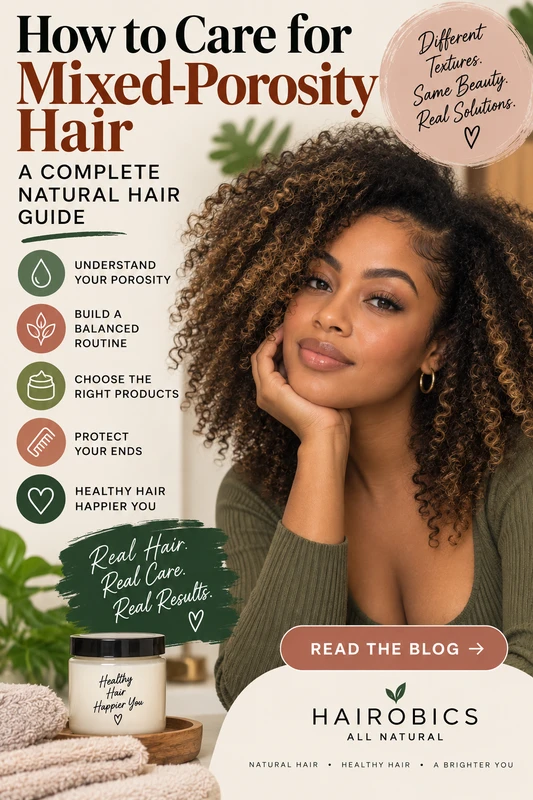
If some sections of your hair seem to absorb moisture immediately while other areas seem to repel water and products, you may be dealing with mixed-porosity hair. This can make building a natural hair routine confusing because one product or technique may work beautifully on one section of your hair but leave another section dry, greasy, frizzy, or weighed down.
Mixed porosity is more common than many people realize. Your roots may behave like low-porosity hair while your ends absorb products like a sponge. You might have highly porous areas around your crown but lower-porosity strands toward the back of your head. Chemical treatments, heat styling, environmental exposure, friction, and everyday wear can also cause the porosity of individual strands to change over time.
The good news is that you don't necessarily need completely separate routines for every section of your hair. The key is learning how your hair responds to water, conditioner, oils, styling products, and drying—and then adjusting your routine accordingly.
In this guide, we'll explain how to care for mixed-porosity hair, how to recognize different porosity levels, how to moisturize mixed-porosity natural hair, which products and techniques may work best, and how to keep your hair soft, manageable, and protected.
What Is Hair Porosity?
Hair porosity describes how easily your hair takes in and retains water and other substances.
The outermost layer of the hair shaft is called the cuticle. The condition and structure of this outer layer influence how readily water can move into and out of the hair fiber.
Hair is commonly discussed in three general porosity categories:
Low-Porosity Hair
Low-porosity hair tends to resist wetting and product penetration. Water may initially sit on the surface, and heavy products can accumulate relatively easily.
Common signs include:
- Hair takes time to become fully saturated.
- Products sometimes sit on top of the hair.
- Heavy creams and oils can cause buildup.
- Hair may take a long time to air-dry.
- Lightweight products may feel more comfortable than thick formulas.
Medium-Porosity Hair
Medium-porosity hair generally accepts moisture relatively easily without losing it excessively quickly.
You may notice:
- Hair becomes wet without much difficulty.
- Conditioner distributes easily.
- Hair remains moisturized for a reasonable period.
- Styling products generally absorb well.
- Hair responds predictably to many routines.
High-Porosity Hair
Highly porous hair tends to take in water quickly but may also lose moisture relatively quickly.
Some people notice:
- Hair becomes saturated very fast.
- Hair dries quickly.
- Products seem to disappear into the hair.
- Strands frequently feel dry or rough.
- Hair may be prone to tangling or breakage, especially if it is damaged.
Porosity is not necessarily identical across your entire head, which brings us to mixed porosity.
What Is Mixed-Porosity Hair?
Mixed-porosity hair means different areas or lengths of your hair behave as though they have different levels of porosity.
For example, you could have:
Low-porosity roots + high-porosity ends
or:
Low-porosity hair in the back + higher-porosity hair around the crown
or even:
Mostly medium-porosity hair + several highly porous damaged sections.
This variation can explain why a hair product sometimes produces inconsistent results.
You may apply a moisturizing cream to your entire head and notice that one section feels incredibly soft while another becomes coated or greasy.
You may deep condition and find that your ends love the treatment while your roots feel heavy afterward.
Instead of assuming that the product doesn't work, consider whether different sections of your hair simply have different needs.
Why Does Hair Have Different Porosity Levels?
There are several reasons porosity can vary across your hair.
1. Your Ends Are Older Than Your Roots
The hair near your scalp is newer growth.
Your ends may have been exposed to months or years of:
- Washing
- Detangling
- Brushing
- Combing
- Sun exposure
- Heat
- Styling
- Friction
- Hair ties
- Braids
- Twists
- Manipulation
Because your ends are older, they often show more weathering than newer hair near the scalp.
This is one reason someone may have relatively low-porosity roots but more porous ends.
2. Heat Styling
Repeated use of flat irons, curling irons, blow-dryers, and other high-temperature styling tools can alter the condition of the hair fiber.
If you frequently straighten only certain areas—for example, your leave-out or the front of your hair—those sections may behave differently from the rest.
3. Chemical Processing
Hair that has been:
- Relaxed
- Colored
- Bleached
- Permanently waved
- Chemically straightened
may have different porosity characteristics from untreated new growth.
Someone transitioning from relaxed hair to natural hair is a perfect example.
The new natural growth and previously processed ends can behave very differently.
4. Environmental Exposure
The outer portions of your hair may receive more exposure to:
- UV radiation
- Wind
- Dry air
- Chlorinated water
- Salt water
- Pollution
Over time, these factors can contribute to weathering.
5. Mechanical Damage
Some areas of your hair may experience more friction than others.
For example, hair around your:
- Nape
- Crown
- Hairline
- Shoulders
may repeatedly rub against clothing, pillows, hats, scarves, or other surfaces.
6. Different Hair Characteristics Across Your Head
Many people naturally have more than one curl pattern, strand diameter, or density across their scalp.
One area may have tight coils while another has looser curls.
These differences can influence how quickly sections become wet, how much product they need, and how they respond to styling.
Signs You May Have Mixed-Porosity Hair
Mixed porosity isn't always obvious.
You may have mixed-porosity hair if:
- Your roots stay wet much longer than your ends.
- Your ends dry significantly faster.
- Some sections absorb products immediately.
- Products sit on top of other sections.
- Your ends constantly feel dry while your roots feel moisturized.
- One section becomes greasy very easily.
- Certain areas tangle more than others.
- Your crown behaves differently from the rest of your hair.
- Deep conditioner works better on some areas than others.
- Your hair has both natural and chemically processed sections.
- You have old color or bleach remaining on your ends.
- One part of your hair has experienced considerably more heat styling.
The important thing is not necessarily assigning every strand a precise porosity label.
Instead, pay attention to behavior.
If one section consistently needs more moisture while another consistently becomes weighed down, your routine should reflect that.
How to Test Mixed-Porosity Hair
You've probably heard of the popular "float test."
It usually involves putting strands of hair into a glass of water and judging porosity according to whether the strands float or sink.
Unfortunately, this isn't a particularly reliable way to determine hair porosity. Surface oils, product residue, surface tension, and other factors can affect what happens to the strand.
A more practical approach is to observe your hair during your normal routine.
The Water Test
Start with relatively clean hair without heavy product buildup.
Separate your hair into several sections.
Apply water to each section and observe what happens.
Ask:
How quickly does this section become thoroughly wet?
If water initially beads on the surface and the section requires more time and manipulation to become saturated, it may behave more like lower-porosity hair.
If a section becomes thoroughly wet very quickly, it may behave as though it is more porous.
Don't rely on a single observation. Pay attention over several wash days.
Observe Drying Time
After washing your hair, notice which areas dry first.
If your ends repeatedly dry much faster than your roots, they may need more attention when you moisturize and seal your hair.
Observe Product Absorption
Pay attention when applying leave-in conditioner.
Does one section absorb the product immediately?
Does another section remain visibly coated?
That information is often more useful for developing your routine than trying to assign your entire head one porosity category.
How to Care for Mixed-Porosity Hair
The goal of caring for mixed-porosity hair is balance.
You want to give thirsty sections enough conditioning and protection without drowning sections that become weighed down easily.
Here is a practical routine.
1. Divide Your Hair Into Sections
Sectioning is one of the most helpful techniques for mixed-porosity natural hair.
Instead of treating your entire head as one uniform mass of hair, divide it into four to eight sections.
For example:
- Front left
- Front right
- Crown
- Back left
- Back right
You can create additional sections if your hair is especially thick or long.
Sectioning allows you to notice differences.
You might discover that your crown requires more conditioner.
Your ends may need additional leave-in.
The hair near your nape might require less product.
These small adjustments can make a significant difference.
2. Cleanse Your Hair Thoroughly
Product buildup can make porosity even harder to understand.
If the hair is coated with layers of oils, butters, gels, silicones, creams, or styling products, water may have difficulty reaching the strand.
That can sometimes make hair appear less porous than it really is.
Use a shampoo appropriate for your hair and scalp needs.
Focus primarily on cleansing your scalp, but make sure water and cleanser can remove residue throughout the hair.
You don't necessarily need an aggressive clarifying shampoo every wash day.
However, periodic clarification can be useful when you notice:
- Products no longer absorb normally.
- Hair feels coated.
- Hair looks dull.
- Your scalp has significant buildup.
- Your curls aren't responding normally.
- Your hair feels greasy but somehow still dry.
After clarifying, follow with conditioning because stronger cleansing can leave some hair feeling drier.
3. Use Warm Water During Wash Day
Extremely hot water isn't necessary.
However, comfortably warm water can make cleansing and conditioning pleasant and help products distribute through the hair.
If lower-porosity sections resist wetting, spend additional time thoroughly saturating those areas before shampooing.
Don't rush this step.
Sometimes what appears to be "product resistance" is simply hair that wasn't completely wet before the product was applied.
4. Condition Every Section
Conditioner is particularly important for textured hair because it improves lubrication and manageability during detangling.
Apply conditioner in sections.
Instead of automatically applying exactly the same amount everywhere, observe how each section responds.
Your higher-porosity or weathered areas may benefit from slightly more conditioner.
Areas that become weighed down easily may need less.
Pay particular attention to your ends because they are generally the oldest part of your hair.
5. Deep Condition Strategically
You don't necessarily need two entirely different deep conditioners.
Start with one well-formulated conditioner and adjust your application.
Apply more generously to:
- Dry ends
- Weathered sections
- Color-treated hair
- Areas prone to tangles
Apply a lighter amount to areas that easily become coated or limp.
Heat can sometimes improve the conditioning experience, particularly for hair that is difficult to saturate.
A hooded dryer, heat cap, or warm towel can be used if appropriate for the product you're using.
Always follow the manufacturer's directions.
6. Detangle Carefully
Mixed-porosity hair can have areas with very different levels of friction and manageability.
Detangle while your hair has plenty of slip from water and conditioner.
Start at the ends and gradually work upward.
You can use:
- Your fingers
- A wide-tooth comb
- A detangling brush designed for textured hair
Avoid aggressively pulling through knots.
If you encounter a difficult tangle, stop and add water or conditioner before continuing.
Your goal isn't simply to get the comb through your hair.
The goal is to detangle while preserving as much healthy hair as possible.
7. Apply Leave-In Conditioner to Damp Hair
After washing and conditioning, apply your leave-in while your hair still contains water.
Water provides the actual hydration.
Conditioning products can help improve softness, lubrication, and manageability and may reduce how quickly hair feels dry.
For mixed porosity, don't assume every section needs the same amount.
Lower-Porosity Areas
Try:
- Smaller amounts of product
- Lightweight leave-ins
- Thin lotions
- Water-based moisturizers
Applying layer after layer of heavy butter can leave these sections feeling coated.
Higher-Porosity Areas
These areas may respond better to:
- A little more leave-in
- Creamier products
- Additional conditioning
- A light sealing product when appropriate
Pay special attention to damaged or weathered ends.
8. Try a Modified LCO or LOC Method
The LCO method stands for:
Liquid → Cream → Oil
The LOC method stands for:
Liquid → Oil → Cream
Neither method is automatically superior for everyone.
Mixed-porosity hair may benefit from modifying the amount of each layer.
For example, you could apply a lightweight leave-in throughout your hair.
Then apply a small amount of cream everywhere.
Finally, apply a little oil primarily to your drier ends.
You don't have to cover your entire head with the same amount of oil just because you're following a named method.
Your hair's response matters more than following a formula perfectly.
9. Be Careful With Heavy Oils and Butters
Natural hair routines sometimes encourage generous use of oils and butters.
But more isn't always better.
Heavy layers of:
- Castor oil
- Shea butter
- Thick pomades
- Heavy creams
may be useful in certain routines, but they can also leave some hair feeling coated.
This can be especially noticeable on lower-porosity sections.
If your roots become oily while your ends remain dry, don't automatically apply more oil everywhere.
Instead, reduce product around the roots and concentrate moisture and conditioning where your hair actually needs it.
10. Give Your Ends Extra Attention
For many people with mixed porosity, the ends are the area that needs the most attention.
Your ends have survived the longest.
They may have gone through hundreds of wash days, hairstyles, detangling sessions, and nights of friction.
Protect them.
After moisturizing, you may choose to apply a small amount of oil, cream, or pomade to your ends if that helps them remain soft and manageable.
Avoid saturating them with oil.
A small amount may be enough.
11. Protect Your Hair at Night
Nighttime friction can contribute to tangles and breakage.
Consider sleeping with:
- A satin bonnet
- A satin scarf
- A satin pillowcase
You can also place your hair into loose twists, braids, or another low-tension nighttime style.
Avoid extremely tight nighttime hairstyles.
Your scalp and edges shouldn't hurt when you're trying to sleep.
12. Limit Excessive Heat
You don't necessarily have to avoid heat completely.
However, frequent high-temperature styling can contribute to hair damage.
If you use a blow-dryer or flat iron:
- Use a heat protectant.
- Avoid unnecessarily high temperatures.
- Minimize repeated passes.
- Don't flat iron dirty or heavily coated hair.
- Give your hair breaks between heat-styling sessions.
If one section of your hair is already more porous because of previous heat damage, be particularly careful with that area.
13. Trim Damaged Ends When Needed
Products can improve the feel and manageability of weathered hair, but they cannot permanently restore a severely split hair shaft to its original condition.
If your ends are:
- Severely split
- Constantly knotting
- Breaking excessively
- Extremely thin or see-through
a trim may improve overall manageability.
Trimming damaged ends can also make your porosity differences feel less extreme.
Best Products for Mixed-Porosity Hair
There isn't one universal "mixed-porosity product."
Instead, look for products that allow you to control how much you're applying.
Shampoo
Choose a shampoo that cleans effectively without leaving your hair feeling excessively stripped.
If you frequently use oils, gels, butters, or edge-control products, you may occasionally need stronger cleansing to remove accumulated residue.
Conditioner
Look for a conditioner with good slip.
Slip is particularly valuable for curly, coily, and kinky textures because it can make detangling easier.
Leave-In Conditioner
A versatile leave-in is useful because you can apply a light layer throughout your hair and then add more to the sections that need it.
Moisturizing Spray
A lightweight moisturizing spray can be especially useful between wash days.
Instead of coating dry hair with more heavy cream, a spray allows you to lightly refresh areas that need attention.
For natural hair, braids, twists, and locs, a lightweight product such as Raaw Roots Moisturizing Spray from Hairobics All Natural can fit into a moisture-focused routine when used according to your hair's individual needs.
Oil
Oils don't replace water or conditioner.
Instead, a small amount can be used as part of a finishing or sealing routine if your hair responds well to it.
Concentrate oil on the areas that need it rather than automatically covering your entire scalp and hair.
Mixed-Porosity Hair Wash-Day Routine
Here's an example of a simple routine.
Step 1: Section
Divide your hair into four to eight sections.
Step 2: Saturate
Thoroughly wet each section.
Spend additional time on sections that resist water.
Step 3: Shampoo
Clean your scalp and remove product buildup.
Step 4: Condition
Apply conditioner throughout your hair, using a little more on dry or weathered sections when necessary.
Step 5: Detangle
Carefully detangle from ends toward roots.
Step 6: Rinse
Rinse thoroughly so your hair isn't unnecessarily coated.
Step 7: Apply Leave-In
Apply a lightweight layer throughout your hair.
Add additional product to drier sections.
Step 8: Moisturize and Style
Apply your styling cream, gel, or moisturizer according to your hairstyle.
Step 9: Seal Selectively
If your ends tend to dry quickly, apply a small amount of oil or pomade to them.
You don't necessarily need oil on every strand.
Step 10: Dry Thoroughly
Allow your style to dry completely before separating twists, braids, or other set styles.
How Often Should You Moisturize Mixed-Porosity Hair?
There isn't a universal schedule.
Some people need a refresh every few days.
Others can go a week or longer before their hair feels dry.
Instead of automatically moisturizing every day, check your hair.
Ask yourself:
- Does it actually feel dry?
- Are the ends becoming rough?
- Is the hair losing flexibility?
- Does only one section need refreshing?
If only your ends feel dry, moisturize your ends.
You don't have to add product to your entire head.
This is one of the most important principles of caring for mixed porosity:
Treat the section that needs attention.
How Often Should You Wash Mixed-Porosity Hair?
Your ideal wash schedule depends on your scalp, hairstyle, activity level, and product usage.
Many people with natural hair wash approximately every one to two weeks, but that isn't a rule everyone must follow.
You may need to wash sooner if:
- Your scalp becomes uncomfortable.
- You exercise heavily.
- You use lots of styling products.
- You experience significant buildup.
- Your hairstyle allows easy washing.
A clean scalp and hair give you a better foundation for moisturizing and styling.
Protein and Mixed-Porosity Hair
Protein treatments are another area where mixed porosity can become complicated.
More porous or chemically processed sections may sometimes respond differently to protein-containing products than less weathered hair.
However, don't assume that all high-porosity hair automatically needs frequent protein treatments.
Pay attention to how your hair responds.
If a protein-containing product consistently leaves your hair unusually stiff, rough, or difficult to manage, reduce how often you use it or choose a different formula.
If your hair is significantly damaged from bleach, chemical treatments, or heat, you may want to discuss appropriate care with an experienced stylist.
Low-Porosity Roots and High-Porosity Ends
This is one of the most common mixed-porosity patterns.
Here's a simple strategy.
At the Roots
Use:
- Lightweight products
- Smaller amounts
- Thorough cleansing
- Plenty of water
Avoid repeatedly coating the roots with thick layers of butter and oil if that causes buildup.
At the Ends
Use:
- Adequate conditioner
- Leave-in conditioner
- A little extra cream if necessary
- A small amount of oil or pomade when helpful
- Low-manipulation styling
This approach allows you to address both areas without maintaining two completely separate wash-day routines.
Mixed Porosity and Protective Styles
Protective styles can simplify mixed-porosity hair care, but the hair still needs attention.
Styles may include:
- Two-strand twists
- Flat twists
- Braids
- Cornrows
- Buns
- Wigs with properly maintained hair underneath
Avoid assuming that hair doesn't need care simply because it isn't visible.
Before installing a long-term protective style:
- Cleanse your hair.
- Condition thoroughly.
- Detangle carefully.
- Moisturize.
- Make sure the style isn't excessively tight.
While wearing the style, pay attention to your scalp and exposed hair.
Avoid continuously layering heavy products onto the scalp without cleansing.
Common Mixed-Porosity Hair Mistakes
Mistake #1: Using the Same Amount of Product Everywhere
Uniform application sounds logical, but it may not work well for mixed porosity.
Use more where needed and less where it isn't.
Mistake #2: Using Oil as Your Only Moisturizer
Oil and water aren't interchangeable.
If your hair is dehydrated, repeatedly adding oil may simply leave it oily while it continues to feel dry.
Mistake #3: Never Clarifying
Buildup can interfere with your ability to understand how your hair naturally behaves.
Periodically remove accumulated residue when needed.
Mistake #4: Overloading Low-Porosity Areas
If a section repeatedly becomes greasy or coated, adding even more product probably isn't the solution.
Try less.
Mistake #5: Ignoring the Ends
Your ends are often the oldest and most weathered part of your hair.
Give them extra attention.
Mistake #6: Using Too Much Heat
Repeated high heat can worsen damage and increase differences between sections of your hair.
Mistake #7: Obsessing Over Porosity Tests
Porosity categories are useful, but they shouldn't make hair care unnecessarily complicated.
Your hair doesn't need to pass a test before you can care for it.
Observe how it behaves.
How to Make Mixed-Porosity Hair Easier to Manage
Keep your routine simple.
You don't need 15 products.
A basic routine might consist of:
- Shampoo
- Conditioner
- Leave-in conditioner or moisturizing spray
- Styling product
- Optional oil or pomade
Then adjust the amount and placement of those products.
That's often easier than buying separate product collections for low-, medium-, and high-porosity sections.
Can Your Hair Porosity Change?
Hair behavior can change over time.
New growth may behave differently from older hair because the older lengths have experienced more environmental and mechanical wear.
Chemical processing and significant heat damage can also alter the hair fiber.
That's why a routine that worked perfectly two years ago may not produce identical results today.
Periodically reassess your hair instead of assuming its needs will remain exactly the same forever.
How to Tell If Your Mixed-Porosity Routine Is Working
Don't judge your routine only by how your hair looks immediately after styling.
Look at what happens over several weeks.
Positive signs may include:
- Hair remains manageable longer.
- Ends don't become dry as quickly.
- You experience fewer severe tangles.
- Products aren't constantly sitting on the surface.
- Hair doesn't feel excessively greasy.
- Detangling becomes easier.
- You experience less unnecessary breakage.
- Styles remain moisturized and flexible.
Take notes if necessary.
You might discover something as simple as:
"My crown needs more conditioner, but my back section needs less leave-in."
That observation can be more useful than knowing a porosity label.
Frequently Asked Questions About Mixed-Porosity Hair
Can You Have Both Low- and High-Porosity Hair?
Yes. Different sections and different lengths can behave differently, particularly when some hair has experienced more chemical processing, heat, or weathering than other areas.
Why Are My Roots Low Porosity but My Ends High Porosity?
Your roots are newer hair.
Your ends are older and have experienced more washing, detangling, friction, environmental exposure, and styling.
This can make older sections behave differently from newer growth.
Should I Use Different Products on Different Sections?
Sometimes, but you don't always need to.
Try adjusting the amount first.
For example, use the same leave-in throughout your hair but apply more to your dry ends and less near areas that become coated easily.
Is Mixed Porosity Damaged Hair?
Not necessarily.
Differences in hair behavior don't automatically mean your hair is damaged.
However, chemical processing, repeated high heat, and physical weathering can contribute to increased porosity in certain areas.
Is LOC or LCO Better for Mixed-Porosity Hair?
Neither method is universally better.
Try both and observe your results.
You may even find that a simplified version works best—for example, leave-in plus cream on most of your hair and a tiny amount of oil only on your ends.
Should You Oil Mixed-Porosity Hair Every Day?
Not necessarily.
Daily oiling can lead to buildup for some people.
Apply products according to what your hair actually needs rather than automatically following a daily schedule.
How Do You Moisturize Mixed-Porosity Hair?
Start with water and a suitable leave-in or moisturizing product.
Apply lighter amounts to sections that become weighed down easily and slightly more to sections that dry quickly.
If helpful, finish the driest areas with a small amount of oil, cream, or pomade.
Does Mixed-Porosity Hair Need Deep Conditioner?
Deep conditioning can be useful, especially for dry, weathered, or chemically treated hair.
Concentrate the product on the areas that need the most conditioning rather than automatically applying a very heavy layer everywhere.
Final Thoughts: Listen to Your Hair, Not Just the Label
Learning how to care for mixed-porosity hair doesn't have to mean creating three completely different hair-care routines.
The biggest change is learning to stop treating every section exactly the same.
Your roots may need less product.
Your crown may need additional conditioner.
Your ends may need more moisture and protection.
One section may need to be clarified more thoroughly because products accumulate there.
Another may need additional care because it has experienced years of heat or chemical processing.
Start by keeping your routine simple: cleanse thoroughly, condition well, detangle gently, moisturize with water-based products, protect your ends, and use oils or heavier products selectively.
Most importantly, observe your hair over time.
Porosity is a useful tool for understanding hair behavior, but your actual results should guide your routine.
When you learn which areas need more moisture, which need less product, and which require extra protection, caring for mixed-porosity natural hair becomes much easier.
Hairobics All Natural offers hair-care products designed to fit into routines for natural hair, locs, braids, twists, and other textured hairstyles. Whether you're maintaining your everyday natural style or protecting older, drier ends, focus on consistent cleansing, moisture, gentle handling, and a routine that responds to what your individual hair needs.