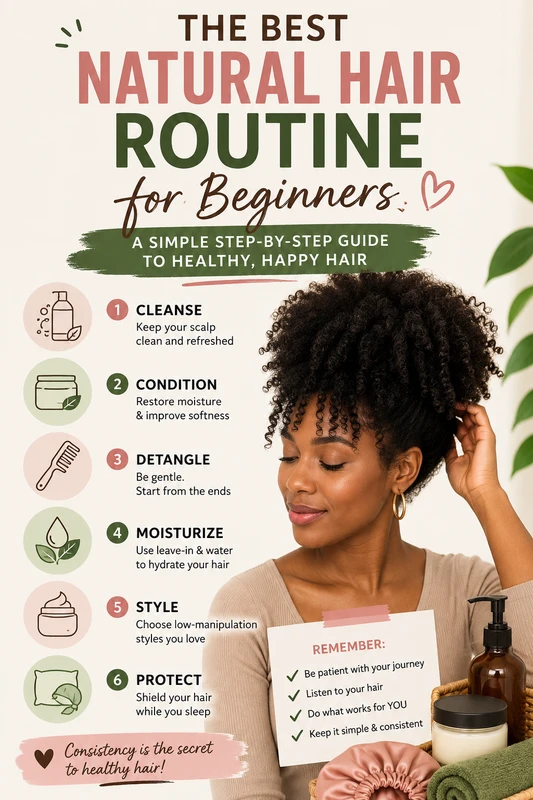
Starting a natural hair journey can feel exciting, confusing, and overwhelming all at once. Between shampoos, conditioners, leave-ins, oils, creams, gels, protective styles, deep treatments, and dozens of techniques on social media, it can be difficult to figure out what your natural hair actually needs.
The good news is that a healthy natural hair routine does not have to be complicated.
For most beginners, the best natural hair routine focuses on a few fundamentals: keeping the scalp clean, maintaining moisture, reducing unnecessary breakage, protecting the ends, and staying consistent.
Whether you recently did the big chop, are transitioning from relaxed hair, have been natural for years but never established a routine, or simply want healthier-looking hair, this beginner-friendly guide will help you build a routine you can realistically maintain.
In this complete guide, we'll cover how often to wash natural hair, how to moisturize it, when to deep condition, how to detangle safely, which products you actually need, how to protect your hair at night, and common beginner mistakes to avoid.
What Is a Natural Hair Routine?
A natural hair routine is a consistent system for cleansing, conditioning, moisturizing, styling, and protecting naturally textured hair.
Your routine does not need to look exactly like someone else's.
Natural hair varies enormously. Two people may both have type 4 hair but need completely different routines because of differences in density, strand thickness, porosity, scalp condition, lifestyle, climate, styling habits, and product preferences.
This is why beginners should avoid building an entire routine around hair type alone.
Instead, pay attention to how your hair responds.
Does your hair dry out quickly?
Does it become weighed down easily?
Does your scalp develop buildup?
Are your ends constantly breaking?
Does your hair tangle easily?
These observations can tell you much more about what your hair needs than simply knowing whether you have 3C, 4A, 4B, or 4C curls.
A good beginner natural hair routine gives you a foundation. You can then adjust that foundation as you learn more about your hair.
The Best Natural Hair Routine for Beginners
A simple beginner routine can be broken into these main steps:
- Cleanse your hair and scalp.
- Condition your hair.
- Detangle gently.
- Deep condition when needed.
- Apply a leave-in or moisturizer.
- Seal or layer moisture if your hair benefits from it.
- Choose a low-manipulation style.
- Protect your hair while sleeping.
- Refresh moisture between wash days when necessary.
- Repeat consistently.
You do not need 15 different products.
In fact, starting with fewer products can make it easier to understand what is actually working.
Let's break down each step.
Step 1: Cleanse Your Hair and Scalp
Healthy natural hair begins with a clean scalp.
One of the biggest misconceptions beginners encounter is that natural hair should rarely be washed because water or shampoo will dry it out.
While harsh cleansing can contribute to dryness, avoiding cleansing altogether can allow sweat, oil, dead skin, styling products, and environmental debris to accumulate.
The goal is balance.
You want your hair and scalp clean without repeatedly stripping your strands.
How Often Should Beginners Wash Natural Hair?
There is no universal wash schedule, but many people can start by cleansing approximately once every 7 to 10 days and adjust from there.
You may need to wash more frequently if you:
- Exercise heavily
- Sweat frequently
- Use a lot of styling products
- Have an oily scalp
- Swim regularly
- Experience significant buildup
You might prefer a somewhat longer interval if your hair and scalp remain comfortable and relatively free of buildup.
The key is not blindly following a calendar.
Pay attention to your scalp and hair.
If your scalp feels dirty, itchy from buildup, or heavily coated in product, it may be time to cleanse.
How to Shampoo Natural Hair Correctly
Start by thoroughly wetting your hair.
Natural hair—especially very dense hair—may take longer to become completely saturated than you expect.
Divide your hair into sections if necessary.
Four to eight sections can make washing thick natural hair considerably easier.
Apply shampoo primarily to your scalp.
Use the pads of your fingertips to gently massage the scalp. Avoid aggressively scratching with your nails.
Allow the shampoo and water to move through the length of your hair as you rinse.
If your hair has significant buildup, a second shampoo may be useful.
The goal is for your scalp to feel clean and refreshed—not painfully tight or excessively stripped.
Step 2: Condition After Shampooing
Conditioning is one of the most important parts of a beginner natural hair routine.
Curly and coily hair can be more vulnerable to dryness because the bends and curves of the strand make it harder for natural scalp oils to travel down the entire length.
A conditioner helps improve softness, lubrication, and manageability.
After shampooing, apply conditioner throughout your hair, paying particular attention to the mid-lengths and ends.
Your ends are the oldest part of your hair and often require the most care.
This is also an excellent time to begin detangling.
Step 3: Detangle Your Natural Hair Gently
Detangling incorrectly can turn a healthy hair routine into a source of unnecessary breakage.
Natural hair should generally be detangled when it has enough moisture and slip to allow strands to separate more easily.
For many people, conditioner provides that slip.
Divide your hair into manageable sections.
Begin detangling at the ends.
Slowly work upward toward the roots.
Do not start at your roots and aggressively pull a comb through every knot below them.
You can use your fingers, a wide-tooth comb, or a detangling brush designed for textured hair.
The best tool is whichever allows you to remove tangles with minimal breakage and discomfort.
Take Your Time
Speed is not the goal.
Hair strands naturally shed as part of the growth cycle, so seeing some shed hair during detangling is normal.
However, lots of short broken pieces may suggest that your hair is experiencing excessive breakage.
Being gentler during detangling is one of the easiest changes beginners can make.
Step 4: Deep Condition When Your Hair Needs It
Deep conditioning is popular in natural hair care because it can help improve softness and manageability, particularly for hair that tends to feel dry.
Some people deep condition every wash day.
Others use deep conditioner occasionally.
You don't necessarily need to deep condition every single time you wash your hair.
Pay attention to how your hair responds.
If your hair frequently feels rough, dry, tangled, or difficult to manage after regular conditioning, incorporating a deep-conditioning treatment may be useful.
Apply your deep conditioner according to the product instructions.
More time is not automatically better.
If the instructions recommend 15 or 30 minutes, leaving the treatment on for several hours doesn't necessarily provide additional benefits.
Step 5: Apply a Leave-In Conditioner
After rinsing out your conditioner or deep conditioner, you're ready for one of the most important steps: maintaining moisture.
A leave-in conditioner is an excellent beginner product because it can help improve softness, manageability, and styling.
Apply your leave-in to damp hair.
Working in sections can help you distribute the product evenly.
Focus especially on areas that dry quickly and on your ends.
Avoid automatically applying huge amounts.
More product does not always equal more moisture.
Too much leave-in can create buildup and make the hair feel coated rather than hydrated.
Start with a reasonable amount and add more only if your hair needs it.
Step 6: Layer Moisture Correctly
You may have heard natural hair creators discussing the LOC method and LCO method.
These are simply approaches to layering moisturizing and sealing products.
LOC Method
LOC stands for:
L – Liquid or leave-in
O – Oil
C – Cream
You apply a water-based leave-in first, followed by oil and then cream.
LCO Method
LCO stands for:
L – Liquid or leave-in
C – Cream
O – Oil
Here, the cream comes before the oil.
Which one is best?
Whichever one works better for your hair.
And importantly, you do not have to use either method.
Some people get excellent results from a leave-in and styling cream alone. Others prefer leave-in plus oil. Some fine-haired naturals find that multiple layers make their hair heavy.
Experiment instead of assuming you need every product category.
Water Is the Foundation of Moisture
One of the most useful things a beginner can understand is that oil and water are not the same thing.
Applying more oil does not necessarily fix hair that needs hydration.
Water is the foundation of hydration.
Water-based conditioners, leave-ins, and moisturizing products can help support softness and manageability.
Oils can play a useful role in a hair routine, but they should not automatically replace water-based moisture.
This distinction can prevent a common beginner problem: repeatedly adding oil to hair that continues to feel dry.
Step 7: Choose a Low-Manipulation Hairstyle
After moisturizing, style your hair in a way that doesn't require constant handling.
Low-manipulation hairstyles are particularly useful for beginners because frequent combing, brushing, pulling, and restyling can increase mechanical stress.
Beginner-friendly options include:
- Two-strand twists
- Flat twists
- Twist-outs
- Braid-outs
- Buns
- Puffs worn without excessive tension
- Mini twists
- Simple cornrows
- Wash-and-go styles when appropriate for your texture and routine
The objective isn't to keep your hair hidden constantly.
It is to avoid manipulating it unnecessarily.
Step 8: Protect Your Natural Hair at Night
You can have an excellent daytime routine and still wake up with dry, tangled hair if you ignore nighttime protection.
Cotton bedding can create friction against your hair.
That friction may contribute to tangling, frizz, and breakage.
A satin or silk bonnet, scarf, or pillowcase can help reduce friction while you sleep.
Simple Beginner Night Routine
Before bed:
- Make sure your hair isn't severely tangled.
- Put longer hair into several loose twists or braids if needed.
- Cover your hair with a satin or silk bonnet or scarf.
- Sleep on a satin or silk pillowcase as additional protection if desired.
Your hairstyle does not need to be perfect.
The purpose is simply to keep your hair protected.
Step 9: Refresh Your Hair Between Wash Days
You do not necessarily need to apply products every single day.
This is another area where beginners often overdo things.
If your hair still feels moisturized, leave it alone.
If it begins feeling dry, you can lightly refresh the sections that need attention.
Depending on your hair, that might involve a small amount of water-based moisturizing spray, leave-in conditioner, or moisturizer.
You can then use a small amount of oil or cream if your hair responds well to it.
The goal is to restore softness without creating layer after layer of buildup.
Step 10: Repeat the Routine Consistently
Natural hair care is rarely about finding one magical product.
Consistency is far more important.
A basic routine repeated consistently for several months can teach you a tremendous amount about your hair.
You will begin noticing patterns.
Maybe your hair feels best when washed every seven days.
Maybe it prefers a lightweight leave-in rather than a heavy butter.
Maybe your ends need extra moisture halfway through the week.
Maybe your scalp doesn't tolerate heavy oils.
These observations help you customize your routine over time.
A Simple Weekly Natural Hair Routine for Beginners
If you're wondering how everything fits together, here's an easy starting schedule.
Wash Day
1. Section Your Hair
Divide your hair into four to eight sections.
This helps prevent tangling and makes it easier to distribute products.
2. Shampoo
Focus on cleansing the scalp.
Massage gently and rinse thoroughly.
3. Condition
Apply conditioner from roots to ends, focusing especially on the ends.
4. Detangle
Detangle carefully while the hair has plenty of slip.
5. Deep Condition If Needed
Use a deep conditioner according to its directions.
6. Rinse
Rinse thoroughly.
7. Apply Leave-In
Work your leave-in conditioner through damp sections.
8. Add Cream or Oil If Needed
Use whichever combination works best for your hair.
9. Style
Choose a low-manipulation hairstyle.
10. Protect at Night
Use satin or silk protection before sleeping.
That's your basic routine.
It does not need to be more complicated.
Midweek Natural Hair Routine
Around the middle of the week, assess your hair.
Ask yourself:
Does my hair actually feel dry?
If the answer is no, you don't necessarily need to do anything.
If the answer is yes, lightly moisturize the dry areas.
Pay special attention to your ends.
Avoid soaking your hair in products every day simply because you saw someone else doing it online.
Your hair should determine your schedule.
What Products Do Natural Hair Beginners Actually Need?
Walking into the natural hair section of a beauty supply store can be overwhelming.
There may be hundreds of products promising moisture, growth, curl definition, shine, strength, repair, and everything in between.
You don't need all of them.
A basic beginner collection can consist of:
Shampoo
Used to cleanse your scalp and hair.
Rinse-Out Conditioner
Provides softness, slip, and easier detangling.
Deep Conditioner
Optional but useful when your hair needs additional conditioning.
Leave-In Conditioner
Helps maintain softness and manageability after washing.
Moisturizer or Styling Cream
Can provide additional softness and help with styling.
Oil
Optional depending on your hair and routine.
Styling Product
Gel, mousse, cream, or another styler may be useful depending on the hairstyle you want.
That's enough to start.
You can add specialized products later.
Understanding Your Hair Porosity
Beginners often hear the term "hair porosity."
Porosity generally describes how readily hair interacts with and retains moisture, influenced in large part by the condition and structure of the cuticle.
Rather than becoming obsessed with at-home porosity tests, pay attention to your hair's real behavior.
Hair That Resists Wetting
If water seems to sit on your hair initially and products build up easily, your hair may benefit from lighter application and thorough cleansing.
Hair That Gets Wet and Dries Quickly
Hair that absorbs water readily but loses that moisture quickly may need more attention to conditioning, product layering, and protection.
Chemical treatments, heat damage, weathering, and general wear can also affect the hair cuticle and change how hair behaves.
Porosity is useful information, but it shouldn't become the entire foundation of your routine.
What About Curl Type?
The curl typing system commonly categorizes textured hair into groups such as:
Type 3A–3C: Curly hair
Type 4A–4C: Coily or kinky hair
Curl type can help describe the appearance of your curl pattern, but it does not tell you everything about hair care.
Two people with 4C hair may have completely different:
- Density
- Porosity
- Strand thickness
- Scalp needs
- Styling preferences
- Moisture needs
Use curl type as descriptive information—not a strict instruction manual.
How to Keep Natural Hair Moisturized
Dryness is one of the most common concerns among people starting their natural hair journey.
A strong moisture routine begins on wash day.
Start with thoroughly cleansing your hair so water and conditioning products aren't simply being layered over excessive buildup.
Follow with conditioner.
Apply your leave-in to damp hair.
Use a cream or oil if needed.
Then protect your hair from excessive friction and manipulation.
Between wash days, moisturize only when necessary.
Pay Extra Attention to Your Ends
If length retention is one of your goals, your ends deserve special attention.
The ends are the oldest portion of your hair.
They have experienced more washing, styling, combing, environmental exposure, and friction than newer hair near the scalp.
Protect your ends by:
- Detangling carefully
- Keeping them moisturized
- Avoiding excessive heat
- Minimizing friction
- Avoiding constant manipulation
- Trimming damaged or severely split ends when necessary
You cannot permanently repair a split end with oil or conditioner.
Products may temporarily improve its appearance, but damaged ends sometimes need to be trimmed.
Natural Hair Growth vs. Length Retention
Many beginners become frustrated because they believe their hair isn't growing.
In many cases, the issue may actually be length retention.
Hair grows from follicles in the scalp.
But if the ends break at a similar rate, you may not see much change in overall length.
Imagine gaining several inches of new growth while losing several inches from breakage.
Your hair grew—but you didn't retain the length.
This is why healthy hair routines focus so heavily on minimizing unnecessary breakage.
How to Reduce Natural Hair Breakage
You cannot prevent every broken strand, but you can reduce unnecessary mechanical damage.
Be especially careful when:
- Detangling
- Removing braids
- Taking down twists
- Brushing edges
- Using ponytail holders
- Installing tight styles
- Using heat
- Styling wet or tangled hair
Listen to your hair.
If you're hearing strands snap while detangling, slow down.
If a hairstyle hurts, it is too tight.
If your edges are being pulled constantly, change the style.
Healthy natural hair should not require pain.
Protective Styling for Beginners
Protective styles can be useful, but they aren't automatically healthy simply because they're labeled "protective."
Braids, twists, wigs, and other styles can still cause problems if installed too tightly or left in too long.
A good protective style should minimize manipulation without placing excessive tension on the scalp.
Before Installing a Protective Style
Start with:
- Clean hair
- Conditioned hair
- Detangled hair
- Moisturized hair
Pay attention to the hairline.
Your edges are especially vulnerable to repeated tension.
If braids feel painfully tight, do not assume the discomfort is necessary.
How Often Should Beginners Oil Their Scalp?
There is no universal rule saying natural hair requires daily scalp oiling.
Some people enjoy using scalp oils.
Others find that frequent oiling contributes to buildup.
If you use oil, start with a small amount and observe your scalp.
Avoid continuously adding oil to an itchy or flaky scalp without considering the underlying cause.
Sometimes itching is related to buildup, irritation, or a scalp condition rather than a lack of oil.
Persistent or severe scalp symptoms are worth discussing with a dermatologist.
Should Beginners Use Hair Grease?
Hair grease has made a major comeback in natural hair communities.
Some people find petroleum-based or heavier occlusive products useful for reducing moisture loss and protecting their strands.
Others find them too heavy.
Again, there is no universal answer.
If you enjoy grease and your hair responds well to it, it can fit into your routine.
If it leaves your hair coated and difficult to cleanse, use less or choose a lighter alternative.
How Often Should Natural Hair Be Trimmed?
You do not need to trim natural hair according to a rigid schedule simply because someone online says so.
Instead, monitor the condition of your ends.
Signs you may need a trim include:
- Persistent split ends
- Excessive knots
- Thin or see-through ends
- Ends that constantly tangle
- Difficulty achieving a clean hairstyle because of damaged ends
Regular trims can make detangling and styling easier while helping your hair maintain a healthier appearance.
Heat Styling Natural Hair
You do not necessarily have to eliminate heat forever to maintain healthy natural hair.
However, excessive heat can damage the hair's structure and alter curl patterns.
If you choose to blow-dry or straighten your hair:
- Use reasonable temperatures
- Apply an appropriate heat protectant
- Avoid repeatedly passing a hot tool over the same section
- Do not straighten unnecessarily often
- Stop if you notice increasing breakage or changes in your curl pattern
The objective is controlled styling rather than fear of heat.
Beginner Mistake #1: Buying Too Many Products
This is probably one of the most common natural hair mistakes.
You watch five videos and suddenly have 15 products in your cart.
Then you use multiple new products simultaneously.
If your hair feels amazing—or terrible—you have no idea which product caused it.
Start simple.
Introduce new products gradually.
That makes it much easier to understand your hair.
Beginner Mistake #2: Copying Someone Else's Routine Exactly
Finding someone online with beautiful hair can be inspiring.
But their routine isn't automatically right for you.
They may have:
- Different density
- Different porosity
- Different strand thickness
- A different climate
- Different styling habits
- Different scalp needs
Use other people's routines for ideas.
Don't treat them as rules.
Beginner Mistake #3: Manipulating Your Hair Every Day
You don't need to completely restyle your hair every morning.
Constant combing, brushing, twisting, and pulling can increase mechanical stress.
Learn how to preserve hairstyles overnight.
A twist-out that lasts several days requires much less manipulation than creating a new style every morning.
Beginner Mistake #4: Ignoring Your Scalp
Natural hair care isn't only about the strands.
Your scalp matters too.
Regular cleansing helps remove sweat, excess oil, dead skin, and product residue.
Pay attention to persistent:
- Itching
- Flaking
- Redness
- Tenderness
- Scaling
- Unusual hair shedding
Do not assume every scalp issue can be solved with another oil.
Persistent scalp concerns may require professional evaluation.
Beginner Mistake #5: Wearing Tight Hairstyles
Tight does not mean neat.
And pain does not mean your hairstyle will last longer.
Repeated tension can place unnecessary stress on the hairline and follicles.
Braids, ponytails, buns, wigs, and extensions should not constantly pull on your edges.
If your hairstyle hurts, address the tension rather than waiting for your scalp to "get used to it."
Beginner Mistake #6: Using Too Much Oil
Oil has a place in many natural hair routines.
But more isn't automatically better.
Heavy oil application can contribute to buildup and make hair feel coated.
Start small.
Add more only if your hair actually benefits from it.
Beginner Mistake #7: Expecting Overnight Hair Growth
Hair growth takes time.
There is no natural hair routine that will produce waist-length hair in a few weeks.
Focus on healthy habits and length retention.
Take progress photos every few months rather than checking your length every day.
Small improvements become much easier to notice over longer periods.
Beginner Mistake #8: Neglecting Nighttime Hair Care
Sleeping without protecting your hair can undo some of your daytime effort.
A simple satin bonnet or scarf can dramatically simplify your morning routine by reducing tangling and helping preserve your hairstyle.
Keep your nighttime routine easy enough that you'll actually follow it.
Beginner Mistake #9: Never Clarifying Your Hair
Even a gentle routine can eventually create buildup, especially if you regularly use creams, oils, gels, butters, or heavy stylers.
If your hair begins feeling coated despite washing, a more thorough cleansing shampoo may occasionally be useful.
How often you need one depends on your products, water quality, and routine.
The goal isn't to clarify constantly.
It's to recognize when ordinary cleansing isn't removing enough buildup.
Beginner Mistake #10: Changing Your Routine Every Week
Natural hair requires patience.
If you change your shampoo, conditioner, leave-in, oil, styling cream, technique, and wash schedule every week, it becomes almost impossible to determine what works.
Give a reasonable routine enough time to evaluate it.
Make small adjustments rather than constantly starting over.
A 30-Day Natural Hair Routine for Beginners
If you want structure, try this simple first-month plan.
Week 1: Establish Your Wash Day
Focus on cleansing, conditioning, detangling, moisturizing, and styling.
Don't worry about making everything perfect.
Pay attention to how your hair feels immediately after styling and over the next several days.
Week 2: Repeat and Observe
Repeat your routine.
Ask:
Did my hair stay moisturized?
Was detangling easier?
Did my scalp develop buildup?
Did I use too much product?
Write down what you notice.
Week 3: Make One Adjustment
Change only one major variable if necessary.
Maybe use less cream.
Maybe wash slightly sooner.
Maybe add a deep-conditioning treatment.
Avoid changing everything at once.
Week 4: Evaluate
After four weeks, compare your experience.
Your hair probably won't transform completely in one month, but you should have a better understanding of what it likes and dislikes.
That information is extremely valuable.
Example Natural Hair Routine for 4C Hair Beginners
Type 4C hair is often described as having a tight coil pattern and significant shrinkage.
Shrinkage itself is not a problem. It is a normal characteristic of highly textured hair.
A simple 4C routine might look like this:
Wash day: Shampoo thoroughly.
Condition: Apply a conditioner with good slip.
Detangle: Work in small sections from ends upward.
Deep condition: Use when your hair needs additional softness or manageability.
Moisturize: Apply a water-based leave-in to damp hair.
Layer: Add cream and/or oil if your hair responds well.
Style: Two-strand twists are an excellent beginner option.
Night: Cover with satin or silk.
Midweek: Refresh dry sections as needed.
Simple routines often work better than routines filled with unnecessary steps.
Natural Hair Routine for Transitioning Beginners
If you're transitioning from relaxed hair to natural hair rather than doing a big chop, your routine requires additional patience.
You are dealing with two different textures simultaneously.
The area where your natural hair and chemically processed hair meet can be particularly vulnerable.
Be extremely gentle during detangling.
Condition thoroughly.
Limit excessive heat.
Low-manipulation styles can help blend the two textures while your natural hair grows.
Gradually trimming away the relaxed ends is another option.
You do not have to cut everything at once unless that's what you want.
Natural Hair Routine After the Big Chop
The big chop can simplify your routine because you're working primarily with your natural texture.
This is a great time to learn your hair without obsessing over length.
Focus on:
- Keeping your scalp clean
- Conditioning regularly
- Learning how much product your hair needs
- Experimenting with simple styles
- Protecting your hair at night
Short natural hair still needs moisture and gentle handling.
Use this stage to develop healthy habits that can continue as your hair gets longer.
How Long Should Wash Day Take?
Natural hair wash day doesn't have to consume your entire day.
For beginners, the process may initially take longer because you're learning how to section, detangle, and style efficiently.
Over time, you'll get faster.
Try preparing before you begin.
Have your shampoo, conditioner, clips, detangling tool, towel, leave-in, moisturizer, and styling products nearby.
Working in sections can also save time by keeping your hair organized.
The best routine is not the most elaborate routine.
It is the routine you can consistently maintain.
Build a Routine Around Your Lifestyle
Your hair routine needs to fit your actual life.
If you're extremely busy, a six-hour weekly routine probably isn't sustainable.
Simplify it.
Maybe you choose larger twists instead of mini twists.
Maybe you use a hairstyle that lasts the entire week.
Maybe you wash on Sunday evening because that works best with your schedule.
Consistency beats complexity.
Diet, Hydration, and Healthy Hair
Hair care products primarily affect the hair and scalp externally, but overall health also matters.
Hair follicles rely on nutrients supplied through the body.
A balanced diet that provides adequate protein, vitamins, minerals, and calories supports normal biological functions, including hair production.
Extreme dieting and nutritional deficiencies can affect hair.
There is also no need to assume that taking large amounts of hair supplements will automatically make your hair grow dramatically faster.
If you suspect a nutritional deficiency or experience unexplained hair loss, talk with a qualified healthcare professional.
When Hair Loss Is More Than Breakage
Beginners sometimes describe every hair concern as "breakage," but shedding, breakage, and hair loss are not necessarily the same thing.
Breakage occurs along the hair shaft.
Normal shedding generally involves the entire strand naturally releasing from the follicle as part of the hair cycle.
Hair loss can involve changes in density, patches, recession, or excessive shedding.
If you notice sudden hair loss, bald patches, significant scalp discomfort, or rapidly decreasing density, consider seeing a dermatologist.
A hair-care routine should complement appropriate medical care—not replace it.
How to Know If Your Natural Hair Routine Is Working
You don't need to judge your routine only by how quickly your hair becomes longer.
Look for improvements such as:
- Easier detangling
- Less unnecessary breakage
- Softer-feeling hair
- Better moisture retention
- Less severe tangling
- A comfortable scalp
- Easier styling
- Healthier-looking ends
- Better hairstyle longevity
These are meaningful signs of progress.
Your Beginner Natural Hair Routine Checklist
Wash Day
-
Section hair
-
Thoroughly wet hair
-
Cleanse scalp and hair
-
Apply conditioner
-
Detangle gently
-
Deep condition if needed
-
Rinse thoroughly
-
Apply leave-in conditioner
-
Apply cream or oil if needed
-
Style hair
-
Protect hair at night
During the Week
-
Check hair for dryness
-
Moisturize only when needed
-
Pay extra attention to ends
-
Avoid unnecessary manipulation
-
Avoid tight hairstyles
-
Keep scalp comfortable
-
Wear satin or silk at night
Monthly
-
Evaluate breakage
-
Check the condition of your ends
-
Monitor scalp buildup
-
Clarify if needed
-
Take a progress photo
-
Adjust one part of your routine if necessary
Frequently Asked Questions About Natural Hair Routines
What is the best natural hair routine for beginners?
The best beginner natural hair routine is simple: cleanse regularly, condition, gently detangle, moisturize damp hair, choose low-manipulation hairstyles, protect your hair at night, and repeat consistently.
You can customize the routine as you learn what your hair needs.
How often should a beginner wash natural hair?
Many beginners can start around once every 7 to 10 days and adjust based on scalp condition, product buildup, activity level, and personal preference.
Should I moisturize natural hair every day?
Not necessarily.
If your hair still feels moisturized, adding more product may only create buildup.
Moisturize when your hair actually needs it.
Should I oil my scalp every day?
Daily scalp oiling is not required for healthy natural hair.
If you enjoy using oil, use an amount and frequency that keeps your scalp comfortable without excessive buildup.
What products do I need to start my natural hair journey?
Start with a shampoo, conditioner, leave-in conditioner, and appropriate styling product. A deep conditioner, oil, or styling cream can be added depending on your hair's needs.
Is the LOC or LCO method better?
Neither is universally better.
Experiment to determine which layering order gives your hair the best balance of softness, moisture retention, and manageability.
How can I make my natural hair grow faster?
There is no guaranteed product or routine that dramatically accelerates normal hair growth. Focus instead on maintaining a healthy scalp, minimizing unnecessary breakage, eating a balanced diet, and retaining the length your hair grows.
Why is my natural hair always dry?
Dry-feeling hair can be associated with many factors, including product buildup, insufficient conditioning, environmental exposure, heat or chemical damage, styling habits, and the natural characteristics of textured hair.
Evaluate your entire routine instead of simply adding more oil.
Is protective styling necessary for natural hair growth?
No.
Protective styling can reduce manipulation when done properly, but healthy natural hair can also be maintained without constantly wearing braids, wigs, or extensions.
How long does it take to see results from a natural hair routine?
You may notice improvements in softness and manageability relatively quickly, but meaningful changes in length retention and overall hair condition take time.
Evaluate your progress over months rather than days.
Final Thoughts: Keep Your Natural Hair Routine Simple
Starting a natural hair journey doesn't mean you need an overflowing bathroom cabinet or a complicated eight-hour wash day.
The foundation of healthy natural hair care is surprisingly simple:
Cleanse your scalp. Condition your strands. Detangle gently. Maintain moisture. Reduce unnecessary manipulation. Protect your hair. Stay consistent.
Everything else is customization.
Your hair will teach you what it needs if you pay attention.
Notice how long it stays moisturized.
Notice which products create buildup.
Notice which hairstyles cause breakage and which ones make your routine easier.
Notice whether your ends are improving.
Then make gradual adjustments.
You don't need to master natural hair care overnight.
Start with a simple routine you can repeat consistently. As you gain experience, you'll become better at recognizing what your hair needs—and what it doesn't.
The best natural hair routine for beginners isn't necessarily the routine with the most steps or most expensive products.
It's the routine that keeps your hair clean, conditioned, manageable, protected, and healthy while fitting realistically into your life.
Consistency, patience, and gentle hair care can take you much further than constantly chasing the newest natural hair trend.