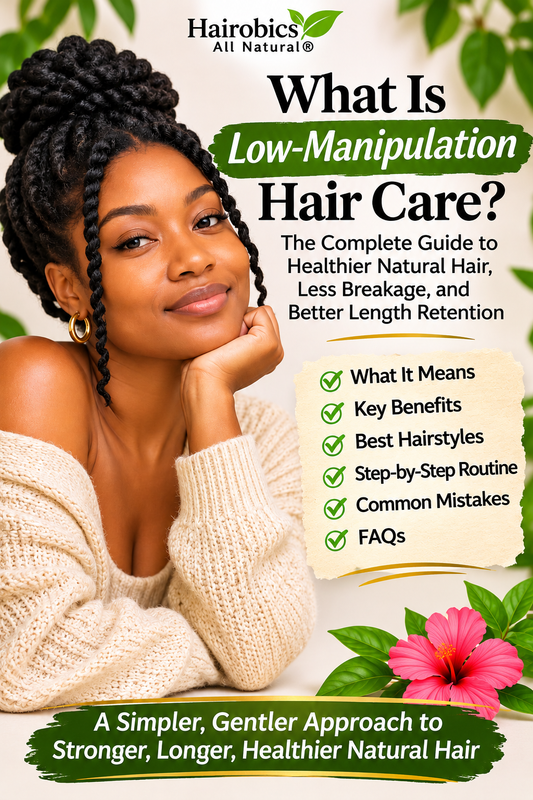
If you have natural hair, you probably know how much time and effort goes into maintaining beautiful, healthy curls and coils. Between detangling, moisturizing, brushing, twisting, styling, and refreshing your hair, your daily routine can sometimes feel like a full-time job.
But what if one of the best things you could do for your natural hair was simply to handle it less?
That's the idea behind low-manipulation hair care, a gentle approach to maintaining natural hair that focuses on reducing unnecessary combing, brushing, pulling, and restyling.
For women with 4A, 4B, and 4C natural hair, low-manipulation techniques can be particularly helpful for reducing mechanical damage, protecting fragile ends, and supporting better length retention.
However, low-manipulation hair care isn't only for tightly coiled textures. Anyone experiencing excessive tangling, dryness, breakage, or styling fatigue may benefit from a simpler routine.
The goal isn't to stop caring for your hair. It's to make every step of your routine more intentional.
In this complete guide, we'll explain what low-manipulation hair care means, how it works, which hairstyles are best, and how to build a routine that supports healthy natural hair without unnecessary stress.
What Is Low-Manipulation Hair Care?
Low-manipulation hair care is a method of maintaining your hair while minimizing unnecessary physical handling.
Instead of repeatedly combing, brushing, pulling, twisting, and restyling your hair throughout the day, you choose techniques that allow your hair to remain relatively undisturbed between maintenance sessions.
For example, someone following a high-manipulation routine might comb their hair every morning, create a new hairstyle daily, brush their edges repeatedly, and detangle frequently.
Someone following a low-manipulation routine might wash, condition, detangle, and style their hair once, then maintain that hairstyle for several days with minimal adjustments.
The difference is the amount of physical stress placed on the hair.
Low-manipulation care focuses on:
-
Reducing unnecessary combing and brushing.
-
Choosing hairstyles that last several days.
-
Minimizing repeated pulling and tension.
-
Protecting fragile ends.
-
Maintaining adequate moisture.
-
Detangling gently when necessary.
-
Reducing friction during sleep.
-
Keeping the scalp clean and comfortable.
The goal is to make natural hair maintenance easier while limiting opportunities for preventable breakage.
For additional guidance, read our Best Natural Hair Routine for Beginners.
Why Is Low-Manipulation Hair Care Important?
Natural hair is incredibly versatile, but individual hair strands can become damaged through repeated physical stress.
Every time you brush, comb, stretch, pull, or restyle your hair, you create some degree of friction and tension.
Gentle styling is a normal part of hair care. The problem develops when the hair experiences more stress than it can tolerate.
Repeated manipulation may contribute to:
-
Broken strands.
-
Split ends.
-
Increased tangling.
-
Frayed cuticles.
-
Hairline damage.
-
Shorter-looking hair.
-
Difficulty retaining length.
The oldest sections of your hair, particularly your ends, have experienced the most washing, styling, environmental exposure, and everyday wear.
These areas often require extra protection.
Low-manipulation hair care helps reduce unnecessary wear by allowing your strands to remain in manageable styles for longer periods.
It also encourages you to focus on maintaining healthy hair instead of constantly changing its appearance.
10 Benefits of Low-Manipulation Hair Care
1. Helps Reduce Hair Breakage
One of the biggest benefits of low-manipulation hair care is reducing opportunities for mechanical breakage.
Frequent combing and brushing can place tension on tangled or fragile strands.
When hair is repeatedly pulled, especially without enough conditioning or slip, some strands may snap.
Reducing unnecessary handling gives your hair fewer opportunities to experience this damage.
For additional techniques, explore our Guide to Stopping Natural Hair Breakage.
2. Supports Better Length Retention
Low-manipulation hair care is often associated with natural hair growth, but an important distinction must be made.
Hair grows from follicles within the scalp.
Reducing manipulation does not necessarily make your follicles produce hair faster.
Instead, it can help preserve the length your hair naturally grows by reducing breakage along the strands.
If your hair grows but constantly breaks at the ends, you may struggle to notice an increase in length.
Protecting those ends can make a meaningful difference over time.
3. Helps Protect Fragile Hairlines
Your edges are especially vulnerable to repeated tension.
Tight ponytails, slicked-back buns, braids, extensions, and aggressive edge brushing may contribute to hairline damage.
Low-manipulation care encourages loose, comfortable hairstyles that don't constantly pull at the roots.
Avoid styles that cause soreness, bumps, or headaches.
For more information, read How to Protect Fragile Hair Around the Hairline.
4. Reduces Daily Styling Time
Imagine waking up and spending five minutes refreshing your hairstyle instead of 45 minutes detangling and restyling.
That's one of the practical advantages of low-manipulation hair care.
Styles such as two-strand twists, loose braids, and flat twists can often be maintained for several days.
You spend more time enjoying your hair and less time working on it.
5. May Reduce Unnecessary Tangling
Repeatedly separating, fluffing, brushing, and rearranging natural hair can sometimes cause strands to wrap around each other.
Keeping hair organized in manageable sections may help limit tangling.
This is especially useful for tightly coiled textures that experience significant shrinkage.
However, leaving loose hair completely unattended for too long can also lead to tangles or matting.
The goal is controlled, gentle maintenance rather than neglect.
6. Helps Preserve Hairstyles
A properly maintained hairstyle can look attractive for several days without being completely redone.
Instead of recreating a twist-out every morning, you can preserve the style overnight and make small adjustments when necessary.
This reduces repeated styling stress.
7. Encourages a Simpler Routine
Natural hair care doesn't have to involve 15 different products and several hours of styling.
Low-manipulation care encourages a manageable routine built around cleansing, conditioning, moisturizing, and protection.
You can learn more in our Guide to Building a Simple Natural Hair Routine.
8. Helps Protect Hair Ends
Your ends are the oldest and often most vulnerable sections of your hair.
Repeated brushing, friction against clothing, and rough detangling can contribute to damage.
Low-manipulation hairstyles can help keep your ends organized and reduce everyday wear.
9. Makes Hair Care More Consistent
A routine that takes less time is often easier to maintain.
Instead of constantly experimenting with complicated styling techniques, you can establish a predictable schedule.
Consistency helps you recognize what your hair needs and which practices are working.
10. Can Reduce Styling Fatigue
Natural hair should be something you enjoy.
When every morning requires extensive detangling and styling, hair maintenance can become exhausting.
A simpler approach can make your routine more convenient without sacrificing healthy hair practices.
Low-Manipulation Hair Care vs. Protective Styling
Although these terms are closely related, they aren't exactly the same.
Low-manipulation styling focuses primarily on reducing how often you handle your hair.
Protective styling focuses on limiting exposure and physical damage to vulnerable parts of the hair, particularly the ends.
Some hairstyles accomplish both goals.
For example, loose two-strand twists can reduce daily manipulation while keeping strands organized.
A tucked bun may reduce manipulation and protect your ends from rubbing against clothing.
However, not every protective hairstyle is automatically healthy.
Braids installed too tightly can damage the hairline.
Extensions that are too heavy can create excessive tension.
A hairstyle that causes pain or repeated pulling is not truly protective, regardless of what it's called.
The best approach combines minimal handling with comfortable, low-tension styling.
Best Low-Manipulation Hairstyles for Natural Hair
1. Two-Strand Twists
Two-strand twists are among the most versatile low-manipulation hairstyles.
They work well for many natural hair textures and lengths.
Once installed, twists can often be maintained for several days or longer, depending on their size and how well your hair responds.
Benefits include reduced daily detangling, organized strands, and convenient styling.
Avoid twisting too tightly at the roots.
2. Mini Twists
Mini twists are smaller versions of traditional two-strand twists.
They can provide a flexible hairstyle that lasts longer than many loose styles.
However, installing and removing tiny twists requires patience.
Rushing the takedown process may create unnecessary breakage.
3. Loose Braids
Braids can help keep natural hair organized and reduce the need for daily styling.
Choose braid sizes that are comfortable and easy to maintain.
Avoid excessive tension around your edges and nape.
4. Flat Twists
Flat twists lie close to the scalp and can create attractive styles without requiring extensions.
They are especially useful for people who prefer simple hairstyles that can be maintained overnight.
5. Loose Buns
A loose bun can be an excellent low-manipulation option.
However, constantly placing the bun in exactly the same position may create repeated tension.
Alternate placement and avoid pulling the hair too tightly.
6. Twist-Outs
Twist-outs can be low-manipulation when you preserve the style for several days.
Instead of retwisting every night, consider using a satin bonnet or loosely gathering your hair.
7. Braid-Outs
Braid-outs offer another way to achieve defined, stretched natural hair.
Once the style is created, avoid repeatedly combing through the finished curls.
8. Wash-and-Go Styles
A wash-and-go can also be low-manipulation if it works for your hair and doesn't require extensive daily detangling.
Some people find wash-and-go styles easy to maintain.
Others experience more tangling.
Choose techniques based on how your individual hair responds.
How to Build a Low-Manipulation Natural Hair Routine
The most effective low-manipulation routine is simple, consistent, and flexible.
You don't need to follow an overly complicated schedule.
Instead, focus on performing necessary maintenance gently and avoiding unnecessary styling between wash days.
Step 1: Cleanse Your Hair and Scalp
Healthy hair care begins with regular cleansing.
Shampoo removes sweat, excess oil, dirt, and product buildup.
Choose a cleansing schedule based on your scalp, activity level, hairstyle, and product use.
Some people prefer weekly washing, while others need a different schedule.
Low manipulation should never mean avoiding shampoo when your scalp needs cleansing.
Step 2: Condition Thoroughly
Conditioning helps improve softness, manageability, and lubrication.
These benefits can make detangling easier.
Apply conditioner throughout your hair, paying special attention to dry or tangled sections.
Allow it to work according to the product instructions.
Step 3: Detangle Gently
Detangling is necessary, but it doesn't have to be aggressive.
Divide your hair into manageable sections.
Use a conditioner with sufficient slip.
Start at the ends and gradually work toward the roots.
Use your fingers, a suitable detangling brush, or a wide-tooth comb based on your preferences.
Stop when you encounter a stubborn knot rather than pulling harder.
Step 4: Apply a Leave-In Treatment
After washing and conditioning, apply a suitable leave-in product to help maintain softness and manageability.
A leave-in treatment can make hair easier to style while reducing the need for repeated brushing.
The Hairobics Leave-In Treatment can be incorporated into your natural hair maintenance routine.
Apply according to the product directions and use an amount appropriate for your hair.
Step 5: Add an Oil-Based Product If Needed
Some natural hair textures benefit from additional lubrication or an oil-based conditioning product.
Oil does not replace water-based moisture, but it may help reduce friction and improve the feel of dry hair.
The Hairobics Hair & Scalp Booster contains a blend of botanical oils and conditioning ingredients, including coconut oil, jojoba oil, olive oil, rosemary oil, and vitamin E.
Use it as directed, particularly when incorporating scalp conditioning into your routine.
Avoid applying so much product that your hair becomes excessively coated.
Step 6: Choose a Comfortable Hairstyle
Once your hair is moisturized and detangled, choose a hairstyle that won't require constant attention.
Two-strand twists, loose braids, flat twists, and simple buns are excellent starting points.
The ideal hairstyle should be comfortable, easy to maintain, and appropriate for your hair's condition.
Step 7: Protect Your Hair Overnight
Nighttime protection can help reduce friction and preserve your hairstyle.
Consider using a satin or silk bonnet, scarf, or pillowcase.
Avoid tight nighttime ponytails and unnecessary brushing before bed.
Step 8: Refresh Only When Necessary
One of the most important principles of low-manipulation hair care is learning when to leave your hair alone.
If your hair feels soft, comfortable, and manageable, you may not need additional products.
If certain sections feel dry, refresh those areas gently.
Avoid completely restyling your hair simply because a few curls have shifted.
How Often Should You Manipulate Natural Hair?
There is no universal number of times you should manipulate natural hair each week.
Your ideal frequency depends on your hair texture, density, condition, hairstyle, and personal preferences.
For many people, performing a complete detangling and styling session on wash day, followed by light maintenance, can be a practical approach.
However, some hairstyles require more frequent attention.
The important question isn't whether you're touching your hair every day.
It's whether the handling is necessary and gentle.
Lightly adjusting a bonnet, applying moisturizer, or checking your scalp is different from aggressively brushing and pulling your hair.
You can care for your hair regularly without subjecting it to excessive manipulation.
A Simple 7-Day Low-Manipulation Hair Care Schedule
Sunday: Wash and Style
Cleanse your scalp and hair.
Apply conditioner and detangle carefully.
Use your preferred leave-in treatment.
Choose a low-manipulation hairstyle.
Monday: Minimal Handling
Leave your hairstyle mostly undisturbed.
Make small adjustments if necessary.
Avoid unnecessary combing.
Tuesday: Moisture Check
Check whether your ends feel dry.
If needed, lightly refresh with a suitable moisturizing product.
Avoid excessive product layering.
Wednesday: Scalp Care
Inspect your scalp for dryness, irritation, or buildup.
If an oil-based scalp product suits your needs, apply a small amount according to its directions.
The Hairobics Scalp Rejuvenator Oil is one option available in the Hairobics hair growth products collection.
Thursday: Style Maintenance
Preserve your existing hairstyle.
Avoid completely removing and reinstalling twists or braids unless necessary.
Friday: Gentle Refresh
Check for dryness, tangling, or discomfort.
Refresh only the sections that need attention.
Saturday: Evaluate Your Hair
Examine your ends and scalp.
Determine whether your hair needs cleansing, conditioning, or detangling.
Prepare for your next wash day based on its actual condition.
This schedule is a starting point rather than a strict rule.
Low-Manipulation Hair Care for 4C Natural Hair
Low-manipulation care can be especially helpful for people with 4C hair.
Tightly coiled strands often experience significant shrinkage, which can make tangling and detangling more challenging.
However, 4C hair is not inherently unhealthy or incapable of growing long.
It simply benefits from techniques suited to its structure.
Keep Hair Organized
Work in manageable sections when washing and detangling.
Consider loose twists or braids to help keep strands separated.
Prioritize Conditioning
Use products that provide sufficient softness and slip.
Avoid forcing combs through dry, tangled hair.
Protect Your Ends
Choose styles that reduce friction and unnecessary handling.
Avoid Excessive Tension
Tightly coiled hair does not need to be pulled straight or tightly stretched to look beautiful.
Comfort should always be a priority.
Respect Your Shrinkage
Shrinkage is a normal characteristic of natural curls and coils.
You don't need to eliminate it to maintain healthy hair.
Can Low-Manipulation Hair Care Help Hair Grow Longer?
Low-manipulation hair care can support the appearance of longer hair primarily by helping reduce breakage.
This distinction is important.
Your hair growth cycle is controlled by biological processes within the follicles.
Genetics, age, nutrition, hormones, and overall health can influence growth.
Styling practices mainly affect how well you preserve the hair that has already grown.
For example, imagine your hair grows approximately half an inch during a month.
If your ends experience significant breakage, you may retain very little of that new length.
Reducing breakage may help you keep more of the length your hair produces.
That's why low-manipulation care can be valuable for people who feel their natural hair has stopped growing.
The hair may still be growing, but breakage could be affecting visible progress.
Best Hairobics Products for Low-Manipulation Hair Care
A successful low-manipulation routine doesn't require an overwhelming number of products.
The goal is to choose products that complement gentle styling, moisture maintenance, and scalp care.
Hairobics Leave-In Treatment
The Hairobics Leave-In Treatment can be used as part of a moisturizing routine after cleansing and conditioning.
It is particularly useful for people looking to maintain softer, more manageable hair between styling sessions.
Shop: Hairobics Leave-In Treatment
Hairobics Hair & Scalp Booster
The Hair & Scalp Booster is an oil-rich conditioning formula containing a combination of botanical ingredients.
It can be incorporated into a scalp conditioning routine while maintaining low-tension hairstyles.
Shop: Hairobics Hair & Scalp Booster
Hairobics Scalp Rejuvenator Oil
Scalp care remains important even when you're reducing daily hair manipulation.
The Scalp Rejuvenator Oil is another option for people who enjoy incorporating oil-based scalp care into their routine.
Apply sparingly and follow the product instructions.
Shop: Hairobics Scalp Rejuvenator Oil Collection
Hairobics Raaw Roots Locs & Braids Moisturizer Spray
If you wear braids, twists, or locs, a convenient moisturizing spray may help you refresh your hairstyle without taking it down.
The Hairobics Raaw Roots Locs & Braids Moisturizer Spray is designed for protective-style maintenance.
Shop: Raaw Roots Locs & Braids Moisturizer Spray
Hairobics Hair Growth Bundle
If you prefer a coordinated hair care routine, the Hairobics Hair Growth Bundle combines the Hair & Scalp Booster, Leave-In Treatment, and Scalp Rejuvenator Oil.
These products can complement a routine focused on conditioning, scalp care, and gentle styling.
Explore the Hairobics Hair Growth Products Collection to find the bundle and individual products.
Remember that products work best alongside gentle handling, appropriate cleansing, and comfortable hairstyles. No product can completely prevent breakage caused by excessive tension.
Common Low-Manipulation Hair Care Mistakes
Mistake 1: Never Detangling
Low manipulation doesn't mean allowing hair to become severely tangled or matted.
Detangle when necessary using gentle techniques.
Mistake 2: Keeping Hairstyles Too Long
Leaving a hairstyle installed beyond what your hair and scalp can comfortably tolerate may create problems.
Monitor for buildup, tangling, and tension.
Mistake 3: Ignoring Moisture
Your hair may still need moisturizing products even when it's styled.
Check for dryness and respond appropriately.
Mistake 4: Wearing Tight Hairstyles
A hairstyle that causes pain, bumps, or persistent pulling is not a healthy low-manipulation choice.
Mistake 5: Using Too Much Product
Applying heavy layers of oils, creams, and moisturizers can create buildup.
Use products according to your hair's needs.
Mistake 6: Ignoring Your Scalp
Low-manipulation care should include appropriate cleansing and attention to scalp health.
Persistent itching, redness, scaling, or unusual shedding may require professional evaluation.
Mistake 7: Constantly Switching Hairstyles
Changing hairstyles repeatedly defeats the purpose of reducing unnecessary manipulation.
Choose styles you can comfortably maintain for several days.
How Long Does It Take to See Results?
The benefits of low-manipulation hair care vary from person to person.
Some people notice that their routine becomes easier almost immediately.
Others may gradually observe less breakage during detangling or improved length retention.
Hair that is already split or severely damaged cannot be permanently repaired by simply reducing manipulation.
Damaged ends may still require trimming.
Rather than expecting overnight results, evaluate your routine over several months.
Pay attention to how your hair feels, how easily it detangles, and whether you're experiencing less breakage.
Frequently Asked Questions About Low-Manipulation Hair Care
Is low-manipulation hair care good for natural hair?
Yes. Reducing unnecessary brushing, combing, pulling, and restyling can help limit mechanical stress and support length retention.
Can low-manipulation hairstyles grow your hair?
Low-manipulation hairstyles don't directly increase your biological hair growth rate. However, they may help reduce breakage, allowing you to retain more length.
What is the best low-manipulation hairstyle for 4C hair?
Two-strand twists, loose braids, flat twists, and comfortable buns are popular options. The best choice depends on your hair's condition and maintenance needs.
Should I moisturize my natural hair every day?
Not necessarily. Moisturize based on how your hair feels and responds. Some people need frequent refreshing, while others can go several days between applications.
Is a wash-and-go a low-manipulation hairstyle?
It can be. If your wash-and-go lasts several days without excessive detangling or restyling, it may fit a low-manipulation routine.
Can I wear my natural hair out?
Absolutely. Low-manipulation care doesn't require keeping your hair braided or twisted all the time. You can wear your curls, coils, or Afro while avoiding unnecessary handling.
Does low-manipulation hair care prevent split ends?
It may help reduce some mechanical damage, but it cannot guarantee that split ends won't develop. Regular assessment and trimming when necessary remain important.
Can I use hair oils in a low-manipulation routine?
Yes. Oils may help with lubrication, shine, and the feel of dry hair. Apply them appropriately without creating excessive buildup.
Final Thoughts: Healthy Natural Hair Doesn't Have to Be Complicated
Low-manipulation hair care is about working with your natural hair instead of constantly working against it.
You don't need to brush your curls every morning, recreate your hairstyle daily, or spend hours manipulating your strands to maintain beautiful hair.
Sometimes, a simpler approach is more practical.
By choosing comfortable hairstyles, reducing unnecessary detangling, protecting your ends, and maintaining a consistent cleansing and moisturizing routine, you can help reduce preventable breakage and support better length retention.
The key is finding the right balance.
Your hair still needs care, moisture, cleansing, and occasional detangling. It simply doesn't need constant handling.
Whether you wear two-strand twists, loose braids, flat twists, a wash-and-go, or a beautiful natural Afro, the best routine is one that keeps your hair healthy, comfortable, and manageable.
For botanical-inspired hair and scalp care products that complement your natural hair routine, explore Hairobics All Natural.
Healthy hair care isn't about doing more. It's about doing what your hair actually needs.