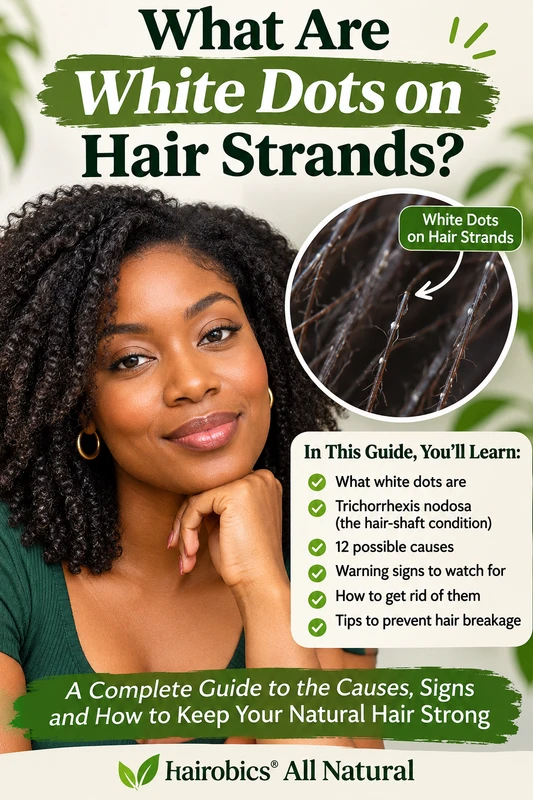
Have you ever examined your natural hair and noticed tiny white dots scattered along individual strands? Maybe you discovered small white spots near your ends while detangling, or you noticed that certain hairs seem to snap exactly where those white dots appear.
If you've been wondering, "What are white dots on hair strands, and should I be worried?", you're not alone.
White dots on hair can be confusing, especially when you're trying to grow longer, stronger, healthier natural hair. They may look like tiny beads, pale specks, or miniature white knots attached to individual strands.
Some white dots are simply product residue or debris. Others may indicate structural damage that makes hair more likely to break.
One important cause is a hair shaft condition called trichorrhexis nodosa, which produces weakened points along the hair fiber.
Understanding the difference can help you protect your hair, prevent unnecessary breakage, and maintain the length you've worked hard to achieve.
In this complete guide, we'll explain what causes white dots on hair strands, how to identify different types of white spots, why natural hair may develop them, and what you can do to protect your curls, coils, and ends.
What Are White Dots on Hair Strands?
White dots on hair strands are small, pale areas that appear along the length of individual hairs or near their ends.
They may be visible when you hold a strand against a dark background or examine your hair under bright lighting.
Their appearance depends on the underlying cause.
Some white dots are:
-
Weak points in the hair shaft
-
Frayed or damaged hair fibers
-
Product buildup attached to strands
-
Small pieces of lint or debris
-
Split or fractured ends
-
Hair casts surrounding the shaft
-
Naturally shed hairs with pale root bulbs
When the white dot is part of the strand itself, especially when the hair breaks at that location, structural damage becomes a significant possibility.
Hair consists primarily of keratin proteins arranged into a complex structure. Its outer protective layer, called the cuticle, helps shield the internal fibers.
When the cuticle becomes damaged, the inner structure becomes more vulnerable to splitting and breaking.
For a deeper understanding of how this protective layer works, read our complete guide to the hair cuticle and healthier natural hair.
What Is Trichorrhexis Nodosa?
Trichorrhexis nodosa is a hair shaft disorder characterized by weak, swollen, or frayed areas along individual strands.
These damaged points often appear as tiny white dots or pale knots.
Under magnification, the affected fibers can resemble two small paintbrushes pushed together, with the internal hair fibers spreading outward.
This happens because the structural integrity of the hair has been compromised.
Instead of remaining smooth and intact, the strand develops a weak point where breakage becomes more likely.
Common Signs of Trichorrhexis Nodosa
You may notice:
-
Tiny white dots attached to individual strands
-
Hair breaking where the dots appear
-
Rough or uneven hair texture
-
Short broken hairs of different lengths
-
Hair that appears dull or brittle
-
White spots near the ends
-
Difficulty retaining length
-
Frayed ends that resemble tiny brushes
Trichorrhexis nodosa can be inherited, but acquired forms are more common and are frequently associated with physical, chemical, or heat-related damage.
Not every white dot means you have this condition. A dermatologist can examine the hair under magnification to determine whether the dots represent damaged hair fibers.
12 Possible Causes of White Dots on Hair Strands
1. Excessive Heat Styling
Heat damage is one of the most important causes of weakened hair shafts.
Flat irons, curling irons, hot combs, and blow dryers can damage the cuticle and internal hair structure when temperatures are excessive or heat is applied repeatedly.
You may notice white dots appearing after frequent straightening sessions.
Other warning signs include hair that feels rough, breaks easily, or no longer returns to its original curl pattern.
What to do: Reduce heat styling, use an appropriate heat protectant, avoid repeated passes, and choose lower temperatures that achieve the desired result.
2. Chemical Processing
Relaxers, bleaching, permanent coloring, and other chemical treatments can weaken the hair shaft.
These processes alter the hair's structure and may increase its vulnerability to mechanical damage.
Hair that has been chemically processed may develop white weak points, particularly when chemical treatments are combined with frequent heat styling.
The transition between chemically processed hair and new natural growth can also be vulnerable to breakage.
What to do: Avoid overlapping chemical treatments, follow processing instructions carefully, and seek professional help when your hair is already fragile.
3. Aggressive Detangling
Detangling natural hair requires patience.
When you pull a comb through tangled curls or coils, individual strands experience significant tension.
If the hair is already weakened, this pulling can cause microscopic damage that eventually develops into visible fractures.
Repeated rough combing may also worsen existing white weak points.
To reduce damage, work in sections, use a conditioner with sufficient slip, and begin detangling near the ends.
4. Excessive Hair Manipulation
Constant styling can create repeated stress on the hair.
Twist-outs, braid-outs, ponytails, buns, and other styles may involve pulling, separating, brushing, or stretching strands.
These activities are not inherently damaging, but excessive manipulation can increase wear.
If you change your hairstyle multiple times daily, your hair may not have enough opportunity to avoid repeated mechanical stress.
Learn more in our article about whether too much styling can cause hair breakage.
5. Dry, Brittle Hair
Hair that lacks adequate conditioning may feel stiff, rough, or difficult to detangle.
Dryness does not automatically cause trichorrhexis nodosa, but brittle, poorly conditioned strands may be more vulnerable to damage during styling.
This can be particularly noticeable with tightly coiled natural hair.
Because natural scalp oils may not distribute evenly along curved hair fibers, the ends can require additional conditioning.
What to do: Maintain a consistent shampoo and conditioning routine, use a suitable leave-in product, and avoid aggressively manipulating dry hair.
6. Split Ends and Frayed Hair Fibers
Split ends develop when the hair shaft separates into multiple fibers.
Some damaged ends appear white or translucent because the fibers have become frayed.
A white spot close to the end of a strand may indicate localized damage or splitting.
Once a strand is physically split, conditioning products cannot permanently fuse it back together.
Trimming severely damaged ends may be necessary to prevent continued snagging and breakage.
7. Tight Protective Hairstyles
Braids, twists, cornrows, and extensions can reduce daily styling, but excessive tension may damage both hair shafts and follicles.
Tight hairstyles may contribute to breakage around the edges, temples, nape, and other vulnerable areas.
Repeated pulling can also contribute to traction alopecia.
If your hairstyle causes pain, tenderness, bumps, or persistent pulling, it is too tight.
Protective hairstyles should protect your hair rather than place additional stress on it.
8. Friction From Clothing and Bedding
Hair experiences friction throughout the day.
Your ends may rub against clothing, scarves, jackets, pillowcases, and other surfaces.
Over time, repeated rubbing can wear down the cuticle and increase tangling.
This is particularly relevant for shoulder-length hair that frequently touches clothing.
A satin or silk bonnet, scarf, or pillowcase may help reduce friction while sleeping.
Keeping fragile ends away from rough fabrics can also help.
9. Product Buildup
Not every white dot is structural damage.
Some white specks are dried styling products, conditioner residue, gel flakes, or buildup.
Unlike a damaged section of the hair shaft, residue may loosen or disappear after proper cleansing.
If you frequently layer gels, creams, oils, and sprays, buildup may become more noticeable.
Use a shampoo appropriate for your hair and scalp, and avoid applying unnecessary amounts of product.
10. Hard Water Mineral Deposits
Hard water contains dissolved minerals, primarily calcium and magnesium.
These minerals may contribute to deposits on the hair, affecting how it feels and responds to cleansing.
However, hard water deposits do not automatically produce the characteristic white nodes associated with trichorrhexis nodosa.
If your hair feels coated, rough, or difficult to cleanse, your water quality may be worth investigating.
Our guide to how hard water affects Black hair explains how mineral deposits can affect your routine.
11. Hair Casts and Scalp Debris
Sometimes white material surrounds the hair rather than forming inside it.
Hair casts are small, sleeve-like structures that encircle individual strands and may slide along them.
They can be confused with white dots, nits, or damaged hair.
Scalp flakes and other debris may also become trapped in curly or coily hair.
If you notice persistent flaking, itching, redness, or unusual material attached to your strands, seek an appropriate scalp evaluation.
12. Underlying Hair or Health Conditions
Although most acquired hair-shaft damage is associated with external stress, some people develop fragile hair because of inherited disorders or underlying health conditions.
Certain nutritional deficiencies, thyroid conditions, and uncommon genetic disorders can contribute to hair fragility.
These conditions should not be assumed simply because white dots are present.
However, widespread unexplained breakage, sudden hair changes, or additional symptoms deserve medical attention.
A dermatologist may recommend further evaluation when appropriate.
Why Are White Dots Commonly Noticed on 4C Natural Hair?
People with 4C hair may notice white dots and broken ends while stretching, detangling, or examining individual coils.
Tightly coiled hair has bends and curves along its structure.
These bends can create areas where mechanical stress becomes concentrated during combing, brushing, and styling.
The natural shape of coily hair can also make it more challenging for scalp oils to spread evenly along the entire strand.
As a result, careful conditioning and gentle handling are especially important.
However, white dots are not a normal requirement of having 4C hair.
Healthy coily hair should not repeatedly snap during ordinary care.
If you notice increasing white spots, rough ends, or tiny broken pieces, examine your routine for sources of unnecessary friction and tension.
White Dots on Hair Ends vs. White Dots Along the Hair Shaft
The location of a white dot may provide clues about its cause.
White Dots Near the Ends
White spots near the tips may indicate:
-
Frayed ends
-
Split ends
-
Localized hair-shaft damage
-
Repeated friction
-
Heat-related damage
Because the ends are usually the oldest parts of your hair, they have experienced the greatest amount of wear.
White Dots in the Middle of Hair Strands
White spots along the middle of a strand may be associated with localized shaft fractures, including trichorrhexis nodosa.
These areas may become weak points where the strand eventually breaks.
White Dots Near the Roots
White material close to the scalp may be related to hair casts, flakes, product residue, or other scalp conditions.
A pale bulb attached to one end of a completely shed hair is different from a white dot located midway along the shaft.
The location alone cannot confirm a diagnosis, but it can help you decide what to examine next.
How to Tell Whether White Dots Are Hair Damage or Product Residue
Before cutting your hair, determine whether the white material is actually part of the strand.
Start by examining a few affected hairs under bright lighting.
Look for the following differences.
Possible hair-shaft damage:
-
The dot appears embedded in the strand.
-
The affected area looks frayed or swollen.
-
The hair bends or breaks near the white spot.
-
The dot remains after cleansing.
-
Multiple strands show similar weak points.
Possible product residue:
-
The white material sits on the surface.
-
It flakes away during gentle cleansing.
-
It appears after applying styling products.
-
It disappears after shampooing.
-
The underlying strand appears intact.
Do not repeatedly pull or snap affected hairs to test their strength.
If you cannot identify the cause, a dermatologist can examine the hair using magnification.
Can White Dots Cause Hair Breakage?
Yes, when white dots represent structural weak points, they may be associated with increased breakage.
A damaged hair shaft has less ability to withstand repeated pulling and bending.
During detangling, styling, or brushing, the strand may snap at its weakest point.
This can explain why you sometimes find small pieces of hair in your sink, brush, or on your clothing.
You may also notice that your hair seems to remain the same length despite continued growth from the scalp.
For more information, read our article on why you keep finding tiny broken hairs.
How to Get Rid of White Dots on Hair Strands
The appropriate solution depends on the cause.
If the white dots are residue, thorough but gentle cleansing may remove them.
If they represent damaged hair fibers, the damaged section cannot be permanently restored to its original structure.
The goal is to remove severely damaged portions when necessary and prevent additional weak points from forming.
Step 1: Identify the Source of Damage
Review your recent hair routine.
Have you been using more heat than usual?
Have you recently relaxed, bleached, or colored your hair?
Are you brushing or detangling more aggressively?
Have you been wearing tight hairstyles?
Identifying the likely source helps you make meaningful changes rather than constantly purchasing new products.
Step 2: Trim Severely Damaged Ends
If white dots are concentrated near your ends and the strands repeatedly break, a careful trim may help.
You do not necessarily need a major haircut.
The amount to remove depends on how far the damage extends.
Use sharp hair-cutting shears or visit a professional stylist.
Avoid cutting with dull household scissors, which may leave uneven ends.
Step 3: Improve Your Conditioning Routine
Conditioning helps improve softness, manageability, and the ability of strands to move past one another during styling.
After shampooing, use a conditioner suited to your hair type.
Pay particular attention to the ends.
A leave-in treatment may provide additional conditioning between wash days.
For example, Hairobics Leave-In Treatment contains botanical conditioning ingredients including aloe vera, jojoba oil, and avocado oil.
It can help improve the feel and manageability of dry natural hair as part of a consistent routine.
Remember that conditioners can improve the appearance and handling of damaged hair, but they cannot permanently rebuild fractured fibers.
Step 4: Reduce Heat Exposure
If you regularly straighten your hair, consider taking a break from direct heat.
Try twist-outs, braid-outs, roller sets, or other styles that do not require high temperatures.
When you do use heat, follow safe styling practices.
Avoid repeatedly passing a flat iron over the same section.
Step 5: Detangle With Less Tension
Divide your hair into manageable sections.
Use a conditioner that provides enough slip for your hair.
Begin near the ends and work gradually toward the roots.
Hold the section above the area you're detangling to reduce pulling on the scalp.
If you encounter a stubborn knot, loosen it carefully rather than forcing a comb through it.
Step 6: Protect Your Hair Overnight
Use a satin or silk bonnet, scarf, or pillowcase.
Avoid tight nighttime ponytails.
Keep your ends organized without stretching or pulling them excessively.
Reducing unnecessary friction can help preserve fragile strands.
Step 7: Give Your Hair a Styling Break
If your hair has become brittle or breaks easily, simplify your routine.
Avoid frequent chemical treatments, repeated heat styling, and excessive manipulation.
Choose comfortable, low-tension hairstyles.
Our article on 15 signs your hair needs a styling break can help you recognize when your routine may be too demanding.
The Importance of Moisture and Protein Balance
Healthy hair care requires more than simply applying oils.
Hair needs appropriate cleansing, conditioning, and protection from damage.
Protein-based treatments may temporarily improve the feel or strength of some damaged hair, depending on the formulation and condition of the strands.
However, more protein is not automatically better.
Some treatments may leave certain hair types feeling stiff or difficult to manage.
Similarly, excessive product layering can cause buildup without addressing the underlying cause of breakage.
A balanced routine should be based on how your hair responds.
Read our protein versus moisture schedule for natural hair to learn how to develop a more consistent conditioning routine.
Can Hair Oils Repair White Dots?
Hair oils can play a useful role in conditioning routines, but their limitations are important.
Some oils help lubricate strands, improve softness, and reduce friction.
However, applying oil to a white fracture point cannot permanently reconnect broken internal hair fibers.
If the white dot represents trichorrhexis nodosa, preventing additional damage is more important than trying to coat the weak point repeatedly.
Oil-based products may complement a broader hair-care routine that includes cleansing, conditioning, gentle styling, and trimming when needed.
For example, Hairobics Hair & Scalp Booster contains botanical oils including coconut, jojoba, olive, rosemary, and peppermint oils.
It can be used sparingly to condition dry hair and scalp areas.
The product is not a medical treatment for trichorrhexis nodosa and cannot permanently repair fractured hair shafts.
A Simple Weekly Routine to Help Prevent White Dots and Breakage
Consistency is more important than following a complicated routine.
Wash Day
-
Separate your hair into manageable sections.
-
Cleanse your scalp with an appropriate shampoo.
-
Apply conditioner throughout your hair.
-
Detangle gently while the hair has adequate slip.
-
Rinse and apply a suitable leave-in treatment.
-
Style without excessive pulling or heat.
Between Wash Days
Check whether your hair needs additional conditioning.
Avoid repeatedly brushing or restyling your ends.
Keep hairstyles comfortable and avoid excessive tension.
Use a small amount of conditioning product when needed rather than layering multiple heavy products unnecessarily.
Nighttime
Protect your hair with a satin or silk covering.
Avoid tight elastics and hairstyles that pull on your edges.
If your hair is long enough, loosely organize it into sections to reduce tangling.
Every Few Weeks
Examine your ends under good lighting.
Look for visible splitting, recurring white weak points, and excessive breakage.
Consider a trim if the ends are severely damaged.
There is no universal trimming schedule that works for everyone.
How Long Does It Take for White Dots to Disappear?
The answer depends on what caused them.
Product residue may disappear after appropriate cleansing.
Damaged hair-shaft nodes generally remain until the affected portions are trimmed away, break off, or are eventually removed as the hair grows.
If you reduce the mechanical or chemical damage responsible for the problem, newly growing hair may remain healthier.
However, you should not expect existing fractured strands to become structurally normal simply because you begin using conditioner.
The goal is to prevent new damage while gradually replacing or removing damaged lengths.
You may notice less breakage relatively quickly after changing rough styling habits, but meaningful length retention takes longer.
White Dots vs. Hair Shedding: What's the Difference?
White dots along a strand should not be confused with the pale bulb sometimes visible at the root end of a naturally shed hair.
A shed hair may have a small, club-shaped end.
This is associated with the normal hair growth cycle.
A damaged hair shaft, however, may have white nodes located anywhere along its length.
Broken pieces are often shorter than the surrounding hair.
If you're unsure whether your hair is shedding or breaking, read our guide to normal hair shedding and warning signs.
When Should You See a Dermatologist?
Occasional white specks do not automatically indicate a serious condition.
However, professional evaluation is appropriate if you experience:
-
Widespread hair breakage
-
Sudden or progressive thinning
-
Bald patches
-
Hair breaking very close to the scalp
-
Persistent scalp pain or inflammation
-
Severe itching or scaling
-
Unexplained changes in hair texture
-
White nodes affecting large numbers of strands
A dermatologist may examine your hair using a dermatoscope or microscope.
This can help distinguish structural hair damage from other hair and scalp conditions.
If an underlying medical problem is suspected, additional testing may be recommended.
Frequently Asked Questions About White Dots on Hair Strands
Are white dots on hair strands normal?
A few white specks may simply be residue or debris. However, persistent white nodes associated with fraying and breakage may indicate hair-shaft damage and deserve attention.
Do white dots mean my hair is damaged?
Not always. White dots can have several causes. If they are part of the strand and the hair breaks at those points, damage becomes more likely.
Should I cut off hair with white dots?
Not automatically. If the dots are residue, cleansing may be sufficient. If they are structural fractures, trimming damaged sections may help prevent continued snagging and breakage.
Can white dots appear on healthy natural hair?
Surface residue and debris can appear on otherwise healthy hair. Structural white nodes associated with repeated breakage are not considered a sign of healthy hair fibers.
Why do I have white dots on my 4C hair ends?
Possible causes include friction, heat damage, chemical processing, rough detangling, split ends, and localized hair-shaft fractures.
Can moisturizing products remove white dots?
Conditioning products can improve softness and manageability. They cannot permanently repair a fractured hair shaft. If the white material is product residue, cleansing may remove it.
Are white dots caused by too much protein?
White dots do not reliably indicate protein overload. Product-related stiffness may make some strands harder to handle, but a white dot alone cannot establish a protein imbalance.
Can white dots spread up the hair shaft?
A damaged area does not spread like an infection. However, cracks can extend, and repeated stress may create additional weak points elsewhere along the strand.
Are white dots the same as split ends?
Not exactly. Split ends involve separation of hair fibers, usually near the tips. Trichorrhexis nodosa involves localized weak points that may appear anywhere along the hair shaft. Both can involve structural damage.
Can white dots stop my hair from growing?
White dots associated with breakage generally affect length retention rather than hair production inside the follicle. Your hair may continue growing while damaged strands repeatedly break.
Will damaged hair grow back healthy?
If the hair follicle is healthy and the damaging factors are addressed, newly produced hair may grow normally. Existing damaged fibers cannot regenerate their internal structure.
How can I prevent white dots from returning?
Focus on gentle detangling, appropriate conditioning, reducing excessive heat, avoiding harsh chemical processing, protecting your ends, and limiting unnecessary friction.
Final Thoughts: White Dots on Hair Strands Are Worth Understanding
Discovering white dots on your hair can be frustrating, especially when you're trying to maintain longer, healthier natural hair.
The most important step is identifying what the dots actually represent.
Some white specks are harmless residue that can be removed through cleansing.
Others may indicate structural weakness, including trichorrhexis nodosa, that makes strands more likely to break.
If your white dots are associated with brittle hair, frayed ends, or frequent breakage, pay close attention to how you're styling and maintaining your hair.
Reduce unnecessary heat, detangle gently, keep your hair appropriately conditioned, and trim severely damaged sections when needed.
Remember that healthy hair growth and length retention are connected but different goals.
Your hair may continue growing from the scalp even when damaged ends prevent you from seeing progress.
At Hairobics All Natural, we believe that caring for natural hair begins with understanding what your strands need.
With a consistent routine, gentle styling practices, and appropriate conditioning products, you can help protect your curls and coils from avoidable damage.
Healthy natural hair isn't about perfection. It's about building habits that help your hair remain strong, manageable, and beautiful over time.
Explore natural hair-conditioning products and hair-care education at Hairobics All Natural.