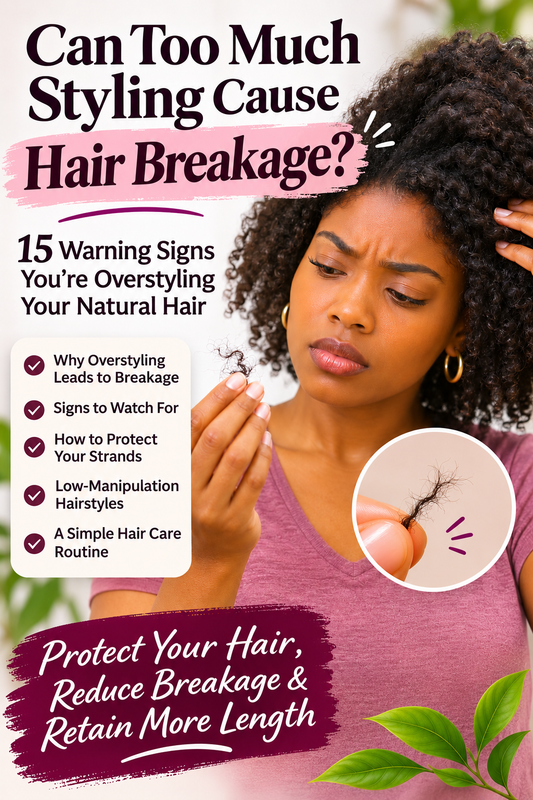
Natural hair offers incredible versatility. From twist-outs and braid-outs to sleek ponytails, protective braids, wash-and-go styles, and beautiful natural updos, there are countless ways to express yourself through your hair.
However, have you ever wondered whether styling your hair too often could actually be preventing you from achieving your hair goals?
Perhaps you spend time moisturizing, detangling, brushing, twisting, and restyling your hair every day. You use quality hair products, maintain a consistent routine, and try to protect your strands.
Yet your hair continues breaking.
Your ends look thinner. Your edges appear fragile. Your hair seems to grow but never gets noticeably longer.
Can too much styling cause hair breakage?
Yes. Excessive styling can contribute to hair breakage, especially when it involves repeated pulling, brushing, combing, tight hairstyles, heat exposure, or unnecessary manipulation.
Although styling is an important part of maintaining natural hair, constantly handling your strands can gradually weaken their protective outer layers.
This is particularly important for women with curly, coily, and tightly textured natural hair.
The good news is that you don't have to stop styling your hair or sacrifice your favorite hairstyles.
Instead, learning how to balance styling, moisture, gentle handling, and proper maintenance can help you protect your strands and retain more length.
In this comprehensive guide, we'll explain why excessive styling causes breakage, reveal 15 warning signs that you're manipulating your hair too much, and share practical strategies for maintaining stronger, healthier natural hair.
What Is Overstyling Natural Hair?
Overstyling happens when your hair experiences more styling-related stress than it can comfortably tolerate.
This stress may come from excessive handling, repeated tension, friction, heat, or frequent hairstyle changes.
Common examples of overstyling include:
-
Combing natural hair several times daily.
-
Brushing edges aggressively every morning.
-
Constantly changing hairstyles.
-
Repeatedly twisting and untwisting hair.
-
Installing tight ponytails or buns.
-
Using flat irons and curling irons frequently.
-
Detangling hair unnecessarily.
-
Pulling tightly on braids or extensions.
-
Constantly separating curls.
-
Repeatedly stretching hair with heat.
-
Removing and reinstalling protective hairstyles too frequently.
Not every styling session causes damage.
Healthy natural hair can tolerate regular grooming when handled appropriately.
However, repeated mechanical stress can gradually wear down individual hair strands.
The goal is not to eliminate styling completely. It is to reduce unnecessary stress while maintaining clean, conditioned, manageable hair.
Why Does Too Much Styling Cause Hair Breakage?
Understanding how hair breakage develops can help you recognize which styling habits need to change.
Every hair strand contains several structural layers.
The outermost layer, called the cuticle, consists of overlapping cells that help protect the inner hair shaft.
When hair is repeatedly brushed, pulled, twisted, stretched, or exposed to friction, the cuticle can gradually become damaged.
This process is commonly described as mechanical weathering.
As the cuticle becomes worn, the strand may become more vulnerable to tangling, splitting, and breaking.
Repeated Friction
Combs, brushes, hair accessories, and even your fingers create friction when they move against your strands.
Gentle grooming is generally manageable.
However, excessive friction can contribute to cuticle wear and surface damage.
Excessive Tension
Tight hairstyles place pulling forces on individual strands and hair follicles.
Repeated tension may cause broken hairs, scalp discomfort, and thinning around the hairline.
Prolonged traction can also contribute to traction alopecia, a form of hair loss that may become permanent if the tension continues.
Repeated Stretching
Natural hair stretches when you detangle, braid, twist, or straighten it.
Healthy strands have some elasticity, but excessive stretching can weaken already damaged areas.
Heat Exposure
Frequent high-temperature styling can damage the hair's protective structure and reduce its ability to withstand further manipulation.
These factors can overlap.
For example, someone who frequently blow-dries, flat-irons, brushes, and pulls their hair into tight ponytails may experience several forms of stress at once.
15 Warning Signs You're Styling Your Natural Hair Too Much
Your hair often provides clues when your styling routine becomes too demanding.
Here are 15 signs worth paying attention to.
1. You're Finding Short Broken Hairs Everywhere
One of the clearest signs of mechanical breakage is finding short hair fragments on your bathroom counter, clothing, sink, or styling tools.
Normal shedding usually involves entire hairs released from the follicle.
Breakage occurs when the hair shaft snaps somewhere along its length.
If you consistently notice many short pieces after styling, your technique may be contributing to damage.
2. Your Ends Are Becoming Thin and See-Through
The ends are the oldest portions of your hair.
They have experienced years of washing, brushing, detangling, styling, and environmental exposure.
When the ends repeatedly experience friction and tension, they may gradually become thinner.
You might notice that your roots look full while the bottom portion of your hair appears sparse.
Reducing manipulation and trimming severely damaged ends can help prevent additional splitting.
3. Your Hair Breaks During Detangling
Detangling should remove knots without causing excessive damage.
If your hair constantly snaps while you're combing, brushing, or finger detangling, examine your technique.
Common problems include detangling without enough slip, pulling through stubborn knots, using excessive force, working with sections that are too large, and repeatedly combing already detangled hair.
Use a conditioner or detangling product that provides sufficient slip, work in manageable sections, and begin near the ends.
For additional manageability between wash days, consider incorporating the Hairobics Leave-In Treatment into your routine.
4. Your Edges Are Becoming Thinner
The hair around your temples and forehead is often especially vulnerable to repeated tension.
Tight ponytails, braids, buns, and aggressive edge brushing can contribute to thinning.
Early warning signs may include broken hairs, tenderness, small bumps, or a changing hairline.
Avoid hairstyles that pull tightly on your edges.
If thinning continues, consult a dermatologist because early treatment of traction-related hair loss is important.
5. Your Hair Constantly Feels Rough
Healthy hair doesn't have to feel perfectly smooth, especially when naturally textured.
However, a noticeable increase in roughness may indicate dryness, product buildup, cuticle damage, or a combination of these factors.
Repeated brushing and styling can contribute to surface wear.
Pay attention to whether roughness increases after particular hairstyles or styling sessions.
6. Your Hair Tangles More Than Usual
Hair with damaged or raised cuticles may catch against neighboring strands more easily.
This can increase tangling.
Frequent restyling may also disturb curl groupings and create additional opportunities for knots.
If you're constantly detangling the same sections, consider whether your styling routine is creating unnecessary friction.
7. Your Hair Appears to Have Stopped Growing
Sometimes hair continues growing from the scalp while the ends break at a similar rate.
This can create the appearance of a growth plateau.
For example, if your hair grows approximately half an inch during a month but loses a comparable amount through breakage, your visible length may remain nearly unchanged.
This is why length retention matters.
8. Your Scalp Feels Tender After Styling
A hairstyle should not cause persistent pain.
Tenderness, pulling, headaches, redness, or bumps may indicate excessive tension.
These symptoms are particularly concerning after tight braids, extensions, ponytails, or sew-ins.
Loosen or remove uncomfortable styles rather than waiting for your scalp to adjust.
9. Your Twist-Outs Become Frizzy Quickly
Frizz is a normal characteristic of textured hair and does not automatically indicate damage.
However, constantly separating, fluffing, brushing, and manipulating twist-outs can disturb curl definition.
Repeated handling may also increase tangling.
Instead of recreating your entire hairstyle every morning, try refreshing only the sections that need attention.
10. Your Hair Breaks Around the Crown
The crown may experience repeated tension from ponytails, buns, brushing, and certain protective styles.
Some people also have naturally different textures or densities in this area.
If you notice short broken hairs concentrated around your crown, review how you style and secure that section.
Persistent crown thinning or scalp symptoms should be evaluated professionally because not all crown hair loss is caused by styling.
11. Your Nape Hair Stays Short
The nape is another area that can experience repeated friction.
Clothing collars, tight hairstyles, frequent brushing, and hair accessories may contribute to damage.
If the back of your hair consistently remains shorter, pay attention to how much tension and rubbing that area experiences.
12. You're Constantly Reapplying Edge Control
Edge control can help create polished hairstyles, but repeated brushing and firm pulling may place unnecessary stress on delicate hairs.
Product buildup can also make styling more difficult.
Try using less product, avoiding excessive brushing, and allowing your hairline to remain relaxed between styles.
13. Your Hair Has More Split Ends
Split ends occur when the end of a hair shaft separates.
Mechanical wear, heat, chemical treatments, and environmental exposure can all contribute.
Once a strand is split, products may temporarily improve its appearance but cannot permanently restore the original structure.
Trimming damaged ends when necessary can help prevent further deterioration.
14. Your Hair Feels Weaker After Heat Styling
Excessive heat can damage the hair shaft, especially when high temperatures are used repeatedly.
Warning signs include increased snapping, unusual roughness, persistent straight sections, or curls that no longer return to their previous pattern.
Use appropriate heat protection and minimize unnecessary high-temperature styling.
15. Your Hair Looks Healthier When You Leave It Alone
One of the most useful observations is how your hair responds to a simpler routine.
If your strands experience fewer tangles, less snapping, and better length retention when you reduce styling, excessive manipulation may have been contributing to your problems.
This doesn't prove that styling was the only cause, but it provides valuable information about your hair's needs.
Is 4C Natural Hair More Vulnerable to Overstyling?
Tightly coiled 4C hair has a distinctive structure that deserves thoughtful handling.
Its curves and bends can create points where strands catch on one another during grooming.
This may increase vulnerability to mechanical breakage when excessive force is used.
However, 4C hair is not inherently unhealthy.
With appropriate conditioning, gentle detangling, low-tension styling, and consistent maintenance, tightly coiled hair can retain substantial length.
The key is understanding how your individual strands respond to manipulation.
For many women with 4C hair, reducing unnecessary brushing and repeated detangling can make hair maintenance easier.
Instead of completely restyling every day, consider choosing a hairstyle that can remain comfortable and manageable for several days.
How Often Should You Style Natural Hair to Prevent Breakage?
There is no universal styling schedule that works for everyone.
Your ideal frequency depends on hair texture, strand thickness, density, length, current damage, hairstyle preferences, scalp condition, and washing needs.
For some people, one main styling session each week with gentle maintenance between sessions works well.
Others may need more frequent adjustments.
The important distinction is between necessary maintenance and unnecessary manipulation.
You may need to cleanse, condition, detangle, or refresh your hair regularly.
But you generally don't need to repeatedly comb and completely restyle hair that is already manageable.
A practical approach is to choose styles that reduce daily pulling while still allowing appropriate scalp care.
Low-Manipulation Hairstyles That Help Reduce Breakage
One of the simplest ways to reduce styling-related damage is to choose hairstyles that require less daily handling.
Low-manipulation styling doesn't mean your hair must remain hidden.
It means choosing manageable styles that minimize unnecessary friction and tension.
Two-Strand Twists
Two-strand twists are popular because they can remain styled for several days while reducing repeated combing.
They also offer versatility.
You can wear the twists initially and later unravel them into a twist-out.
Avoid twisting too tightly at the roots.
Loose Braids
Loose braids can help keep hair organized and reduce tangling.
The important word is loose.
Braids that create persistent tension or discomfort may cause more harm than benefit.
Flat Twists
Flat twists provide a neat hairstyle without requiring daily restyling.
They can be especially useful for people who want a polished look with minimal maintenance.
Low-Tension Buns
A loose bun can help keep ends contained and reduce friction.
Avoid pulling the hairline tightly or securing the bun in exactly the same position every day.
Wash-and-Go Styles
Wash-and-go styles can work well when curls are conditioned and allowed to remain relatively undisturbed.
Try refreshing the style without completely detangling and restyling every morning.
Loose Natural Updos
Simple updos can reduce daily manipulation when they are comfortable and secured gently.
Choose accessories that do not snag or pull your strands.
For more hairstyle inspiration, explore our guide to 15 best low-manipulation hairstyles for natural hair.
Can Protective Hairstyles Cause Hair Breakage?
Yes. Protective hairstyles can cause breakage when installed too tightly, maintained improperly, or removed aggressively.
Braids, twists, wigs, and extensions are often called protective because they can reduce daily styling.
However, a protective hairstyle is only beneficial when it actually protects your hair.
Potential problems include excessive tension during installation, heavy extensions pulling on the roots, neglecting scalp hygiene, allowing severe tangling or matting, keeping styles installed beyond what the hair tolerates, aggressive removal, and repeated installation without addressing existing damage.
A hairstyle should never require you to tolerate pain to achieve a polished appearance.
Choose comfortable styles and monitor your scalp and hairline.
How to Stop Hair Breakage From Excessive Styling
If you believe overstyling is contributing to your hair breakage, you can begin making changes immediately.
The following strategies focus on reducing mechanical stress while maintaining proper hair care.
1. Reduce Unnecessary Daily Combing
You don't need to comb your entire head simply because another day has passed.
Detangle when necessary.
If your hairstyle remains manageable, avoid repeatedly combing through it.
2. Use Conditioner With Enough Slip
Conditioner can reduce friction during detangling.
Apply enough product to help your fingers or detangling tool move through the hair without excessive pulling.
Work slowly through difficult sections.
3. Keep Your Hair Properly Conditioned
Conditioning is an important part of maintaining manageable natural hair.
Dry-feeling strands may be more difficult to detangle and style comfortably.
Use suitable moisturizing and conditioning products according to your hair's needs.
Avoid assuming that applying more oil automatically adds moisture.
Oils can help lubricate hair and reduce friction, but they do not replace water-based conditioning.
4. Choose Hairstyles That Last Several Days
Instead of changing your entire hairstyle every morning, choose styles that can be maintained with minor adjustments.
For example, you might wear twists for several days and then enjoy a twist-out.
This provides versatility without repeated full styling sessions.
5. Avoid Tight Hairstyles
Reduce tension around your edges, temples, crown, and nape.
Alternate hairstyles when possible.
Use gentle accessories and avoid repeatedly pulling on the same sections.
6. Protect Your Hair at Night
Nighttime friction can contribute to tangling and mechanical wear.
Consider using a satin or silk bonnet, scarf, or pillowcase.
Secure your hair comfortably without creating excessive tension.
7. Reduce Excessive Heat
Limit unnecessary flat-ironing and high-temperature blow-drying.
When using heat, choose appropriate temperatures and a suitable heat protectant.
Avoid repeatedly passing hot tools over the same section.
8. Be Gentle During Hairstyle Removal
Taking down braids, twists, or extensions can involve significant manipulation.
Work patiently.
Avoid pulling through tangles or cutting close to your natural hair without clearly identifying where your hair ends.
Use conditioner or detangling products when appropriate.
9. Trim Damaged Ends When Necessary
Reducing styling cannot permanently repair severely split ends.
If your ends are frayed, tangled, or breaking repeatedly, a careful trim may help prevent further damage.
There is no need to follow an identical trimming schedule for everyone.
10. Give Your Hair a Styling Break
A styling break doesn't mean neglecting your hair.
It means temporarily reducing unnecessary manipulation.
Continue cleansing, conditioning, moisturizing when needed, and monitoring your scalp.
Choose comfortable styles that allow your hair to remain relatively undisturbed.
Learn more in our guide to low-manipulation hair care.
Best Hairobics All Natural Products for a Low-Manipulation Hair Routine
Maintaining healthy natural hair doesn't require an overwhelming number of products or complicated daily styling sessions.
A simple routine that emphasizes gentle handling, conditioning, and scalp care can be easier to maintain consistently.
Hairobics All Natural offers products that can complement a low-manipulation routine.
1. Hairobics Leave-In Treatment
A leave-in treatment can be a useful part of your conditioning routine, especially when your hair needs additional manageability between wash days.
The Hairobics Leave-In Treatment contains botanical ingredients and conditioning components designed to support softer, healthier-looking hair.
Apply according to the product directions and your hair's needs.
Rather than repeatedly brushing your hair after applying products, distribute them gently and style with minimal unnecessary handling.
Shop Now: Hairobics Leave-In Treatment
2. Hairobics Hair & Scalp Booster
The Hairobics Hair & Scalp Booster contains a blend of oils and botanical ingredients, including coconut oil, jojoba oil, olive oil, rosemary oil, and vitamin E oil.
It can be incorporated into your regular hair and scalp care routine as directed.
The oil-rich formula can complement conditioning and scalp maintenance while you focus on reducing unnecessary styling.
Use an appropriate amount to avoid unnecessary product buildup.
Remember that a hair product cannot reverse severe mechanical damage or permanently repair split ends.
Shop Now: Hairobics Hair & Scalp Booster
3. Hairobics Scalp Rejuvenator Oil
Scalp care remains important even when you're reducing daily manipulation.
The Hairobics Scalp Rejuvenator Oil can be incorporated into your scalp-care routine according to its directions.
Apply gently without excessive rubbing, scratching, or pulling on fragile strands.
A comfortable scalp and gentle maintenance routine are important parts of overall hair care.
Shop Now: Hairobics Scalp Rejuvenator Oil
Keep Your Routine Consistent
No single product can prevent every type of hair breakage.
The best approach combines suitable products with gentle detangling, appropriate cleansing, low-tension styling, and consistent maintenance.
A Simple 7-Day Low-Manipulation Hair Routine
If you're trying to reduce styling-related breakage, the following sample routine can help you get started.
Day 1: Wash and Condition
Cleanse your scalp and hair as needed.
Apply conditioner and detangle gently in sections.
Use your preferred leave-in treatment.
Style your hair into comfortable twists, loose braids, or another manageable hairstyle.
Day 2: Leave Your Hairstyle Alone
Avoid unnecessary combing.
Protect your hair at night with a satin bonnet or scarf.
Day 3: Check Your Hair's Condition
Check for dryness, tangling, and scalp discomfort.
If necessary, refresh your hair gently without completely restyling.
Day 4: Minimal Maintenance
Maintain your existing hairstyle.
Avoid aggressive brushing around your edges.
Day 5: Protect Your Ends
Check whether your ends are becoming tangled or exposed to excessive friction.
Make small adjustments when necessary.
Day 6: Evaluate Your Scalp
Look for signs of buildup, irritation, or excessive tension.
Cleanse earlier if your scalp needs it.
Day 7: Prepare for Your Next Styling Session
Determine whether your hair needs washing, conditioning, detangling, or restyling.
If your hair and scalp remain comfortable, adjust the routine to suit your needs.
This schedule is only an example.
Some people require more frequent cleansing or styling, while others can comfortably maintain a hairstyle longer.
Does Styling Less Make Natural Hair Grow Faster?
Reducing styling does not directly increase the biological rate of hair growth.
Hair growth begins inside follicles beneath the scalp.
Genetics, age, hormones, nutrition, health, and other factors influence how quickly hair grows.
However, reducing excessive styling may help you retain more length by preventing unnecessary breakage.
This distinction matters.
Hair growth is the production of new hair. Length retention is the amount of hair you keep.
If your strands constantly snap before reaching your desired length, your hair may appear to grow slowly even when the follicles are producing hair normally.
By reducing mechanical damage, protecting your ends, and maintaining a consistent routine, you may gradually notice better length retention.
How Long Does It Take to Recover From Overstyling?
Recovery depends on the type and severity of damage.
If your hair is simply experiencing excessive tangling or friction, adjusting your routine may improve manageability relatively quickly.
However, existing split ends and severely damaged sections cannot be permanently restored to their original condition.
Those sections may require trimming as healthier hair grows.
If excessive tension has caused traction alopecia, early intervention is particularly important.
Some cases improve after the tension is removed, but longstanding follicle damage can lead to permanent hair loss.
Rather than expecting instant results, evaluate your hair over several months.
Look for fewer broken strands, easier detangling, less discomfort, and improved length retention.
Frequently Asked Questions About Overstyling and Hair Breakage
Can styling your hair every day cause breakage?
Yes, daily styling can contribute to breakage when it involves repeated pulling, brushing, detangling, tension, or heat.
However, gentle daily maintenance is not automatically harmful.
The amount of stress matters more than the number of times you touch your hair.
Is it bad to comb 4C hair every day?
Daily combing is not necessary for everyone with 4C hair.
If your hair remains manageable without daily detangling, reducing unnecessary combing may help minimize mechanical wear.
Use conditioner or sufficient slip when detangling.
Can too many twist-outs damage natural hair?
Repeatedly twisting, unraveling, separating, and restyling hair can increase manipulation.
Try maintaining your twist-out for several days instead of completely recreating it every morning.
Do tight ponytails cause hair breakage?
Yes. Tight ponytails can place excessive tension on strands and follicles.
Repeated tension may contribute to breakage and traction alopecia.
Choose looser hairstyles and avoid pulling tightly around your hairline.
Can protective braids damage natural hair?
Yes. Braids may cause damage when they are too tight, too heavy, installed improperly, or removed aggressively.
Comfortable installation and proper maintenance are essential.
Should I stop styling my hair if it's breaking?
You don't necessarily need to stop styling altogether.
Instead, reduce unnecessary manipulation, avoid tension, improve detangling techniques, and address existing damage.
If breakage is severe or accompanied by thinning, scalp pain, or inflammation, seek professional evaluation.
Does moisturizing prevent hair breakage?
Appropriate conditioning can improve manageability and reduce friction during grooming.
However, moisturizing products cannot prevent every form of breakage or reverse severe structural damage.
Gentle styling remains important.
What is the best hairstyle for damaged natural hair?
The best hairstyle is one that minimizes tension and unnecessary handling while allowing appropriate scalp care.
Loose twists, low-tension braids, and simple natural styles may be suitable options.
Avoid styles that pull tightly or require aggressive daily brushing.
Can too much brushing thin your edges?
Yes. Repeated aggressive brushing and tension can contribute to broken hairs around the hairline.
Persistent thinning may also have other causes, so professional evaluation is appropriate when hair loss continues.
How do I know whether my hair is breaking or shedding?
Shedding involves hairs released from the follicle, often with a small club-shaped end.
Breakage occurs when the shaft snaps, producing shorter fragments.
If you notice sudden or substantial hair loss, consult a healthcare professional.
Final Thoughts: Healthy Natural Hair Doesn't Need Constant Styling
Natural hair is versatile, beautiful, and capable of thriving with a routine that respects its individual needs.
Although styling is part of enjoying your natural hair, excessive manipulation can gradually contribute to friction, split ends, weakened strands, and breakage.
The solution isn't to avoid every hairstyle.
Instead, focus on maintaining a balance between styling and protecting your hair.
Choose comfortable hairstyles that don't require constant brushing or pulling.
Detangle gently.
Keep your hair appropriately conditioned.
Protect your ends.
Avoid excessive heat and tight hairstyles.
Most importantly, pay attention to how your hair responds to your routine.
Sometimes achieving better length retention doesn't require adding more steps.
It requires removing unnecessary ones.
Healthy natural hair isn't about how often you style it. It's about how well you care for it between styling sessions.
Explore the Hairobics All Natural hair care collection and build a simpler routine focused on conditioning, gentle maintenance, and healthier-looking hair.