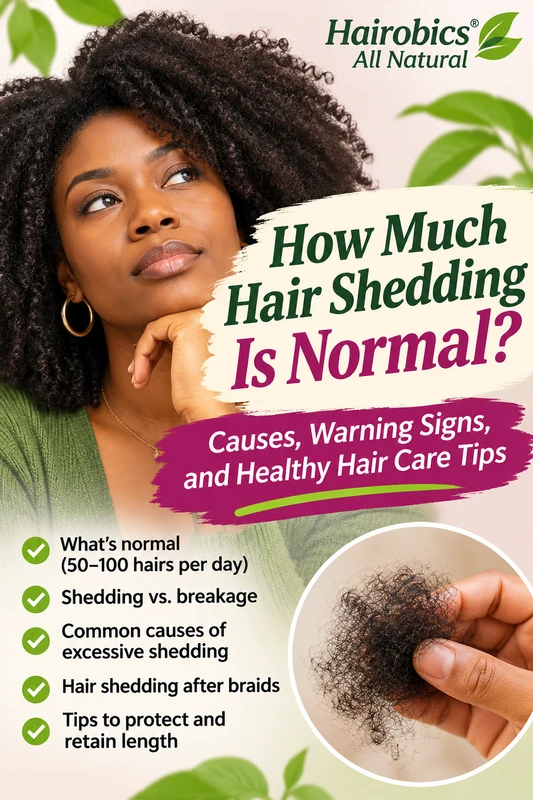
Finding loose hair in your brush, shower drain, or hands can be alarming, especially when you're working hard to grow longer, thicker, healthier natural hair.
You may wonder whether your hair is shedding normally, breaking from damage, or beginning to thin.
The good news is that hair shedding is a natural part of the hair growth cycle. Everyone loses hair regularly, even people with thick, healthy hair.
But how much hair shedding is normal?
According to the American Academy of Dermatology, most people naturally shed approximately 50 to 100 hairs per day. This happens as older hairs complete their growth cycle and make room for new growth.
However, the amount of hair you notice can vary depending on your hair texture, washing schedule, styling habits, and overall health.
For Black women with natural hair, particularly curly, coily, and 4C textures, shedding can appear more dramatic because loose strands often remain trapped within curls until wash day or detangling.
Understanding the difference between normal shedding, excessive shedding, and hair breakage can help you make better decisions about your hair care routine.
In this complete guide, we'll explain how much hair shedding is normal, why shedding happens, what causes excessive shedding, and how to maintain healthier natural hair.
1. How Much Hair Shedding Per Day Is Normal?
Most people naturally shed between 50 and 100 strands of hair daily.
This number is a general guideline rather than an exact limit.
Some people shed fewer strands, while others naturally shed more depending on their individual hair growth cycle.
Your hair is constantly growing, resting, shedding, and replacing older strands.
This means that seeing hair in your brush does not automatically indicate a problem.
For example, you may notice:
-
Loose strands on your pillow in the morning
-
Hair collecting in your comb during detangling
-
Several strands coming out while shampooing
-
Hair wrapped around your fingers during styling
-
Shed hair accumulating after removing braids or twists
These experiences can be completely normal.
What matters most is whether your shedding remains consistent with your usual pattern.
If you normally see a small amount of hair during wash day but suddenly begin losing significantly larger amounts, that change deserves attention.
Likewise, if your hair is becoming noticeably thinner, your part is widening, or your scalp is becoming more visible, you should investigate the cause rather than assuming the shedding is harmless.
Remember: Normal hair shedding does not necessarily mean your hair is unhealthy.
2. Why Does Hair Shed Naturally?
To understand hair shedding, you first need to understand the natural hair growth cycle.
Every hair follicle goes through several stages throughout its lifetime.
These stages determine when hair grows, rests, and eventually sheds.
Anagen Phase: Active Hair Growth
The anagen phase is the active growing stage.
During this period, the hair follicle produces new hair cells, allowing the strand to grow longer.
Scalp hair can remain in this phase for approximately two to six years, although the duration varies.
The longer a strand remains in the growing phase, the greater its potential length.
Genetics, age, hormones, and health influence this process.
Catagen Phase: Transition
The catagen phase is a short transitional stage.
Hair growth slows and the follicle begins preparing for its resting period.
This phase generally lasts a few weeks.
Only a small percentage of scalp hairs are in this stage at any given time.
Telogen Phase: Resting
During the telogen phase, the hair follicle rests.
The existing strand remains in place while the follicle prepares for another growth cycle.
This resting stage typically lasts several months.
Exogen Phase: Shedding
The exogen phase describes the release of the old hair strand.
The strand separates from the follicle and eventually falls away.
Meanwhile, the follicle can begin producing another hair.
This is why normal shedding does not automatically lead to baldness.
The problem occurs when excessive numbers of hairs shed, replacement growth is disrupted, or the follicles become damaged.
Understanding these stages can help you recognize the difference between ordinary shedding and changes that may require professional evaluation.
3. Is Hair Shedding Different for Natural Black Hair?
Yes, the appearance of shedding can differ significantly depending on hair texture and styling habits.
Natural Black hair often has curls, coils, bends, and tightly packed strands.
These characteristics can cause loose hairs to remain tangled among neighboring strands instead of falling directly onto clothing or the floor.
As a result, someone with tightly coiled hair may not notice much shedding throughout the week.
Then, during wash day, they may discover a surprisingly large collection of loose strands.
This does not necessarily mean they lost all those hairs at once.
Instead, the strands may have accumulated over several days.
For example, someone who sheds an average of 75 hairs daily could theoretically shed approximately 525 hairs over seven days.
Not every strand will remain trapped, but this illustrates why a weekly detangling session may reveal considerably more hair than a daily combing routine.
The same principle applies to people wearing braids, twists, cornrows, or other protective hairstyles.
If you want to understand how your washing schedule influences shedding and detangling, read our guide on how often you should wash natural hair.
The important lesson is that the amount of hair collected during one styling session does not necessarily represent the amount shed that day.
4. How Much Hair Shedding Is Normal on Wash Day?
Wash day is one of the most common times people become concerned about hair shedding.
When you shampoo, condition, and detangle your hair, loose strands that accumulated between washes are released.
The amount you notice depends on several factors.
These include how frequently you wash your hair, whether you detangle between washes, your hair length, and how tightly your curls hold loose strands.
Someone who washes and detangles every three days may notice relatively small amounts of shed hair.
Someone who washes every two weeks may notice considerably more.
Neither situation automatically indicates a hair loss condition.
However, pay attention to changes.
If your usual wash-day shedding suddenly doubles or triples, or you begin noticing obvious thinning, consider whether something has changed in your health or routine.
You should also examine the loose strands.
Long, complete strands often indicate shedding.
Short, uneven fragments may indicate breakage.
These two problems require different approaches.
5. Hair Shedding vs. Hair Breakage: What's the Difference?
One of the biggest mistakes people make is assuming every loose strand represents hair shedding.
In reality, hair can fall out naturally from the follicle or snap somewhere along the shaft.
Understanding this distinction is essential.
What Normal Shedding Looks Like
Shed hairs generally:
-
Come from the follicle
-
Are often close to the full length of the hair in that area
-
May have a small white or pale club-shaped end
-
Appear during brushing, washing, or styling
-
Result from the natural hair growth cycle
The small white club at the end of a shed hair is not the entire follicle.
It does not mean the follicle has been permanently removed.
What Hair Breakage Looks Like
Broken hairs often:
-
Appear shorter than surrounding strands
-
Have uneven lengths
-
Lack a club-shaped root end
-
Result from friction, tension, or weakened hair fibers
-
Accumulate after aggressive brushing or styling
Breakage is particularly frustrating because your scalp may continue producing new hair while your ends repeatedly snap off.
This can make it appear that your hair has stopped growing.
For a more detailed explanation, read our article on shedding vs. breakage and how to tell the difference.
Knowing which problem you're experiencing helps you avoid spending time and money on the wrong solutions.
6. What Causes Excessive Hair Shedding?
Although normal shedding is expected, excessive shedding can occur when the hair growth cycle becomes disrupted.
One common cause is a condition called telogen effluvium.
Telogen effluvium happens when an unusually large number of hairs enter the resting phase and subsequently shed.
The increased shedding often becomes noticeable two to three months after a triggering event.
Several factors can contribute.
Physical or Emotional Stress
Significant stress can affect the hair growth cycle.
Major life events, severe illness, surgery, or prolonged emotional stress may trigger increased shedding.
Because the effects can be delayed, you might not immediately connect your hair changes to an earlier stressful experience.
Hormonal Changes
Hormonal fluctuations can influence hair growth.
Pregnancy, childbirth, menopause, thyroid disorders, and changes in hormonal medications can affect shedding patterns.
Postpartum shedding is particularly common.
During pregnancy, hormonal changes can cause more hairs to remain in the growing phase.
After childbirth, many of those hairs eventually enter the shedding phase.
This can make postpartum shedding appear unusually heavy.
Nutritional Deficiencies
Hair follicles require adequate nutrients to function properly.
Insufficient iron, protein, or other essential nutrients may contribute to hair loss in some people.
Severely restrictive diets and rapid weight loss can also trigger excessive shedding.
Illness or Medication Changes
High fevers, significant infections, certain medications, and medical conditions can disrupt the growth cycle.
If your shedding begins after a new medication, speak with your healthcare professional before making changes.
Never discontinue prescribed medication solely because you suspect it is affecting your hair.
Scalp Conditions
Some scalp conditions can cause inflammation, discomfort, and hair loss.
Persistent itching, redness, tenderness, scaling, or sores should not be ignored.
These symptoms may require medical treatment rather than additional styling products.
7. How Much Shedding Is Too Much?
There is no single hair count that perfectly identifies excessive shedding for everyone.
The commonly cited 50-to-100-hair guideline is useful, but individual patterns vary.
Instead of obsessively counting every strand, monitor your usual hair density and shedding pattern.
Possible warning signs include:
-
A sudden increase in loose hair
-
Hair coming out in unusually large handfuls
-
A noticeably wider part
-
Increasing scalp visibility
-
Reduced ponytail thickness
-
Thinning around the crown or temples
-
New bald patches
-
Persistent shedding accompanied by scalp discomfort
These symptoms do not all indicate the same condition.
For example, diffuse shedding throughout the scalp may have a different cause than localized thinning around the hairline.
A dermatologist can help determine whether you're experiencing telogen effluvium, pattern hair loss, traction alopecia, alopecia areata, or another condition.
Early evaluation is especially important if you notice smooth bald patches, scalp pain, or progressive thinning around the crown.
8. Is Hair Shedding After Braids Normal?
Yes. Seeing accumulated shed hair after removing braids is common.
Protective hairstyles can keep loose strands contained for weeks.
When you finally remove the braids, those strands are released during detangling.
Imagine wearing braids for four weeks.
Even if your hair sheds at an ordinary rate, many loose strands may remain trapped within the hairstyle.
This can create a large collection of hair during takedown.
However, braids can also cause actual breakage or traction-related hair loss when installed too tightly.
Signs of excessive tension include scalp pain, bumps, pulling around the edges, and broken hairs near the roots.
Protective styling should never require enduring discomfort.
When removing braids, work slowly and separate accumulated shed hairs before shampooing.
Avoid forcing a comb through tangled roots.
Use a conditioning product that provides enough slip to reduce friction.
Most importantly, remember that protective hairstyles should protect your hair, not place constant stress on your follicles.
9. Does 4C Hair Shed More Than Other Hair Types?
Having 4C hair does not automatically mean you shed more hairs each day.
Hair texture influences how shedding appears, but it does not establish a universal daily shedding rate.
Because 4C strands have tight coils, naturally shed hairs may remain caught within the hairstyle.
This can make detangling sessions appear more dramatic.
The tightly curved structure can also make 4C hair more vulnerable to mechanical breakage when handled roughly.
That is why it is important to distinguish between full-length shed strands and shorter broken pieces.
If you have 4C hair, consider using smaller sections during detangling, maintaining adequate conditioning, and choosing hairstyles that minimize unnecessary tension.
Avoid judging your hair health solely by the size of the hairball you collect after wash day.
Instead, pay attention to density, scalp condition, length retention, and whether your usual shedding pattern changes.
10. Can Dry Hair Cause Excessive Shedding?
Dryness is more directly associated with hair shaft breakage than true shedding from the follicle.
When hair becomes excessively dry, it may feel rough, brittle, tangled, or difficult to manage.
This can increase friction during styling.
As a result, strands may snap before reaching their potential length.
Someone experiencing significant breakage might mistakenly believe their hair is shedding excessively.
Proper moisture management helps maintain softness, flexibility, and manageability.
However, moisturizing products do not necessarily stop medically caused hair shedding.
For example, applying more oil will not correct an iron deficiency, thyroid disorder, or other underlying medical condition.
This distinction matters when building an effective routine.
Healthy hair care can help protect the strands you have, while medical evaluation may be necessary to address abnormal shedding.
11. How to Reduce Hair Breakage While Managing Normal Shedding
You cannot and should not attempt to eliminate normal shedding completely.
Your hair needs to complete its natural growth cycle.
However, you can reduce unnecessary breakage and support healthier hair care habits.
Detangle Gently
Avoid aggressively pulling through knots.
Separate your hair into manageable sections.
Apply a conditioner or detangling product with sufficient slip.
Begin near the ends and gradually work toward the roots.
Use your fingers, a wide-tooth comb, or another tool that works well for your texture.
Maintain a Consistent Moisture Routine
Dry, brittle hair is more likely to break during handling.
Use water-based conditioning products when appropriate and avoid relying on heavy oils alone to provide hydration.
Pay attention to how your hair feels after cleansing.
If your strands remain rough and tangled, your conditioning routine may need adjustment.
Avoid Excessive Heat
Frequent high-temperature styling can weaken the hair shaft.
When using heated tools, apply an appropriate heat protectant and avoid unnecessary passes.
Give your hair breaks from repeated straightening.
Choose Low-Manipulation Hairstyles
Styles that require less daily combing and pulling can help reduce mechanical stress.
Examples include loose twists, gentle buns, and properly installed protective styles.
Our guide to low-manipulation hair care explains how reducing unnecessary handling can support length retention.
Protect Your Hairline
Avoid repeatedly pulling your edges into tight hairstyles.
Be especially careful with braids, ponytails, wigs, and extensions that create tension.
Read our article on protecting fragile hair around the hairline for additional tips.
Maintain Scalp Hygiene
Keep your scalp clean according to its needs.
Remove product buildup regularly and address persistent itching or flaking.
A comfortable, healthy scalp is an important part of overall hair care.
12. Can Hair Oils Stop Shedding?
Hair oils can be useful for conditioning, reducing friction, and improving the feel of dry hair.
However, oils should not be considered a guaranteed treatment for excessive shedding.
True shedding occurs through processes involving the hair follicle and growth cycle.
If excessive shedding is caused by illness, hormonal changes, medication, or nutritional deficiencies, oil alone will not resolve the underlying problem.
Some oils may help improve lubrication and reduce hair shaft damage when used appropriately.
This can be especially helpful for natural hair that experiences frequent friction during styling.
The goal is to use oils as part of a balanced routine rather than expecting them to replace medical treatment.
Also remember that applying excessive amounts of oil can create buildup and make cleansing more difficult.
Use the amount your hair and scalp actually need.
13. Supporting Healthy Natural Hair With Hairobics All Natural
At Hairobics All Natural, we believe that maintaining healthy-looking hair requires consistency, gentle handling, and attention to the scalp.
While no cosmetic hair product can eliminate normal shedding or treat every cause of hair loss, conditioning products can complement a routine focused on protecting natural hair.
Hairobics Hair & Scalp Booster
The Hairobics Hair & Scalp Booster is an oil-rich conditioning formula featuring botanical ingredients such as coconut oil, olive oil, jojoba oil, aloe vera, rosemary oil, and vitamin E oil.
It can be incorporated into a scalp and hair conditioning routine, especially when dryness is a concern.
Use it as directed and avoid excessive application.
Shop the Hairobics Hair & Scalp Booster.
Hairobics Leave-In Treatment
The Hairobics Leave-In Treatment is formulated with a blend of botanical ingredients and conditioning oils.
It can be used as part of a routine focused on maintaining softer, more manageable hair.
For people who experience tangling and friction during styling, appropriate conditioning can make daily hair care easier.
Explore the Hairobics Leave-In Treatment.
Remember that these products are intended to complement regular hair care. Persistent or unexplained excessive shedding should be evaluated by a qualified healthcare professional.
14. How to Monitor Your Hair Shedding at Home
You do not need to count every strand to monitor changes.
A simple tracking routine can help you identify patterns over time.
Start by observing your usual shedding during several wash days.
Notice how much hair collects in your comb, brush, or drain.
Try to compare sessions with similar intervals between washes.
Next, examine your hair density.
Look at your part, hairline, crown, and overall fullness.
Take photographs in consistent lighting if you are concerned about thinning.
You can also keep a brief record of major changes such as illness, stress, dietary restrictions, medication changes, or new hairstyles.
These details may be useful if you consult a dermatologist.
Avoid repeatedly pulling on your hair to test shedding.
Home observations are helpful, but they cannot reliably diagnose a hair loss disorder.
If you notice continued thinning or an obvious change in shedding, seek professional evaluation.
15. How Long Does Excessive Hair Shedding Last?
The duration depends on the cause.
When excessive shedding results from a temporary event, such as a major illness or childbirth, the condition may improve after the body recovers.
With acute telogen effluvium, shedding often begins several months after the triggering event.
Many cases improve over the following months.
According to the American Academy of Dermatology, hair may regain its usual fullness within approximately six to nine months after the body readjusts, although recovery varies.
Some people experience prolonged shedding, especially when the triggering factor remains present.
Other forms of hair loss may not resolve without treatment.
This is why identifying the cause matters more than simply trying to reduce the amount of hair visible in your brush.
If shedding persists, worsens, or produces noticeable thinning, a dermatologist can assess the situation and recommend appropriate next steps.
16. Common Hair Shedding Mistakes to Avoid
When people notice increased shedding, they sometimes make changes that unintentionally create additional hair problems.
One common mistake is avoiding wash day completely.
While washing can release accumulated shed hairs, skipping cleansing indefinitely will not stop the natural shedding process.
Another mistake is aggressively brushing the hair to remove every loose strand.
This can cause additional breakage.
Some people also begin applying large amounts of oils, pomades, or scalp treatments without identifying the actual cause.
Others repeatedly switch products, making it difficult to determine what is helping or irritating the scalp.
A better approach is to remain consistent with gentle hair care while monitoring meaningful changes.
If you're experiencing breakage rather than shedding, our article on what causes breakage in Black hair explains common sources of mechanical damage.
Healthy hair care should be deliberate, comfortable, and appropriate for your individual needs.
17. When Should You See a Dermatologist About Hair Shedding?
Although some shedding is normal, certain symptoms deserve professional attention.
Schedule an evaluation if you notice sudden, unusually heavy shedding, persistent thinning, or visible bald patches.
You should also seek care if your scalp becomes painful, inflamed, or develops persistent scaling.
Hair loss around the crown or hairline should not automatically be blamed on ordinary shedding or tight hairstyles.
Some conditions affecting these areas can lead to permanent hair loss if treatment is delayed.
A dermatologist may examine your scalp, review your medical history, and recommend laboratory testing when appropriate.
Depending on the cause, treatment may involve addressing an underlying medical condition, modifying hairstyles, or using evidence-based hair loss therapies.
The earlier the cause is identified, the better the opportunity to protect your remaining hair.
Frequently Asked Questions About Normal Hair Shedding
Is losing 100 hairs a day normal?
Yes. Approximately 50 to 100 hairs daily is a commonly cited normal range. However, individual shedding varies, and a noticeable change from your usual pattern can be more informative than an exact count.
Is losing 200 hairs a day too much?
Losing 200 hairs every day may represent excessive shedding for many people, especially if it is a new pattern. However, counting hair from a single wash day can be misleading because loose strands may have accumulated over several days.
Why does my hair shed so much when I wash it?
Shampooing and detangling release strands that have already completed their growth cycle. If you wash infrequently or have tightly coiled hair, more accumulated strands may become visible during one session.
Is it normal to shed hair every time I comb it?
Yes. Combing often releases naturally shed hairs. However, excessive pulling, repeated snagging, and rough detangling can also cause breakage.
Does a white bulb mean my hair is falling out permanently?
No. A small white club-shaped end is commonly seen on naturally shed hairs. It does not mean the entire follicle has been removed or that new hair cannot grow.
Can stress make your hair shed?
Yes. Significant physical or emotional stress can trigger telogen effluvium, which may cause increased shedding several months after the stressful event.
Is hair shedding normal after taking down braids?
Yes. Loose strands may remain trapped within braids for weeks. However, severe breakage, scalp pain, or thinning around the edges may indicate excessive tension or another problem.
Does natural hair shed more in the winter?
Some people notice seasonal changes in shedding, but these patterns vary and are not a reliable explanation for significant hair loss. Winter dryness may also contribute to breakage, which can be mistaken for shedding.
Can moisturizing your hair reduce shedding?
Moisturizing and conditioning can help reduce dryness-related breakage, but they do not necessarily stop natural shedding or treat medical causes of excessive hair loss.
Can hair grow while it is shedding?
Absolutely. Hair follicles operate on individual growth cycles. Some hairs may be shedding while many others are actively growing.
How do I know if my hair is shedding too much?
Watch for persistent increases in shedding, reduced hair density, a widening part, or new bald areas. These changes are more meaningful than judging one collection of hair after detangling.
Final Thoughts: How Much Hair Shedding Is Normal?
Hair shedding is a normal and necessary part of maintaining a healthy hair growth cycle.
For many people, losing approximately 50 to 100 hairs per day is expected.
However, the amount you notice depends on your hair texture, styling routine, washing frequency, and individual growth cycle.
For natural Black hair, especially tightly curled and coily textures, shed strands often remain trapped until wash day or protective-style removal.
This can make ordinary shedding appear excessive.
The most important thing is understanding the difference between shedding and breakage.
Shedding happens when a strand naturally releases from the follicle. Breakage happens when the hair shaft snaps.
You can help protect your hair by maintaining a consistent conditioning routine, detangling gently, avoiding tight hairstyles, and minimizing unnecessary heat and manipulation.
If you notice sudden or persistent excessive shedding, bald patches, or progressive thinning, consult a dermatologist.
At Hairobics All Natural, our goal is to help you build a simple, consistent hair care routine that supports comfortable scalp care, manageable natural hair, and better length retention.
Healthy hair doesn't mean never losing a strand.
It means understanding your hair's natural cycle, recognizing when something changes, and caring for your strands with patience and consistency.
Discover more natural hair care tips and products at Hairobics All Natural.