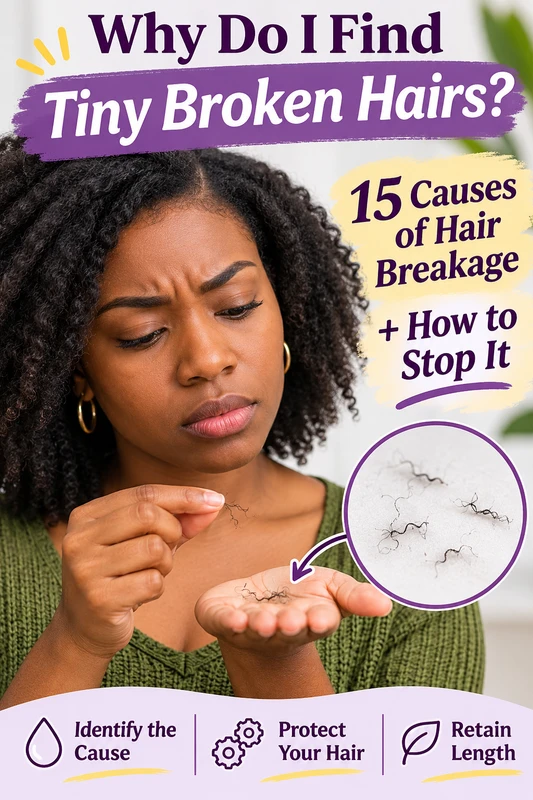
Have you ever finished combing your hair and noticed tiny pieces of hair scattered across your bathroom sink? Maybe you find short hairs on your shirt, pillowcase, shoulders, or bathroom floor. You might even notice little curly fragments falling out whenever you touch or style your natural hair.
If you've been asking yourself, "Why do I find tiny broken hairs everywhere?", you're not alone.
Finding small pieces of hair can be frustrating, especially when you're trying to grow longer, thicker, healthier natural hair. You may be moisturizing regularly, using protective hairstyles, and following a consistent hair care routine, yet those little pieces keep appearing.
The important thing to understand is that tiny broken hairs often indicate hair breakage rather than normal hair shedding.
Hair shedding is a natural part of the hair growth cycle. Breakage happens when a strand snaps somewhere along its length, often because of mechanical stress, dryness, excessive styling, heat damage, or weakened ends.
Although occasional breakage can happen, consistently finding large amounts of tiny hair fragments may mean your hair needs a change in how it's handled and maintained.
In this complete guide, we'll explain why tiny hairs break off, how to identify the cause, what those broken pieces reveal about your hair's condition, and how to develop a routine that helps protect your natural hair and retain more length.
What Does It Mean When You Find Tiny Broken Hairs?
Tiny broken hairs are short pieces of hair that have separated from longer strands.
They may appear as small curls, straight fragments, short coils, or little pieces that resemble eyelashes.
You might notice them:
-
On your bathroom counter after styling
-
Inside your comb or detangling brush
-
On your pillowcase in the morning
-
Across your shoulders and clothing
-
In the shower after washing
-
On the floor after taking down braids
-
Around your sink after moisturizing
-
On your hands after manipulating your hair
These pieces can range from barely visible fragments to strands several inches long.
When a hair breaks, it does not necessarily mean the follicle has stopped producing hair. The strand may continue growing from the scalp, but repeated breakage can prevent you from retaining its length.
For example, if your hair grows approximately half an inch in a month but the ends continually snap off, you may see very little improvement in your overall length.
This is why understanding the difference between growing hair and retaining hair is so important.
For a deeper explanation, read our guide to length retention and avoiding breakage on natural hair.
Tiny Broken Hairs vs. Normal Hair Shedding
Before changing your hair routine, determine whether you're experiencing breakage or shedding.
Although they can happen simultaneously, they are different processes.
What Is Normal Hair Shedding?
Hair naturally moves through a growth cycle that includes growing, transitioning, resting, and shedding.
When a strand completes its cycle, it eventually releases from the follicle.
Shed hairs often have these characteristics:
-
They may be relatively long.
-
They can have a tiny white or pale club-shaped bulb at one end.
-
They often resemble the length of your surrounding hair.
-
They may accumulate during washing or detangling.
Losing approximately 50–100 hairs daily is often considered typical, although individual patterns vary.
People who wash or detangle less frequently may notice several days' worth of shed hair during one session.
What Is Hair Breakage?
Breakage happens when the hair shaft snaps before the entire strand naturally sheds.
Broken hairs often:
-
Look much shorter than your overall hair length
-
Have no visible root bulb
-
Appear uneven or jagged
-
Collect after brushing or detangling
-
Become more noticeable after heat styling
-
Appear alongside split or rough ends
A short strand without a visible bulb is not absolute proof of breakage. Naturally short hairs and newly growing hairs can also be present.
However, consistently finding numerous small fragments during styling strongly suggests that mechanical damage may be occurring.
15 Reasons You Keep Finding Tiny Broken Hairs
1. Your Hair Is Too Dry
Dryness is a common contributor to natural hair breakage.
Hair needs sufficient conditioning to remain flexible and manageable.
When strands become excessively dry, they may feel rough, stiff, tangled, or brittle.
This makes them more vulnerable to snapping during ordinary activities such as brushing, combing, styling, and sleeping.
Curly and coily hair can require additional conditioning because natural scalp oils do not spread as easily along tightly curved strands.
Signs that dryness may be contributing to breakage include:
-
Hair that feels rough after washing
-
Ends that become tangled quickly
-
Strands that snap during detangling
-
Hair that feels stiff rather than flexible
-
Excessive frizz and difficulty managing curls
What to do: Use a moisturizing conditioner after shampooing, follow with an appropriate leave-in treatment, and reduce unnecessary handling while your hair is dry.
For additional help, explore our complete guide to stopping natural hair breakage.
2. You're Combing Your Hair Too Aggressively
Detangling can become a major source of breakage when it's rushed.
Natural hair often forms curls, coils, and tangles that require patience to separate.
Pulling a comb through resistant sections creates tension on individual strands.
If a strand cannot withstand that force, it may snap.
You might notice tiny pieces falling onto your shoulders immediately after combing.
To reduce damage:
-
Divide your hair into manageable sections.
-
Apply conditioner or a detangling product that provides slip.
-
Begin detangling near the ends.
-
Work gradually toward the roots.
-
Use your fingers to loosen stubborn knots.
-
Avoid forcing a comb through tangled sections.
Detangling should be controlled and gentle, not a battle between your hair and your comb.
3. You're Manipulating Your Hair Too Frequently
Natural hair is versatile, but constantly changing hairstyles can increase mechanical stress.
Every time you brush, comb, twist, separate, smooth, or restyle your hair, you place some stress on the strands.
Frequent manipulation becomes especially problematic when your hair is already damaged.
Examples include:
-
Repeatedly brushing your edges
-
Retwisting your hair every night
-
Constantly separating curls
-
Restyling ponytails several times daily
-
Combing hair unnecessarily
-
Frequently taking down and reinstalling hairstyles
A low-manipulation routine can reduce this repeated stress.
If your hair keeps snapping despite regular moisturizing, consider reducing how often you handle it.
4. Your Ends Are Severely Damaged
Your ends are usually the oldest parts of your hair.
They have experienced more washing, styling, friction, heat, and environmental exposure than newer hair near the roots.
Over time, the protective cuticle can wear down.
This makes older ends more vulnerable to splitting and breaking.
Signs of damaged ends include:
-
Tiny broken hairs after detangling
-
Rough or uneven ends
-
Frequent tangling
-
Visible splits
-
Thin, transparent-looking ends
-
Hair that breaks easily near the bottom
Unfortunately, split ends cannot be permanently repaired with oils or conditioners.
Products may temporarily smooth their appearance, but severely damaged ends may require trimming.
Learn more about protecting natural hair ends and preventing breakage.
5. You're Using Too Much Heat
Flat irons, curling irons, blow dryers, and hot combs can damage hair when used excessively or incorrectly.
High temperatures may weaken the hair shaft and reduce its ability to tolerate tension.
Over time, heat-damaged strands can become brittle and break into small pieces.
Warning signs include:
-
Hair snapping after straightening
-
Curls that no longer return to their usual pattern
-
Rough or fragile ends
-
Excessive dryness
-
Short broken hairs around heat-styled sections
To reduce heat-related breakage, lower your styling temperature, avoid repeated passes, use an appropriate heat protectant, and allow your hair to recover between heat-styling sessions.
6. Your Protective Hairstyles Are Too Tight
Braids, twists, cornrows, and other protective styles can help reduce daily manipulation.
However, they are not automatically protective.
When installed too tightly, they place excessive tension on the hair shaft and follicles.
This can cause broken hairs around the edges, temples, crown, and nape.
Repeated tension may also contribute to traction alopecia, a form of hair loss associated with pulling hairstyles.
Signs of excessive tension include:
-
Pain during or after installation
-
Small bumps around the hairline
-
Tenderness or irritation
-
Broken hairs near the temples
-
A receding or thinning hairline
Protective hairstyles should never cause significant pain.
If a style is pulling tightly, loosen or remove it rather than waiting for the discomfort to disappear.
7. You're Not Protecting Your Hair While Sleeping
Your hair continues experiencing friction while you sleep.
As you move your head against your pillow, strands can rub against the fabric and become tangled.
This is especially problematic when your ends are already dry or damaged.
A satin or silk bonnet, scarf, or pillowcase can help reduce friction.
For longer natural hair, loosely gathering your hair before bedtime may also reduce tangling.
Avoid tight nighttime hairstyles that place tension on your edges.
8. You Have Too Many Fairy Knots
Fairy knots, also called single-strand knots, occur when an individual strand curls around itself and forms a small knot.
They are especially common in tightly curled and coily hair.
A fairy knot can catch on neighboring strands, comb teeth, or fingers during detangling.
When excessive force is applied, the strand may break near the knot.
This can produce the tiny broken hairs you find in your sink.
To reduce fairy knots:
-
Keep your ends conditioned.
-
Avoid excessive manipulation.
-
Detangle gently.
-
Reduce friction.
-
Trim damaged ends when necessary.
-
Consider styles that keep your ends organized.
Read our article on how to reduce fairy knots in natural hair without losing length.
9. You're Brushing Your Edges Too Often
Your edges are often finer and more vulnerable to repeated pulling than other areas of your hair.
Daily brushing, strong-hold styling products, tight ponytails, and repeated slicked-back hairstyles can create stress along the hairline.
Over time, you may notice short broken pieces around your forehead and temples.
To protect your edges, use gentle styling techniques and avoid brushing the same area repeatedly.
Allow your hairline to rest between tight or slicked hairstyles.
If you notice thinning or persistent breakage, consider switching to looser styles.
10. Your Hair Has Chemical Damage
Relaxers, bleaching, permanent coloring, and other chemical treatments can weaken the structure of the hair shaft.
Chemically processed hair may be more susceptible to breaking when exposed to additional heat, friction, or tension.
The area where chemically treated hair meets new natural growth can also be vulnerable because the two textures may respond differently to manipulation.
If you're transitioning from relaxed to natural hair, pay particular attention to this boundary.
Use conditioning products, minimize heat, and detangle carefully.
Severely damaged sections may eventually need to be trimmed as healthier hair grows.
11. You're Using Products That Leave Your Hair Stiff
Not every product works equally well for every hair type.
Some styling gels, strong-hold products, and treatments may leave hair feeling stiff or difficult to manipulate.
When you repeatedly comb or separate hardened hair without softening it first, strands may break.
Excessive buildup can also make detangling more difficult.
Pay attention to how your hair feels after using a product.
If it becomes unusually stiff, rough, or tangled, consider changing the product or adjusting how often you use it.
12. You're Neglecting Your Crown
The crown is a common area for repeated breakage.
Depending on your hairstyle and routine, it may experience frequent brushing, pulling, heat exposure, or friction.
Some people also notice that their crown has a different texture or requires additional conditioning.
If you repeatedly find tiny broken hairs near the top of your head, examine how you're styling that section.
Avoid pulling the crown tightly into buns and ponytails.
Give it individual attention during conditioning and detangling.
Persistent crown thinning, scalp discomfort, or patchy hair loss should be evaluated by a dermatologist because not all crown problems are caused by ordinary breakage.
13. Your Hair Is Rubbing Against Clothing
Hair that reaches your shoulders may constantly rub against jackets, collars, scarves, and other clothing.
Repeated friction can contribute to tangling and wear, especially around the ends and nape.
This may explain why some people notice more broken hairs at the back of their heads.
Consider occasionally wearing styles that keep fragile ends away from rough fabrics.
You can also choose smoother clothing materials around your hair.
14. You're Not Conditioning Your Hair Properly
Shampoo removes dirt, oil, and product buildup, but cleansing alone is not enough for many hair types.
Conditioners help improve manageability, reduce friction, and make detangling easier.
Skipping conditioner may leave some hair types feeling rough and difficult to comb.
For natural hair, a consistent conditioning routine can make a noticeable difference in how easily strands separate.
Apply conditioner throughout your hair, paying particular attention to the oldest ends.
Use a leave-in product when additional conditioning is needed between wash days.
15. Your Hair Needs a Break From Styling
Sometimes tiny broken hairs are a sign that your overall routine has become too demanding.
You may be doing too many things at once:
-
Frequent heat styling
-
Repeated braiding
-
Tight ponytails
-
Daily edge brushing
-
Constant detangling
-
Excessive manipulation
-
Repeated chemical processing
Even when each styling method seems manageable individually, the combined stress can contribute to breakage.
Consider simplifying your routine for several weeks.
Choose comfortable hairstyles that require minimal handling.
Focus on conditioning, gentle detangling, and protecting your ends.
Our article on signs your hair needs a styling break explains when it may be time to change your styling habits.
Why Do I Find Tiny Broken Hairs Even When My Hair Is Moisturized?
This is one of the most confusing parts of natural hair care.
You might moisturize your hair consistently and still find small broken pieces.
The reason is that moisture and conditioning are only part of the solution.
Hair can still break because of mechanical damage, split ends, chemical processing, excessive heat, or repeated tension.
Also, products cannot permanently restore severely damaged hair fibers to their original condition.
A leave-in conditioner may improve softness and manageability, but it cannot reverse every form of structural damage.
If your hair feels moisturized yet continues breaking, examine your detangling methods, styling frequency, heat exposure, and condition of your ends.
How to Stop Finding Tiny Broken Hairs
Reducing breakage usually requires several consistent changes rather than one dramatic treatment.
Step 1: Start With a Gentle Wash Routine
Wash your hair often enough to keep your scalp and strands clean without unnecessarily drying them out.
Use a shampoo appropriate for your scalp and follow with a moisturizing conditioner.
Concentrate on gently cleansing rather than aggressively scrubbing the hair lengths.
Step 2: Use a Leave-In Treatment
A leave-in treatment can help improve manageability and reduce friction during styling.
The Hairobics Leave-In Treatment is formulated with botanical ingredients, including aloe vera, jojoba oil, avocado oil, and other plant-derived components.
It can be incorporated into a conditioning routine for dry or difficult-to-manage natural hair.
Apply according to the product directions and pay attention to how your hair responds.
Step 3: Protect Your Ends
Your ends deserve special attention because they have experienced the most wear.
Keep them conditioned, avoid rough brushing, and reduce unnecessary friction.
If your ends are severely split or repeatedly snagging, a careful trim may help prevent additional breakage.
Step 4: Reduce Daily Manipulation
You do not need to comb or restyle your hair constantly.
Consider low-manipulation hairstyles such as loose twists, comfortable braids, or simple natural styles.
Choose styles that do not place excessive tension on your scalp.
Step 5: Maintain a Comfortable Scalp Care Routine
Healthy scalp care supports the environment in which hair grows.
Keep your scalp clean and address persistent itching, flaking, or irritation rather than covering symptoms with heavy products.
The Hairobics Hair & Scalp Booster contains a blend of botanical oils, including coconut, jojoba, olive, rosemary, and peppermint oils.
It can be used as part of a scalp-conditioning routine according to its directions.
Remember that scalp oils and moisturizers do not permanently repair split hair shafts or replace treatment for a medical hair-loss condition.
Step 6: Protect Your Hair Overnight
Use a comfortable satin or silk bonnet, scarf, or pillowcase to help reduce friction.
Avoid sleeping with your hair pulled tightly.
Step 7: Monitor Your Progress
Pay attention to how many broken hairs appear during comparable styling sessions.
You don't need to count every strand.
Instead, look for patterns.
Are you finding fewer fragments after changing your detangling technique?
Are your ends becoming easier to manage?
Is your hair retaining more length over time?
These observations can help you determine whether your new routine is working.
A Simple Weekly Routine to Reduce Natural Hair Breakage
A consistent routine can help protect your strands without making hair care unnecessarily complicated.
Wash Day
-
Gently separate your hair into sections.
-
Cleanse your scalp with a suitable shampoo.
-
Apply moisturizing conditioner.
-
Detangle carefully while the hair has sufficient slip.
-
Rinse and apply an appropriate leave-in treatment.
-
Style without excessive pulling or tension.
Between Wash Days
Check whether your hair actually needs additional moisture or conditioning before applying more product.
Avoid repeatedly brushing or combing hair that is already styled.
Keep your ends protected from unnecessary friction.
Nighttime
Loosely secure your hair if needed.
Use a satin or silk covering.
Avoid tight elastics and uncomfortable hairstyles.
Every Few Weeks
Inspect your ends and assess how much breakage you're experiencing.
If you notice recurring tangles or visible splitting, consider whether a trim is needed.
There is no universal trimming schedule. The right frequency depends on your hair's condition and styling habits.
Can Tiny Broken Hairs Grow Back?
The answer depends on what you mean by growing back.
When a hair shaft breaks, the damaged fragment cannot reattach itself.
However, if the follicle remains healthy, the hair can continue growing from the scalp.
This means breakage does not automatically indicate permanent hair loss.
Your goal should be to protect the new and existing hair so it has a better opportunity to retain length.
For most people dealing with ordinary mechanical breakage, improved hair handling and conditioning can make a meaningful difference.
However, if you're experiencing patchy hair loss, persistent thinning, scalp pain, or unusual changes in your hair, consult a dermatologist.
How Long Does It Take to Notice Less Hair Breakage?
The timeline depends on the cause and severity of the damage.
If rough detangling is the main problem, you may notice fewer broken fragments soon after changing your technique.
If your hair has extensive heat or chemical damage, improvement may require more time as damaged sections are gradually trimmed and new hair grows.
Remember that existing split ends do not become permanently repaired simply because you begin moisturizing.
The goal is to reduce new damage while protecting the healthier hair you already have.
Consistency matters more than constantly switching products.
Frequently Asked Questions About Tiny Broken Hairs
Why do I find tiny broken hairs on my shirt?
Short hairs on your shirt may be fragments that snapped during styling, brushing, or ordinary friction.
If they appear frequently, inspect your ends and consider whether your hairstyle or clothing is causing unnecessary stress.
Why do tiny hairs fall out when I touch my hair?
If short fragments fall whenever you touch your hair, the strands may already be weakened or damaged.
Dryness, tangles, chemical damage, and excessive manipulation can contribute.
However, some short hairs may be naturally shed strands rather than broken pieces.
Is it normal to find a few tiny broken hairs?
Occasional breakage can occur, especially during detangling.
Finding a few pieces does not necessarily mean your hair is unhealthy.
Consistent, increasing breakage deserves closer attention.
Why does my natural hair keep snapping at the ends?
Your ends are older and often experience more wear than the rest of your hair.
Repeated friction, heat exposure, tangling, and rough handling can make them vulnerable.
Conditioning, gentle detangling, and trimming damaged ends when necessary may help.
Can too much brushing cause tiny broken hairs?
Yes.
Excessive or aggressive brushing can create mechanical stress that causes strands to snap.
Reduce unnecessary brushing and avoid forcing brushes through tangles.
Do tiny broken hairs mean my hair is not growing?
Not necessarily.
Your hair may continue growing normally from the scalp while breaking along the shaft.
This can make overall length appear unchanged.
Read our article on why hair grows but won't retain length for a closer look at this problem.
Should I cut my hair if I keep finding tiny broken pieces?
Not automatically.
A major haircut is not always necessary.
First, identify whether the breakage is concentrated in damaged ends or occurring throughout the hair.
A small trim may help remove split ends, while widespread breakage may require broader changes to your routine.
Can hair oils stop breakage?
Hair oils can help lubricate strands and reduce friction in some routines.
However, oils alone cannot permanently repair damaged hair fibers.
Conditioning, gentle styling, and protecting your ends remain essential.
When should I see a dermatologist?
Seek professional evaluation if breakage is accompanied by sudden or patchy hair loss, scalp inflammation, pain, persistent itching, scaling, or progressive thinning.
These symptoms may indicate a condition that requires more than routine hair care.
Final Thoughts: Tiny Broken Hairs Are a Sign to Pay Attention to Your Routine
Finding tiny broken hairs can be discouraging, particularly when you're working hard to grow and maintain healthy natural hair.
However, small broken pieces do not automatically mean your hair has stopped growing or that permanent damage has occurred.
In many cases, breakage is related to habits that can be improved.
Start by examining how often you manipulate your hair, how you detangle, whether your ends are damaged, and how much tension or heat your hairstyles create.
Focus on gentle cleansing, consistent conditioning, reduced friction, and comfortable protective styling.
Most importantly, remember that healthy hair growth and length retention work together.
Your scalp produces new hair, but your daily routine helps determine how much of that length you keep.
For more natural hair care guidance and botanical hair and scalp products, visit Hairobics All Natural.
Healthy hair isn't just about how fast it grows. It's also about how well you protect every strand.