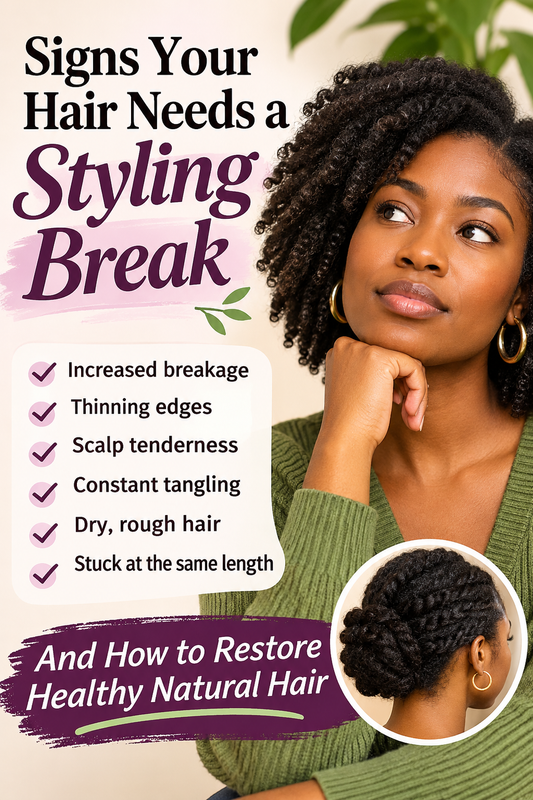
Natural hair is incredibly versatile. From beautiful twist-outs and braid-outs to sleek buns, knotless braids, silk presses, cornrows, and protective hairstyles, there are countless ways to express your personal style.
But sometimes, even the most carefully maintained hair needs a break.
If your natural hair has been feeling unusually dry, breaking more frequently, tangling excessively, or becoming difficult to manage, your styling routine could be contributing to the problem.
Many people focus on finding the perfect hair growth product without realizing that excessive styling, constant manipulation, and repeated tension may be preventing them from retaining the length they already grow.
The truth is that healthy hair requires more than moisture and good products. It also needs gentle handling, regular maintenance, and protection from unnecessary damage.
Recognizing the signs your hair needs a styling break can help you prevent further breakage, protect fragile edges, and improve your natural hair's overall condition.
In this comprehensive guide, we'll explore 15 warning signs that your hair may be experiencing styling stress, explain why over-manipulation can damage natural hair, and share practical ways to give your strands the attention they deserve.
Whether you have 3C curls, 4A coils, 4B hair, or tightly coiled 4C natural hair, understanding when to simplify your styling routine is an important part of maintaining healthier hair.
What Does It Mean When Your Hair Needs a Styling Break?
A styling break is a period when you intentionally reduce activities that place unnecessary stress on your hair and scalp.
This may include taking a break from:
-
Tight braids and cornrows
-
Heavy hair extensions
-
Frequent ponytails and slicked-back buns
-
Daily brushing and combing
-
Excessive heat styling
-
Repeated twist-outs and braid-outs
-
Tight wigs and sew-ins
-
Frequent edge styling
-
Hairstyles requiring constant manipulation
Taking a styling break does not mean completely neglecting your hair.
Instead, it means choosing gentler hairstyles and simplifying your routine so that your hair experiences less pulling, friction, heat, and handling.
For example, instead of creating a new hairstyle every morning, you might wear loose two-strand twists for several days.
You can still cleanse, condition, moisturize, and maintain your scalp while minimizing unnecessary styling.
If you're unfamiliar with this approach, read our guide to What Is Low-Manipulation Hair Care? to understand how reducing daily styling can support healthier hair habits.
1. Your Hair Is Breaking More Than Usual
One of the clearest signs your hair needs a styling break is increased breakage.
You may notice short pieces of hair collecting in your sink, on your bathroom counter, or inside your comb after styling.
Although some shedding is normal, frequent breakage can indicate that your strands are experiencing excessive mechanical stress.
Hair breakage occurs when the hair shaft snaps rather than naturally shedding from the follicle.
Common causes include:
-
Aggressive detangling
-
Tight hairstyles
-
Repeated brushing
-
Heat damage
-
Chemical processing
-
Friction from extensions
-
Styling already weakened hair
If you notice numerous short, uneven pieces after every styling session, consider reducing manipulation immediately.
Choose hairstyles that require less daily handling and use conditioner to improve slip during detangling.
Remember that hair can continue growing from the scalp while breaking at the ends.
Reducing breakage helps you retain more of the length you naturally grow.
2. Your Edges Are Becoming Thinner
Your edges are among the most vulnerable areas of your hair.
The delicate strands around your temples and forehead can experience repeated tension from hairstyles that pull tightly against the scalp.
Over time, this stress may contribute to thinning edges or traction alopecia.
Warning signs include:
-
A widening hairline
-
Short broken hairs near the temples
-
Tenderness around the edges
-
Small bumps after braiding
-
Areas where hair appears noticeably thinner
-
Hairline discomfort when removing a hairstyle
If your edges are becoming thinner, avoid tight braids, high ponytails, slicked-back hairstyles, and heavy extensions.
Allow your hairline to remain loose and comfortable.
Importantly, persistent tension-related hair loss can become permanent if the pulling continues.
For additional prevention tips, read How to Protect Fragile Hair Around the Hairline.
If thinning continues despite reducing tension, consult a dermatologist experienced with hair loss.
3. Your Scalp Feels Tender or Painful
Healthy hairstyles should not cause ongoing pain.
If your scalp feels sore after braiding, twisting, installing extensions, or wearing a tight ponytail, your hairstyle may be placing too much tension on the hair follicles.
Common symptoms include:
-
Tenderness when touching your scalp
-
Headaches after styling
-
Pain when moving your braids
-
Tightness around the hairline
-
Redness or small bumps
-
Discomfort while sleeping
Never assume that painful braids are normal or that they simply need time to loosen.
Persistent pulling can damage the hair and contribute to traction-related hair loss.
If a hairstyle causes significant pain, loosen or remove it promptly.
Avoid immediately replacing it with another tight hairstyle.
Give your scalp an opportunity to become comfortable before considering another installation.
4. Your Hair Feels Dry Even After Moisturizing
Does your hair feel dry shortly after applying moisturizer?
Although dryness can result from several factors, repeated styling may contribute by increasing friction and damaging the hair's protective outer layer.
Frequent manipulation can leave strands feeling rough, difficult to detangle, and less manageable.
Signs include:
-
Hair that feels rough to the touch
-
Ends that become brittle quickly
-
Increased tangling
-
Reduced softness
-
Hair that snaps during styling
-
A dull or weathered appearance
During a styling break, focus on gentle cleansing, conditioning, and moisturizing.
Apply a water-based leave-in conditioner when appropriate and avoid constantly layering products without cleansing.
The Hairobics Hair & Scalp Booster contains a blend of conditioning oils and botanical ingredients, including coconut oil, olive oil, jojoba oil, and vitamin E oil.
It can complement a gentle hair and scalp conditioning routine.
However, moisturizing products cannot reverse split ends or eliminate damage caused by continued pulling.
5. Your Hair Is Constantly Tangling
Natural hair naturally forms curls, coils, and bends, so occasional tangling is expected.
However, excessive tangling can indicate that your hair is experiencing damage or that your styling routine needs adjustment.
When hair repeatedly rubs against itself, clothing, extensions, or styling tools, strands can become tangled and difficult to separate.
You may notice:
-
Knots forming shortly after detangling
-
Hair catching on your fingers
-
Increased resistance when combing
-
Tangled ends after removing braids
-
More breakage during wash day
Instead of aggressively brushing through these tangles, work in small sections.
Apply conditioner for slip and gently separate knots from the ends upward.
Avoid detangling dry hair when it is causing excessive snapping.
If tangling continues, inspect your ends for splits, roughness, and single-strand knots.
6. You Are Developing More Fairy Knots
Fairy knots, also called single-strand knots, form when an individual hair strand loops around itself and creates a tiny knot.
They are particularly common in tightly curled and coily hair.
Although occasional fairy knots are normal, an increase may suggest that your hair needs additional protection.
Repeated manipulation, dryness, friction, and exposed ends can make these knots more troublesome.
You may feel tiny bumps along your strands or notice your ends catching on one another.
Avoid pulling knots apart aggressively.
Instead, consider gentle detangling, maintaining conditioned ends, and wearing low-manipulation hairstyles.
Our article Are Fairy Knots Damaging Your Hair? explains how to recognize troublesome knots and reduce the risk of additional breakage.
7. Your Hair Ends Look Thin or See-Through
Your ends are the oldest part of your hair.
They have experienced more washing, brushing, environmental exposure, and styling than the newer hair growing near your scalp.
Over time, repeated manipulation can contribute to weakened ends.
Signs of damaged ends include:
-
Thin, uneven-looking hair
-
Split ends
-
Rough texture
-
Frequent snapping
-
Ends that tangle easily
-
Hair that appears much thinner toward the bottom
If your ends are severely split, moisturizing products cannot permanently repair them.
A careful trim may be necessary.
You do not necessarily need a major haircut, but removing damaged ends can make your hair easier to maintain.
During your styling break, minimize brushing, protect your ends at night, and avoid repeatedly exposing fragile strands to friction.
Learn more in our Guide to Protecting Natural Hair Ends.
8. Your Hair Seems Stuck at the Same Length
Have you been growing your natural hair for months but haven't noticed much length progress?
Sometimes the problem is not slow hair growth.
Instead, your hair may be breaking at approximately the same rate it grows.
This is known as a length-retention problem.
For example, your roots may show noticeable new growth, but repeated breakage at the ends prevents your hair from appearing longer.
Frequent heat styling, tight hairstyles, aggressive detangling, and constant restyling can contribute to this problem.
A styling break may help by reducing opportunities for additional damage.
Focus on protecting your ends, maintaining moisture, and avoiding unnecessary manipulation.
Remember that natural hair growth is influenced by genetics, age, health, and other factors.
A styling break does not directly accelerate the biological growth cycle, but it may help preserve more of the length your hair produces.
9. Your Hair Has Lost Its Normal Elasticity
Healthy hair has some ability to stretch and return toward its original shape.
However, damaged strands may behave differently.
You might notice hair snapping with very little tension or feeling unusually weak when wet.
Repeated heat exposure, chemical treatments, and mechanical damage can affect the hair shaft's structural integrity.
Pay attention to:
-
Hair that breaks during gentle detangling
-
Strands that feel unusually brittle
-
Hair that stretches excessively and breaks
-
Changes in texture after heat styling
-
Increased fragility during wash day
Do not repeatedly stretch individual hairs to test their strength, especially if they are already fragile.
Instead, assess how your hair behaves during normal, gentle maintenance.
Consider temporarily eliminating direct heat and harsh styling practices.
Condition regularly and use strengthening treatments only when appropriate for your hair's needs.
If damage is extensive, trimming may be necessary because severely damaged hair cannot be restored to its original structure.
10. Your Scalp Is Itchy, Flaky, or Irritated
A healthy scalp is an important part of maintaining healthy-looking hair.
If your scalp becomes persistently itchy, flaky, or irritated after styling, pay attention.
Possible contributors include:
-
Product buildup
-
Tight hairstyles
-
Irritation from extensions
-
Sensitivity to styling products
-
Infrequent cleansing
-
Dandruff or other scalp conditions
A styling break may help when irritation is caused by pulling, friction, or a particular product.
Remove the suspected trigger, cleanse gently, and avoid scratching aggressively.
If your scalp is irritated, avoid applying numerous oils or heavy products in an attempt to cover up the problem.
For customers seeking a simple conditioning routine, the Hairobics Hair & Scalp Booster can be used according to its directions on a scalp that tolerates the ingredients.
Discontinue any product that causes burning, rash, or worsening irritation.
Persistent flaking, sores, or inflammation may require professional evaluation rather than additional styling products.
11. Your Hair Breaks Every Time You Take Down Braids
Braids are often considered protective hairstyles because they can reduce daily manipulation.
However, protective styles are not automatically harmless.
When braids are installed too tightly, worn too long, or removed aggressively, they can contribute to breakage.
After taking down your braids, you may notice:
-
Numerous short broken hairs
-
Severe tangling near the roots
-
Dry, brittle ends
-
Thinning around the hairline
-
Tenderness or irritated areas
-
Hair that feels weaker than before installation
Some accumulated shedding during braid removal is normal because shed hairs may remain trapped within the style.
However, large amounts of short broken hair deserve attention.
Before installing another set of braids, assess your hair and scalp.
Avoid immediately covering damaged hair with another high-tension hairstyle.
Read Why Protective Styles Sometimes Cause More Breakage for a closer look at common protective styling mistakes.
12. Your Hairline or Nape Keeps Breaking
The hairline and nape often experience repeated stress from everyday styling.
High ponytails, tight buns, braids, wig friction, and extension attachments can place pressure on these delicate areas.
If you notice that the hair at the back of your neck or around your temples remains shorter than surrounding sections, investigate your styling habits.
Not every shorter section indicates damage. Hair naturally varies in growth patterns and length.
However, repeated breakage in the same areas may indicate mechanical stress.
Try rotating hairstyles rather than pulling the same sections repeatedly.
Avoid tight elastic bands, excessive brushing, and heavy extensions.
When wearing buns, keep them loose and change their position occasionally.
Protect the nape from unnecessary friction caused by clothing and accessories.
13. Your Hair Looks Dull and Feels Rough
Healthy natural hair does not have to look extremely shiny.
Different curl patterns reflect light differently, and tightly coiled hair may naturally appear less glossy than straight hair.
However, a noticeable change in your hair's usual appearance can be meaningful.
If your hair suddenly feels rough, tangled, and difficult to style, consider whether excessive heat or manipulation may be contributing.
Frequent brushing, repeated straightening, and rough handling can wear down the hair's outer protective layers.
During your styling break, prioritize conditioning and gentle handling rather than constantly chasing shine with additional products.
Avoid excessive heat and allow your natural texture to remain undisturbed whenever possible.
A simple routine often makes it easier to identify which products and styling habits work best for your hair.
14. You Need to Restyle Your Hair Every Day
If you spend significant time brushing, twisting, slicking, stretching, and rearranging your hair every morning, you may be manipulating it more often than necessary.
Daily styling is not automatically damaging.
However, repeated tension and friction can accumulate, especially when your strands are already fragile.
For example, repeatedly pulling your hair into a tight ponytail may stress the same areas day after day.
Similarly, constantly separating and re-twisting curls can increase opportunities for tangling and breakage.
Instead, choose hairstyles that can remain comfortable and presentable for several days.
Loose twists, gentle updos, and other low-manipulation options can reduce the need for daily restyling.
The goal is not to stop enjoying your natural hair.
It is to find a balance between styling versatility and protecting your strands.
15. Your Hair Feels Healthier When You Leave It Alone
Sometimes the strongest clue is simply noticing how your hair responds when you reduce styling.
Perhaps your hair tangles less when you wear loose twists.
Maybe your edges feel more comfortable when you stop wearing tight ponytails.
Or you notice fewer broken strands when you detangle less aggressively.
These observations can help you identify habits that may be causing unnecessary damage.
Pay attention to your hair's response over several weeks.
Keep track of changes in breakage, scalp comfort, tangling, and manageability.
If your hair consistently feels better with less manipulation, consider making low-manipulation styling a regular part of your routine.
What Causes Natural Hair to Become Over-Manipulated?
Over-manipulation happens when repeated styling activities place more stress on the hair than it can comfortably tolerate.
Natural hair is especially vulnerable to mechanical damage when strands are already dry, weathered, or chemically processed.
Common contributors include daily combing, frequent brushing, tight hairstyles, repeated extension installations, aggressive detangling, and excessive heat.
The amount of manipulation your hair can tolerate depends on its condition, texture, length, and previous damage.
Someone with fragile, color-treated hair may need a gentler routine than someone whose hair has experienced little chemical or heat processing.
There is no universal number of styling sessions that automatically causes damage.
The most useful approach is to monitor your hair and adjust your routine when warning signs appear.
How Long Should You Give Your Hair a Styling Break?
There is no scientifically established recovery period that works for everyone.
The appropriate length of a styling break depends on the type and severity of the damage.
For mild dryness or tangling, several days of gentler handling may improve manageability.
If your hair has experienced repeated breakage from tight extensions, you may benefit from several weeks without high-tension hairstyles.
If you have thinning edges, scalp inflammation, or suspected traction alopecia, avoid the responsible hairstyles and seek professional advice rather than relying on a short break.
A useful starting point is to spend one to two weeks simplifying your styling routine, then reassess.
During that time, focus on:
-
Comfortable, low-tension hairstyles
-
Gentle cleansing
-
Regular conditioning
-
Minimal brushing
-
Careful detangling
-
Protecting your ends
-
Avoiding unnecessary heat
Remember that hair which has already split or snapped will not physically reconnect during a styling break.
The purpose is to reduce additional damage while maintaining healthier hair practices.
A Simple 7-Day Natural Hair Styling Break Routine
A styling break does not have to be complicated.
The following example can help you simplify your routine while maintaining clean, conditioned hair.
Day 1: Cleanse and Condition
Begin with a gentle wash day.
Use an appropriate shampoo to remove buildup, sweat, and residue.
Follow with conditioner to improve softness and manageability.
Detangle carefully in sections, beginning at the ends.
Apply a leave-in conditioner if needed.
Choose a comfortable hairstyle that requires minimal daily manipulation.
Day 2: Leave Your Hairstyle Alone
Avoid unnecessary brushing, combing, or restyling.
Check that your hairstyle is not pulling on your edges or scalp.
If your hair feels comfortable and moisturized, you may not need to apply additional products.
Day 3: Check Your Moisture Levels
Gently assess whether your hair feels dry.
If needed, lightly refresh the strands with a suitable moisturizing product.
Avoid saturating the hair unnecessarily or applying heavy layers of oil.
Keep manipulation minimal.
Day 4: Protect Your Hair at Night
Continue wearing your low-tension hairstyle.
Use a satin bonnet, scarf, or pillowcase to reduce friction while sleeping.
Avoid tightly wrapping or pulling your hairline.
Day 5: Examine Your Ends
Check for roughness, tangling, and visible split ends.
Avoid repeatedly handling damaged sections.
If your ends need trimming, plan a careful trim rather than pulling apart splits.
Day 6: Maintain Scalp Comfort
Assess whether your scalp feels clean and comfortable.
If your scalp needs cleansing, wash it rather than applying more products over buildup.
Avoid vigorous scratching or massaging irritated areas.
Day 7: Evaluate Your Progress
Consider whether your hair feels softer, tangles less, or experiences fewer broken strands.
Decide whether to continue your current low-manipulation hairstyle or gently refresh it.
If breakage or scalp discomfort continues, reassess your routine and consider professional guidance.
Best Hairstyles to Wear During a Styling Break
Choosing the right hairstyle is an important part of reducing styling stress.
The best options are generally comfortable, lightweight, and easy to maintain without constant manipulation.
Loose Two-Strand Twists
Two-strand twists help keep hair organized while reducing daily detangling.
Avoid twisting too tightly at the roots.
Loose Flat Twists
Flat twists can provide a neat hairstyle without requiring heavy extensions.
Make sure they do not pull on your edges.
Low-Tension Buns
A loose bun can help keep ends protected.
Use gentle hair accessories and avoid repeatedly pulling the same sections tightly.
Loose Braids Without Heavy Extensions
Simple braids may help reduce tangling and manipulation.
However, avoid braiding damaged or irritated areas under tension.
Natural Wash-and-Go Styles
A wash-and-go may work well for some curl patterns when it does not require excessive daily detangling or restyling.
Choose whichever style allows your hair to remain comfortable and manageable.
For additional ideas, explore The Complete Guide to Protective Styles.
How Hairobics All Natural Can Complement Your Styling Break
During a styling break, the goal should be to simplify your hair-care routine rather than overwhelm your strands with unnecessary products.
Hairobics All Natural offers hair and scalp conditioning products that can fit into a routine focused on moisture, manageability, and gentle maintenance.
Hairobics Hair & Scalp Booster
The Hairobics Hair & Scalp Booster contains a blend of conditioning oils and botanical ingredients.
It is designed to complement hair and scalp care, particularly for customers who prefer an oil-based conditioning product.
Apply according to the directions, beginning with a small test area.
A little product may be sufficient depending on your hair's needs.
Hairobics Leave-In Treatment
A leave-in treatment can be useful when natural hair feels dry or difficult to manage.
Leave-in conditioning can help improve softness and reduce friction during gentle styling.
For customers seeking a moisturizing product, explore the Hairobics Hair Growth Products Collection, which includes the Leave-In Treatment.
Remember that no hair product can compensate for ongoing damage caused by excessively tight hairstyles.
Healthy hair care works best when conditioning is combined with gentle handling and appropriate styling choices.
Common Mistakes to Avoid During a Styling Break
Even when you are trying to protect your hair, certain habits may interfere with your progress.
Replacing one tight hairstyle with another: A tight bun is not necessarily gentler than tight braids. The amount of tension matters more than the hairstyle's name.
Avoiding cleansing completely: Your scalp still needs appropriate hygiene. A styling break should not mean allowing sweat and product buildup to accumulate indefinitely.
Applying too much oil: Oils can provide lubrication and conditioning, but they do not replace water-based moisture or proper cleansing.
Ignoring damaged ends: Severely split ends may continue tangling and breaking until they are trimmed.
Detangling aggressively: Use conditioner for slip, work in sections, and avoid forcing a comb through resistant knots.
Expecting immediate regrowth: Reducing styling stress can help prevent further damage, but visible improvements in length and density take time.
Ignoring persistent hair loss: Ongoing thinning, bald patches, or scalp inflammation deserve medical attention.
Frequently Asked Questions About Taking a Break From Styling
How do I know if my natural hair is over-manipulated?
Common signs include increased breakage, excessive tangling, thinning edges, scalp tenderness, rough ends, and hair that becomes difficult to manage after frequent styling.
Consider whether your hair improves when you reduce brushing, heat, and tension.
Can too much styling cause hair loss?
Yes. Hairstyles that repeatedly pull on the hair follicles can contribute to traction alopecia.
This type of hair loss may become permanent if tension continues for an extended period.
Early intervention is important.
Should I stop wearing braids if my hair is breaking?
If braids appear to be contributing to breakage, temporarily stop wearing them and evaluate the cause.
Avoid tight installations, heavy extensions, and aggressive removal techniques.
If your scalp is painful or your hairline is thinning, remove the source of tension promptly.
Can natural hair recover from over-manipulation?
Reducing damaging practices may prevent additional breakage and allow new hair to grow under healthier conditions.
However, existing split ends and severely damaged hair shafts cannot completely repair themselves.
Trimming and gentle maintenance may be necessary.
Are protective styles always better than wearing your hair out?
No.
A protective hairstyle is only helpful when it reduces unnecessary damage.
Tight braids, heavy extensions, and uncomfortable buns can cause more harm than a loose natural hairstyle.
How often should I moisturize my hair during a styling break?
Moisturize according to your hair's condition rather than following a rigid daily schedule.
Some hair needs refreshing more frequently than others.
Focus on softness, manageability, and avoiding excessive product buildup.
Does taking a styling break make hair grow faster?
A styling break does not necessarily increase the biological rate of hair growth.
However, reducing breakage may improve length retention, allowing your hair to appear longer over time.
Can I still wear wigs during a styling break?
Possibly, if the wig is comfortable, does not pull on your edges, and allows appropriate scalp and hair maintenance.
Avoid tight attachments, irritating adhesives, and friction that damages fragile areas.
What should I do if my edges are already thinning?
Stop hairstyles that pull on your hairline and avoid aggressive brushing or edge styling.
Consult a dermatologist if thinning persists, worsens, or involves smooth bald areas.
Early assessment may improve the chances of addressing treatable causes.
Final Thoughts: Sometimes Healthier Hair Starts With Less Styling
Natural hair does not need constant styling to look beautiful or remain healthy.
In fact, reducing unnecessary manipulation may be one of the most helpful changes you can make when dealing with breakage, thinning edges, excessive tangling, or fragile ends.
The key is learning to recognize when your hair is experiencing more stress than it can comfortably tolerate.
If your hair feels dry, breaks frequently, or becomes increasingly difficult to manage, consider simplifying your routine.
Choose comfortable hairstyles, condition regularly, protect your ends, and avoid unnecessary pulling or friction.
Remember that a styling break is not about giving up the hairstyles you love.
It is about finding a healthier balance between beauty, versatility, and long-term hair care.
Healthy natural hair is not defined by how often you style it. It is supported by how consistently you protect and care for it.
At Hairobics All Natural, we believe a thoughtful hair-care routine begins with understanding your hair's needs.
Explore our Hair & Scalp Booster and natural hair-care products to complement your journey toward healthier-looking, more manageable hair.
Give your hair the gentle care it deserves, and make length retention a priority.