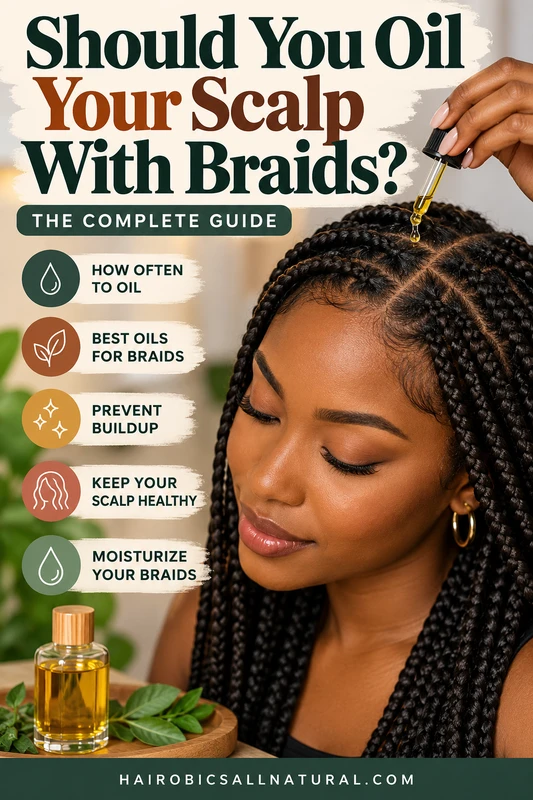
Braids are one of the most popular protective hairstyles for Black women and natural hair. Whether you wear knotless braids, box braids, cornrows, feed-in braids, stitch braids, or another braided style, braids can reduce daily manipulation and make maintaining your natural hair much easier.
But putting your hair into braids doesn't mean you can completely forget about your scalp.
One of the biggest questions people have while wearing a protective style is:
Should you oil your scalp with braids?
The short answer is yes, you can oil your scalp while wearing braids—but you don't necessarily need to oil it every day.
For many people, applying a small amount of oil once or twice a week is enough. Others may need oil a little more frequently, while people with naturally oily scalps may need very little additional oil at all.
The most important thing is understanding the difference between hydrating your hair, oiling your scalp, and keeping your scalp clean.
Oil can help lubricate a dry-feeling scalp and reduce moisture loss, but constantly pouring oil onto your scalp can lead to greasy roots, buildup, itching, and residue around your braids.
In this complete guide, we'll explain how often you should oil your scalp with braids, the best way to apply scalp oil, which oils work well with protective styles, how to prevent buildup, and how to create a simple braid-care routine that supports healthy natural hair.
Should You Oil Your Scalp When Wearing Braids?
You can oil your scalp while wearing braids if your scalp benefits from it.
Braids expose much of your scalp because your natural hair is divided into individual sections. This makes it easy to apply a small amount of oil directly where you need it.
Scalp oiling may be particularly useful when your scalp feels:
- Dry
- Tight
- Rough
- Uncomfortable
- Slightly flaky from dryness
However, oil should not become an automatic solution for every scalp problem.
An itchy scalp doesn't necessarily mean you need more oil.
Flaking doesn't necessarily mean you need more oil.
And a sore scalp definitely doesn't mean you need more oil.
Your scalp may need cleansing, your braids could be too tight, or you could be experiencing irritation from one of the products used during installation.
If your braids hurt, feel excessively tight, or are pulling around your hairline, read our guide on How to Tell if Braids Are Too Tight.
Adding oil cannot remove mechanical tension from excessively tight braids.
What Does Scalp Oil Actually Do?
There is a common misconception that putting oil on your scalp automatically moisturizes it.
Oil and water aren't the same thing.
Water provides hydration.
Oil primarily provides lubrication and can help reduce moisture loss.
Think about your natural hair the same way you think about your skin. Applying an oily product can make dry skin feel softer, but it doesn't mean your skin never needs water.
The same principle applies when you're wearing braids.
This is why a good braid routine may contain both a lightweight water-based moisturizer and a small amount of oil.
Our complete guide on How to Keep Natural Hair Moisturized in Braids explains this difference in greater detail.
How Often Should You Oil Your Scalp With Braids?
There isn't one perfect schedule for everyone.
A good starting point for many people is approximately:
1–2 times per week.
Then adjust based on how your scalp responds.
Your ideal frequency can depend on:
- Your natural scalp oil production
- Hair density
- Hair porosity
- Climate
- Exercise frequency
- How much you sweat
- How frequently you wash your braids
- Products used during installation
- Type of oil you're applying
- Whether you have an existing scalp condition
Someone with a very dry-feeling scalp may prefer oil every few days.
Someone whose scalp becomes oily quickly might use oil only occasionally.
Your scalp should help determine your schedule.
If you'd like a deeper explanation of scalp-oiling frequency, read How Often Should You Oil Your Scalp?.
Should You Oil Your Scalp Every Day With Braids?
Usually, daily scalp oiling isn't necessary.
This is especially true if you're applying generous amounts every time.
Imagine applying oil every day for four weeks without properly cleansing your scalp.
You're potentially layering oil over:
- Sweat
- Natural sebum
- Dead skin
- Braiding gel
- Edge control
- Leave-in products
- Dirt
- Environmental debris
Eventually, your scalp may become heavily coated.
That's why more product doesn't automatically equal healthier hair.
If you feel like your scalp needs oil every single day, first ask yourself whether it actually needs hydration, cleansing, or treatment for an underlying scalp issue instead.
What Happens If You Oil Your Braids Too Much?
Over-oiling is one of the easiest ways to create buildup while wearing braids.
Because protective styles are often worn for several weeks, every product you apply has the potential to accumulate.
You may begin noticing a white or gray ring around the base of your braids.
This residue can contain a combination of:
- Oil
- Gel
- Edge control
- Sweat
- Dead skin
- Lint
- Shed hair
- Other styling products
If you're already noticing residue around your roots, see our article What Is the White Buildup Around My Braids?.
Adding another layer of oil generally won't remove existing buildup.
Your scalp may need cleansing instead.
The Difference Between Oiling Your Scalp and Moisturizing Your Braids
This distinction is extremely important.
Your scalp and your natural hair aren't exactly the same thing.
Your scalp is skin.
Your hair is made of strands that extend from follicles in your scalp.
Both need care, but they don't necessarily need identical products.
Scalp oil
Scalp oil is typically applied directly between your braid parts.
It can provide lubrication and help a dry-feeling scalp feel more comfortable.
Hair moisturizer
A moisturizer is generally water-based and intended to provide hydration to the hair.
When wearing braids, a lightweight moisturizing spray is particularly convenient because it can reach your natural hair without requiring you to unravel the style.
This is where Hairobics Raaw Roots Antiseptic Moisturizer Spray can fit naturally into a braid-care routine.
Shop Hairobics Raaw Roots Moisturizer Spray
The lightweight spray format makes it easy to apply moisture to natural hair while wearing braids, locs, twists, and other protective styles.
The important idea to remember is:
Moisturize first when your hair needs hydration. Use oil strategically rather than treating oil as a replacement for moisture.
The Best Way to Oil Your Scalp With Braids
You don't need to drench your scalp.
In fact, less is often better.
Here's a simple method.
Step 1: Check Your Scalp
Before automatically reaching for oil, look at your scalp.
Ask yourself:
Does it actually feel dry?
Is there visible buildup?
Is it oily?
Is it itchy?
Does it hurt?
Are there flakes?
Are the braids pulling?
Your answer should determine what you do next.
Step 2: Apply a Small Amount
Apply several small drops along your parts rather than pouring oil across your entire head.
Focus on the areas that actually feel dry.
A precision applicator or nozzle can make this easier.
You shouldn't need so much oil that it's running down your forehead or neck.
Step 3: Massage Gently
Use the pads of your fingertips to distribute the oil.
Don't scratch your scalp with your nails.
Massage gently around your parts.
You don't need to aggressively rub the scalp to get the oil to work.
Step 4: Leave Your Braids Alone
After applying the oil, give it time to distribute.
Avoid immediately adding several more products.
Your scalp doesn't need:
Oil + grease + braid spray + serum + edge control + another oil
all at the same time.
A simpler routine often makes buildup easier to control.
What Are the Best Oils for Braids?
There are many oils used in natural-hair routines.
Different scalps respond differently, so there isn't one oil that will be perfect for everyone.
Some popular choices include:
Jojoba Oil
Jojoba is lightweight compared with many heavier oils.
It's commonly used in scalp and hair-care products and may be a good choice for someone who doesn't want their braids feeling extremely greasy.
Grapeseed Oil
Grapeseed oil is another relatively lightweight option.
It can be useful for people who find heavier oils too thick.
Sweet Almond Oil
Sweet almond oil is commonly used to add softness and lubrication to natural hair.
Avocado Oil
Avocado oil is another popular option for natural hair and protective styles.
Coconut Oil
Some people love coconut oil while others find that it leaves their hair feeling coated or stiff.
Pay attention to your own hair rather than assuming an oil will work simply because it's popular.
Jamaican Black Castor Oil
Jamaican black castor oil is considerably thicker than many lightweight oils.
A small amount may be enough.
If you're interested in comparing different options, see our guide to The Best Oils for Braids and Twists.
Should You Use Essential Oils on Braids?
Essential oils such as peppermint, rosemary, and tea tree oil are frequently included in hair-care products.
But essential oils are extremely concentrated.
They generally shouldn't be poured undiluted directly onto your scalp.
Using too much can potentially cause irritation.
If you want to incorporate essential oils into your routine, use an appropriately formulated product or properly diluted mixture.
And remember that experiencing a tingling sensation doesn't automatically mean a product is making your hair grow.
Scalp irritation isn't a sign that a product is "working."
Can Oiling Your Scalp Make Your Hair Grow Faster in Braids?
This is where expectations need to be realistic.
Your hair continues growing while it's braided.
Braids don't switch hair growth on.
And scalp oil isn't a magic growth treatment.
What braids can do is reduce manipulation.
When your hair isn't constantly being combed, brushed, styled, straightened, or manipulated, you may experience less breakage.
That can improve length retention.
In other words, your hair may appear to grow better because you're keeping more of the length you produce.
A healthy braid routine therefore focuses on more than oil.
It includes:
Clean scalp + hydrated hair + minimal tension + gentle handling + nighttime protection.
Those habits can help you protect the hair you've already grown.
Oil Cannot Fix Tight Braids
This deserves special attention.
If your braids hurt, applying scalp oil isn't the solution.
People sometimes use oil because freshly installed braids feel:
- Tight
- Sore
- Tender
- Painful
- Irritated
Oil may temporarily make the skin feel lubricated, but it doesn't eliminate the pulling force being placed on your hair follicles.
Excessive and repeated tension can contribute to traction alopecia.
Pay particular attention to your:
- Temples
- Edges
- Nape
- Hairline
If individual braids are painfully tight, have them loosened or removed.
Don't simply keep applying products while waiting for painful braids to "loosen up."
Should You Oil an Itchy Scalp With Braids?
It depends on why your scalp is itching.
Dryness can sometimes contribute to itching.
But so can:
- Sweat
- Product buildup
- Irritation
- Braiding hair
- Dandruff
- An underlying scalp condition
- Excessive tension
- Infrequent cleansing
If you've been applying oil repeatedly and your scalp keeps getting itchier, adding even more oil may not solve the problem.
Your scalp might need cleansing.
If itching becomes severe or is accompanied by sores, significant redness, swelling, pus, persistent scaling, or hair loss, consider seeing a dermatologist.
Should You Wash Your Scalp While Wearing Braids?
Yes.
Wearing braids doesn't stop your scalp from getting dirty.
Your scalp continues producing natural sebum and shedding skin cells.
You may also accumulate sweat and styling-product residue.
That's especially important if you:
- Exercise regularly
- Sweat heavily
- Wear hats frequently
- Live in a hot climate
- Apply edge control often
- Use scalp oils regularly
You don't necessarily need to wash your braids every few days, but you shouldn't avoid washing them for weeks simply because you're worried about frizz.
Our complete Braids Washing Guide explains how to cleanse your scalp without unnecessarily disturbing your hairstyle.
Should You Oil Your Scalp After Washing Braids?
You can—but only if your scalp needs it.
After washing, allow your scalp and braids to dry properly.
Then assess your hair.
If your scalp feels comfortable, you may not need to immediately apply oil.
If it feels dry, use a small amount.
One mistake is automatically applying a large quantity of oil immediately after every wash.
Start small.
You can always add more.
Removing excessive oil from braids is much more difficult.
Never Apply Heavy Oil to Damp Braids and Forget About Drying
One of the most important parts of washing braided hair is drying it thoroughly.
Long box braids and thick braids can hold a surprising amount of water.
The outside may feel dry while the interior remains damp.
After washing:
Gently squeeze out excess water.
Use a microfiber towel if available.
Separate your braids so air can circulate.
Make sure your roots dry completely.
Avoid putting soaking-wet braids into a bun.
And don't immediately coat wet braids with layers of heavy products.
For detailed instructions, read How to Dry Braids After Washing.
How to Combine Moisturizer and Oil With Braids
A simple approach is:
1. Hydrate
Apply a lightweight, water-based moisturizing spray to the areas of your braids containing your natural hair.
You don't need to soak them.
A light mist is enough.
2. Distribute
Gently squeeze or press the product into your braids.
Avoid rough rubbing.
3. Seal if needed
If your hair responds well to oil, apply a small amount afterward.
Remember that oil isn't automatically necessary every time you moisturize.
4. Protect
Allow your hair to dry and then protect your braids at night with satin or silk.
This straightforward routine can be much more effective than constantly layering products.
How Often Should You Moisturize Braids?
Moisturizing and oiling aren't necessarily performed on the same schedule.
Some people may moisturize their natural hair every few days while only oiling their scalp once or twice per week.
Your routine might look something like this:
Monday: Lightly moisturize braids.
Tuesday: No product unless needed.
Wednesday: Moisturize and apply a small amount of scalp oil if your scalp feels dry.
Thursday: No product.
Friday: Light moisture if needed.
Weekend: Check your scalp for buildup and cleanse when appropriate.
This is only an example.
Your hair may need more or less.
For more help determining your schedule, read How Often Should You Moisturize Braids?.
Signs You're Using Too Much Scalp Oil
Your hair will often tell you when you're overdoing it.
Watch for:
- Constantly greasy roots
- Oil running onto your forehead
- Sticky braid roots
- Excessive lint collection
- White buildup
- Heavy-feeling braids
- Increased scalp odor
- Hair that feels coated
- Frequent need to wash away product
If these problems develop, don't immediately switch oils.
First try using less.
You may discover that the oil itself wasn't the problem—the quantity and frequency were.
Signs Your Scalp May Benefit From Less Oil
Some people naturally produce plenty of scalp oil.
If your scalp already looks and feels oily a few days after washing, additional oil may be unnecessary.
Instead, focus on keeping your natural hair hydrated.
This is another reason to separate the idea of scalp oiling from hair moisturizing.
Your scalp could be oily while the natural hair inside your braids is still dry.
In that situation, adding more scalp oil isn't necessarily the answer.
Concentrate your moisturizing product on your natural hair.
What About Dry, Flaky Scalp?
Dryness can cause flaking, but not every flake means dry skin.
Dandruff and other scalp conditions can also produce flakes.
That's why repeatedly covering flakes with oil isn't always helpful.
If your flakes disappear after gentle cleansing and your scalp feels comfortable, product buildup may have contributed.
If you continuously experience significant flaking, redness, itching, irritation, or sores regardless of your routine, consider consulting a dermatologist.
You don't want to spend months trying different oils when the underlying issue requires a different approach.
How to Avoid Buildup When Oiling Braids
Buildup prevention is easier than trying to remove thick residue after it develops.
Follow a few simple rules.
Use small amounts.
Your scalp doesn't need to be dripping.
Don't oil automatically.
Check whether your scalp actually needs it.
Avoid mixing too many products.
One moisturizing product and one oil may be enough.
Cleanse your scalp.
Oil doesn't remove dirt.
Use edge control strategically.
Constantly layering edge control around your hairline can create significant residue.
Keep your nighttime accessories clean.
Wash your bonnet, scarf, and pillowcase regularly.
Don't keep braids installed indefinitely.
Eventually every protective style needs to come down.
Don't Forget Your Edges
Your edges deserve special attention when wearing braids.
The hair around your temples and hairline can be more vulnerable to repeated tension.
Avoid repeatedly pulling your braids into tight:
- Ponytails
- Buns
- Updos
- Half-up styles
Also avoid constantly brushing and applying edge control to your hairline.
Oiling your edges won't protect them from excessive pulling.
Reducing tension is much more important.
Can You Oil Knotless Braids?
Yes.
Knotless braids provide relatively easy access to the scalp.
Apply a small amount of oil directly between the parts when needed.
Because knotless braids begin with your natural hair, you can also lightly moisturize the root area and the portion of each braid containing your natural hair.
Avoid soaking the braid roots with heavy products.
Can You Oil Box Braids?
Yes.
Traditional box braids can be maintained similarly.
Follow the parts and place a small amount of oil directly on the scalp.
There's no need to coat the entire extension with scalp oil.
Focus on your actual hair and scalp.
Can You Oil Cornrows?
Yes.
Cornrows actually make scalp-oil application extremely easy because the parts are clearly exposed.
Apply a thin amount along the exposed scalp and massage gently.
Again, don't assume that visible scalp means you need to coat every part with oil daily.
A Simple Weekly Scalp Routine for Braids
Protective styling shouldn't require a complicated 15-product routine.
A simple routine may work better.
Throughout the week
Check your scalp.
If your natural hair feels dry, lightly mist it with a water-based moisturizer such as Hairobics Raaw Roots Moisturizer Spray.
Once or twice per week
If your scalp feels dry, apply a small amount of scalp oil.
Massage gently.
As needed
Cleanse your scalp when you notice excessive oil, sweat, odor, or product buildup.
Every night
Protect your braids with satin or silk.
Throughout the style
Monitor your hairline for excessive pulling or thinning.
That's it.
A healthy braid routine doesn't need to be complicated.
Frequently Asked Questions About Oiling Your Scalp With Braids
Should I oil my scalp before getting braids?
You don't need to heavily oil your scalp immediately before braiding.
Starting with clean, properly conditioned hair and a clean scalp is generally more important.
If your scalp feels dry, a small amount of an appropriate product may be used, but avoid covering your scalp in heavy grease immediately before installation.
How many times a week should I oil my scalp with braids?
For many people, about 1–2 times per week is a reasonable starting point.
Adjust based on how your scalp responds.
Should I oil my scalp every night with braids?
Usually not.
Daily oiling can contribute to buildup, especially if you're applying large quantities.
Does oil moisturize braids?
Not exactly.
Oil and water serve different purposes.
A water-based product provides hydration, while oil can help lubricate hair and reduce moisture loss.
Should I oil my scalp if it itches?
Only if dryness appears to be the cause.
Itching can also result from sweat, buildup, irritation, dandruff, tight braids, or another scalp issue.
Should I oil my scalp after washing my braids?
You can apply a small amount if your scalp feels dry after your braids have been properly washed and dried.
It isn't mandatory.
Can too much oil damage braids?
Excessive oil can contribute to buildup, greasy roots, odor, lint accumulation, and a coated feeling.
Moderation is important.
Does oil make braids grow your hair faster?
Braids and oils don't automatically increase your natural growth rate.
A healthy protective-style routine may help you retain more length by reducing unnecessary breakage and manipulation.
What should I put on my braids first: moisturizer or oil?
If your hair needs hydration, use a water-based moisturizer first.
A small amount of oil can then be used afterward if your hair responds well to it.
Can I oil my scalp without moisturizing my braids?
Yes, but remember that your scalp and hair have different needs.
A comfortable scalp doesn't necessarily mean the natural hair inside your braids is adequately hydrated.
The Bottom Line: Should You Oil Your Scalp With Braids?
Yes—you can oil your scalp while wearing braids, but moderation is key.
You don't need to pour oil over your scalp every day for your braids to be healthy.
For many people, applying a small amount approximately once or twice per week is a good starting point.
More importantly, listen to your scalp.
If it's comfortable, don't add products simply because your calendar says it's "oil day."
If it's dry, apply a small amount.
If it's dirty, cleanse it.
If your natural hair is dry, use a water-based moisturizer.
If your braids hurt, loosen or remove the source of tension rather than trying to cover the discomfort with oil.
And if you're experiencing persistent itching, sores, significant flaking, inflammation, or hair loss, consider speaking with a dermatologist.
Healthy protective styling is about balance.
Cleanse. Hydrate. Oil when needed. Protect at night. Minimize tension.
When you follow those basic principles, braids can remain one of the easiest and most versatile ways to protect your natural hair while maintaining a simple hair-care routine.
For additional help building your protective-style routine, explore The Best Oils for Braids and Twists and How to Keep Natural Hair Moisturized in Braids.