Braids are one of the most popular protective hairstyles for Black women. From knotless braids and box braids to cornrows, stitch braids, and feed-in styles, braiding offers versatility, convenience, and a beautiful way to manage natural hair.
However, there's an important difference between neatly installed braids and braids that are too tight.
Many women have experienced leaving a salon with a beautiful hairstyle only to discover that their scalp feels sore, their edges are pulling, or even smiling and moving their eyebrows causes discomfort.
Some people believe that tight braids are necessary for a hairstyle to last longer. Others assume that scalp pain is simply part of getting freshly braided hair.
Neither assumption is correct.
Braids should never cause significant pain, headaches, visible scalp pulling, or excessive tension around your hairline.
When braids place continuous pressure on the hair follicles, they can contribute to breakage, scalp inflammation, thinning edges, and a form of hair loss known as traction alopecia.
The good news is that recognizing the warning signs early can help you protect your natural hair before unnecessary damage occurs.
In this comprehensive guide from Hairobics All Natural, we'll explain how to recognize braids that are too tight, identify early symptoms of scalp damage, understand which hairstyles can create excessive tension, and learn how to protect your edges while enjoying beautiful braided styles.
1. What Happens When Braids Are Installed Too Tight?
When braids are installed, sections of natural hair are gathered and secured into individual plaits or cornrows.
A properly installed braid should feel secure without continuously pulling on the scalp.
However, when a stylist grips the hair too firmly, the tension can place unnecessary stress on the hair shaft and follicle.
This becomes especially concerning when extensions are added because their additional weight can increase the pulling force.
Repeated tension can eventually cause traction alopecia, a form of hair loss associated with hairstyles that continuously pull on the hair.
The American Academy of Dermatology explains that hairstyles such as cornrows, tight braids, extensions, and tightly pulled buns can contribute to this condition.
It's important to remember that protective styling should reduce unnecessary manipulation, not create additional damage.
For more information about how styling tension affects hair health, read our guide on How Tight Braids Affect Hair Growth .
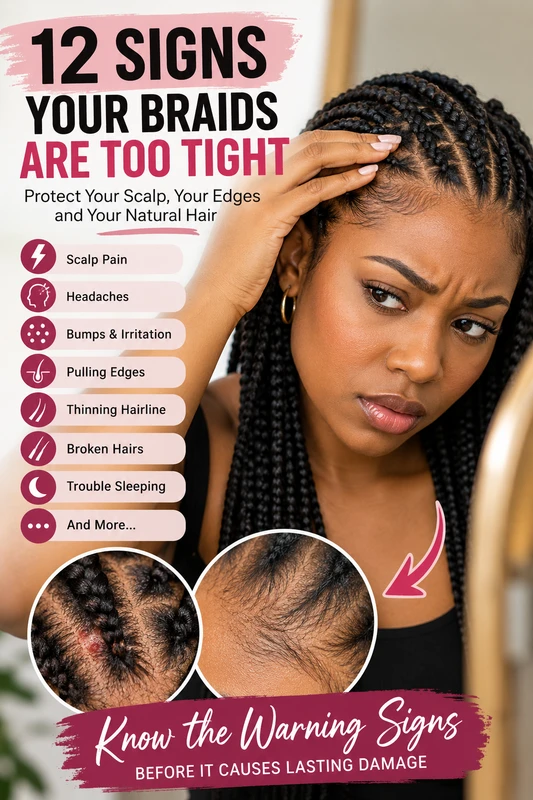
2. Twelve Warning Signs Your Braids Are Too Tight
Your scalp often provides warning signs before noticeable hair loss develops.
Recognizing these symptoms can help you decide whether your hairstyle needs immediate adjustment.
Sign 1: Your Scalp Hurts Immediately After Braiding
One of the clearest warning signs is pain immediately following installation.
Your braids may feel secure, but they should not cause significant discomfort.
Warning symptoms include:
-
Throbbing around the roots.
-
Sharp discomfort when touching individual braids.
-
Pain when moving your head.
-
Tenderness around your temples.
-
A constant pulling sensation.
Some people experience minor sensitivity from the manipulation involved in styling. However, significant pain should never be considered normal.
If your braids hurt, ask your stylist to loosen them rather than waiting several days for the discomfort to disappear.
Sign 2: You Develop a Headache After Getting Braids
Have you ever left the salon with a headache that started shortly after your braids were completed?
Excessive tension around the scalp may contribute to this discomfort.
You might notice pressure around your forehead, temples, or the back of your head.
The sensation can become particularly noticeable when your braids are pulled into a ponytail or bun.
A headache does not automatically mean your braids are responsible, but when it begins during installation and accompanies scalp pulling, excessive tension should be considered.
Remove or loosen the painful sections promptly.
Sign 3: Small Bumps Appear Around Your Hairline
Small bumps near your braid roots are another important warning sign.
These bumps may develop around the forehead, temples, nape, or individual braid sections.
They can be associated with irritation, inflamed follicles, or excessive pulling.
Some bumps may resemble tiny pimples.
Avoid squeezing, scratching, or applying irritating products to the affected areas.
If bumps appear alongside painful braids, remove the tension. Persistent bumps, pustules, spreading redness, or drainage should be evaluated by a healthcare professional.
Sign 4: Your Scalp Looks Shiny or Stretched
Examine your scalp in a mirror after your appointment.
Does the skin around your braids appear unusually stretched?
Does your hairline look as though it is being pulled backward?
Excessive tension can create a stretched appearance around the braid roots.
Your natural scalp should not look dramatically distorted simply because your hair has been braided.
Pay particular attention to the temples and front hairline.
These areas often experience considerable stress when small sections are braided tightly.
Sign 5: Your Edges Feel Like They Are Being Pulled
Your edges contain delicate strands that may be especially vulnerable to repeated styling tension.
If the braids around your forehead feel tighter than those elsewhere on your head, address the problem immediately.
Common symptoms include tenderness around the temples, discomfort when touching your baby hairs, and visible pulling at the hairline.
Continued tension can contribute to breakage and thinning.
Learn additional prevention techniques in our article, How to Protect Edges While Wearing Braids .
Sign 6: You Cannot Move Your Eyebrows Comfortably
This is a simple observation that many people overlook.
Try raising your eyebrows naturally.
If doing so causes noticeable pain around your forehead or temples, your braids may be pulling excessively on the surrounding skin.
You may also notice discomfort when smiling, laughing, or making certain facial expressions.
These symptoms suggest that the hairstyle is affecting more than the hair itself.
A properly installed style should allow normal facial movement without significant discomfort.
Sign 7: Sleeping Becomes Uncomfortable
Fresh braids can take some getting used to, particularly when extensions add length or volume.
However, you should not experience significant scalp pain simply from resting your head on a pillow.
Warning signs include difficulty finding a comfortable sleeping position, pain when turning your head, and tenderness when the braids touch your pillow.
If you find yourself avoiding certain positions because your roots hurt, consider loosening or removing the affected braids.
A satin pillowcase can reduce friction, but it cannot correct excessive tension at the roots.
Sign 8: You Notice Redness or Scalp Irritation
Redness, swelling, or tenderness around braid sections may indicate irritation.
On darker skin tones, inflammation may appear as a darker or purplish discoloration rather than bright redness.
Examine your scalp under good lighting.
Look for changes around the braid roots, temples, and nape.
If the skin appears irritated, avoid applying strong essential oils, alcohol-heavy products, or harsh scalp treatments.
Remove the source of tension first.
Sign 9: Individual Braids Feel Painful When Lifted
Gently lift one braid near its base without pulling.
Does the movement create sharp discomfort?
If individual braids feel painful when repositioned, they may have been secured too tightly.
You should be able to move your braids naturally without significant pain.
This is especially important with long box braids, knotless braids, and other extension styles.
Heavy extensions can create additional stress even when the initial installation feels comfortable.
Sign 10: Your Hairline Starts Looking Thinner
Visible thinning around the edges is a more concerning symptom.
You might notice that your temples look less full, individual hairs are breaking near the forehead, or small gaps are appearing around your hairline.
These changes should not be ignored.
Repeated pulling can damage hair follicles and eventually contribute to traction alopecia.
Early intervention is important because advanced traction alopecia can result in permanent hair loss.
Sign 11: You See Broken Hairs Around the Roots
Short, uneven hairs around the braid base can indicate breakage.
Although some shorter hairs are normal, a sudden increase in broken strands after tight styling deserves attention.
Look for hair snapping near the hairline, broken strands around individual braid sections, and noticeable thinning after removing extensions.
If your hair repeatedly breaks after braided styles, consider changing your installation method and allowing your hair to recover between appointments.
Sign 12: You Feel Burning or Persistent Scalp Tenderness
A burning sensation should never be dismissed as a normal part of braiding.
It may indicate significant irritation, excessive pulling, or a reaction to something used during installation.
If your scalp feels hot, burns, or becomes increasingly tender, remove the tension promptly.
Seek medical attention for severe pain, blistering, drainage, or symptoms that continue after removing the hairstyle.
3. How Tight Is Too Tight for Braids?
A common question is whether braids are supposed to feel slightly tight when first installed.
The answer depends on what you mean by tight.
There is a difference between a hairstyle feeling secure and experiencing painful pulling.
A secure braid stays in place without placing excessive strain on your scalp.
An overly tight braid creates discomfort because the hair is being pulled too firmly.
Use this comparison to evaluate your hairstyle.
|
Normal braid installation |
Warning signs |
|---|---|
|
Braids feel secure |
Roots feel painfully tight |
|
Normal facial movement |
Pain when raising eyebrows |
|
Scalp looks comfortable |
Skin appears stretched |
|
No significant headache |
Headache after installation |
|
Braids move comfortably |
Pain when repositioning braids |
|
Hairline maintains its appearance |
Edges appear pulled backward |
|
Comfortable sleep |
Pain when resting on a pillow |
Important: You do not need to wait 24–48 hours to determine whether painful braids are too tight.
If the installation causes significant pain, have the tension corrected immediately.
4. Can Tight Braids Cause Permanent Hair Loss?
Yes. Repeatedly wearing hairstyles that pull on the hair can contribute to permanent hair loss.
The condition is called traction alopecia.
It develops when repeated or prolonged tension damages hair follicles.
In its earlier stages, removing the source of tension may allow hair to recover.
However, continued pulling can eventually produce scarring that prevents affected follicles from growing new hair.
The American Academy of Dermatology recommends seeking professional evaluation when symptoms first become noticeable rather than waiting for significant thinning.
Early signs of traction alopecia
Watch for tenderness, broken hairs, thinning around the temples, and changes in your hairline.
Some people also develop small bumps or irritation around affected follicles.
Advanced signs of traction alopecia
More advanced cases may involve noticeable bald patches, a receding hairline, or smooth areas where hair no longer grows.
Hair loss does not always have a single cause, so a dermatologist should evaluate persistent thinning rather than assuming braids are solely responsible.
For additional information, read our article about Edge Damage From Protective Styles .
5. What Should You Do Immediately If Your Braids Are Too Tight?
If you realize your braids are too tight, acting promptly can help prevent additional stress.
Step 1: Identify the painful areas
Determine whether the discomfort is concentrated around your edges, temples, crown, or nape.
Sometimes only a few braids are responsible.
Other times, the entire hairstyle may have been installed with excessive tension.
Step 2: Ask your stylist to loosen the braids
If you are still at the salon, explain exactly where you feel discomfort.
Ask your stylist to redo the painful sections with less tension.
You should not feel pressured to accept a hairstyle that causes pain simply because it looks neat.
Step 3: Remove painful braids if necessary
If loosening individual sections does not resolve the discomfort, consider removing the affected braids.
If the entire style is painfully tight, taking it down may be the safest option.
Use patience when removing extensions to avoid additional pulling and breakage.
Step 4: Avoid tight ponytails and buns
Do not pull already-tight braids into another restrictive hairstyle.
High ponytails, tight buns, and tightly secured updos can increase tension around your hairline.
Allow your hair to hang naturally while assessing the discomfort.
Step 5: Give your scalp time to recover
Once the tension has been removed, avoid immediately reinstalling another tight protective style.
Choose gentle, low-manipulation hairstyles.
If pain, bumps, or thinning persist, schedule an appointment with a dermatologist.
Do not rely on oils, hot water, painkillers, or scalp sprays to make an excessively tight hairstyle tolerable.
These approaches do not remove the underlying pulling force.
6. How to Keep Your Braids Moisturized Without Damaging Your Scalp
Once your braids have been properly installed and are comfortable, maintaining moisture is an important part of your protective styling routine.
Braided hair can still experience dryness, brittleness, tangling, and breakage.
Keeping your natural hair moisturized helps maintain softness and manageability while your hairstyle is installed.
However, remember that moisturizing products cannot repair damage caused by excessive pulling or loosen painfully tight braids.
Recommended Product: Hairobics Raaw Roots Moisturizer Spray

Raaw Roots Locs & Braids Moisturizer Spray
Designed for braids, locs, twists, and natural hair, this moisturizing spray contains botanical ingredients and conditioning oils to help maintain soft, manageable hair.
The formula includes apricot kernel oil, jojoba oil, castor oil, vegetable glycerin, and other conditioning ingredients.
To incorporate it into your braid maintenance routine, lightly mist your braids and hair as needed, avoid oversaturating the roots, and allow your hair to dry thoroughly before covering it.
Do not massage irritated follicles aggressively or apply products to broken skin.
For additional moisturizing tips, explore our article on How to Keep Your Scalp Healthy Under Braids .
7. Are Knotless Braids Less Likely to Cause Tension?
Knotless braids have become increasingly popular among women who prefer a natural-looking protective hairstyle.
Unlike traditional box braids, which commonly begin with an extension knot at the root, knotless braids gradually incorporate extension hair into the natural braid.
This installation technique can reduce the bulk concentrated at the roots.
However, knotless braids are not automatically tension-free.
They can still damage your edges when installed too tightly, made excessively heavy, or repeatedly pulled into restrictive hairstyles.
When choosing knotless braids, consider medium-sized sections, lightweight extensions, shorter lengths, and gentle installation around your hairline.
Your natural hair density should also influence the size and weight of the extensions.
Someone with fine or low-density hair may need a different installation approach than someone with very thick natural hair.
8. How to Prevent Tight Braids Before Your Next Appointment
Preventing excessive tension starts before you sit in the braiding chair.
Taking time to prepare your natural hair and communicate your preferences can make a significant difference.
Prepare your hair properly
Start with clean, conditioned, and thoroughly detangled hair.
Avoid arriving with severely tangled strands because excessive pulling during detangling and installation can increase breakage.
If your scalp is already irritated, postpone your appointment until the underlying issue has been addressed.
Read our How to Prep Hair for Braids guide for additional preparation techniques.
Tell your braider that you prefer low tension
Communicate your expectations before installation begins.
Explain that protecting your hairline is important and that you do not want your edges pulled tightly.
If you have previously experienced traction-related thinning, mention this before the stylist begins.
Choose extension weight carefully
Extremely long or heavy extensions can increase stress on individual hair sections.
Choose a length and weight that your natural hair can comfortably support.
Avoid braiding fragile baby hairs
Not every strand around your forehead needs to be incorporated into a braid.
Allowing delicate edge hairs to remain outside the hairstyle can help minimize unnecessary pulling.
Check the first few braids
Before your stylist completes the entire hairstyle, assess how the initial braids feel.
Ask for adjustments immediately if you experience discomfort.
Correcting tension during installation is much easier than removing a completed hairstyle.
9. How Long Should You Keep Braids In?
Even properly installed braids should not remain in your hair indefinitely.
Keeping extensions installed for excessive periods can contribute to tangling, buildup, and difficulty removing shed hair.
The American Academy of Dermatology recommends wearing braids for no longer than approximately six to eight weeks as part of its traction-alopecia prevention guidance.
Your individual removal schedule may need to be shorter depending on your hair condition, scalp sensitivity, and installation method.
If you experience significant pain, thinning, or irritation, do not wait until your planned removal date.
For a more detailed explanation, explore our Complete Guide to Braids for Natural Hair .
10. Frequently Asked Questions About Tight Braids
Are braids supposed to hurt the first day?
No. Significant pain is not a normal requirement for a successful braid installation. Braids may feel unfamiliar or secure, but they should not create persistent discomfort, headaches, or painful pulling.
Can tight braids cause bald spots?
Yes. Repeated tension can contribute to traction alopecia, which may cause thinning or bald patches. Early intervention is important because prolonged follicle damage can become permanent.
Should I take my braids out if I see bumps?
If bumps appear around painful braid roots, remove the tension promptly. Persistent or worsening bumps should be evaluated by a healthcare professional, particularly if they contain pus or are accompanied by swelling.
Can I loosen tight braids with hot water?
Hot water is not a reliable or safe way to correct excessive tension at the roots. It can also burn your scalp. Painful braids should be physically loosened or removed.
Can tight knotless braids damage edges?
Yes. Although knotless braids can distribute extension hair differently from traditional box braids, excessive gripping and heavy extensions can still damage fragile hairline strands.
Will my edges grow back after tight braids?
Regrowth depends on the extent of follicle damage. Hair may recover when tension is removed early, but advanced traction alopecia can cause permanent hair loss. A dermatologist can assess the affected area and discuss treatment options.
How do I know whether my braider is pulling too tightly?
Pay attention to pain during installation, stretched scalp skin, excessive pulling around your temples, and discomfort when moving individual braids. Speak up immediately rather than waiting until the appointment is finished.
Can moisturizing spray prevent traction alopecia?
No. Moisturizing products can help maintain hair softness and manageability, but they cannot eliminate mechanical tension or prevent traction alopecia when hairstyles repeatedly pull on the follicles.
Final Thoughts: Healthy Braids Should Never Require Pain
Braids are a beautiful and versatile way to protect natural hair, but their benefits depend heavily on proper installation and maintenance.
Recognizing the early warning signs of excessive tension can help you protect your scalp, preserve your edges, and reduce the risk of unnecessary hair damage.
If your braids cause significant pain, headaches, visible pulling, bumps, or thinning, address the problem immediately.
Choose a stylist who prioritizes your natural hair health, avoid excessively heavy extensions, and give your scalp adequate recovery time between hairstyles.
Once your braids are comfortably installed, maintain a consistent cleansing and moisturizing routine.
At Hairobics All Natural, we believe beautiful protective styles should complement healthy natural hair—not compromise it.
Remember: A hairstyle is only protective when it protects the hair underneath.