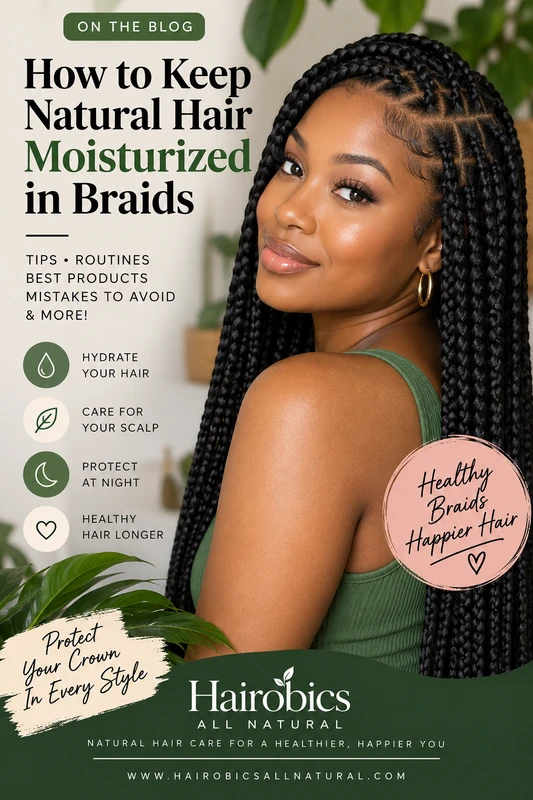
Braids are one of the most popular protective styles for natural hair. They can reduce daily manipulation, make your morning routine easier, protect your ends, and give you a break from constant styling. But wearing braids does not automatically mean your natural hair is protected from dryness.
In fact, keeping natural hair moisturized in braids is one of the most important parts of maintaining healthy hair while wearing a protective style.
Your natural hair is still underneath the braids. It can become dry, brittle, tangled, and prone to breakage if it goes weeks without adequate moisture. Your scalp may also become dry, flaky, or uncomfortable when it isn't properly cared for.
The good news is that maintaining moisture doesn't have to be complicated.
With the right moisturizing routine, lightweight products, scalp care, and nighttime protection, you can keep your natural hair soft and hydrated throughout the life of your braided hairstyle.
In this guide, we'll explain how to keep natural hair moisturized in braids, how often you should moisturize, which products work best, common mistakes to avoid, and how to protect your hair so it remains healthy when your braids finally come down.
Why Natural Hair Gets Dry in Braids
Braids reduce manipulation, but they don't eliminate your hair's need for moisture.
Natural hair can already be prone to dryness because the curls, coils, and bends along the hair strand can make it more difficult for natural scalp oils to travel from the roots to the ends.
When your hair is braided, additional factors can contribute to dryness.
These include:
- Going too long without adding moisture
- Using heavy products that coat the hair
- Not cleansing the scalp
- Sleeping without protecting your braids
- Exposure to dry air
- Excessive heat
- Swimming
- Product buildup
- Keeping braids installed too long
- Using drying styling products
- Focusing on the scalp while ignoring the hair underneath
The purpose of a protective style is to help protect your natural hair. If the hair becomes extremely dry underneath the style, however, you may experience unnecessary breakage during takedown.
That is why moisture maintenance should begin almost immediately after your braids are installed.
How to Keep Natural Hair Moisturized in Braids
The key to keeping braided natural hair moisturized is creating a simple routine you can repeat throughout the life of the hairstyle.
You generally don't need a dozen different products.
Instead, concentrate on four things:
- Adding moisture to the hair
- Helping the hair retain that moisture
- Keeping the scalp comfortable and clean
- Protecting the hair at night
Let's examine each one.
1. Start With Moisturized Hair Before Getting Braids
Healthy braid maintenance actually begins before the first braid is installed.
Avoid putting extremely dry hair directly into a long-term protective style.
Before your appointment, your natural hair should ideally be:
- Properly cleansed
- Conditioned
- Detangled
- Hydrated
- Gently stretched if necessary
A deep-conditioning treatment before installing braids can also be useful, especially if your hair tends to become dry quickly.
The objective isn't to coat your hair in enormous amounts of oil or butter.
You simply want your strands to begin the hairstyle in good condition.
If your hair is already extremely dry when it goes into braids, maintaining moisture may become much more difficult.
2. Use a Water-Based Moisturizing Spray
One of the easiest ways to moisturize natural hair while it is braided is with a lightweight moisturizing spray.
This is particularly convenient because sprays can reach areas of your natural hair without requiring you to take down the hairstyle.
Look for products that provide hydration without leaving excessive residue.
Apply the spray along the length of your braids, concentrating especially on the portions where your natural hair is located.
You don't need to completely soak your braids.
A light mist is usually sufficient.
Gently squeeze or press the moisture into the braids afterward.
This can help distribute the product to the natural hair inside.
Water Is Important for Hydration
Many people automatically reach for oil whenever their natural hair feels dry.
However, oil and water perform different functions.
Water provides hydration.
Oil can help reduce moisture loss and provide lubrication, but simply covering extremely dry hair with oil does not necessarily solve the underlying lack of hydration.
That is why a water-based moisturizing product can be particularly helpful when wearing braids.
3. Pay Attention to Your Ends
Your ends are the oldest part of your hair.
They are also one of the areas most vulnerable to breakage.
Depending on the length of your natural hair, your ends may extend fairly far down your braids.
When moisturizing your protective style, don't automatically stop at the roots.
Apply your moisturizing product along the portion of each braid containing your natural hair.
This helps ensure that your ends receive attention too.
Healthy length retention isn't only about encouraging growth at the scalp.
You also need to keep the hair you've already grown.
Protecting your ends from excessive dryness and breakage is an important part of that process.
4. Use Oil Strategically
After adding moisture, some people like to use a small amount of oil.
The key word is small.
You don't need to saturate your braids in oil every day.
Excessive oil can attract dirt and contribute to buildup.
Instead, use a lightweight amount where needed.
Popular oils used in natural hair routines include:
- Jojoba oil
- Grapeseed oil
- Avocado oil
- Coconut oil
- Olive oil
- Sweet almond oil
- Castor oil
Different hair types respond differently to oils, so there is no universal "best" oil for everyone.
If your hair becomes greasy or heavily coated after using an oil, reduce the amount or frequency.
How Often Should You Moisturize Braids?
There is no perfect schedule that works for every person.
For many people, moisturizing braids approximately two to three times per week is a reasonable starting point.
However, your ideal frequency depends on factors such as:
- Hair porosity
- Hair density
- Climate
- Product choice
- How quickly your hair dries
- How often you wash your braids
- Exercise frequency
- Whether you swim
- How long you've had your braids installed
Instead of moisturizing solely according to a calendar, learn to recognize how your hair feels.
If your natural hair feels dry before your scheduled moisturizing day, you may need moisture sooner.
If your hair still feels soft and moisturized, you may not need another heavy application.
Signs Your Braids May Need Moisture
Look for:
- Dry-feeling hair
- Roughness
- Increased frizz
- Brittle strands
- Dry ends
- A tight or uncomfortable scalp
- Hair that feels unusually stiff
You want to address dryness before your hair becomes severely dehydrated.
Don't Forget Your Scalp
Keeping your hair moisturized and maintaining your scalp are related, but they aren't exactly the same thing.
Your scalp is skin.
It produces natural oils and needs regular cleansing.
A common mistake with braids is applying layer after layer of oils, creams, and grease to the scalp without removing previous buildup.
This can leave the scalp coated rather than properly cared for.
Instead, aim for balance.
Keep your scalp clean and avoid applying more product than you actually need.
Should You Oil Your Scalp With Braids?
You can oil your scalp while wearing braids if your scalp responds well to oil, but you don't necessarily need to do it every day.
Use a small amount.
Apply it directly to your scalp rather than pouring large amounts over your entire hairstyle.
Then gently massage it into the scalp with your fingertips.
Avoid aggressive scratching with your nails.
A gentle scalp massage can also be a relaxing part of your protective-style routine.
If your scalp becomes increasingly itchy, flaky, irritated, painful, or develops sores, don't assume that adding more oil will solve the problem. Persistent scalp problems may need to be evaluated by a dermatologist or another qualified healthcare professional.
Should You Wash Your Hair While Wearing Braids?
Yes, braids can be washed.
Many people avoid washing protective styles because they're worried about frizz.
Some frizz is normal.
Hair and scalp health should generally take priority over keeping every braid perfectly smooth.
Over time, your scalp accumulates:
- Sweat
- Sebum
- Dead skin
- Dust
- Styling-product residue
This can be particularly noticeable if you exercise frequently.
How often you cleanse depends on your scalp, lifestyle, and hairstyle.
Some people may cleanse every one to two weeks, while others may need a different schedule.
How to Wash Braids Without Creating Excessive Frizz
You don't need to aggressively scrub your braids.
Focus primarily on your scalp.
Step 1: Dilute Shampoo if Necessary
A diluted shampoo mixture can sometimes make it easier to distribute cleanser between braided sections.
Apply it directly to your scalp.
Step 2: Massage Gently
Use the pads of your fingertips.
Don't aggressively scratch the scalp with your nails.
Step 3: Rinse Thoroughly
Product left behind can contribute to buildup and irritation.
Allow water to flow through your scalp and braids until the cleanser has been removed.
Step 4: Dry Your Braids Completely
This step is extremely important.
Braids can hold a surprising amount of water.
Avoid repeatedly going to sleep with soaking-wet braids.
Give the style adequate time to dry.
Moisturize After Washing Your Braids
Cleansing can remove dirt and buildup, but your hair may need moisture afterward.
Once excess water has been removed and your braids have begun drying, apply a lightweight leave-in or moisturizing spray to the sections containing your natural hair.
You can then use a small amount of oil if that works well for your hair.
This gives you a simple cycle:
Cleanse → Hydrate → Protect → Repeat as needed.
Avoid Heavy Product Buildup
More product doesn't automatically equal more moisture.
This is one of the biggest mistakes people make with protective styles.
You may start with a moisturizing spray.
Then add leave-in conditioner.
Then oil.
Then grease.
Then edge control.
Then braid spray.
Then more oil.
Eventually, your hair and scalp may be covered in layers of residue.
That buildup can make it difficult to determine whether your hair actually needs moisture.
Keep your routine simple.
Your hair should feel moisturized—not sticky, greasy, waxy, or coated.
Best Types of Products for Moisturizing Braids
A braid-moisturizing routine can be surprisingly simple.
Consider products from these basic categories.
Water-Based Moisturizer
A lightweight spray makes it easier to distribute moisture throughout the style.
Lightweight Leave-In Conditioner
If your hair needs additional softness, a lightweight leave-in can help.
Avoid applying huge quantities because it may become difficult to remove from inside the braids.
Hair or Scalp Oil
A small amount can be incorporated as needed.
Scalp Care Product
Choose products appropriate for your scalp and avoid excessive layering.
You don't necessarily need all four every time you moisturize.
How to Moisturize Box Braids
Box braids provide relatively easy access to your scalp because the hair is divided into individual sections.
To moisturize box braids:
- Separate the braids into several large sections.
- Lightly mist the length containing your natural hair.
- Gently squeeze the braids to distribute the moisturizer.
- Apply a small amount of oil if desired.
- Allow the hair to dry before covering it for the night.
Pay special attention to your edges.
Avoid pulling or constantly manipulating the braids around your hairline.
How to Moisturize Knotless Braids
Knotless braids can be maintained with a similar routine.
Because the braid begins with your natural hair rather than a traditional knot, you have good access to the root area.
Use a lightweight moisturizer along the natural-hair portion of the braid and avoid repeatedly loading the roots with heavy creams.
If you notice significant product buildup around the base of your braids, reduce the amount of product you're using.
How to Keep Your Scalp Moisturized Without Making Braids Greasy
If your braids constantly look oily, you may simply be using too much product.
Try reducing the quantity before abandoning your entire routine.
For scalp oil:
- Apply a few drops directly where needed.
- Massage gently.
- Don't coat every inch of the scalp unless necessary.
- Avoid applying multiple oils at the same time.
- Give the product time to absorb.
Your scalp shouldn't have to look shiny to be healthy.
Protect Your Braids at Night
Nighttime protection is one of the easiest ways to support moisture retention.
Cotton bedding can create friction against your hairstyle and absorb some moisture from the hair.
Consider using:
- A satin bonnet
- A satin scarf
- A satin pillowcase
For long braids, loosely gather them before covering your hair.
Avoid tying your hair so tightly that you're placing unnecessary tension on your scalp or edges.
Nighttime protection also helps reduce frizz, which can extend the neat appearance of your hairstyle.
Use a Satin Pillowcase as Backup Protection
If your bonnet tends to disappear halfway through the night, a satin pillowcase provides another layer of protection.
This can be particularly helpful for people who move around a lot while sleeping.
A bonnet plus satin pillowcase can reduce friction even if your head covering comes off overnight.
Protect Braids While Exercising
Sweat isn't necessarily bad for your hair, but frequent workouts can change your braid-maintenance routine.
If you exercise several times per week, your scalp may need more frequent cleansing.
After your workout:
- Allow your scalp to breathe.
- Avoid immediately covering soaking-wet or sweaty braids.
- Dry the roots thoroughly.
- Cleanse when necessary.
- Moisturize after cleansing.
Don't continuously add oil on top of sweat and product buildup.
Keep Braids Moisturized During Hot Weather
Summer heat can create additional challenges.
Sun exposure, swimming, frequent sweating, and air conditioning can all affect how your hair feels.
During warm weather:
- Check your hair's moisture level more frequently.
- Cleanse after excessive sweating when necessary.
- Protect your hair when swimming.
- Don't leave wet braids bundled up for extended periods.
- Continue nighttime protection.
Keeping Braids Moisturized in Winter
Cold outdoor air combined with dry indoor heating can leave natural hair feeling especially dry.
You may find that your hair needs moisturizing more frequently in winter than in humid weather.
Monitor your hair rather than following exactly the same routine throughout the year.
If your hair starts feeling rough sooner, adjust your schedule.
How Hair Porosity Affects Moisture in Braids
Porosity describes how your hair absorbs and retains moisture.
Understanding your hair's tendencies can help you customize your braid routine.
Low-Porosity Hair
Low-porosity hair may be prone to product sitting on the surface.
Heavy creams and oils can quickly create buildup.
Lightweight, water-based products may work better.
Use small amounts and evaluate the results before applying additional layers.
High-Porosity Hair
High-porosity hair tends to absorb moisture easily but may lose it relatively quickly.
You may find yourself moisturizing more frequently.
A leave-in followed by a small amount of oil or another suitable sealing product may help your hair retain softness longer.
Medium-Porosity Hair
Medium-porosity hair often falls somewhere between these two.
A straightforward moisturizing routine a few times per week may be enough.
Porosity is only one factor, however. Your individual hair response matters more than following rigid rules.
Don't Confuse Oil With Moisture
This point is worth repeating.
If your braids feel dry and you continuously add oil, you may eventually end up with oily braids surrounding dry natural hair.
Instead, think:
Hydration first. Oil second, if needed.
A water-based moisturizer provides hydration.
Oil can help with lubrication and reducing moisture loss.
Understanding this difference can completely change your protective-style routine.
Avoid Over-Moisturizing Your Braids
Dryness is a common concern, but more moisture isn't always better.
Constantly soaking your braids several times per day can create other problems.
Your hair shouldn't remain wet all the time.
Instead, moisturize according to how your hair feels and allow your braids to dry thoroughly.
The goal is balanced hydration.
Protect Your Edges While Wearing Braids
Moisture isn't the only factor that determines whether your hair remains healthy in braids.
Tension matters too.
Even perfectly moisturized hair can experience damage if the hairstyle is pulling excessively on your roots.
Pay particular attention to your:
- Hairline
- Temples
- Nape
- Fine hairs around your ears
Avoid repeatedly pulling your braids into extremely tight ponytails or buns.
If your braids feel painfully tight immediately after installation, speak up.
A protective hairstyle shouldn't require sacrificing your edges.
Don't Keep Braids Installed Too Long
It can be tempting to keep braids installed as long as possible.
After all, installation can take hours and may be expensive.
However, protective styles aren't intended to remain indefinitely.
As your natural hair grows, shed hairs accumulate inside the braid.
Product buildup also increases.
Eventually, detangling can become more difficult.
Many people wear braided protective styles for roughly four to eight weeks, depending on the style, their hair, scalp condition, and maintenance routine.
Your hair may need to come down sooner if you experience:
- Significant matting
- Severe buildup
- Persistent scalp irritation
- Excessive frizz
- Loosening braids
- Excessive tension
- Tangling at the roots
- An unpleasant odor that persists after cleansing
Don't keep an unhealthy protective style simply because you planned to wear it for a certain number of weeks.
What Happens If You Don't Moisturize Hair in Braids?
You might not notice the consequences immediately.
The braids can still look perfectly fine on the outside.
The problem often becomes apparent during takedown.
Extremely dry natural hair may be more prone to:
- Breakage
- Snapping
- Roughness
- Tangling
- Difficult detangling
- Split ends
This is one reason people sometimes believe that braids "broke their hair off."
In reality, several factors may have contributed, including excessive tension, dryness, poor maintenance, rough takedown, or keeping the style installed too long.
How to Take Down Braids Without Excessive Breakage
Your moisture routine shouldn't stop on takedown day.
In fact, takedown is one of the most important stages of protective styling.
Don't rush.
Carefully unravel each braid.
Once a braid is removed, gently separate and detangle that section.
Remember that it's normal to see shed hair.
Humans naturally shed hairs every day. When your hair is braided, many of those shed strands remain trapped inside the hairstyle instead of falling away.
After several weeks, the accumulated shedding can look like a large amount of hair.
That doesn't automatically mean you're experiencing abnormal hair loss.
Detangle Before Shampooing
After removing your braids, resist the temptation to immediately jump into the shower with severely tangled hair.
Remove major tangles and accumulated shed hairs first.
Work in sections.
Use your fingers or an appropriate detangling tool and enough slip to minimize unnecessary pulling.
Start at the ends and gradually work upward.
Once your hair has been adequately detangled, you can proceed with cleansing.
Deep Condition After Removing Braids
After several weeks in a protective style, your hair may benefit from a conditioning session.
Apply conditioner according to the product instructions.
Focus on softness, manageability, and detangling.
This is also a good opportunity to examine your hair.
Check for:
- Split ends
- Excessive dryness
- Unusual breakage
- Thinning areas
- Scalp irritation
If necessary, trim damaged ends before installing another long-term style.
Give Your Hair a Break Between Braided Styles
Some people remove one set of braids and immediately install another.
Although this may be convenient, your hair and scalp can benefit from a break—especially if the previous hairstyle caused significant tension.
During the break, focus on:
- Cleansing
- Conditioning
- Moisturizing
- Gentle detangling
- Low-tension hairstyles
- Scalp care
If your hairline appears stressed or thin, consider waiting before installing another tight protective style.
A Simple Weekly Moisturizing Routine for Braids
You don't need an elaborate 15-step schedule.
Here is an example.
Monday
Lightly mist your natural hair inside the braids with a water-based moisturizer.
Apply a small amount of oil if needed.
Wednesday
Check your hair and scalp.
If your hair feels dry, moisturize again.
If it still feels soft, wait.
Friday
Lightly moisturize your braids again.
Massage your scalp gently if desired.
Weekend
Evaluate your scalp.
If you have significant sweat or buildup, cleanse your scalp and braids.
Follow with your moisturizing routine.
Every Night
Cover your braids with satin or sleep on a satin pillowcase.
This schedule is only a starting point.
Adjust it according to your hair.
Common Mistakes When Moisturizing Braids
Avoiding a few mistakes can make your routine much more effective.
Mistake #1: Using Only Oil
Oil doesn't replace water-based hydration.
Mistake #2: Applying Too Much Product
Heavy buildup can make your hair and scalp difficult to cleanse.
Mistake #3: Ignoring the Length of Your Hair
Don't moisturize only your roots.
Your ends need attention too.
Mistake #4: Never Washing Your Scalp
Protective styles still require scalp hygiene.
Mistake #5: Going to Bed With Soaking-Wet Braids
Allow your hair to dry thoroughly.
Mistake #6: Ignoring Scalp Irritation
Persistent itching, pain, sores, or inflammation shouldn't simply be covered with more product.
Mistake #7: Wearing Braids Too Long
There comes a point when the protective style needs to be removed.
Mistake #8: Sleeping Without Protection
Nightly friction can increase frizz and contribute to dryness.
Mistake #9: Pulling Braids Into Tight Hairstyles
Constant tension can stress your hairline.
Mistake #10: Waiting Until Your Hair Is Extremely Dry
Consistent maintenance is easier than trying to restore severely dry hair at the end of the hairstyle.
Frequently Asked Questions About Keeping Braids Moisturized
How often should I moisturize my natural hair in braids?
For many people, two to three times per week is a useful starting point. Adjust the frequency according to your hair's porosity, climate, lifestyle, and how quickly your hair feels dry.
Can I spray my braids with water every day?
A light mist may be appropriate for some hair types, but you don't need to soak your braids every day. Too much water can keep the hairstyle damp for extended periods. Pay attention to how your hair responds.
Should I oil my braids every day?
Usually, daily oiling isn't necessary. Excessive oil can create buildup. Apply a small amount when your hair or scalp actually needs it.
What should I put on braids to keep them moisturized?
A lightweight water-based moisturizing spray or leave-in is a good starting point. You can follow with a small amount of oil if your hair benefits from it.
How do you moisturize natural hair underneath box braids?
Mist the sections containing your natural hair with a lightweight moisturizer and gently squeeze the braid so the product reaches the hair inside. Pay attention to your ends as well as your roots.
Can braids help natural hair grow?
Your hair continues its normal growth process while braided. Braids may help with length retention because they reduce daily manipulation and can protect the ends. However, braids themselves don't automatically make hair grow faster.
Why is my hair still dry after applying oil?
Your hair may need hydration rather than additional oil. Try using a water-based moisturizer first and then a small amount of oil if necessary.
Should I moisturize my scalp or my braids?
They have different needs. Maintain a clean, comfortable scalp while also moisturizing the natural hair contained inside your braids.
Can I use leave-in conditioner on box braids?
Yes. A lightweight leave-in can be useful, but avoid applying excessive amounts that leave residue inside the braids.
How do I know if my braids are too dry?
Dryness may show up as rough-feeling natural hair, brittle ends, stiffness, excessive frizz, or hair that feels noticeably less soft than usual.
Building a Healthy Protective-Style Routine
Braids work best when they're treated as part of your hair-care routine—not as a replacement for one.
Installing braids and forgetting about your hair for eight weeks isn't the ideal approach.
Instead, use your protective style as an opportunity to simplify your routine.
You can spend less time styling while still maintaining:
Moisture + scalp hygiene + nighttime protection + low manipulation.
That combination can help you get much more out of your braided hairstyle.
The Goal Is Length Retention
Many people wear protective styles because they're trying to grow longer natural hair.
Remember that hair growth and length retention aren't exactly the same thing.
Your scalp produces new hair growth.
But whether you see significant increases in length depends partly on how much of that hair you retain.
If your ends constantly break at approximately the same rate that your hair grows, it may seem as though your hair isn't growing.
That's why protecting your existing strands matters.
Braids can reduce daily manipulation and protect your ends, but they work best when the hair underneath remains moisturized and the style isn't creating excessive tension.
Final Thoughts: How to Keep Natural Hair Moisturized in Braids
Learning how to keep natural hair moisturized in braids doesn't require an enormous product collection or complicated daily routine.
Consistency is more important.
Start your protective style with clean, conditioned, moisturized hair. Use a lightweight water-based moisturizer throughout the life of your braids, concentrating on the portions containing your natural hair. Use oils sparingly when they benefit your hair, maintain a clean scalp, protect your hairstyle at night, and avoid excessive tension.
Most importantly, pay attention to your hair.
Your natural hair will tell you when your routine needs adjusting.
If your hair becomes dry after two days, you may need more frequent hydration. If your braids constantly feel greasy and coated, you may be using too much product. If your scalp is covered in buildup, it may be time for cleansing rather than another layer of oil.
A good braid routine should leave your natural hair in good condition when the protective style comes down.
When you consistently moisturize your braids, protect your ends, maintain your scalp, and handle your hair gently, protective styling can become a valuable part of your natural hair length-retention routine.
Keep Your Braided Hair Hydrated With Hairobics All Natural
Maintaining moisture doesn't have to mean using a complicated lineup of products.
Hairobics All Natural offers hair and scalp products that can easily fit into a protective-style routine for natural hair, braids, and locs.
A lightweight moisturizing spray can be especially convenient for braided styles because it allows you to reach your natural hair without taking down your braids.
Whether you're wearing box braids, knotless braids, feed-in braids, or another protective style, the goal remains the same: keep your natural hair moisturized, protect your scalp, minimize unnecessary tension, and retain the healthy hair you grow.
Explore natural hair and scalp care from Hairobics All Natural at www.hairobicsallnatural.com.