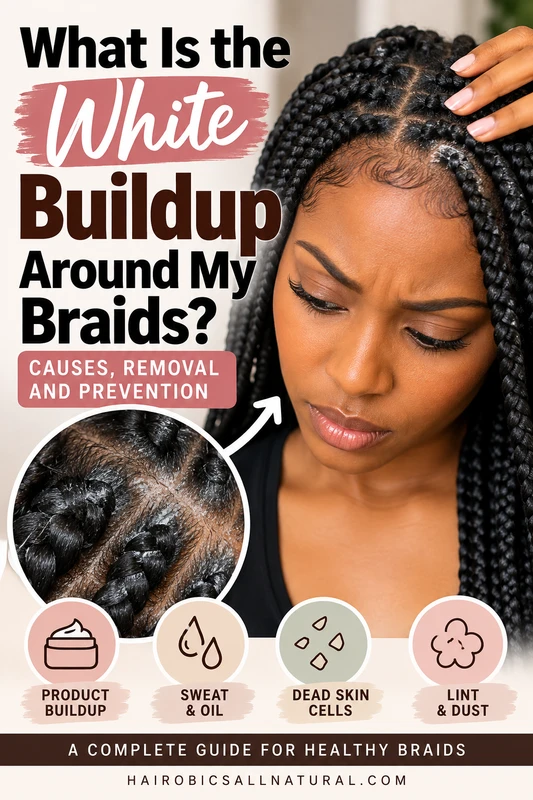
You just got your braids done a few weeks ago. They still look good, your parts are visible, and the style has plenty of life left. Then you look closely at your roots and notice something frustrating: white or gray buildup around the base of your braids.
Sometimes it looks flaky. Sometimes it forms a small ring around each braid. In other cases, it feels sticky, waxy, crusty, or almost like lint has become glued to your hair.
So, what is the white buildup around your braids?
In many cases, the white residue is a combination of styling-product residue, natural scalp oil, sweat, dead skin cells, lint, and shed hair that has accumulated around your roots. Braiding gel, edge control, mousse, creams, oils, and leave-in products can all contribute, especially when new layers of product are repeatedly applied without cleansing the scalp.
The good news is that visible buildup doesn't automatically mean you have to take your braids out immediately.
Depending on how severe the buildup is, you may be able to gently clean your scalp and continue wearing your protective style.
However, knowing why the buildup developed is important because simply covering it with more oil or styling product can make the problem worse.
In this complete guide, we'll explain what causes white buildup around braids, how to tell the difference between product residue and dandruff, how to safely remove buildup without destroying your hairstyle, and how to prevent it from coming back.
What Is the White Stuff Around the Roots of My Braids?
The white or gray material you see around your braided roots isn't necessarily one single substance.
It can be a mixture of several things.
Common contributors include:
- Braiding gel
- Edge control
- Styling mousse
- Leave-in conditioner
- Hair creams
- Scalp oils
- Natural sebum
- Sweat
- Dead skin cells
- Dandruff flakes
- Lint
- Dust
- Shed hair
- Shampoo or conditioner residue
When several of these substances combine, they can create the noticeable white or gray ring that sometimes develops around braid roots.
Your scalp doesn't stop functioning simply because your hair is in a protective style.
It continues producing natural oils and shedding skin cells. You may also sweat during exercise, sleep, hot weather, or normal daily activities.
Meanwhile, products are often added to the scalp and hair throughout the life of the hairstyle.
Eventually, all of those substances can accumulate.
Hairobics discusses this same process in our guide to why your scalp may smell while wearing braids. Sweat, oil, dead skin and styling-product residue can all collect underneath protective styles.
10 Common Causes of White Buildup Around Braids
Understanding the cause makes preventing the problem much easier.
1. Too Much Braiding Gel
Braiding gel is one of the biggest potential contributors to visible residue.
During installation, a stylist may apply gel to every section to:
- Smooth flyaways
- Create cleaner parts
- Improve grip
- Make braids appear neater
- Control short hairs
A small amount may be useful for styling.
The problem begins when a large quantity is placed around every braid.
As the gel dries, some formulas can leave residue behind. Add sweat, oil and additional styling products over the following weeks, and that residue may become increasingly noticeable.
You might eventually see a whitish ring directly around the base of individual braids.
2. Edge Control Is Accumulating
Edge control is another frequent source of buildup.
It's tempting to reapply edge control whenever your braids begin looking older.
Monday: edge control.
Wednesday: another layer.
Friday: another layer before going out.
The previous product doesn't magically disappear.
Unless you're removing or cleansing it, you may simply be stacking fresh product on top of older product.
After several applications, the edges can begin looking:
- White
- Waxy
- Sticky
- Flaky
- Greasy
- Coated
Use edge control strategically rather than automatically applying it every day.
3. You're Layering Too Many Products
A complicated braid routine isn't necessarily a better braid routine.
Someone might apply:
- Moisturizing spray
- Scalp oil
- Leave-in conditioner
- Mousse
- Edge control
- Styling spray
Individually, a product may work perfectly well.
The issue is layering multiple formulas repeatedly without cleansing.
Different ingredients can dry differently or interact on the hair, while the total amount of residue continues increasing.
A simpler routine often makes buildup easier to control.
4. Your Scalp Naturally Produces Oil
Your scalp produces sebum whether your hair is loose, twisted, braided, or underneath a wig.
Sebum isn't automatically bad.
It is part of your skin's natural protective system.
However, oil can mix with styling products, sweat, dead skin and environmental debris.
This mixture may eventually collect around your roots.
People with oilier scalps may notice this happening faster.
5. Sweat Is Drying Around Your Roots
If you exercise regularly or live in a warm environment, sweat can accumulate quickly underneath braids.
You may notice more buildup after:
- Working out
- Running
- Dancing
- Outdoor activities
- Sleeping in a hot room
- Spending extended time outdoors
- Wearing hats frequently
Sweat itself isn't the only issue.
The combination of sweat plus existing hair products can leave your roots feeling coated.
If you exercise frequently, you may need to cleanse your scalp more often than someone who rarely sweats.
6. Dead Skin Cells Are Accumulating
Your scalp is skin.
Skin naturally sheds cells.
Normally, shampooing helps remove excess oil, dead skin and other debris. When wearing braids, however, many people dramatically reduce how frequently they wash their scalp.
That means flakes and other material have more time to accumulate around the roots.
This is one reason scalp hygiene remains important even while you're wearing a protective hairstyle.
7. Lint Is Getting Trapped in the Buildup
Have you ever noticed that the residue around old braids sometimes looks gray rather than white?
Lint may be part of the reason.
Lint can come from:
- Towels
- Clothing
- Blankets
- Pillowcases
- Hoodies
- Hats
- Scarves
When your roots are already coated with oil or sticky styling product, fibers have something to cling to.
Eventually, product buildup that originally looked clear or white may begin looking gray, dusty or dirty.
Protecting your braids at night can reduce friction and exposure to bedding. Our night routine for braids guide explains how nighttime protection can help maintain braided styles.
8. You Aren't Washing Your Braids
One of the biggest braid myths is that you can't wash your hair until the braids come out.
You can.
In fact, leaving your scalp completely unwashed for an extended period can allow oil, sweat and product residue to continue accumulating.
The challenge is washing your scalp without unnecessarily roughening the hairstyle.
If you're unsure how, follow our Braids Washing Guide for a complete step-by-step routine.
9. Shampoo Isn't Being Rinsed Out Completely
Ironically, washing your braids can also leave white residue if you don't rinse thoroughly.
Shampoo can become trapped around:
- Braid bases
- Parts
- Cornrows
- Dense braided sections
Once it dries, remaining shampoo may appear white or flaky.
The same can happen with conditioner.
Take your time when rinsing.
Water should move through the sections thoroughly enough to remove cleanser rather than simply wetting the surface.
10. You May Have Dandruff or Another Scalp Issue
Not every white flake is product buildup.
Sometimes the flakes are coming directly from the scalp.
Dandruff can cause visible flaking and may also be accompanied by itching.
Other scalp conditions can cause flaking, irritation or scaling as well.
If the problem is persistent, severe, painful, accompanied by significant redness, sores, swelling, drainage, hair loss, or doesn't improve with normal cleansing, consider having your scalp evaluated by a dermatologist.
Is White Buildup Around Braids Dandruff?
Not necessarily.
This is an important distinction.
Product Buildup
Product buildup often appears:
- Directly around braid bases
- Along areas where gel was applied
- Around the hairline where edge control is used
- Sticky or waxy
- White, cream or gray
- Attached to the hair rather than freely falling
Dandruff or Scalp Flaking
Flaking may appear:
- Across larger areas of the scalp
- Between the parts
- On multiple scalp areas
- Loose or powdery
- Accompanied by itching or irritation
However, you can have both at the same time.
Product residue, natural oil and flakes can combine, which is why some braid buildup becomes particularly stubborn.
Why Does Buildup Form a Ring Around Each Braid?
This is extremely common.
As your natural hair grows, the braid gradually moves farther away from your scalp.
The small area between the scalp and braid becomes a collection point.
Shed hair remains trapped because it can't naturally fall away.
Product can accumulate there.
Oil moves along the new growth.
Lint sticks to the residue.
Over time, everything can become compacted around the base of the braid.
That's how you can end up with the distinctive white, gray or dark ring around older braids.
The longer the hairstyle remains installed, the more important it becomes to monitor these roots.
How to Remove White Buildup From Braids
If the buildup is moderate and your scalp otherwise feels comfortable, gentle cleansing may help.
Here's a simple approach.
Step 1: Inspect Your Scalp
Before doing anything, look closely at your scalp.
Determine whether you're dealing primarily with:
- Loose flakes
- Greasy buildup
- Dried styling product
- Heavy root buildup
- Lint
- Irritation
If the buildup is extremely thick and your roots are beginning to mat together, it may be better to remove the hairstyle rather than repeatedly trying to clean around it.
Step 2: Don't Scratch It Off With Your Nails
When you see buildup, your first instinct may be to scratch it.
Avoid aggressively scraping your scalp with your fingernails.
You can irritate or injure the skin.
You also don't want to repeatedly pull at the roots of your braids.
Use gentle cleansing rather than trying to physically scrape every piece of residue away.
Step 3: Focus Shampoo on the Scalp
When washing braids, your main target is the scalp and roots.
You don't necessarily need to aggressively scrub the entire length of every braid.
Depending on your shampoo, diluting it with water in an applicator bottle can make distribution around your parts easier.
Apply cleanser strategically along the scalp.
Step 4: Massage Gently
Use your fingertips—not your nails—to gently work the cleanser around your scalp and braid bases.
Avoid vigorous circular rubbing that tangles your new growth.
Think:
Clean the scalp without attacking the hairstyle.
Your goal is loosening oil and residue while minimizing unnecessary manipulation.
Step 5: Rinse Thoroughly
This step is extremely important.
If cleanser remains behind, you can replace one form of buildup with another.
Allow clean water to move through your parts and around the braid bases.
Rinse until the shampoo has been removed.
Step 6: Dry Your Braids Completely
Don't wash your braids and immediately put them underneath a bonnet while they're still wet.
Long or thick braids can hold moisture for much longer than loose hair.
Give your hair sufficient time to dry completely.
This is particularly important around the roots.
If odor is also becoming a problem, read Why Does My Scalp Smell While Wearing Braids? for additional causes and prevention tips.
Should I Oil My Scalp When I Have Buildup?
Don't automatically reach for more oil whenever your scalp feels uncomfortable.
Oil and water are not interchangeable.
Adding oil on top of significant buildup doesn't clean the scalp.
Instead, you may create another layer.
If your scalp visibly needs cleansing, clean it first.
Afterward, evaluate what your hair and scalp actually need.
This is one of the most important principles of protective-style maintenance:
Don't continuously add products when what your scalp really needs is cleansing.
How to Moisturize Braids Without Creating Heavy Buildup
Your natural hair still needs moisture while braided, but that doesn't mean your roots need to be saturated with heavy creams every day.
For a lighter approach, Hairobics offers Raaw Roots Locs & Braids Moisturizer Spray, formulated for braids, locs, extensions and natural hair.
Apply your braid-care products intentionally rather than repeatedly soaking your roots.
More product does not automatically equal more moisture.
If your scalp or roots begin feeling coated, pause and determine whether cleansing is needed before adding another layer.
How Often Should You Wash Braids to Prevent Buildup?
There isn't one perfect schedule for everyone.
Your ideal cleansing frequency depends on:
- How much you sweat
- How oily your scalp becomes
- Exercise frequency
- Products used
- Braid type
- Scalp condition
- Climate
- How long you've had the braids
For many braid wearers, cleansing approximately every couple of weeks can be a useful starting point, but your own scalp may require more or less frequent washing.
Someone exercising several times per week may need to cleanse sooner.
Someone using very little styling product and experiencing minimal oiliness may be comfortable going longer.
Instead of following the calendar blindly, monitor your scalp.
If you're seeing obvious buildup, excessive oil, flakes or developing odor, your scalp may be telling you it's time for cleansing.
How to Prevent White Buildup Around Braids
Preventing buildup is usually easier than removing weeks of accumulated residue.
1. Start With a Clean Scalp
Your braid maintenance routine begins before installation.
Starting with thoroughly cleansed hair and scalp gives you a clean foundation.
Installing braids over existing oil and buildup simply gives new styling products another layer to sit on.
2. Ask Your Braider to Use Product Conservatively
You don't necessarily need a thick layer of gel surrounding every braid.
If you're particularly prone to buildup, talk to your stylist before installation.
Let them know you prefer a lighter amount of styling product at your roots.
3. Stop Layering Product Every Day
Before applying something, ask:
Does my hair actually need this today?
If the answer is no, skip it.
A consistent but simple routine is often better than constantly layering products.
4. Keep Your Scalp Clean
You don't need to choose between clean hair and attractive braids.
Use a gentle cleansing technique and minimize unnecessary manipulation.
Our guide on how to keep braids looking fresh covers additional maintenance strategies for preserving your hairstyle.
5. Protect Your Hair at Night
Use a satin or silk scarf, bonnet or other smooth covering that comfortably accommodates your braids.
Nighttime protection can reduce friction and help prevent unnecessary fuzziness.
Keep your bonnet clean too.
A dirty bonnet can transfer oil and product back onto freshly cleansed hair.
6. Wash Your Hair Accessories
Don't forget about:
- Bonnets
- Scarves
- Headbands
- Hats
- Pillowcases
Anything regularly touching your scalp or hair can collect oils and products.
Clean them regularly.
When Is Buildup a Sign That It's Time to Take Your Braids Down?
Sometimes cleaning the scalp is enough.
Other times, your braids have simply reached the end of their useful life.
Consider removal if you're dealing with substantial:
- Root matting
- Heavy buildup
- Tangling between sections
- Excessive new growth
- Persistent scalp discomfort
- Odor that doesn't improve
- Loose braids
- Excessive frizz
- Hairline stress
Our guide on how long you should keep braids in explains why your scalp, roots and overall hair condition should help determine when it's time for removal.
Don't keep a protective style simply because you want to reach a specific number of weeks.
Your hair's condition matters more.
Be Extra Careful With Buildup During Braid Takedown
One of the most important times to pay attention to buildup is when removing your braids.
That little clump around each root may contain:
- Shed hair
- Product
- Oil
- Lint
- Tangled new growth
Do not immediately drag a fine-tooth comb through it.
Doing so can turn a manageable tangle into unnecessary breakage.
Instead, unravel each braid carefully and separate shed hair before aggressive washing or detangling.
For more help, see our complete guide to detangling after long-term braids without breakage.
Can Buildup Make Braids Smell?
Yes.
Visible residue and scalp odor can occur together because many of the same factors contribute to both.
For example:
- Sweat accumulates.
- Oil accumulates.
- Styling products accumulate.
- Dead skin accumulates.
- Braids remain damp.
- The scalp isn't cleansed often enough.
If your roots are both visibly coated and developing an unpleasant smell, simply spraying fragrance over the hairstyle doesn't solve the underlying problem.
Your scalp probably needs attention.
Can You Have Buildup After Only One Week?
Absolutely.
Buildup isn't determined only by how old your braids are.
You could notice residue relatively quickly if:
- A large amount of gel was used during installation.
- You're applying edge control daily.
- You exercise frequently.
- You sweat heavily.
- Your scalp produces substantial oil.
- You're layering several products.
- A product dries white on your hair.
- Your scalp was not thoroughly cleansed before installation.
This is why two people with the same hairstyle can have completely different experiences.
Why Does My Braid Buildup Look Gray?
White product residue doesn't always stay white.
Once it mixes with oil, dust, lint and other debris, the color can change.
You may notice:
- White buildup
- Cream-colored buildup
- Gray buildup
- Dark gray buildup
The appearance alone doesn't tell you exactly what is in it.
Think about the products you've been using and how long it has been since your last scalp cleansing.
Should I Take My Braids Out If My Scalp Is Itchy?
Mild occasional itching doesn't automatically mean the braids must come out.
However, don't ignore severe or persistent symptoms.
Pay attention to:
- Intense itching
- Burning
- Significant redness
- Pain
- Swelling
- Open sores
- Drainage
- Significant hair loss
- Painful bumps
Itching can have many causes, including product buildup, scalp dryness, irritation, sensitivity to products or braiding hair, dandruff-related conditions, and excessive tension.
Also make sure discomfort isn't coming from the installation itself. Read How to Tell if Braids Are Too Tight if you're experiencing pulling, soreness or pain.
Persistent or severe scalp symptoms deserve professional evaluation rather than simply adding another hair product.
Frequently Asked Questions
What is the white stuff at the roots of my box braids?
It is often accumulated styling product combined with natural scalp oil, sweat, dead skin cells and sometimes lint or shed hair. Dandruff or other scalp flaking can also contribute.
Why do my braids have white buildup after only a few days?
A large amount of braiding gel, edge control or other styling product may have been used during installation. Heavy sweating or applying additional products soon after installation can make residue appear even faster.
Can I wash my braids when they have buildup?
Yes. Gentle scalp cleansing can help remove oil, sweat and product residue without requiring aggressive scrubbing.
Does oil remove braid buildup?
Oil isn't a substitute for cleansing. Applying additional oil over existing residue may simply add another layer of product.
Why is there a hard ball of buildup at the root when I remove a braid?
Shed hair, natural oil, styling products, lint and new growth can become compacted together around the root. Gently separate the area before combing through it.
How do I prevent white flakes after braiding?
Start with clean hair, minimize excessive gel, avoid constantly layering products, keep your scalp clean, rinse shampoo thoroughly and wash items that regularly touch your hair.
Should I scratch buildup off my scalp?
Avoid aggressively scratching or scraping the scalp with your fingernails. Gentle cleansing is safer than repeatedly irritating the skin.
Can I moisturize my hair while wearing braids?
Yes. Moisture can still be part of a braid-care routine. The goal is to use an appropriate amount rather than continuously layering heavy products until the roots become coated.
Final Thoughts: What Is the White Buildup Around My Braids?
If you've been wondering, "What is the white buildup around my braids?", the answer is often simpler than it looks.
The residue around your roots may be a combination of:
Product + oil + sweat + dead skin + lint + shed hair.
Braids make daily hair maintenance easier, but they don't eliminate the need for scalp care.
Your scalp is still producing oil.
You're still sweating.
Your skin is still shedding.
And every product you apply has the potential to accumulate if it isn't eventually removed.
The best strategy is prevention.
Start your braids with clean hair and scalp. Avoid excessive amounts of gel and edge control. Keep your product routine simple. Moisturize intentionally. Cleanse your scalp when necessary. Protect your hair at night and keep your hair accessories clean.
Most importantly, pay attention to what your scalp is telling you.
A little residue doesn't necessarily mean your hairstyle is ruined.
But heavy buildup, matting, persistent itching, odor, pain or irritation shouldn't be ignored just to keep your braids installed for another few weeks.
Protective styling works best when you're protecting both the hairstyle and the healthy natural hair underneath it.