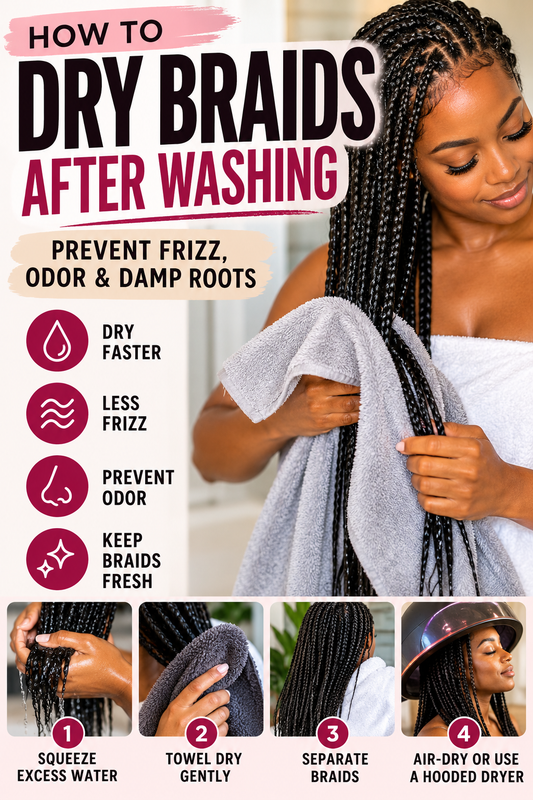
Washing your braids is an important part of keeping your scalp clean and your protective style fresh. But what you do after washing your braids can be just as important as how you wash them.
One of the biggest mistakes people make with box braids, knotless braids, cornrows, feed-in braids, and other braided hairstyles is failing to dry them completely.
Braids can hold a surprising amount of water.
The outside of your braids may feel dry while the roots, natural hair underneath, or inner sections of thicker braids remain damp. When moisture remains trapped for too long, your braids may begin to smell musty, feel heavy, become excessively frizzy, or simply take much longer to look and feel fresh again.
So, how should you dry braids after washing them?
The best method is to gently squeeze out excess water, absorb additional moisture with a microfiber towel or soft T-shirt, separate the braids so air can circulate, and allow them to dry completely. A hooded dryer or handheld blow dryer on a low or cool setting can help speed up the process, especially around the roots.
In this complete guide from Hairobics All Natural, we'll explain how to dry braids after washing, how long braids may take to dry, how to prevent frizz, why your roots stay wet longer, whether you can use a blow dryer, and what to do if your braids smell after wash day.
Why Drying Braids Properly Is So Important
Braids are different from loose natural hair.
With loose hair, air can circulate relatively easily around individual strands. Braided hair is tightly grouped together, and extension hair may add considerably more thickness.
Water can therefore become trapped inside the hairstyle.
This is especially common with:
- Box braids
- Knotless braids
- Jumbo braids
- Long braids
- Thick cornrows
- Feed-in braids
- Stitch braids
- Crochet braids
- Bohemian braids
- Braids containing large amounts of extension hair
The denser the hairstyle, the more important thorough drying becomes.
Proper drying can help your braids feel lighter, smell fresher, reduce unnecessary dampness around your scalp, and make maintaining your protective style easier.
If you're still perfecting your braid wash routine, start with our complete Braids Washing Guide: How to Wash Braids Without Ruining Them.
How to Dry Braids After Washing Step by Step
You don't need an expensive salon dryer to dry braids successfully.
What matters most is removing as much excess water as possible without creating unnecessary friction and then giving moisture trapped inside the braids enough opportunity to evaporate.
Here's the process.
Step 1: Let Excess Water Drain
When you finish rinsing your braids, don't immediately wrap your entire head in a towel.
First, allow some of the water to drain naturally.
Keep the braids hanging downward.
You can gently gather sections of braids and squeeze them from the upper portion toward the ends.
The keyword is gently.
Do not twist or wring your braids as if you're trying to wring water out of a towel.
Aggressive twisting can disturb your natural hair, create frizz, loosen the hairstyle, and place unnecessary tension on your roots.
Instead:
Take a section.
Gently squeeze.
Move downward.
Release.
Repeat with the next section.
You may be surprised by how much water comes out.
Step 2: Pay Special Attention to the Roots
Your roots deserve extra attention.
This is where your natural hair is concentrated, and dense braided sections can make it harder for air to circulate.
Use your fingertips to carefully separate the braids at the scalp.
You don't need to pull them apart aggressively.
You simply want to prevent all your wet braids from sitting tightly against one another.
If your braid lengths feel dry later but your roots still feel cool, damp, or wet, continue drying.
Don't assume the entire hairstyle is dry simply because the ends are dry.
Step 3: Use a Microfiber Towel or Soft T-Shirt
Once you've squeezed out as much water as possible with your hands, use an absorbent material to remove more.
A microfiber towel is an excellent choice.
A soft cotton T-shirt can also work.
Wrap or press the material around sections of your braids and allow it to absorb water.
Again, don't aggressively rub your braids.
Rubbing creates friction.
Friction encourages frizz.
Instead of:
Rub → rub → rub
Think:
Press → squeeze → release.
You can move down the entire length of your braids using this method.
If your towel becomes completely saturated, switch to a dry towel.
Trying to dry your hair with an already soaked towel won't remove much additional moisture.
Reducing friction is particularly important if keeping the hairstyle neat is a priority. For additional maintenance strategies, read How to Keep Braids Looking Fresh: 20 Easy Tips to Make Your Braids Last Longer.
Step 4: Separate Your Braids
Air circulation is your friend.
If you leave 100 wet braids packed together in one large bundle, the inner braids may stay wet significantly longer.
Instead, divide the hairstyle into several loose sections.
For example, you could place:
- Some braids over your left shoulder
- Some over your right shoulder
- Some down your back
You can occasionally reposition them as they dry.
The goal isn't to create a complicated hairstyle.
You're simply exposing more of the wet surface to moving air.
Avoid putting freshly washed wet braids into a tight bun.
A bun can trap moisture between layers of braids.
Step 5: Air-Dry in a Well-Ventilated Area
Once you've removed most of the excess water, you can allow your braids to air-dry.
Choose an area with good airflow.
You can sit near a fan if desired, but you don't need extremely powerful air blowing directly against your scalp.
Keep the braids loose.
Move them occasionally.
Feel your roots periodically.
The time required will depend on your hairstyle.
Thin cornrows may dry much faster than waist-length box braids containing a large amount of extension hair.
This is one reason it's difficult to say that every braided hairstyle will dry in exactly two, four, or six hours.
Instead of relying only on the clock, check the hair itself.
Step 6: Use a Hooded Dryer if Needed
A hooded dryer can be particularly useful for braided hairstyles because it allows air to reach a large portion of your head simultaneously.
If you're using one, choose a comfortable low-to-moderate setting rather than trying to dry your braids with extremely high heat.
Sit underneath the dryer and periodically check your roots.
If you have very long braids, the lengths may extend beyond the hood.
In that case, you can combine methods:
Use the hooded dryer for your scalp and roots.
Then allow the lengths to air-dry or dry them separately.
The goal isn't to make the braids hot.
The goal is to remove moisture.
Step 7: Can You Blow-Dry Braids After Washing?
Yes, a handheld blow dryer can help dry braids.
But technique matters.
Use a cool or appropriately low setting, especially when working around your scalp and natural hair.
Start around the roots.
Move the dryer continuously rather than concentrating heat on one location for an extended period.
Then work down the lengths if necessary.
If your braids contain synthetic extension hair, remember that different synthetic fibers respond differently to heat.
There's rarely a reason to use the hottest setting available.
More heat doesn't automatically mean healthier or better drying.
Airflow is what you need.
Step 8: Check Whether Your Braids Are Actually Dry
Before putting on a bonnet, tying your braids into a bun, or going to bed, check them carefully.
Touch several different areas.
Don't only check the front.
Check:
- Hairline
- Crown
- Middle of the scalp
- Nape
- Roots
- Middle of the braids
- Thickest sections
- Ends
Your braids should not feel noticeably wet or saturated inside.
Thick sections deserve particular attention.
If the roots still feel damp, give them more drying time.
How Long Do Braids Take to Dry After Washing?
There is no universal drying time.
Your braids might take several hours to dry completely depending on the hairstyle and drying method.
Factors affecting drying time include:
Braid Thickness
Thicker braids generally hold more water than very small braids.
Braid Length
Waist-length or hip-length braids contain much more material than shoulder-length braids.
Amount of Extension Hair
More extension hair usually means more material capable of holding water.
Hair Density
Someone with very dense natural hair may notice the roots remain damp longer.
Type of Braids
Cornrows, knotless braids, box braids, boho braids, and jumbo braids don't necessarily dry at the same speed.
Humidity
High humidity can slow evaporation.
Air Circulation
Good airflow can help water evaporate more efficiently.
Drying Method
Using a microfiber towel followed by a hooded dryer will usually be faster than simply stepping out of the shower and waiting.
Rather than focusing on an exact number of hours, focus on the result:
Your scalp, roots, natural hair, and braids should be thoroughly dry.
Should You Sleep With Wet Braids?
It's better to avoid going to bed with soaking-wet braids.
When wet braids are placed under a bonnet or pressed against a pillow for hours, moisture can remain trapped much longer.
The hairstyle may also become flattened or frizzier.
This is why braid wash day is usually easier when you start earlier.
Washing your braids at 10 p.m. and hoping they'll completely dry before midnight may not give thick or long braids enough time.
If possible, wash them in the morning or afternoon.
That gives you several hours for towel drying, air drying, and dryer-assisted drying if necessary.
Once your braids are completely dry, protect them before bed.
Our Night Routine for Braids: The Complete Guide to Keeping Your Braids Looking Fresh explains how nighttime protection can reduce friction and help preserve your style.
Why Do My Braids Smell After Washing?
You washed your hair because you wanted it to smell cleaner.
So discovering an unpleasant smell afterward can be confusing.
One possible reason is prolonged dampness.
If dense braids stay wet for a long period, they may develop a stale or musty odor.
But incomplete drying isn't the only possibility.
Odor can also be associated with:
- Sweat
- Excess scalp oil
- Product buildup
- Incomplete cleansing
- Shampoo residue
- Wearing wet braids under a bonnet
- Frequently exercising without adequately cleansing the scalp
Don't simply spray fragrance over persistent scalp odor.
Find the source.
If you're dealing with recurring odor, read our detailed guide on Why Does My Scalp Smell While Wearing Braids?.
How to Dry Braids Without Making Them Frizzy
A little frizz after washing can be normal.
Your natural hair reacts to water, and some strands may become more visible around the braids.
However, excessive frizz can often be minimized.
Don't Rub With a Bath Towel
Aggressive rubbing creates friction.
Press and squeeze instead.
Keep Braids Hanging Down
Don't pile all your braids on top of your head and rub them together.
Allow them to hang in their natural direction.
Minimize Handling
You don't need to constantly touch the braids while they're drying.
Avoid Excessive Heat
Blasting the hair with maximum heat isn't necessary.
Dry Thoroughly
Trying to style or manipulate soaking-wet braids can make maintenance more difficult.
If frizz is one of your biggest concerns, see our complete How to Wash Your Braids Without Frizz guide.
What Should You Put on Braids After Washing?
After washing, many people immediately start layering oil, cream, spray, mousse, and other products onto the hair.
You don't necessarily need all of that.
A simple routine is often better.
Your natural hair may need lightweight moisture after cleansing, but constantly coating braids with heavy products can contribute to buildup over time.
Once you've removed excess water and your braids are drying, consider using a lightweight moisturizing product where appropriate.
Featured Hairobics Product: Raaw Roots Antiseptic Moisturizer Spray
For braids, locs, twists, and natural hair, Hairobics Raaw Roots Antiseptic Moisturizer Spray is designed to help moisturize, soften, condition, and add shine.
The lightweight spray format makes it convenient for reaching your natural hair while it's inside a protective style.
You don't need to completely saturate freshly washed braids with moisturizer.
Apply an appropriate amount and focus on the areas containing your natural hair.
For a complete moisture routine, read How to Keep Natural Hair Moisturized in Braids.
Should You Oil Your Scalp After Washing Braids?
You can use a small amount of scalp oil if your scalp needs it, but oil doesn't need to be applied automatically after every wash.
Pay attention to how your scalp feels.
If it feels comfortable, you may not need much additional product.
If it feels dry, a small amount of an appropriate scalp product may help.
The mistake is assuming that more oil always means healthier hair.
Repeatedly layering heavy oil onto your scalp can mix with dead skin, sweat, and styling residue.
Eventually, you may be washing your braids primarily to remove the products you continuously apply.
Keep your routine simple.
Cleanse when needed.
Dry thoroughly.
Moisturize appropriately.
Protect your braids at night.
How to Dry Box Braids After Washing
Box braids can take considerable time to dry because each braid contains multiple intertwined strands.
After washing:
- Gently squeeze water down each group of braids.
- Use a microfiber towel.
- Separate the braids into sections.
- Allow them to hang freely.
- Air-dry in a ventilated area.
- Use a hooded or handheld dryer if necessary.
- Check the roots before assuming the style is completely dry.
Pay particular attention to larger box braids.
The exterior may feel dry while moisture remains deeper inside.
How to Dry Knotless Braids After Washing
The same general method works for knotless braids.
Because your natural hair transitions into extension hair, concentrate on getting the root area thoroughly dry.
Avoid rough towel drying.
Separate the braids and allow air to move around the scalp.
If you use a dryer, focus on the roots first.
Once the scalp and natural hair are dry, check the lengths.
How to Dry Cornrows After Washing
Cornrows may look easier to dry because there isn't a large mass of individual braids hanging from your head.
However, your natural hair is braided close to the scalp.
That means the scalp and braided rows need sufficient airflow.
After washing:
Press a microfiber towel gently against the scalp.
Don't rub back and forth.
Allow the hair to air-dry.
A hooded dryer can be especially convenient for cornrows because the entire braided section fits underneath the hood.
Check between the rows before covering your hair.
How to Dry Boho Braids After Washing
Bohemian braids require additional care because loose curls are incorporated into the style.
Those loose sections can tangle or frizz if they're handled aggressively.
After washing, squeeze the braided sections carefully and gently blot the loose hair.
Avoid rubbing everything together.
Keep the loose curls separated when possible and allow the entire style adequate time to dry.
Our Boho Braids Care Guide provides additional tips for maintaining the loose curls and braided sections.
Can You Sit in the Sun to Dry Braids?
Warm outdoor air may help your braids dry, but direct sunlight isn't necessary.
A comfortable, ventilated environment is enough.
Sitting in intense heat for extended periods just to dry your hair can be uncomfortable and unnecessary.
You also shouldn't depend solely on how the outer braids feel.
Even if the sun dries the surface quickly, check your roots and thicker sections.
Can You Use a Fan to Dry Braids?
Yes.
A fan can improve air circulation and help moisture evaporate.
After towel drying, sit somewhere comfortable and spread your braids loosely so air can reach different sections.
Periodically reposition your hair.
A fan can be particularly helpful if you prefer minimizing heat.
However, extremely thick or long braids may still require substantial drying time.
Should You Put Your Braids in a Bun While They're Drying?
Usually, it's better to keep wet braids loose.
Putting them into a tight bun packs damp braids together and reduces airflow.
Let them hang while they're drying.
Once they're completely dry, you can style them however you prefer—as long as you're not creating excessive tension on your roots.
If your scalp hurts when you put your braids up, don't ignore the discomfort. See our guide on How to Tell if Braids Are Too Tight for warning signs of excessive tension.
Common Mistakes When Drying Braids
Mistake #1: Assuming the Outside Represents the Inside
The surface can feel dry before the interior does.
Check your roots and thicker sections.
Mistake #2: Going Straight to Bed
A late-night braid wash can leave insufficient drying time.
Whenever possible, wash earlier.
Mistake #3: Wringing Your Braids
Braids aren't towels.
Twisting them aggressively isn't necessary.
Mistake #4: Using Extremely High Heat
You need airflow—not excessive heat.
Mistake #5: Putting Wet Braids Into a Bun
This reduces airflow and may slow drying.
Mistake #6: Applying Too Much Product Immediately
Adding multiple heavy products to already wet braids may make them feel coated and contribute to buildup.
Mistake #7: Ignoring the Roots
The scalp and roots are among the most important areas to check.
How to Keep Braids Fresh Between Washes
Proper drying is only one part of braid maintenance.
Between washes:
Keep your scalp reasonably clean.
Use lightweight products.
Avoid unnecessary buildup.
Protect the hairstyle while sleeping.
Avoid constantly pulling your braids into tight styles.
Moisturize your natural hair appropriately.
Pay attention to scalp odor, itching, excessive flakes, or unusual irritation.
And don't keep a protective style installed indefinitely.
Our guide on How Long Should You Keep Braids In? explains how installation time can affect your overall braid-care routine.
Frequently Asked Questions About Drying Braids
How do you dry braids quickly after washing?
Start by squeezing out as much excess water as possible without twisting the braids. Follow with a microfiber towel, separate the braids into smaller sections, and increase airflow. A hooded dryer or handheld blow dryer on a suitable low or cool setting can help speed up drying.
Can I blow-dry my braids?
Yes. Use a comfortable low or cool setting and keep the dryer moving. Focus particularly on the roots. Avoid unnecessarily exposing your scalp, natural hair, or synthetic extensions to extreme heat.
Can braids air-dry?
Yes. Braids can air-dry, but thick and long styles may require several hours. Make sure the environment has adequate airflow and check the roots before assuming your hair is completely dry.
Why are my braids still wet hours later?
Long, thick, or extension-heavy braids can retain substantial amounts of water. High humidity and poor air circulation can also slow drying.
Should I towel-dry my braids?
Yes, but avoid aggressive rubbing. A microfiber towel or soft T-shirt can be used to press and absorb water.
Can I sleep with slightly damp braids?
It's preferable to allow your braids to dry thoroughly before covering them and going to bed. If they're still noticeably damp, continue drying.
Why do my braids smell after I wash them?
Persistent dampness can contribute to a musty smell. Sweat, product buildup, excess scalp oil, incomplete cleansing, and residue may also contribute.
Should I moisturize my braids after washing?
Your natural hair may benefit from lightweight moisture. Avoid unnecessarily saturating the entire hairstyle with multiple heavy products.
How do I know when my braids are completely dry?
Check more than the outer surface. Feel the roots, crown, nape, middle sections, thick braids, and lengths. None should feel noticeably wet.
Is a hooded dryer good for braids?
A hooded dryer can be useful because it distributes airflow around the scalp and roots. Use a comfortable setting and check the hair periodically.
Final Thoughts: The Best Way to Dry Braids After Washing
Learning how to dry braids after washing is a simple step that can make a major difference in your protective-style routine.
Start by gently squeezing excess water from the braids.
Use a microfiber towel or soft T-shirt to absorb additional moisture.
Keep your braids loose and separated so air can circulate.
Allow plenty of drying time.
If necessary, use a hooded dryer or handheld blow dryer on a comfortable low or cool setting, paying particular attention to your roots.
Most importantly, don't assume your braids are completely dry simply because the outside feels dry.
Check your scalp, roots, thickest sections, and lengths.
Once your braids are thoroughly dry, use lightweight moisture when needed and protect your hairstyle at night.
A good braid routine doesn't have to be complicated.
Clean scalp. Proper drying. Lightweight moisture. Minimal tension. Nighttime protection.
Those simple habits can help keep your braids feeling fresh and make your protective style easier to maintain.
For lightweight hydration between washes, explore Hairobics Raaw Roots Antiseptic Moisturizer Spray for Locs, Twists, Braids & Natural Hair.