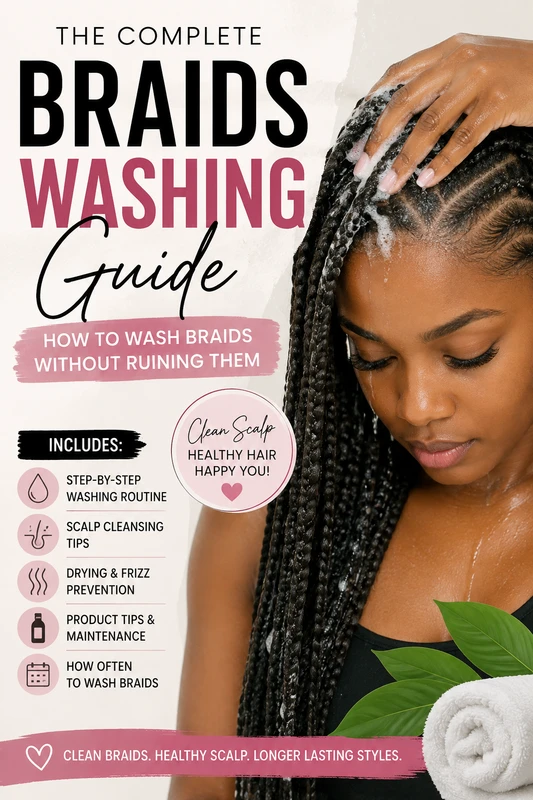
Braids are one of the most popular protective hairstyles for Black hair. From knotless braids and box braids to feed-in braids, cornrows, and stitch braids, braided styles can give your natural hair a break from daily manipulation while offering countless styling possibilities.
But wearing braids does not mean you should stop washing your hair.
One of the biggest questions people have after getting braids is: Can you wash braids without ruining them?
Yes. In fact, properly cleansing your scalp and braids can be an important part of maintaining a healthy protective style.
The challenge is washing them correctly.
Aggressive scrubbing, using too much shampoo, piling wet braids on top of your head, or failing to dry them completely can leave your braids frizzy, heavy, tangled, or covered with product residue.
The goal is to clean your scalp and hair while disturbing the braided style as little as possible.
In this complete braids washing guide, we'll explain how to wash braids step by step, how often you should wash them, how to prevent frizz, how to dry braids properly, and how to keep your scalp comfortable throughout your protective style.
Can You Wash Your Hair While Wearing Braids?
Yes, you can wash your hair while wearing braids.
Your scalp continues producing natural oils, shedding skin cells, and accumulating sweat while your hair is braided. Hair products can also collect around the roots.
Over time, this combination can create buildup.
People who exercise frequently, sweat heavily, use several styling products, or live in hot climates may notice buildup even faster.
Washing your braids can help remove:
- Sweat
- Excess oil
- Dirt
- Dead skin
- Styling product residue
- Environmental debris
- Scalp buildup
The important part is using a gentle washing technique.
You do not need to scrub your braids aggressively to get your scalp clean.
How Often Should You Wash Braids?
There is no perfect washing schedule that works for everyone.
For many people, washing braids approximately every two to three weeks can be a reasonable starting point.
However, you may need to wash them sooner depending on your scalp, lifestyle, products, and the type of braids you're wearing.
For example, someone who exercises five days a week may need to cleanse their scalp more frequently than someone who rarely sweats.
Your scalp may also tell you when it needs cleansing.
Common signs include:
- Noticeable product buildup
- Excess oiliness
- Sweat accumulation
- Visible flakes
- Unpleasant scalp odor
- Hair that feels coated
- Heavy product residue around the roots
Don't follow a washing calendar so strictly that you ignore what your scalp is telling you.
At the same time, washing braids excessively can create unnecessary frizz and manipulation.
The objective is balance.
Should You Wash New Braids?
You generally don't need to wash freshly installed braids immediately unless there's a specific reason.
New braids are usually at their neatest during the first several days.
Washing them too soon may cause your natural hair to swell or frizz, particularly around the roots.
If possible, allow your braids some time to settle before completing a full wash.
However, scalp comfort and cleanliness are more important than maintaining perfectly neat braids.
If your scalp becomes excessively sweaty or dirty, cleansing may be appropriate.
What You Need to Wash Braids
You don't need an enormous collection of products.
A simple braid-washing routine may include:
- Gentle shampoo
- Applicator bottle
- Water
- Microfiber towel or soft T-shirt
- Lightweight moisturizing product
- Scalp oil if desired
- Hair dryer with a low or cool setting if necessary
An applicator bottle can be especially useful because it allows you to direct shampoo toward your scalp rather than coating the entire length of your braids.
This can make washing significantly easier.
How to Wash Braids Step by Step
The way you wash braids is different from the way you might wash loose natural hair.
Your goal is to clean the scalp without creating unnecessary friction.
Here is a simple method.
Step 1: Dilute Your Shampoo
One of the easiest ways to wash braids is using diluted shampoo.
Place a small amount of shampoo into an applicator bottle and add water.
Shake gently.
Diluting shampoo makes it easier to distribute across your scalp and can reduce the amount of concentrated product that gets trapped between your braids.
You don't need to create an extremely weak solution. You simply want something that spreads easily.
Step 2: Wet Your Scalp and Braids
Use lukewarm water.
Avoid extremely hot water because it can be uncomfortable and may leave your scalp and hair feeling dry.
Allow the water to flow downward over your scalp and braids.
Don't immediately start rubbing.
Give the water time to loosen surface dirt and product residue.
Step 3: Apply Shampoo Directly to Your Scalp
Use the applicator bottle to place the diluted shampoo between the sections of your braids.
Focus primarily on your scalp.
Pay attention to areas where buildup tends to accumulate, including:
- Hairline
- Crown
- Behind the ears
- Nape
- Parts between braids
You do not need to completely saturate every inch of your extensions with shampoo.
As you rinse, shampoo and water will travel down the braids.
Step 4: Massage Your Scalp Gently
This is one of the most important steps.
Use the pads of your fingertips to gently massage your scalp.
Do not scratch aggressively with your fingernails.
Work between the braids rather than rubbing the braids together.
Small, gentle motions can help loosen sweat, oil, and product buildup.
Avoid moving your braids around excessively.
The more friction you create around the roots, the more likely your natural hair is to become frizzy.
Step 5: Clean the Length of the Braids Gently
If your braids themselves need cleaning, don't scrub them like laundry.
Instead, gently squeeze shampoo and water through sections of the braids.
Work downward.
Avoid twisting, bunching, or rubbing the braids against one another.
This is especially important with long box braids or knotless braids.
Heavy manipulation can make them look older much faster.
Step 6: Rinse Thoroughly
Rinsing is extremely important.
Allow clean water to flow from the scalp downward through the braids.
Continue rinsing until the shampoo is completely removed.
Pay close attention to the roots.
Leftover shampoo can dry on the scalp and look like flakes or buildup.
People sometimes assume their scalp is dirty immediately after washing when the white residue they're seeing is actually leftover product.
Take your time.
Step 7: Gently Remove Excess Water
Braids can absorb a surprising amount of water.
After rinsing, gently squeeze sections of the braids from top to bottom.
Do not wring them aggressively.
Then wrap your braids in a microfiber towel or soft cotton T-shirt.
Allow the fabric to absorb excess water.
Avoid vigorously rubbing your head with a regular bath towel.
Friction can contribute to frizz.
Step 8: Dry Your Braids Completely
Drying is one of the most overlooked parts of washing braids.
Thick or long braids can stay damp much longer than expected.
Don't simply assume that because the outside feels dry, the hair underneath is completely dry.
Whenever possible, wash your braids earlier in the day so they have plenty of time to dry.
You can allow them to air-dry in a well-ventilated environment.
A hooded dryer or blow dryer on an appropriate low or cool setting can also help speed up the process.
Concentrate especially on the roots.
Avoid sleeping with soaking-wet braids.
How to Wash Braids Without Making Them Frizzy
Some frizz after washing is normal.
Your natural hair is exposed to water, which can cause it to expand slightly.
However, you can reduce excessive frizz.
The first rule is simple:
Minimize friction.
Do not scrub your braids together.
Don't pile your braids into a tangled mass on top of your head.
Instead, keep them hanging downward as much as possible.
Wash your scalp in sections and massage gently.
When drying, squeeze rather than rub.
Once your braids are dry, you can use braid mousse if appropriate for your style to help smooth flyaways.
How to Wash Knotless Braids
Knotless braids can be washed using essentially the same technique.
Because knotless braids begin with your natural hair rather than a knot of extension hair at the scalp, you'll want to be particularly gentle around the roots.
Apply diluted shampoo between the parts.
Massage carefully with your fingertips.
Rinse downward.
Avoid excessive root manipulation.
Knotless braids are loved for their natural-looking appearance, so protecting the neatness of the roots is important.
After washing, make sure the roots are completely dry.
How to Wash Box Braids
Box braids can hold a considerable amount of water, especially if they're long or thick.
Focus shampoo primarily on your scalp.
If the lengths need washing, gently squeeze the shampoo solution through them.
Rinse thoroughly.
Then remove as much excess water as possible before air-drying or using a dryer.
Large or extra-long box braids may take considerably longer to dry than smaller styles.
Plan accordingly.
How to Wash Feed-In Braids
Feed-in braids usually lie close to the scalp, making scalp cleansing relatively straightforward.
Diluted shampoo works well because you can direct it between each braid.
Massage the exposed scalp gently.
Try not to scrub the braided sections themselves because doing so may create frizz.
Rinse thoroughly and blot excess moisture.
Because feed-in braids expose more of the scalp, keeping the parts clean can make the entire hairstyle look fresher.
How to Wash Cornrows
Cornrows are another style where the scalp is relatively accessible.
Apply diluted shampoo between the rows.
Use your fingertips to gently clean the exposed scalp.
Allow water to rinse through the braids rather than rubbing them.
Cornrows may dry faster than large individual box braids, but you should still make sure your scalp and natural hair are thoroughly dry.
How to Wash Stitch Braids
Stitch braids are known for their crisp, defined sections.
Because the clean parting is part of the style, aggressive washing can quickly change their appearance.
Apply diluted shampoo carefully between the rows.
Massage with minimal movement.
Rinse downward.
Blot with a soft towel instead of rubbing.
The more carefully you handle the roots, the longer the stitch pattern may continue looking neat.
Should You Use Conditioner on Braids?
Conditioner can be useful, but you need to be careful with heavy products.
Thick conditioners can become difficult to rinse from braided hair.
If conditioner becomes trapped inside the braids or around the roots, it may contribute to residue.
Some people prefer using a lightweight leave-in product after cleansing rather than applying a heavy rinse-out conditioner throughout the braids.
The best approach depends on your hair and the specific protective style.
Whatever you use, avoid saturating the roots with layers of thick product.
Should You Oil Your Scalp After Washing Braids?
You can apply a small amount of scalp oil if your scalp feels like it needs it.
However, more oil is not automatically better.
Heavy oil application can mix with sweat, dead skin, and styling products, potentially contributing to buildup.
Apply only what your scalp needs.
If your scalp already feels comfortable after washing, you may not need additional oil immediately.
How to Moisturize Braids After Washing
Your natural hair still needs moisture while it is braided.
After your braids are mostly or completely dry, you can apply a lightweight moisturizing product.
Concentrate on the areas containing your natural hair.
Avoid coating your braids with excessive layers of thick cream.
A good braid routine should help maintain moisture without creating unnecessary buildup.
For people who struggle with dry hair while wearing protective styles, lightweight hydration between washes may be more useful than repeatedly applying heavy oils.
How to Clean Your Scalp Between Braid Washes
You may occasionally want to freshen your scalp without doing a complete wash.
This can be useful after a workout or when you have mild buildup but aren't ready for a full shampoo.
You can gently clean accessible areas of the scalp using an appropriate scalp-cleansing product.
However, scalp refreshing should not permanently replace proper washing.
If substantial buildup develops, shampoo and water usually provide a more thorough cleanse.
Washing Braids After Working Out
Exercise can make braid maintenance more challenging.
Sweat can accumulate around your scalp, hairline, and roots.
If you exercise frequently, pay attention to how your scalp feels rather than waiting for a predetermined wash date.
After workouts, allow your scalp to dry instead of immediately covering damp hair with a scarf, bonnet, or hat.
If sweat accumulation becomes significant, consider cleansing sooner.
A clean protective style is more important than trying to keep every braid looking freshly installed for weeks.
Can You Shower With Braids?
Yes.
However, you don't necessarily need to completely soak your braids every time you shower.
If you're not washing your hair, you can use a shower cap to keep your braids relatively dry.
Repeatedly soaking long braids unnecessarily can increase drying time.
When it is wash day, remove the shower cap and cleanse your hair properly.
Can You Swim With Braids?
Braids are popular vacation hairstyles, but swimming requires additional care.
Pool water, ocean water, sweat, sunscreen, and other products can accumulate on your hair.
After swimming, rinse your braids thoroughly with clean water.
Depending on how frequently you're swimming and how your scalp feels, shampoo may also be necessary.
Most importantly, make sure your braids dry completely afterward.
Don't leave them damp under a hat or scarf for hours.
Should You Wash Braids Before Taking Them Out?
It depends.
Some people prefer washing their hair shortly before braid removal, while others wait until the braids are removed and then complete a thorough wash and detangling routine.
If your braids have significant buildup, removing them first may make it easier to properly cleanse and detangle your natural hair.
Be particularly careful around buildup at the roots.
After wearing braids for several weeks, shed hairs can remain trapped inside the style.
This is normal.
Don't mistake normal shed hair for sudden breakage.
Detangle slowly after removing the braids.
Common Mistakes When Washing Braids
Learning what not to do is just as important as learning the correct technique.
1. Scratching the Scalp With Your Nails
Scratching may feel satisfying when your scalp is itchy, but aggressive scratching can irritate the scalp.
Use your fingertips instead.
2. Using Too Much Shampoo
More shampoo doesn't necessarily mean cleaner hair.
Excess shampoo may be harder to rinse from thick braids.
Diluting your shampoo can help distribute it more evenly.
3. Using Too Much Product Afterward
Applying oil, cream, mousse, leave-in conditioner, and multiple scalp products at the same time can quickly undo your cleansing efforts.
Keep your routine simple.
4. Washing Too Aggressively
Rubbing and scrubbing can cause unnecessary frizz.
Your scalp needs cleansing—not punishment.
5. Failing to Rinse Thoroughly
Product left behind can contribute to residue and discomfort.
Take extra time during rinsing.
6. Sleeping With Wet Braids
Long or thick braids may remain damp internally even when the outside feels relatively dry.
Give your hair enough time to dry before bed.
7. Ignoring the Scalp to Protect the Hairstyle
Some people avoid washing because they want their braids to stay perfect.
But scalp cleanliness should take priority over extending a hairstyle indefinitely.
How to Keep Braids Looking Fresh After Washing
Once your braids are clean and completely dry, there are several things you can do to maintain them.
At night, cover your hair with a satin or silk scarf or bonnet.
For long braids, you may need a larger bonnet that allows the braids to fit without being tightly compressed.
You can also use a satin pillowcase as additional protection.
Keeping your braids covered at night reduces friction against cotton bedding and can help preserve the style.
During the day, avoid constantly pulling, twisting, or restyling your braids.
Low manipulation applies to the protective style itself, too.
How Long Should You Keep Braids In?
How long you can comfortably wear braids depends on the style, your hair, your scalp, how quickly your hair grows, and how well the style is maintained.
Don't keep braids installed simply because they still look acceptable from a distance.
Pay attention to your roots.
If you have substantial new growth, matting, tangling, excessive buildup, or discomfort, it may be time to remove the style.
Protective styles should make hair maintenance easier—not become permanent hairstyles.
Why Does My Scalp Itch After Washing My Braids?
There are several possible reasons.
One common possibility is incomplete rinsing.
If shampoo remains around your roots, dried residue may cause discomfort.
Another possibility is that your scalp is reacting to a particular hair product or the extension hair itself.
A tight hairstyle can also make the scalp uncomfortable.
Persistent itching, pain, sores, significant redness, swelling, or other unusual symptoms should not simply be covered with more oil.
Consider removing the style if it is causing significant irritation and consult an appropriate healthcare professional if symptoms are severe or persistent.
Why Do My Braids Smell After Washing?
If your braids develop an unpleasant smell shortly after washing, one possibility is that they remained damp for too long.
This is particularly important with thick, dense, or very long braids.
Another possibility is that the scalp wasn't thoroughly cleansed or shampoo wasn't completely rinsed away.
After your next wash, pay extra attention to:
- Thorough scalp cleansing.
- Complete rinsing.
- Removing excess water.
- Drying the roots and braids completely.
Don't try to cover persistent odor with fragrance sprays.
Address the underlying cause first.
How to Prevent Buildup While Wearing Braids
The easiest way to deal with braid buildup is to prevent excessive buildup from developing in the first place.
Keep your product routine relatively simple.
Your scalp generally doesn't need a new layer of oil every day.
Your braids also don't need to be coated constantly with thick creams.
Use products intentionally.
When your scalp becomes dirty, wash it.
A protective style should simplify your routine.
Should You Wash Braids With Hot or Cold Water?
Lukewarm water is usually a comfortable option.
Extremely hot water isn't necessary for effective cleansing and may leave some hair feeling dry.
Use a comfortable water temperature that allows you to thoroughly cleanse and rinse your scalp.
How Long Do Braids Take to Dry?
Drying time varies dramatically.
It depends on:
- Braid length
- Braid thickness
- Amount of extension hair
- Hair density
- Room temperature
- Humidity
- Air circulation
- Drying method
Small cornrows may dry relatively quickly, while waist-length box braids can take considerably longer.
Rather than relying on a specific number of hours, check the roots and inner sections of the braids.
They should feel completely dry.
Best Time of Day to Wash Braids
Morning or early afternoon is often ideal.
This gives your hair plenty of time to dry before bedtime.
Washing long braids immediately before going to sleep can create problems because the inner portions may remain damp.
If evening is your only option, consider using a hooded dryer or another gentle drying method to make sure the roots are dry before bed.
Simple Braids Washing Routine
If you want an easy routine to remember, use this sequence:
Wet → Shampoo → Massage → Rinse → Blot → Dry → Moisturize → Protect
Wet your scalp and braids with lukewarm water.
Apply diluted shampoo primarily to the scalp.
Massage gently with your fingertips.
Rinse thoroughly.
Blot excess water with a microfiber towel or T-shirt.
Allow your scalp and braids to dry completely.
Apply lightweight moisture if needed.
Protect the style at night with satin or silk.
That's it.
Braid care does not need to involve 15 different products.
Braids Washing FAQ
Can I wash braids once a week?
You can if your scalp and lifestyle require it, although frequent washing may cause the style to become frizzier faster.
People who exercise frequently or sweat heavily may need more frequent cleansing.
Can I wash braids every two weeks?
For many people, washing approximately every two weeks can work well.
Adjust according to your scalp.
Will washing ruin my braids?
Proper washing should not automatically ruin your braids.
Some frizz is normal, but gentle cleansing can help maintain your scalp while preserving the style.
Should I shampoo the entire braid?
Your scalp is usually the main focus.
If the lengths are dirty, gently clean them without aggressive rubbing.
Can I use dry shampoo on braids?
Some people use dry shampoo to refresh the scalp, but it can add residue if used excessively.
It shouldn't become a permanent substitute for proper cleansing.
Why do my braids get fuzzy after washing?
Water causes your natural hair to swell, while friction during washing can loosen small hairs from the braid.
Gentler washing can help reduce excessive fuzziness.
Can I blow-dry braids?
Yes, but use an appropriate low or cool setting and avoid excessive heat.
Your goal is drying—not heat styling.
Should I put oil on my braids every day?
Not necessarily.
Daily oiling can contribute to buildup for some people.
Use oil according to what your scalp actually needs.
Can I wash knotless braids?
Yes. Use gentle scalp cleansing and minimize manipulation around the roots.
Can I wash box braids?
Absolutely. Concentrate on the scalp, rinse thoroughly, and allow enough time for the braids to dry completely.
Final Thoughts: Keeping Braids Clean and Healthy
Braids may be protective, but the hair and scalp underneath them still need attention.
You don't have to choose between clean hair and neat braids.
With the right technique, you can cleanse your scalp while minimizing frizz and preserving your hairstyle.
Focus shampoo on your scalp, massage gently, rinse thoroughly, avoid excessive product buildup, and—most importantly—make sure your braids dry completely.
Remember that protective styling is supposed to support your natural-hair routine.
Listen to your scalp.
If your braids are dirty, wash them. If your hair needs moisture, moisturize it. If your roots are heavily tangled or the style has been installed too long, take the braids down.
Healthy braid maintenance isn't about keeping a hairstyle perfect forever.
It's about protecting the hair underneath it.