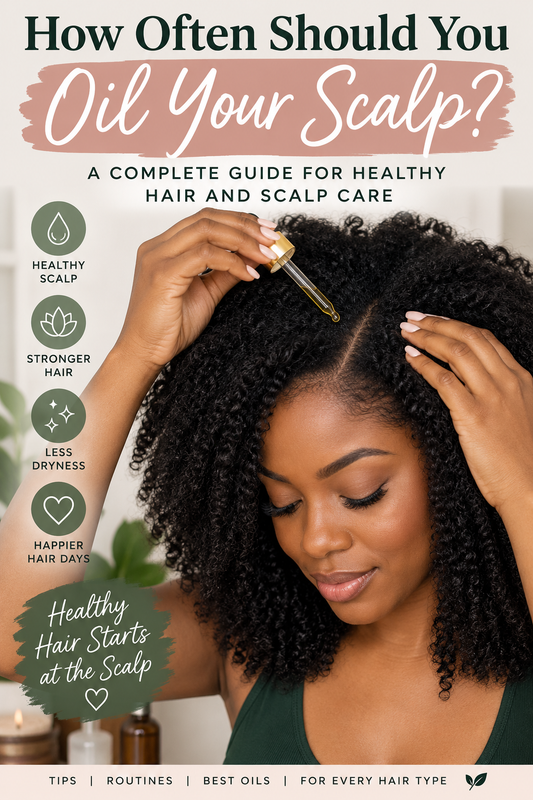
Keeping your scalp healthy is one of the most important parts of maintaining strong, moisturized, healthy-looking hair. Yet one question continues to cause confusion:
How often should you oil your scalp?
For many people with natural hair, curly hair, locs, braids, twists, or other protective styles, scalp oiling is already part of the hair-care routine. But more oil isn't necessarily better. Applying oil too frequently can contribute to buildup, while not using it often enough may leave a dry-feeling scalp uncomfortable.
For most people, oiling the scalp about 1–2 times per week is a reasonable starting point, but there is no universal schedule. Your ideal frequency depends on your scalp, hairstyle, wash schedule, products, environment, and the type of oil you use.
Some people may prefer oiling every few days, while others find that once a week—or even avoiding direct scalp oiling—is better.
This complete guide explains how often to oil your scalp, how much oil to use, how to recognize when you're overdoing it, and how to create a scalp-care routine that works for your hair.
Table of Contents
-
What Does Scalp Oil Actually Do?
-
How Often Should You Oil Your Scalp?
-
Should You Oil Your Scalp Every Day?
-
How Often to Oil a Dry Scalp
-
How Often to Oil an Oily Scalp
-
How Often to Oil a Normal Scalp
-
How Often Should You Oil Your Scalp With Natural Hair?
-
How Often Should You Oil Your Scalp With Braids?
-
How Often Should You Oil Your Scalp With Locs?
-
How Often Should You Oil Your Scalp With Twists?
-
How Often Should Men Oil Their Scalp?
-
How Much Oil Should You Use?
-
Best Time to Oil Your Scalp
-
How to Oil Your Scalp Correctly
-
Signs You May Be Oiling Too Often
-
Signs Your Scalp May Need Attention
-
Best Oils for Scalp Care
-
Scalp Oil vs. Scalp Moisturizer
-
Common Scalp-Oiling Mistakes
-
Frequently Asked Questions
-
Final Thoughts
What Does Scalp Oil Actually Do?
Before deciding how often to oil your scalp, it helps to understand what scalp oil can—and cannot—do.
Your scalp naturally produces sebum, an oily substance that helps lubricate and protect the skin and hair. However, people experience scalp oiliness differently.
With tightly curled and coiled hair, natural oils may not travel down the hair shaft as easily as they do on straighter hair. This is one reason textured hair can feel dry even when the scalp itself is producing oil.
Applying a small amount of an appropriate hair oil may help supplement a hair-care routine by:
-
Lubricating dry-feeling areas
-
Reducing a tight or rough feeling
-
Adding shine
-
Helping seal in moisture
-
Reducing friction
-
Making scalp massage easier
-
Supporting the appearance and feel of healthy hair
-
Making protective styles more comfortable to maintain
However, oil does not actually hydrate the scalp in the same way water does.
Oil primarily provides lubrication and helps reduce moisture loss. If your scalp or hair needs hydration, water or a water-based product may be more useful.
This distinction becomes especially important for people who continually add oil because their scalp feels dry.
Sometimes the solution isn't more oil.
How Often Should You Oil Your Scalp?
A practical starting point for many people is:
Oil your scalp approximately 1–2 times per week.
However, treat this as a guideline rather than a strict rule.
Your scalp might need oil:
-
Every 3–4 days
-
Once a week
-
Twice a week
-
Only when it feels dry
-
Very rarely
The correct schedule depends on how your scalp responds.
General Scalp-Oiling Guide
| Scalp/Hair Situation | Possible Starting Frequency |
|---|---|
| Normal scalp | 1–2 times weekly |
| Dry-feeling scalp | 1–2 times weekly as needed |
| Very oily scalp | Occasionally or not at all |
| Natural/coily hair | 1–2 times weekly |
| Braids | About 1–2 times weekly |
| Locs | About once weekly or as needed |
| Twists | About 1–2 times weekly |
| Heavy product buildup | Reduce oil and cleanse |
| Active lifestyle/heavy sweating | Adjust based on cleansing schedule |
The key phrase is as needed.
Instead of automatically applying oil every morning or night, learn to observe your scalp.
Should You Oil Your Scalp Every Day?
Usually, you don't need to.
Daily scalp oiling is a common habit in textured-hair routines, particularly when someone is trying to grow longer hair.
But oiling every day doesn't automatically make hair grow faster.
The scalp naturally produces sebum. Continually layering additional oils over the scalp without properly cleansing it can create buildup.
Excessive scalp oiling may leave the scalp feeling:
-
Greasy
-
Heavy
-
Coated
-
Itchy
-
Sticky
-
Dirty shortly after washing
It can also attract lint and debris.
If you currently oil your scalp every day and experience persistent buildup, try reducing your frequency.
For example:
Instead of: every day
Try: Monday and Thursday
Then observe your scalp for a few weeks.
You may discover that much less oil is necessary.
How Often Should You Oil a Dry Scalp?
If your scalp frequently feels dry, applying oil once or twice a week may be a reasonable starting point.
However, dryness requires a little investigation.
A dry-feeling scalp doesn't automatically mean it needs more oil.
Your scalp could feel dry because of:
-
Harsh shampoos
-
Very hot water
-
Frequent cleansing
-
Dry weather
-
Low humidity
-
Product buildup
-
Residue
-
Skin irritation
-
Certain styling products
Oil alone doesn't provide water-based hydration.
If your hair and scalp feel extremely dry, consider combining appropriate hydration with a small amount of oil rather than continuously applying oil to a dry surface.
Example Dry-Scalp Routine
Day 1: Cleanse the scalp thoroughly.
Day 2 or 3: Assess how your scalp feels.
Day 3 or 4: Apply a small amount of oil if needed.
Day 6 or 7: Reassess and cleanse according to your regular wash schedule.
Your routine should respond to your scalp instead of following an arbitrary calendar.
Persistent flaking, redness, sores, burning, pain, or severe itching deserves professional evaluation rather than simply adding more oil.
How Often Should You Oil an Oily Scalp?
If your scalp naturally becomes oily quickly, you may need very little additional scalp oil.
Some people with oily scalps don't need direct scalp oiling at all.
Instead, oil can be applied primarily to the hair where necessary.
If your roots already become greasy within a day or two after shampooing, adding additional oil could make buildup worse.
Pay attention to your scalp's natural oil production.
Healthy scalp care isn't about using as many products as possible.
Sometimes a simpler routine works better.
How Often Should You Oil a Normal Scalp?
If your scalp generally feels comfortable and doesn't become excessively dry or greasy, start with once a week.
You can increase to twice weekly if your scalp responds well and you prefer the additional lubrication.
The goal is maintenance—not coating your scalp in oil.
If your scalp already feels comfortable, there's little reason to dramatically increase the amount of oil you're applying.
How Often Should You Oil Your Scalp With Natural Hair?
People with natural hair frequently include oils in their routines because tightly curled and coiled hair can be prone to dryness.
For many natural-hair routines, 1–2 scalp oiling sessions per week can be enough.
But distinguish between your scalp and your hair.
Your scalp may be oily while your ends remain dry.
If that's happening, repeatedly oiling the scalp won't necessarily solve the problem.
Instead, focus additional attention on the hair itself.
Your natural-hair routine might include:
-
Cleansing the scalp
-
Conditioning the hair
-
Applying a leave-in product
-
Moisturizing the strands
-
Sealing the hair when appropriate
-
Applying a small amount of scalp oil when needed
-
Protecting the hair overnight
This approach treats scalp care and strand care as related but separate needs.
How Often Should You Oil Your Scalp With Braids?
Braids provide convenient access to the scalp, which makes oil application easy.
For many people wearing box braids, knotless braids, cornrows, feed-in braids, or similar protective styles, oiling approximately 1–2 times per week may be enough.
You don't necessarily need to oil your braids every day.
Too much oil can combine with:
-
Sweat
-
Dead skin
-
Styling gel
-
Edge control
-
Dirt
-
Lint
-
Other hair products
The result can be significant buildup around the roots.
Simple Braided Scalp Routine
Try something like:
Sunday: Scalp care/oil
Wednesday or Thursday: Reapply a small amount if needed
Wash day: Clean the scalp thoroughly when appropriate for your style
Use a nozzle applicator or dropper to place small amounts directly between braid sections.
Avoid saturating your entire head.
A little can go a long way.
How Often Should You Oil Your Scalp With Locs?
Locs require careful product management because excessive oils and heavy products can contribute to residue.
For many people with locs, once a week or as needed is a good place to start.
If your scalp remains comfortable, you may not need to apply oil again until the next week.
If it becomes dry sooner, you can adjust.
Choose lightweight products and avoid repeatedly saturating the locs themselves.
Remember:
More oil doesn't mean healthier locs.
Healthy loc maintenance also depends on:
-
Regular cleansing
-
Thorough drying
-
Avoiding excessive buildup
-
Maintaining a clean scalp
-
Protecting locs while sleeping
-
Using products in moderation
If your locs constantly feel oily, sticky, or heavy, reduce the amount you're using.
How Often Should You Oil Your Scalp With Twists?
For two-strand twists, mini twists, flat twists, and similar styles, once or twice per week is often sufficient.
Twists make scalp access relatively easy.
Apply small amounts along the parts rather than pouring oil over the entire hairstyle.
This helps keep the scalp comfortable without unnecessarily coating the twists.
How Often Should Men Oil Their Scalp?
Men with waves, curls, locs, braids, twists, fades, or Afros can follow the same principle:
Start around 1–2 times per week and adjust according to your scalp.
Men with very short hair may need less product because the scalp's natural oils can distribute more easily.
Someone with longer curls, an Afro, braids, or locs may have different needs.
Men who exercise frequently should also consider sweat.
If you're sweating heavily several times a week, repeatedly layering oil onto a sweaty scalp without cleansing can leave the scalp feeling coated.
Your wash frequency and oiling frequency should work together.
How Much Oil Should You Put on Your Scalp?
One of the biggest scalp-care mistakes isn't necessarily using oil.
It's using too much oil.
Your scalp doesn't need to look wet after every application.
Instead, apply a light amount to targeted areas.
Depending on the product and your hair density, this might mean a few drops per section rather than pouring oil directly onto the scalp.
Your goal is a thin, even application.
If oil is running down your forehead, neck, or ears, you're probably using more than necessary.
Start with less.
You can always add a little more.
Best Time to Oil Your Scalp
There's no scientifically required time of day for applying scalp oil.
The best time is the one that fits your routine.
After Washing
A clean scalp makes it easier to judge whether you actually need additional oil.
Allow excess water to leave the hair before applying your chosen product.
During the Week
If your scalp begins feeling dry several days after wash day, apply a small amount where necessary.
Before Scalp Massage
A small amount of oil can reduce friction during massage.
Use your fingertips—not your fingernails—and massage gently.
Before Bed
Some people prefer nighttime application because it gives them time to massage the scalp without rushing.
If you oil before bed, consider using a satin or silk bonnet, scarf, or pillowcase to protect your bedding and hair.
How to Oil Your Scalp Correctly
Technique matters almost as much as frequency.
Step 1: Start With a Clean Scalp
Oil isn't a substitute for shampoo.
If your scalp is covered in sweat, dirt, flakes, styling gel, and several layers of old oil, adding another layer probably won't solve the underlying issue.
Cleanse regularly according to your hair and scalp needs.
Step 2: Divide Your Hair Into Sections
Work in several sections so you can reach the scalp without over-applying.
With braids or twists, your existing parts already make this easy.
Step 3: Use a Small Amount
Apply a few drops along the exposed scalp.
Don't flood each section.
Step 4: Massage Gently
Using the pads of your fingertips, gently massage the scalp.
Avoid scratching with your nails.
A scalp massage can be relaxing and helps distribute the product.
Step 5: Leave Your Scalp Alone
Once you've finished, you don't need to keep adding more oil throughout the day.
Give your scalp time before deciding whether another application is necessary.
Signs You May Be Oiling Your Scalp Too Often
Your scalp will often tell you when you're overdoing it.
Possible signs include:
-
Hair becomes greasy very quickly
-
Scalp feels coated
-
Excessive product buildup
-
Roots feel sticky
-
Hair looks flat or weighed down
-
You see visible residue
-
Scalp seems dirty shortly after washing
-
Oil transfers heavily onto pillows or headwear
-
You need frequent shampooing just to remove oil
If these problems appear, reduce either the amount of oil or the frequency.
For example, if you're oiling daily, try twice weekly.
If you're oiling three times weekly, try once weekly.
You don't necessarily have to eliminate oil completely.
You may simply need less.
Signs Your Scalp May Need Attention
People sometimes assume that any scalp discomfort means, "I need more oil."
That's not always true.
You might notice:
-
Tightness
-
Dry feeling
-
Visible flakes
-
Itching
-
Irritation
-
Redness
-
Excessive oiliness
-
Unusual buildup
Rather than immediately adding oil, ask yourself:
When did I last wash my scalp?
Did I recently switch products?
Have I been sweating heavily?
Am I using a lot of styling gel?
Am I layering several oils and creams together?
Is my scalp irritated rather than simply dry?
Scalp conditions can sometimes resemble ordinary dryness.
If symptoms are persistent, severe, painful, or worsening, consider seeing a dermatologist or qualified healthcare professional.
Best Oils for Scalp Care
There are many oils used in natural-hair routines.
The best choice depends on your hair, scalp, preferences, and formulation.
Jojoba Oil
Jojoba oil is popular because it is lightweight and technically a wax ester.
It can work well for people who dislike extremely heavy products.
Grapeseed Oil
Grapeseed oil is another relatively lightweight option.
It's often used on both the hair and scalp.
Coconut Oil
Coconut oil is widely used in hair care and has been studied for its interaction with the hair fiber.
However, not everyone's hair or scalp responds to it the same way.
Avocado Oil
Avocado oil is commonly included in moisturizing hair products and oil blends.
It can also be used to help lubricate dry-feeling hair.
Sweet Almond Oil
Sweet almond oil is another popular option for adding softness and shine.
People with relevant nut allergies should check product ingredients and discuss concerns with an appropriate medical professional.
Castor Oil
Castor oil is much thicker than oils such as grapeseed or jojoba.
Because of its consistency, only a small amount may be necessary.
If you dislike heavy buildup, consider a lighter formulation.
Olive Oil
Olive oil is another traditional hair-care ingredient.
Because it can feel relatively heavy, use it sparingly if your hair becomes weighed down easily.
Does Oiling Your Scalp Make Hair Grow Faster?
This is one of the biggest misconceptions surrounding scalp oil.
Oiling your scalp isn't a guaranteed way to dramatically accelerate hair growth.
Hair growth is influenced by many factors, including:
-
Genetics
-
Age
-
Nutrition
-
Hormones
-
Overall health
-
Hair-care practices
-
Scalp conditions
-
Breakage and length retention
Oils can be useful components of a healthy hair routine, particularly for lubrication and reducing friction.
But no ordinary cosmetic hair oil can guarantee extremely fast growth.
A major part of achieving longer-looking hair is retaining the hair you grow.
If your hair grows but continually breaks at the ends, you may feel like your hair isn't growing.
That's why your routine should address both scalp health and length retention.
Scalp Oil vs. Scalp Moisturizer: What's the Difference?
This distinction is particularly important for natural hair.
Water provides hydration.
Oil primarily lubricates and can help reduce moisture loss.
Oil and water are not interchangeable.
If your hair feels extremely dry, pouring more oil over it may simply give you oily, dry hair.
Instead, many textured-hair routines work better when moisture is introduced first and oil is used strategically afterward.
For example:
Water/water-based product → moisturizer or leave-in → small amount of oil when appropriate
You don't have to follow this exact formula, but understanding the difference helps prevent product overload.
Can You Oil a Dirty Scalp?
You can physically apply oil to a dirty scalp, but that doesn't mean it's the best idea.
Imagine your scalp already contains:
-
Sweat
-
Sebum
-
Dead skin
-
Styling product
-
Dust
-
Old oil
Adding another layer of oil doesn't remove those substances.
Eventually, cleansing becomes necessary.
If your scalp is itchy because it hasn't been washed recently, adding oil may temporarily change how it feels without addressing the buildup.
Sometimes your scalp doesn't need more product.
It needs a wash.
Should You Oil Your Scalp Before or After Washing?
Both approaches exist, but they serve different purposes.
Before Washing
Some people use oils as part of a pre-shampoo treatment.
Oil may be applied to the hair before shampooing to help protect the strands during the washing process.
After Washing
Others prefer applying a small amount of oil after washing because the scalp is clean and buildup has been removed.
Neither approach needs to be mandatory.
Choose the method that leaves your scalp and hair feeling their best.
How Often Should You Wash Your Scalp If You Use Oil?
Your wash schedule depends on your scalp, hairstyle, activity level, and product use.
However, the more products you apply, the more important adequate cleansing becomes.
If you're using oils, gels, creams, sprays, edge controls, and leave-ins throughout the week, residue can accumulate.
A consistent wash routine prevents product layers from becoming your permanent scalp environment.
People wearing protective styles should pay particular attention to cleansing because the style may remain installed for weeks.
Protective styling doesn't mean you should ignore your scalp.
Scalp Oiling During Winter
Cold weather and indoor heating can leave hair and skin feeling drier.
You may find yourself reaching for oil slightly more frequently during winter.
For example, someone who oils once weekly during summer might prefer twice weekly during colder months.
But don't increase oil automatically.
Adjust according to how your scalp actually responds.
Scalp Oiling During Summer
Hot weather can mean more:
-
Sweating
-
Sebum
-
Swimming
-
Outdoor activity
-
Product buildup
You may discover that you need less oil and more frequent cleansing during summer.
This is especially relevant if you exercise outdoors or sweat heavily.
Again, your routine can change with the seasons.
How Exercise Changes Your Scalp-Oiling Routine
If you work out several times per week, consider your sweat level before deciding how frequently to oil.
Heavy sweating combined with frequent oil application can create an uncomfortable mixture on the scalp.
If you're highly active:
-
Monitor buildup
-
Cleanse as needed
-
Avoid excessive oil
-
Keep your scalp dry between washes when appropriate
-
Adjust your hairstyle to make scalp maintenance easier
Your ideal routine might look different from someone who rarely sweats heavily.
Common Scalp-Oiling Mistakes
1. Using Oil Every Day Automatically
Don't apply oil simply because the calendar says you should.
Assess your scalp first.
2. Using Too Much
More isn't automatically better.
Start small.
3. Applying Oil Instead of Washing
Oil doesn't cleanse the scalp.
4. Assuming Every Flake Means Dryness
Flaking can have multiple causes.
Persistent flaking may require a different approach.
5. Using Heavy Oils on a Buildup-Prone Scalp
If your scalp becomes greasy quickly, lighter products or less frequent application may work better.
6. Ignoring the Hair
Don't focus so much on the scalp that you neglect your ends.
The oldest portion of your hair often needs the most protection.
7. Scratching During Scalp Massage
Use fingertips instead of fingernails.
Aggressive scratching can irritate the skin.
8. Mixing Too Many Products
Using multiple oils simultaneously isn't automatically better.
A simple routine can make it easier to determine which products actually work for you.
Example Weekly Scalp-Oiling Routine for Natural Hair
Here's a simple routine you can customize.
Sunday — Wash Day
-
Shampoo scalp
-
Condition hair
-
Apply leave-in
-
Moisturize hair
-
Style
-
Apply a small amount of oil if desired
Monday
Leave scalp alone.
Tuesday
Check scalp.
No dryness or discomfort?
Don't add anything unnecessarily.
Wednesday
Apply a small amount of oil if needed.
Massage gently.
Thursday
Leave scalp alone.
Friday
Assess buildup and dryness.
Saturday
Prepare for wash day.
Sunday
Cleanse and restart the routine.
This schedule results in approximately 1–2 oil applications per week, depending on what your scalp actually needs.
Frequently Asked Questions About Oiling Your Scalp
Is it okay to oil your scalp every day?
Some people tolerate daily oiling, but most don't automatically need it. Daily application may increase buildup, especially if you're using heavy oils or aren't cleansing frequently.
Is twice a week enough?
For many people, yes.
Twice weekly can provide regular scalp lubrication without requiring daily application.
Is once a week enough?
Absolutely.
If your scalp feels comfortable for the entire week, once may be all you need.
Can I oil my scalp every three days?
Yes, if your scalp responds well.
Every three to four days is a reasonable schedule for some people.
How often should I oil my scalp for hair growth?
There is no proven universal oiling frequency that guarantees faster hair growth.
Focus on overall scalp health, gentle hair care, reducing breakage, adequate nutrition, and consistency.
Should I oil my scalp if it's itchy?
Not automatically.
Itching can have several causes, including buildup or irritation. If the scalp is dirty, cleansing may be more useful than adding oil.
Persistent or severe itching should be evaluated professionally.
Should I oil my scalp when wearing braids?
You can.
A small amount approximately once or twice weekly may work well for many people, but adjust according to your scalp.
How often should I oil locs?
Start around once weekly or as needed.
Avoid excessive application because buildup can become difficult to remove from locs.
How often should I oil my scalp with cornrows?
Approximately once or twice weekly can be a useful starting point.
The exposed parts make targeted application easy.
Can too much oil damage your hair?
Overusing oil can make hair greasy, heavy, difficult to style, and more difficult to cleanse thoroughly.
Heavy buildup can also interfere with the rest of your hair-care routine.
Should I put oil directly on my scalp?
You can if your scalp responds well to the product.
Use a small amount and distribute it rather than saturating the scalp.
How long should oil stay on your scalp?
That depends on the product and how you're using it.
A small amount of leave-on cosmetic oil may remain until your next wash, while pre-shampoo treatments are typically washed out.
Always follow the directions of formulated products.
Should Black hair be oiled every day?
Not necessarily.
Black hair varies enormously from person to person.
Some people may prefer frequent oiling, but many can maintain a comfortable scalp with once- or twice-weekly application.
The Bottom Line: How Often Should You Oil Your Scalp?
So, how often should you oil your scalp?
For many people, 1–2 times per week is a practical starting point.
But your scalp should ultimately determine the schedule.
If your scalp feels comfortable after a week, you may only need oil once weekly.
If it becomes dry after several days, you might prefer every three or four days.
If your scalp becomes greasy quickly, reduce the frequency or skip direct scalp oil altogether.
Remember:
Oil isn't a replacement for water.
Oil isn't a replacement for shampoo.
More oil doesn't automatically mean faster hair growth.
Your scalp doesn't need to be visibly greasy for the oil to be effective as a lubricant.
A healthy scalp routine should balance cleansing, moisture, appropriate product use, and consistency.
Pay attention to how your scalp feels instead of following someone else's routine exactly.
Whether you have an Afro, curls, coils, braids, locs, twists, waves, or another hairstyle, the goal remains the same: keep your scalp clean, comfortable, and cared for while protecting the hair you already have.
With the right balance, scalp oil can be a useful part of your natural hair-care routine without becoming another source of buildup.