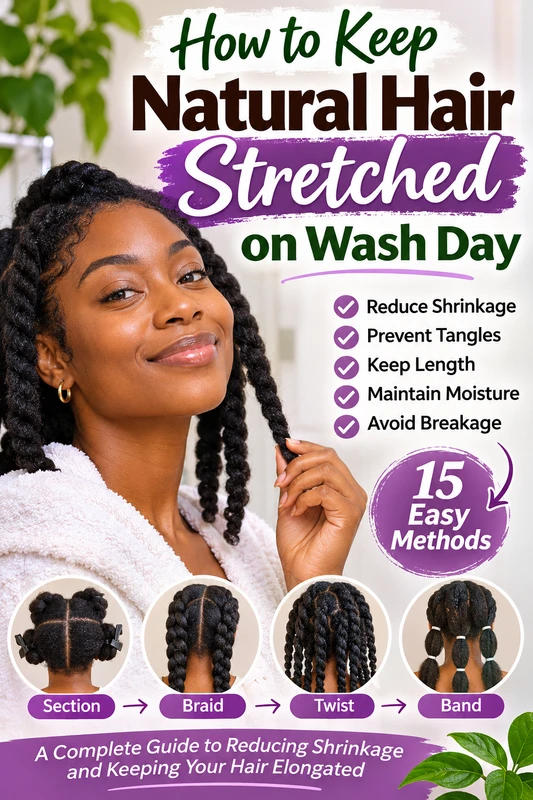
Wash day is an important part of maintaining healthy natural hair, but it can also be frustrating when your freshly washed curls and coils shrink immediately after rinsing.
You may begin wash day with stretched, manageable hair, only to discover that your strands have tightened into compact curls before you finish conditioning.
For women with 4A, 4B, and 4C natural hair, shrinkage can make detangling, moisturizing, drying, and styling more challenging.
The good news is that you can keep natural hair stretched on wash day without constantly using a blow dryer, flat iron, or other heated styling tools.
Simple techniques such as washing in sections, braiding, twisting, banding, and carefully managing moisture can help maintain more visible length while reducing unnecessary tangling.
The secret to keeping natural hair stretched on wash day is to prevent excessive tangling, maintain gentle tension, and keep your hair organized throughout the washing and drying process.
In this complete guide, you'll learn:
-
Why natural hair shrinks during washing
-
How to keep natural hair stretched while shampooing
-
The best heat-free stretching techniques
-
How to stretch 4C hair after washing
-
How to maintain moisture without excessive shrinkage
-
Common mistakes that cause breakage
-
How to preserve stretched natural hair overnight
-
The best wash day routine for healthier-looking, manageable hair
Whether your goal is easier detangling, better length retention, fewer knots, or simply enjoying more visible length, these techniques can help you develop a wash day routine that works for your natural texture.
Why Does Natural Hair Shrink on Wash Day?
Natural hair shrinks because curly and coily strands naturally contract into their characteristic shapes.
When hair becomes wet, temporary hydrogen bonds within the hair are disrupted. As the hair dries, these bonds reform, allowing the strands to settle into their natural curl patterns or the shape created by styling.
This is why natural hair may appear longer while soaking wet but noticeably shorter once it dries.
Tightly coiled textures often experience particularly dramatic shrinkage.
For example, hair that reaches your shoulders when stretched may appear several inches shorter when completely dry.
This does not mean your hair has stopped growing.
It simply means your curls are contracting.
Shrinkage is a normal characteristic of textured hair and often accompanies healthy elasticity, although shrinkage alone cannot determine whether hair is healthy.
For a deeper explanation, read our guide on why natural hair shrinks so much.
Is Keeping Natural Hair Stretched on Wash Day Healthy?
Keeping natural hair gently stretched can be beneficial for certain hair types and styling routines.
When tightly coiled hair contracts, neighboring strands may wrap around one another.
This can contribute to tangling and single-strand knots, particularly when hair is long, dense, or prone to dryness.
Maintaining a stretched arrangement may make some people's hair easier to separate and style.
Potential benefits include:
-
Easier detangling
-
Fewer opportunities for strands to intertwine
-
More visible hair length
-
Easier sectioning
-
More manageable styling
-
Less repeated manipulation
-
Potentially fewer knots for some hair types
However, stretching should never involve painful pulling or excessive tension.
The goal is to keep hair elongated gently, not force it straight.
Stretching also does not directly accelerate hair growth. Its possible benefit to length retention comes from helping reduce avoidable tangling and mechanical damage.
1. Divide Your Hair Into Sections Before Washing
One of the most effective ways to keep natural hair stretched on wash day is to divide it into manageable sections before getting into the shower.
Instead of washing your entire head as one loose mass of curls, separate your hair into approximately four to eight sections.
People with very thick, long, or high-density natural hair may prefer additional sections.
Secure each section using loose twists, braids, or smooth hair clips.
Sectioning helps prevent hair from different areas of your head from becoming intertwined.
It also makes it easier to reach your scalp and distribute products.
How to section natural hair:
-
Separate your hair into four large sections.
-
Divide larger sections further if necessary.
-
Gently remove obvious tangles.
-
Twist or loosely braid each section.
-
Secure the ends without pulling tightly.
-
Keep completed sections organized throughout washing.
Avoid using tight rubber bands that can catch or damage delicate strands.
For more wash day organization tips, read how to reduce wash day time for natural hair.
2. Detangle Before Shampooing When Necessary
Starting wash day with severely tangled hair can make maintaining a stretched arrangement much harder.
When water reaches tangled coils, the strands may contract around existing knots.
For some hair types, gently removing major tangles before shampooing can reduce this problem.
You do not necessarily need to complete a full detangling session before washing.
Instead, focus on separating large tangles and removing trapped shed hairs.
Begin at the ends and gradually work toward the roots.
If your hair feels dry or resistant, apply a suitable detangling product with enough slip before manipulating it.
Never force a comb through stubborn knots.
If your hair is already matted, read our guide on how to detangle matted natural hair without causing breakage.
3. Wash Natural Hair in Loose Twists
Washing natural hair in loose twists can help keep the strands organized.
This technique is particularly useful for women with long or densely packed curls.
Begin by creating several medium-sized two-strand twists.
Wet your scalp thoroughly, apply shampoo, and gently massage the scalp using your fingertips.
Allow water to rinse through the twisted sections.
If the twists are too tight or prevent shampoo from reaching the scalp and strands, loosen or temporarily unravel them.
The objective is effective cleansing without unnecessary tangling.
Important: Washing in twists does not automatically guarantee a thorough cleanse. Make sure shampoo and rinse water reach all areas, especially the roots and interior of dense sections.
After rinsing, gently squeeze out excess water without aggressively rubbing the hair.
4. Keep Hair Elongated While Shampooing
How you handle natural hair during shampooing can influence tangling.
Avoid piling all your hair on top of your head and vigorously rubbing the strands together.
Instead, allow the hair to hang in its natural direction when possible.
Apply shampoo primarily to the scalp.
Use your fingertips to gently massage the scalp rather than scratching with your nails.
As you rinse, allow water to travel downward through the hair.
You can lightly guide the strands with your fingers to prevent them from bunching together.
For long natural hair, work through one section at a time.
Once a section is clean, place it back into a loose twist or braid.
This method helps maintain organization without repeatedly combing or pulling wet hair.
5. Use Conditioner to Improve Slip
Conditioning is essential when preparing natural hair for gentle stretching.
After shampooing, apply a suitable rinse-out conditioner throughout your hair.
Concentrate on the middle lengths and ends, where tangling and dryness may be more noticeable.
Conditioner helps reduce friction between strands and makes detangling easier.
Hair that has enough slip is generally easier to separate without excessive pulling.
Use your fingers to distribute the conditioner before reaching for a comb or brush.
Allow the product to remain on your hair for the time recommended on its label.
Then gently detangle, beginning at the ends.
If you want a more comprehensive routine, explore our simple natural hair care guide.
6. Re-Twist Each Section Immediately After Detangling
One of the biggest wash day mistakes is allowing freshly detangled hair to become tangled again.
You may spend twenty minutes carefully detangling a section, only to leave it loose while working on the rest of your head.
As the hair contracts, neighboring strands can become intertwined.
A better approach is to immediately secure each completed section.
After detangling:
-
Smooth the section gently with your hands.
-
Separate it into two or three strands.
-
Create a loose twist or braid.
-
Secure the ends if necessary.
-
Move to the next section.
Repeat until your entire head is detangled and organized.
This technique can be especially helpful for tightly coiled 4C hair.
7. Use the Banding Method After Washing
Banding is one of the most popular heat-free techniques for stretching natural hair.
It involves placing soft hair bands at intervals along sections of damp hair.
The bands gently hold the strands in an elongated arrangement as they dry.
How to stretch natural hair using banding:
-
Start with freshly washed, conditioned, detangled hair.
-
Apply an appropriate leave-in treatment.
-
Divide your hair into four to eight sections.
-
Gently elongate one section.
-
Place a soft band near the base without pulling tightly.
-
Add additional bands along the length, leaving comfortable spacing.
-
Repeat throughout your hair.
-
Allow the sections to dry completely.
-
Carefully remove each band.
Avoid tightly wrapping bands around your roots or fragile ends.
The hair should feel comfortable throughout the process.
Banding can create noticeable elongation without exposing the strands to direct heat.
For more techniques, read how to stretch natural hair safely.
8. Try Large Braids for a Heat-Free Stretch
Braiding is another excellent way to maintain a stretched appearance after washing.
Unlike some stretching techniques, braiding can also create a defined wave pattern.
Begin with clean, detangled, damp hair.
Apply your preferred leave-in product, then divide your hair into several sections.
Create loose to moderately firm braids without pulling at the scalp.
Allow your hair to dry completely before unraveling.
When removing the braids, separate the strands gently using your fingers.
Avoid immediately brushing through the finished hairstyle.
For more elongation, you may find that several smaller braids work better than two very large braids.
However, smaller braids also require more styling time.
Experiment to find the balance that works for your hair.
9. Use Two-Strand Twists to Maintain Stretch
Two-strand twists are ideal for people who want to keep their hair organized while preserving some natural curl definition.
After washing and conditioning, divide your hair into manageable sections.
Apply a leave-in treatment or suitable moisturizer.
Create two-strand twists while gently smoothing the hair downward.
Avoid pulling the roots tightly.
Allow the twists to dry completely.
Once dry, you can leave them installed as a low-manipulation hairstyle or unravel them for a twist-out.
Twists usually provide a softer, less dramatic stretch than some banding or threading techniques.
However, they are convenient because they can serve as both a stretching method and a finished hairstyle.
10. Consider African Threading
African threading is a traditional heat-free stretching method that can produce substantial elongation.
The technique involves wrapping suitable thread around sections of hair to hold them in an extended position.
When done carefully, threading can help stretch tightly coiled natural hair without a blow dryer.
Start with conditioned, detangled hair.
Divide the hair into sections and wrap each section using appropriate hair-threading materials.
Maintain gentle, even tension.
Avoid wrapping too tightly near the scalp or hairline.
Allow your hair to dry thoroughly before removing the thread.
African threading requires patience and careful installation.
If you are unfamiliar with the technique, consider learning from an experienced natural hair stylist before attempting it yourself.
11. Apply Leave-In Treatment Before Stretching
Maintaining softness and manageability is important when stretching natural hair.
Dry, rough-feeling strands may experience greater friction during manipulation.
After rinsing your conditioner, gently remove excess water using a microfiber towel or soft cotton T-shirt.
Avoid rubbing the hair aggressively.
While your hair is still damp, apply an appropriate leave-in treatment according to its directions.
A product such as Hairobics All Natural Leave-In Treatment can be incorporated into your post-wash hair and scalp care routine.
Its botanical-based formula includes ingredients such as aloe vera, jojoba oil, avocado oil, and other plant-derived components.
The treatment is designed to support hair and scalp conditioning.
Apply the amount appropriate for your hair, avoiding unnecessary saturation if your goal is to maintain a stretched hairstyle.
Remember that a leave-in treatment does not permanently prevent shrinkage.
The stretching technique and drying process are what help temporarily maintain elongation.
12. Avoid Excessive Product Buildup
Using large amounts of heavy styling products does not necessarily keep natural hair stretched longer.
In fact, excessive product layering may leave hair feeling coated, sticky, or difficult to manage.
A simple wash day routine may work better than applying numerous products.
For example:
Shampoo → Conditioner → Leave-In Treatment → Stretching Style
If your hair needs additional conditioning, you may choose to use a small amount of an oil-based product.
Hairobics Hair & Scalp Booster contains ingredients including coconut oil, olive oil, jojoba oil, almond oil, aloe vera, rosemary oil, and vitamin E oil.
It can be used as directed within a hair and scalp conditioning routine.
Because the formula is oil-rich, begin with an appropriate amount rather than heavily coating your hair.
Oils can help lubricate strands, but they do not replace water-based conditioning.
The goal is soft, manageable hair—not unnecessary buildup.
13. Let Your Hair Dry Completely Before Unraveling
Removing braids, twists, or bands too early is a common reason stretched hairstyles lose their shape.
If your hair is still significantly damp when you unravel it, the strands may contract more as they continue drying.
For a more consistent result, allow your hair to dry thoroughly while secured in the stretching style.
Drying time depends on several factors:
-
Hair density
-
Hair length
-
Section size
-
Porosity
-
Product application
-
Air circulation
-
Room humidity
Very dense natural hair may take considerably longer to dry than fine or low-density hair.
Check the roots and interior of each section rather than assuming the surface is completely dry.
Avoid leaving your scalp damp for prolonged periods, especially underneath tightly packed hairstyles.
If necessary, use a hooded dryer or a blow dryer with appropriate precautions to finish drying.
14. Use Low Heat Carefully When Necessary
Although heat-free stretching works well for many people, you may occasionally prefer using a blow dryer.
One option is the tension method.
This involves gently holding a detangled section in an elongated position while directing airflow along the hair.
To reduce the risk of heat damage:
-
Begin with clean, detangled hair.
-
Apply a suitable heat protectant according to its directions.
-
Divide your hair into manageable sections.
-
Use a conservative heat setting.
-
Hold each section with gentle tension.
-
Keep the dryer moving.
-
Avoid repeatedly heating the same area.
-
Stop once you achieve the desired stretch.
Do not assume that a regular leave-in treatment or scalp oil provides adequate heat protection unless it is specifically labeled for that purpose.
Excessive heat can damage the hair shaft and affect the natural curl pattern.
Use heat thoughtfully rather than treating it as a requirement for every wash day.
15. Protect Your Stretched Hair Overnight
Keeping natural hair stretched does not end when wash day is over.
Nighttime maintenance can help preserve your results.
Before sleeping, divide your hair into a few loose sections.
Depending on your hairstyle, you can use large braids, twists, or gentle banding.
Cover your hair with a satin or silk bonnet or scarf.
A smooth pillowcase can provide additional protection from friction.
Avoid sleeping with tight bands or hairstyles that pull at your edges.
In the morning, carefully unravel the sections and shape your hair using your fingers.
You may find that a few minutes of nighttime preparation helps maintain your stretched hairstyle for several days.
How to Keep 4C Natural Hair Stretched on Wash Day
4C natural hair often has tightly packed coils that contract significantly after washing.
Because of this, maintaining organized sections can be especially useful.
The best approach is not to force 4C hair into a straight texture.
Instead, focus on keeping the strands gently elongated and reducing unnecessary manipulation.
A simple 4C wash day stretching routine:
Step 1: Section your hair.
Divide your hair into six to eight manageable sections, adjusting according to density and length.
Step 2: Shampoo gently.
Cleanse the scalp thoroughly while keeping the sections organized.
Step 3: Condition and detangle.
Apply conditioner and work through tangles carefully from ends to roots.
Step 4: Re-twist completed sections.
Prevent detangled hair from becoming intertwined again.
Step 5: Apply leave-in treatment.
Use an appropriate amount on damp hair.
Step 6: Choose a stretching technique.
Try braids, twists, banding, or threading.
Step 7: Dry thoroughly.
Allow enough time for the roots and lengths to dry.
Step 8: Unravel gently.
Remove the stretching style without pulling or excessive combing.
This routine can help make tightly coiled hair easier to manage while maintaining its natural texture.
How to Keep Natural Hair Stretched Without Heat
If your goal is to avoid heat completely, your best options include braiding, twisting, banding, threading, and roller setting.
The most suitable method depends on your desired result.
| Stretching Method | Typical Result |
|---|---|
| Large braids | Elongation with a wavy pattern |
| Two-strand twists | Gentle stretch with curl definition |
| Banding | More elongation with less curl definition |
| African threading | Substantial stretch when applied correctly |
| Roller setting | Elongation with a smooth, rounded shape |
No method guarantees the same result for every person.
Hair texture, length, density, and drying conditions influence how much stretch you achieve.
Experiment with different techniques while prioritizing comfort and gentle handling.
How to Keep Stretched Natural Hair Moisturized
One challenge with stretched natural hair is balancing moisture and hairstyle preservation.
Water-based products can help condition hair, but applying large amounts of water may cause curls to revert toward their natural pattern.
That does not mean you should avoid moisturizing your hair.
Instead, use an appropriate amount based on how your strands feel.
If your ends become dry, lightly moisturize the affected sections.
Avoid repeatedly soaking your entire hairstyle unless you are prepared to restyle it.
For scalp conditioning, Hairobics Scalp Rejuvenator Oil can be incorporated into your routine as directed.
The formula contains botanical oils including olive, rosemary, lavender, peppermint, and tea tree oils.
Use a small amount according to the product instructions, and avoid applying essential-oil-containing products to irritated or broken skin.
Scalp oils do not replace cleansing or treatment for persistent scalp conditions.
A balanced routine should focus on keeping the scalp clean, the hair appropriately conditioned, and the hairstyle comfortable.
Does Stretching Natural Hair Prevent Breakage?
Stretching may help reduce certain types of tangling for some people, but it does not automatically prevent breakage.
The greatest benefit often comes from the habits surrounding the stretching process.
For example, sectioning, gentle detangling, adequate conditioning, and avoiding excessive manipulation can all help protect fragile strands.
However, stretching can also cause damage when performed incorrectly.
Potential problems include:
-
Pulling too tightly
-
Repeatedly stretching fragile hair
-
Using damaging hair accessories
-
Excessive heat exposure
-
Aggressive detangling
-
Neglecting dry or splitting ends
For additional guidance, read how to stop natural hair from breaking.
Remember that retaining length requires protecting the hair you already have, not simply making it appear longer.
Common Mistakes When Stretching Natural Hair on Wash Day
Stretching Hair That Is Severely Tangled
Trying to pull tangled hair into a stretched position can cause snapping and unnecessary breakage.
Detangle carefully before applying tension.
Using Tight Bands
Bands that pull at the roots can create discomfort and damage.
Choose smooth, gentle accessories.
Applying Too Much Heat
Repeated high-heat styling can weaken the hair shaft and affect curl definition.
Use heat protection and conservative settings.
Removing Braids Before Hair Is Dry
Unraveling damp hair can cause the style to lose its stretched appearance more quickly.
Allow adequate drying time.
Skipping Conditioning
Hair that lacks slip may be harder to detangle.
Condition appropriately before stretching.
Repeatedly Combing Finished Styles
Excessive manipulation can disturb the hairstyle and contribute to breakage.
Use your fingers when possible.
Keeping Hair Under Constant Tension
Your scalp and hairline need protection.
Avoid styles that create pain, pulling, or tenderness.
A Simple Weekly Routine for Maintaining Stretched Natural Hair
You can maintain a stretched hairstyle without repeating the entire wash day process every morning.
Wash Day
Cleanse your scalp, condition your hair, detangle in sections, apply suitable leave-in care, and choose a stretching method.
Days 2–3
Wear your stretched hairstyle with minimal manipulation.
Protect your hair at night using loose braids or twists and a satin bonnet.
Midweek
Check your ends and scalp.
If your hair feels dry, apply a modest amount of appropriate moisturizing product where needed.
Avoid repeatedly layering products over buildup.
Before Your Next Wash
Evaluate whether your hair needs cleansing.
Remove trapped shed hairs carefully and address tangles before shampooing.
The ideal schedule depends on your lifestyle, scalp condition, hairstyle, and product use.
For help planning your cleansing schedule, read how often you should wash natural hair.
Frequently Asked Questions About Keeping Natural Hair Stretched
How do I keep my natural hair stretched after washing?
After shampooing and conditioning, detangle your hair in sections, apply suitable leave-in care, and secure each section using braids, twists, banding, or another gentle stretching method. Allow the hair to dry completely before unraveling.
What is the best way to stretch 4C hair without heat?
Banding, braiding, African threading, and two-strand twists are useful options. The best technique depends on your hair length, density, and preferred finished hairstyle.
Should I stretch natural hair while wet or dry?
Many heat-free stretching methods work well on damp, detangled hair. Hair that is soaking wet may take longer to dry, while very dry, tangled hair may be difficult to manipulate safely.
Does braiding natural hair prevent shrinkage?
Braiding can temporarily maintain a more elongated shape while hair dries. However, it does not permanently prevent shrinkage. Water and humidity can cause the hair to revert.
Can I wash natural hair while it is braided?
Yes, loose braids can help keep hair organized during washing. However, you must ensure shampoo and rinse water reach the scalp and all strands. Loosen or unravel sections when necessary for thorough cleansing.
Does stretching natural hair make it grow faster?
No. Stretching changes the appearance of existing hair rather than increasing the biological rate of growth. It may help some people retain length when it reduces tangling and breakage.
How long does stretched natural hair last?
Results vary depending on humidity, exercise, hair texture, styling products, and nighttime maintenance. Some people maintain a stretched style for several days, while others experience faster reversion.
Can I stretch my natural hair every wash day?
Yes, gentle stretching can be part of a regular routine if your hair tolerates it well. Avoid excessive tension, unnecessary heat, and repeated rough manipulation.
Why does my natural hair shrink immediately after washing?
Water temporarily changes the bonds that influence hair shape. As curls and coils dry, they naturally contract. Keeping hair organized in a stretching style during drying can help maintain more visible length.
What products should I use to keep natural hair stretched?
A suitable shampoo, rinse-out conditioner, leave-in treatment, and optional styling product may be sufficient. The stretching method itself plays a major role in the result. No single product permanently eliminates natural shrinkage.
Final Thoughts: Keep Natural Hair Stretched Without Sacrificing Hair Health
Learning how to keep natural hair stretched on wash day can make your routine more manageable, especially if you have tightly coiled, thick, or highly shrinkage-prone hair.
The most effective approach begins before shampooing.
Divide your hair into sections, remove major tangles, and avoid allowing strands to become unnecessarily intertwined.
During washing, cleanse gently and use conditioner to improve slip.
After rinsing, apply appropriate leave-in care and choose a stretching technique that works for your hair.
Braids, twists, banding, African threading, and roller sets can all help create temporary elongation without relying on direct heat.
Most importantly, remember that healthy natural hair does not have to remain stretched to be beautiful or well maintained.
Shrinkage is a normal part of having curls and coils.
The purpose of stretching is to give you another styling option while supporting easier handling and, potentially, better length retention.
A consistent routine built around gentle cleansing, conditioning, careful detangling, and protecting your ends will do more for your hair over time than aggressively chasing maximum length.
Whether you wear your hair in a stretched twist-out, braid-out, protective style, or naturally shrunken Afro, prioritize softness, comfort, and healthy hair-care habits.
Ready to build a better natural hair wash day routine?
Explore Hairobics All Natural Leave-In Treatment and discover botanical-based hair and scalp care products designed to complement your natural hair journey.
Visit HairobicsAllNatural.com to explore our complete collection.