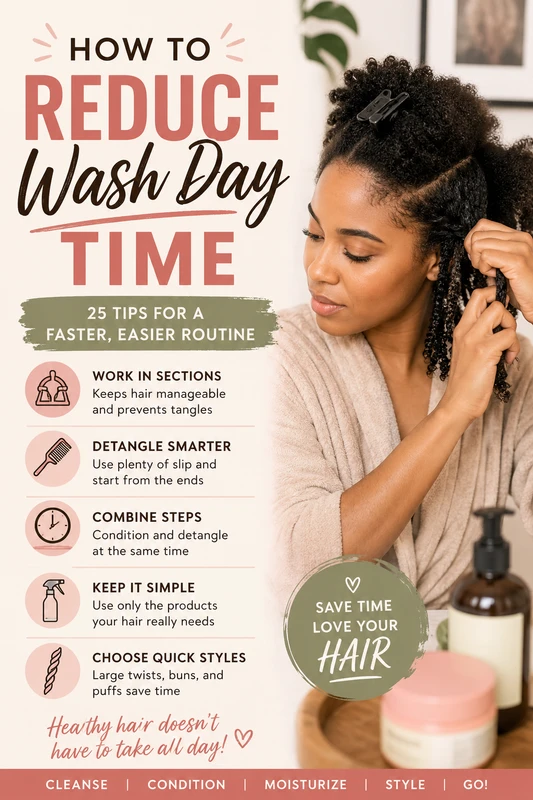
For many people with natural hair, wash day can feel like an all-day event. Between detangling, shampooing, conditioning, deep conditioning, rinsing, moisturizing, drying, and styling, what sounds like a simple hair-washing routine can easily take several hours.
The good news is that caring for natural hair does not have to consume your entire day.
With better preparation, the right techniques, fewer unnecessary steps, and a routine designed around your hair's actual needs, you can dramatically reduce wash day time without sacrificing healthy hair.
Whether you have thick 4C hair, loose curls, long natural hair, short natural hair, transitioning hair, or a protective style, the goal isn't to rush through your routine. The goal is to make every step more efficient.
In this complete guide, we'll explain how to reduce wash day time for natural hair, which steps tend to take the longest, how to detangle faster, how to organize your products, and how to build a simple wash day routine that keeps your hair clean, moisturized, manageable, and healthy.
Why Does Natural Hair Wash Day Take So Long?
Before shortening your routine, it helps to understand where all that time goes.
Natural and textured hair can require more hands-on care because curls, coils, and kinks make it more difficult for natural scalp oils to travel down the hair shaft.
Hair can also wrap around neighboring strands, creating tangles and knots.
As hair becomes longer or thicker, detangling and styling can take even more time.
A typical natural hair wash day may include:
- Pre-pooing
- Sectioning
- Detangling
- Shampooing
- Scalp cleansing
- Rinsing
- Conditioning
- Deep conditioning
- Another round of detangling
- Rinsing again
- Applying leave-in conditioner
- Applying oil
- Applying cream
- Applying styling products
- Drying
- Twisting, braiding, or styling
When every possible hair-care step is included in a single day, it isn't surprising that wash day can become exhausting.
The solution isn't necessarily doing everything faster.
Sometimes the solution is simply doing less.
1. Stop Doing Every Hair Treatment on the Same Day
One of the biggest ways to reduce wash day time is to stop treating every wash as a complete hair restoration session.
Your hair may not need:
- A pre-poo
- Clarifying shampoo
- Regular shampoo
- Protein treatment
- Deep conditioner
- Hot oil treatment
- Scalp treatment
- Leave-in
- Oil
- Cream
- Gel
all on the same day.
Instead, determine what your hair actually needs.
For example, one week might simply be:
Shampoo → Condition → Moisturize → Style
A different wash day might include a deep-conditioning treatment.
A clarifying shampoo could be reserved for when you have significant product buildup.
Protein treatments can be used according to your hair's needs rather than automatically applying them every wash.
Removing unnecessary steps can potentially save a significant amount of time.
2. Detangle Before You Get in the Shower
Detangling is often one of the longest parts of natural hair wash day.
Trying to detangle severely tangled hair while shampooing can make the entire process more difficult.
Instead, lightly detangle before washing.
Divide your hair into manageable sections and gently remove shed hairs and major tangles.
You don't necessarily need to achieve perfectly detangled hair before shampooing. The goal is to prevent the hair from entering the wash process already heavily tangled.
This can make shampooing, conditioning, and styling much easier.
3. Keep Your Hair in Sections
Sectioning can completely change wash day for people with thick, long, tightly coiled, or highly shrinkage-prone hair.
Instead of washing your entire head as one mass of hair, divide it into approximately four to eight sections.
Secure each section loosely with:
- Hair clips
- Scrunchies
- Loose twists
- Hair ties designed to minimize snagging
Then work through one section at a time.
Sectioning helps prevent clean, detangled hair from becoming tangled again while you work on another area.
For very dense natural hair, this can be particularly helpful.
4. Don't Create More Tangles While Shampooing
Sometimes the shampooing technique creates the tangles that take another hour to remove.
Avoid piling your hair on top of your head and aggressively rubbing everything together.
Instead, concentrate primarily on cleansing your scalp.
Massage shampoo into your scalp using the pads of your fingertips.
Then gently work the cleanser through your hair as needed.
When rinsing, allow the water to travel downward through your strands.
The less you manipulate your hair unnecessarily, the less detangling you may have to do later.
5. Use Products With Plenty of Slip
A conditioner with good "slip" allows your fingers or detangling tool to glide through your hair more easily.
This can make an enormous difference in detangling time.
If your conditioner leaves your hair feeling rough and difficult to separate, you may spend much longer fighting knots.
When applying conditioner, make sure your hair is adequately saturated and give the product time to distribute through your strands.
Then detangle from the ends upward.
Never begin aggressively pulling through tangles from the roots toward the ends.
6. Finger-Detangle Major Knots First
Before grabbing your brush or comb, use your fingers.
Your fingers can detect knots that a comb may simply rip through.
Separate large tangles carefully and remove loose shed hairs.
After you've completed the initial detangling, you can follow with a wide-tooth comb or detangling brush if desired.
This two-stage approach may sound like extra work, but it can actually make the overall process faster because you spend less time fighting difficult tangles with a tool.
7. Detangle From the Ends Up
One of the simplest ways to make detangling easier is to start at the ends.
Hold a section of hair firmly but gently above the area you're working on.
Begin detangling the last few inches.
Once they're manageable, move slightly higher.
Continue until you reach the roots.
Trying to drag a comb from the roots through several inches of tangled hair can push small tangles together into larger knots.
Working upward gradually is usually more manageable.
8. Detangle Once Whenever Possible
Some natural hair routines involve detangling the hair three or four times during a single wash day.
That can add substantial time.
For example:
Detangle before shampoo.
Detangle during shampoo.
Detangle during conditioning.
Detangle again before styling.
Instead, try to complete one thorough detangling session during the stage when your hair has the most slip—often while conditioner is applied.
Afterward, keep the section twisted or clipped so it doesn't tangle again.
The goal is simple:
Once a section is detangled, keep it detangled.
9. Wash Your Hair Before It Becomes Severely Tangled
Waiting too long between washes can sometimes make wash day longer.
Over time, shed hairs can remain trapped inside curls and coils.
Those strands can wrap around other hairs and contribute to tangling.
Product buildup may also accumulate.
When wash day finally arrives, you may be dealing with weeks of shed hair, knots, buildup, and dryness.
Finding a wash schedule that works for your scalp, lifestyle, hairstyle, and hair needs may help keep each individual wash more manageable.
10. Keep Your Wash Day Products Together
You shouldn't spend 20 minutes searching for a detangling brush, clips, conditioner, or leave-in treatment.
Create a dedicated wash day station or basket.
Keep commonly used items together, such as:
- Shampoo
- Conditioner
- Deep conditioner
- Leave-in treatment
- Scalp products
- Detangling brush
- Wide-tooth comb
- Sectioning clips
- Spray bottle
- Towels
- Styling products
Before starting, make sure everything you need is accessible.
Organization doesn't change your hair, but it can make your routine considerably more efficient.
11. Simplify Your Product Routine
Natural hair routines became extremely complicated during the era of 10-step and 12-step hair regimens.
More products do not automatically equal healthier hair.
If you're applying:
Leave-in conditioner.
Then oil.
Then cream.
Then butter.
Then gel.
Then mousse.
Then edge control.
you may be adding unnecessary time and product buildup.
Instead, identify the products that consistently give you the results you want.
Your post-wash routine might be as simple as:
Leave-in treatment → Styling product
Some people may prefer:
Leave-in → Oil → Styling cream
The exact combination depends on your hair.
The important thing is not adding products simply because they're popular on social media.
12. Deep Condition While Doing Something Else
If you deep condition for 20–30 minutes, that doesn't have to be 30 minutes of standing in the bathroom.
Apply your treatment, cover your hair as directed, and use the processing time for something else.
You could:
- Shower
- Get dressed
- Prepare breakfast
- Clean the bathroom
- Answer emails
- Organize your clothes
- Complete part of your skincare routine
This doesn't technically shorten the conditioning period, but it reduces the amount of your day devoted exclusively to your hair.
13. Don't Deep Condition Longer Than Necessary
Leaving a deep conditioner on your hair for hours isn't automatically better.
Follow the product's instructions unless you have a specific reason for doing otherwise.
If a treatment is designed to work within 10–20 minutes, leaving it on for three hours may simply make wash day three hours longer.
Efficient hair care means allowing products enough time to work without assuming that longer always means better.
14. Use a Shower Detangling Routine
The shower can be an excellent place to detangle because water and conditioner help provide lubrication.
After applying conditioner, divide your hair into sections.
Take one section.
Add water if necessary.
Finger-detangle.
Use your preferred detangling tool.
Twist the completed section.
Move to the next section.
By the time you finish, your hair is conditioned, detangled, and organized for rinsing.
Combining compatible steps is one of the easiest ways to reduce total wash day time.
15. Let Water Do Some of the Work
Water pressure can help separate strands and remove loose shed hairs.
While rinsing, allow your hair to hang naturally downward when possible.
Use your fingers to gently guide water through the strands.
Instead of constantly scrubbing, rubbing, and manipulating your hair, allow the water to assist you.
Natural hair often responds better to deliberate manipulation than aggressive handling anyway.
16. Prevent Tangles During the Week
A faster wash day actually begins several days before you shampoo.
The more tangled your hair becomes between washes, the longer your next detangling session may take.
Protect your hair at night.
Consider using:
- A satin bonnet
- Satin scarf
- Satin pillowcase
- Loose twists
- Loose braids
- Pineapple method for appropriate curl patterns
Keeping your hair organized while sleeping can reduce matting and tangling.
If your hairstyle allows it, separating your hair into a few loose sections at night may make wash day easier.
17. Avoid Excessive Manipulation Between Washes
Constantly restyling natural hair can create more tangles.
If you're brushing, combing, fluffing, separating, twisting, untwisting, and restyling your hair every day, strands have more opportunities to wrap around each other.
Low-manipulation hairstyles can reduce the amount of work required during your next wash day.
Examples include:
- Two-strand twists
- Braids
- Buns
- Flat twists
- Updos
- Stretched natural hairstyles
Choose styles that fit your hair and don't place excessive tension on your scalp.
18. Stretch Your Hair Before Styling
Shrinkage is a beautiful and normal characteristic of textured hair, but styling tightly shrunken hair can sometimes take longer.
If your desired hairstyle works better on stretched hair, consider stretching it after washing.
Methods can include:
- Banding
- Braiding
- Twisting
- African threading
- Tension blow-drying with appropriate heat precautions
Stretched hair may be easier to section and style because the strands are less tightly intertwined.
However, stretching is optional.
If you prefer wearing your natural shrinkage, there's no requirement to stretch your hair.
19. Choose Faster Hairstyles
Your wash day hairstyle can easily become the longest part of the entire routine.
A detailed twist-out with 40 small twists will naturally take longer than eight large twists.
Tiny braids may take much longer than a simple puff or bun.
When you're short on time, choose a style based partly on how long it takes to install.
Faster options might include:
- Large two-strand twists
- Chunky twist-outs
- Large braid-outs
- Wash-and-go styles
- Puffs
- Simple buns
- Ponytails
- Headband styles
Save elaborate hairstyles for days when you actually have the time.
20. Use Larger Sections When Appropriate
Not every part of your routine requires tiny sections.
Very small sections can dramatically increase styling time.
If your hair allows it, use larger sections for:
- Shampooing
- Conditioning
- Moisturizing
- Blow-drying
- Twisting
- Braiding
You can always make sections smaller around areas that tangle more easily.
21. Create a Regular Wash Day Schedule
When wash day happens randomly, it's easy to feel unprepared.
A consistent routine makes the process more predictable.
For example:
Sunday morning: Wash and condition
Sunday afternoon: Simple protective or low-manipulation style
Then maintain the hairstyle during the week.
The exact frequency should depend on your scalp, lifestyle, exercise habits, hairstyle, and hair needs.
There isn't one universal schedule for every person with natural hair.
The goal is consistency.
22. Separate Your "Quick Wash" From Your "Full Wash"
Not every wash needs to be identical.
You can create two routines.
Quick Wash Day
Your basic routine could be:
- Shampoo
- Condition and detangle
- Rinse
- Apply leave-in
- Style
Full Treatment Wash Day
Periodically, when needed, your routine might include:
- Pre-treatment
- Clarifying shampoo
- Deep conditioning
- Thorough detangling
- Scalp treatment
- Moisturizing
- Styling
Your full treatment routine might take significantly longer, but it doesn't necessarily have to happen every wash day.
23. Try a 60-Minute Natural Hair Wash Day
Can natural hair wash day really take approximately an hour?
For some people, yes.
Hair density, length, condition, styling preferences, and detangling needs vary considerably, so an hour won't be realistic for everyone.
But here's an example of how a streamlined routine might look.
Minutes 0–10: Section and Shampoo
Divide your hair into several sections and thoroughly cleanse your scalp and hair.
Minutes 10–30: Condition and Detangle
Apply conditioner and detangle section by section.
Twist each completed section.
Minutes 30–35: Rinse
Rinse while keeping the hair organized.
Minutes 35–45: Moisturize
Apply leave-in conditioner and any additional moisturizing products your hair needs.
Minutes 45–60: Simple Style
Install several large twists, braids, or another low-manipulation hairstyle.
Done.
If your hair requires longer detangling or styling, you might need 90 minutes or two hours.
That's still very different from spending six hours on wash day.
24. Use a Timer
It is surprisingly easy to lose track of time during wash day.
Try timing each section of your routine.
For example:
Detangling: 20 minutes
Shampooing: 10 minutes
Conditioning: 20 minutes
Moisturizing: 10 minutes
Styling: 30 minutes
A timer helps you identify exactly where your time is going.
You might discover that washing isn't actually the problem.
Perhaps you're spending two hours installing tiny twists afterward.
Once you identify your biggest time-consuming step, you can focus on improving it.
25. Stop Trying to Make Every Wash Day Perfect
Natural hair doesn't have to look Instagram-ready after every shampoo.
Sometimes your hair simply needs to be:
Clean.
Conditioned.
Moisturized.
Protected.
That's enough.
You don't need an elaborate twist-out every week.
You don't need perfect parts.
You don't need 30 identical twists.
You don't need to spend hours styling your edges.
A practical routine that you can consistently maintain is often more useful than an elaborate routine that leaves you dreading wash day.
How to Reduce Detangling Time on Wash Day
Because detangling is such a major part of natural hair maintenance, it deserves extra attention.
Try following this approach:
Step 1: Divide Your Hair
Start with approximately four to eight sections.
Step 2: Add Moisture and Slip
Use water and an appropriate conditioner or detangling product.
Step 3: Finger-Detangle
Separate large tangles with your fingers.
Step 4: Start at the Ends
Gradually work upward.
Step 5: Use a Detangling Tool
If desired, follow with your preferred comb or brush.
Step 6: Twist the Section
Immediately twist or clip the detangled section.
Step 7: Leave It Alone
Don't repeatedly comb the same section unless necessary.
This system prevents you from undoing your own work.
How to Reduce Wash Day Time for 4C Hair
4C hair can have significant shrinkage and densely packed coils, which can make detangling especially important.
The goal isn't to aggressively straighten or stretch the texture.
Instead, focus on organization.
Try:
- Washing in sections
- Keeping hair stretched between washes when desired
- Detangling with plenty of slip
- Preventing matting at night
- Using low-manipulation hairstyles
- Working from ends toward roots
- Twisting completed sections immediately
- Avoiding unnecessary combing
If you have very dense 4C hair, fewer well-organized steps may make a bigger difference than trying to move faster.
How to Reduce Wash Day Time for Long Natural Hair
Long natural hair presents a different challenge.
The longer your hair becomes, the more opportunity strands have to wrap around each other.
Sectioning becomes particularly useful.
Avoid allowing long wet hair to move around freely if it tends to tangle.
After detangling each section, place it in a loose twist.
When applying leave-in products, work through those same sections.
When styling, use those sections as your starting point.
Think of your hair as several smaller manageable areas instead of one large head of hair.
How to Reduce Wash Day Time for Thick Hair
Hair density can dramatically affect wash time.
People with thick hair may struggle to get shampoo, conditioner, and water all the way to the scalp.
Instead of repeatedly adding more product, divide the hair.
Smaller sections give you direct access to your scalp.
A handheld showerhead can also make rinsing dense hair easier if you have one available.
Make sure shampoo and conditioner are thoroughly rinsed from dense areas before moving on.
Wash Day Mistakes That Waste Time
Sometimes shortening wash day isn't about learning new techniques. It's about eliminating inefficient habits.
Common mistakes include:
Using Too Many Products
Every additional product takes time to apply and may eventually contribute to buildup.
Detangling Repeatedly
Once your hair is detangled, keep it organized.
Starting With Extremely Tangled Hair
Prevent tangles throughout the week.
Using Tiny Sections for Everything
Reserve tiny sections for styles that genuinely require them.
Leaving Treatments on Too Long
Follow product instructions.
Trying New Techniques Every Week
Constant experimentation can make your routine unpredictable.
Styling Without a Plan
Decide what hairstyle you're doing before you begin washing.
Prepare Your Hairstyle Before Wash Day
One surprisingly effective wash day hack is knowing exactly what you're going to do with your hair afterward.
Before shampooing, decide:
"Today I'm doing eight chunky twists."
or:
"I'm wearing a wash-and-go."
or:
"I'm putting my hair into a low-manipulation bun."
This determines how you should section and prepare your hair.
If you don't have a plan, you can finish washing your hair and spend another hour trying to decide what to do with it.
Create a Wash Day Kit
Consider keeping a basket exclusively for wash day.
Your kit might contain:
- Shampoo
- Conditioner
- Deep conditioner
- Leave-in treatment
- Detangling brush
- Wide-tooth comb
- Hair clips
- Satin scrunchies
- Spray bottle
- Microfiber towel or cotton T-shirt
- Scalp oil
- Styling product
When wash day arrives, grab one basket.
Everything is ready.
Should You Pre-Poo to Save Time?
Pre-pooing can be useful for some hair routines, particularly when it makes detangling or shampooing easier.
But if your main goal is shortening wash day, evaluate whether the step actually helps your hair.
Ask yourself:
Does pre-pooing reduce my detangling time?
Does my hair feel noticeably better?
Does it make shampooing easier?
If the answer is yes, keep it.
If pre-pooing adds 45 minutes without a noticeable benefit, you may decide it isn't necessary for every wash.
Natural hair routines should be individualized rather than based entirely on trends.
Should You Deep Condition Every Wash Day?
Deep conditioning can be a valuable part of a hair-care routine, but frequency depends on your hair, products, styling practices, and needs.
You don't necessarily need to turn every wash into an extended conditioning session.
A regular rinse-out conditioner may be enough for some washes, while a deeper treatment can be incorporated when appropriate.
Pay attention to how your hair responds.
Nighttime Care Can Make Wash Day Faster
One of the most underrated wash day strategies happens while you're sleeping.
Protecting your hair at night can reduce:
- Friction
- Tangling
- Matting
- Moisture loss
- Excessive manipulation the following morning
Cover your hair with satin or silk material, or use an appropriate pillowcase.
If your hair tangles easily, consider loosely sectioning it before bed.
Five minutes of preparation at night can potentially save much more time during detangling later.
A Simple Wash Day Routine for Busy Women
If you have work, children, errands, school, or other responsibilities, spending half a day washing your hair may simply not be practical.
Try this streamlined routine:
Step 1: Section
Divide your hair into four to eight sections.
Step 2: Shampoo
Focus on your scalp and cleanse thoroughly.
Step 3: Condition and Detangle
Combine these two steps.
Step 4: Rinse
Keep the sections organized.
Step 5: Apply Leave-In
Work through your existing sections.
Step 6: Choose a Simple Style
Use large twists, braids, a wash-and-go, bun, puff, or another manageable hairstyle.
That's it.
Your hair-care routine doesn't have to contain ten different steps to be effective.
Frequently Asked Questions About Reducing Wash Day Time
How long should natural hair wash day take?
There is no universal time. Hair length, density, tangling, styling choices, and routine complexity can make wash day anywhere from under an hour to several hours.
Instead of comparing yourself to someone else's routine, track your own wash day and look for unnecessary steps.
How can I wash my natural hair faster?
Wash in sections, combine conditioning and detangling, minimize unnecessary treatments, organize your products beforehand, and choose a simple post-wash hairstyle.
Why does detangling take me so long?
Your hair may be accumulating shed hairs or becoming tangled between washes. You may also be using too little slip, working with sections that are too large, or starting from the roots instead of the ends.
Is it okay to wash natural hair in sections?
Yes. Section washing can be particularly helpful for long, thick, tightly coiled, or easily tangled hair.
How many sections should I use?
Four to eight sections are a good starting point, but the ideal number depends on your hair's length and density.
How can I stop my natural hair from tangling during washing?
Keep your hair sectioned, avoid piling it on top of your head, use downward motions when possible, and twist each section after detangling.
Can I skip deep conditioning?
Your conditioning routine should be based on your hair's needs. Not every wash necessarily requires an extended deep-conditioning treatment.
What is the fastest natural hairstyle after washing?
Large twists, chunky braids, puffs, buns, and some wash-and-go routines can be relatively quick. The fastest option depends on your hair texture, length, and preferred finished look.
The Ultimate Wash Day Time-Saving Checklist
Before wash day:
- Decide on your hairstyle.
- Gather all products and tools.
- Separate major tangles if necessary.
- Set out your clips and detangling tools.
During washing:
- Work in sections.
- Focus shampoo on your scalp.
- Avoid unnecessary rubbing.
- Condition and detangle together.
- Start detangling from the ends.
- Twist each completed section.
After washing:
- Keep hair sectioned.
- Apply only the products you need.
- Choose a manageable hairstyle.
- Avoid repeatedly combing detangled hair.
During the week:
- Protect your hair while sleeping.
- Minimize unnecessary manipulation.
- Prevent severe tangling.
- Maintain moisture according to your hair's needs.
Final Thoughts: Wash Day Doesn't Have to Take All Day
Learning how to reduce wash day time is less about rushing and more about creating an efficient natural hair routine.
The biggest improvements often come from simple changes: wash your hair in sections, prevent tangles throughout the week, combine conditioning and detangling, use products with good slip, stop repeating steps, and choose simpler hairstyles when you're short on time.
Most importantly, stop believing that a natural hair routine has to be complicated to be effective.
Healthy hair care is about consistency, gentle handling, proper cleansing, adequate conditioning, moisture, and protecting your strands from unnecessary damage.
Once you develop a routine that works for your specific hair, wash day becomes more predictable and manageable.
Instead of losing an entire Saturday or Sunday to your hair, you can clean, condition, moisturize, and style efficiently—and get on with the rest of your day.