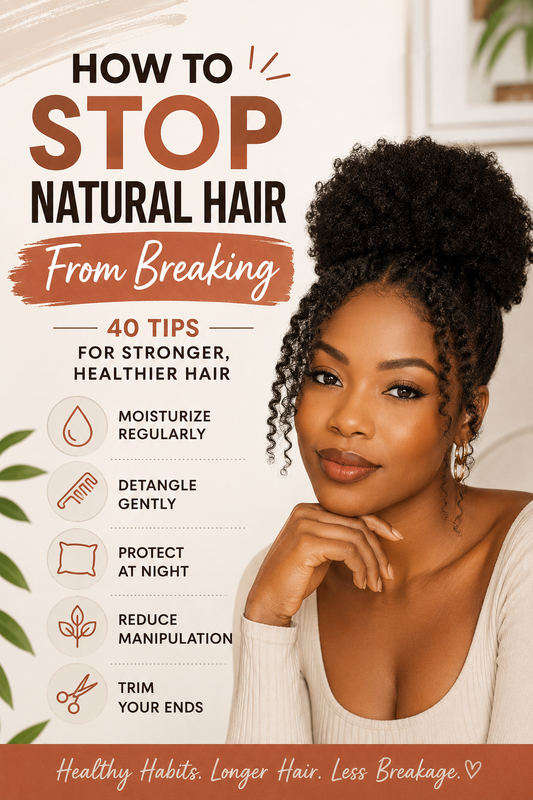
Natural hair can be incredibly strong, versatile, and beautiful, but it can also be vulnerable to breakage when it becomes dry, tangled, overworked, or improperly handled. If it seems like your hair is growing but never getting longer, excessive breakage could be one of the reasons.
Learning how to stop natural hair from breaking isn't about finding one miracle oil or product. Healthy length retention usually comes from combining moisture, gentle handling, scalp care, protective styling, proper detangling, and a consistent natural hair routine.
This guide explains why natural hair breaks, how to recognize excessive breakage, what you can do to reduce it, and how to build a routine that supports stronger, healthier-looking hair from root to tip.
Why Does Natural Hair Break So Easily?
Natural hair has a unique structure. Curly, coily, and kinky strands bend and curve repeatedly from the root toward the ends. These bends can create points along the strand that are more vulnerable to dryness and mechanical stress.
Natural scalp oils also have a harder time traveling down tightly curled strands compared with straighter hair.
As a result, the ends of natural hair can become especially dry.
Dryness alone isn't always responsible for breakage. Hair can also break because of:
- Excessive manipulation
- Rough detangling
- Tight hairstyles
- Heat damage
- Chemical processing
- Split ends
- Lack of conditioning
- Excessive protein treatments
- Product buildup
- Improper nighttime protection
- Friction from clothing or bedding
- Keeping protective styles installed too long
- Frequently wearing the same high-tension style
The goal shouldn't be to prevent every single broken strand. Some shedding and occasional breakage are normal.
Instead, focus on reducing excessive breakage so that your hair has a better opportunity to retain the length it grows.
Breakage vs. Shedding: Know the Difference
Before changing your hair routine, determine whether you're dealing with breakage or normal shedding.
Hair shedding
Hair naturally goes through growth and resting cycles. Eventually, individual hairs are released from the follicle.
A shed hair usually comes out as a relatively complete strand and may have a tiny bulb-like appearance at one end.
Hair breakage
Breakage happens when the hair shaft snaps somewhere between the root and the end.
You may notice:
- Short pieces of hair in the sink
- Tiny hairs on your clothes
- Broken strands during detangling
- Uneven areas throughout your hair
- Ends that continually become thinner
- Hair that grows at the roots but doesn't seem to gain length
If you're seeing lots of short pieces during your normal routine, reducing breakage should become a priority.
1. Keep Natural Hair Properly Moisturized
One of the most important steps for reducing natural hair breakage is maintaining adequate moisture.
When natural hair becomes excessively dry, it can lose flexibility. Instead of bending when manipulated, dry strands may snap.
Think about the difference between a dry twig and a flexible green branch.
Your hair isn't a tree branch, of course, but the principle helps explain why flexibility matters.
How to moisturize natural hair
A basic moisture routine might include:
- Cleansing the hair and scalp as needed.
- Applying conditioner.
- Deep conditioning when appropriate.
- Applying a water-based leave-in or moisturizer.
- Using an oil, butter, cream, or styling product when needed to help maintain softness.
Water is the primary source of hydration.
Oil can be useful in a natural hair routine, but oil alone doesn't replace water.
If your hair constantly feels dry despite using oil, try applying your moisturizer or leave-in first and then using a small amount of oil afterward.
2. Don't Wait Until Your Hair Is Extremely Dry
Many people wait until their hair feels rough before moisturizing it.
A better approach is to pay attention to your hair before it reaches that stage.
Touch your hair regularly.
Ask yourself:
Does it still feel soft and flexible?
If not, it may be time to refresh your moisture.
Some people need additional moisture every couple of days, while others can go considerably longer.
There is no universal schedule.
Your hair's:
- Porosity
- Density
- Strand thickness
- Environment
- Hairstyle
- Product selection
- Wash frequency
can all affect how quickly it loses moisture.
3. Deep Condition Regularly
Deep conditioning can be an important part of a breakage-prevention routine, particularly for hair that frequently feels dry or difficult to manage.
A good deep conditioner can improve softness and make detangling easier.
And easier detangling can mean less mechanical damage.
Many people with natural hair deep condition approximately once every one to two weeks, but your ideal schedule depends on your hair.
Pay attention to how your strands respond.
More isn't necessarily better.
Follow the directions on the product you're using rather than assuming that leaving a conditioner on for hours will produce better results.
4. Be Extremely Gentle When Detangling
Detangling is one of the easiest times to accidentally break natural hair.
Imagine trying to pull a comb through a tightly tangled section.
The comb meets resistance.
You pull harder.
Eventually, something has to give.
Unfortunately, that something may be your hair.
Instead, slow down.
A gentler detangling method
Divide your hair into manageable sections.
Apply water, conditioner, leave-in conditioner, or a detangling product that provides good slip.
Start near the ends.
Carefully work through tangles before gradually moving higher toward the roots.
When you encounter a knot, don't immediately force your comb through it.
Use your fingers to gently separate the strands when possible.
The objective is not speed.
The objective is preserving your hair.
5. Detangle in Sections
Trying to detangle your entire head at once can quickly become overwhelming, especially with thick or long natural hair.
Sections make the process easier to control.
Depending on your hair density, you might create:
- 4 sections
- 6 sections
- 8 sections
- Or more
After detangling one section, twist or braid it loosely before moving to the next.
This helps prevent freshly detangled hair from becoming tangled again.
Sectioning can also be helpful during:
- Shampooing
- Conditioning
- Moisturizing
- Styling
- Product application
Less chaos often means less unnecessary manipulation.
6. Stop Detangling Natural Hair Aggressively While Dry
For many people with tightly textured hair, aggressive dry detangling increases the chance of breakage.
Dry strands may have less flexibility and slip.
That doesn't mean every person must completely soak their hair before touching it.
Instead, determine the detangling state that works best for your texture.
Many people find success using:
- Damp hair
- Conditioner-coated hair
- Leave-in conditioner
- Detangling spray
- Moisturizing mist
The important thing is to create enough lubrication and flexibility to separate strands without unnecessary force.
7. Use the Right Detangling Tools
The tool you use can make a major difference.
Popular options include:
- Fingers
- Wide-tooth combs
- Flexible detangling brushes
Avoid tools with rough seams or damaged teeth that can snag individual strands.
You should also clean your combs and brushes regularly.
Look at the hair caught in your brush after detangling.
Some hair is expected.
But if you're consistently seeing large amounts of short broken pieces, reconsider your technique, products, and tools.
8. Start Detangling From the Ends
This simple change can prevent a surprising amount of unnecessary stress.
Don't put your comb at your roots and drag every knot toward your ends.
Start at the bottom.
Detangle the last few inches.
Then move slightly higher.
Continue gradually until the entire section is detangled.
Working from the ends upward allows you to remove knots individually instead of compacting multiple tangles together.
9. Protect Your Ends
If your goal is longer natural hair, your ends deserve special attention.
Your ends are the oldest part of your hair.
If your hair is several years old, the ends have experienced years of:
- Washing
- Styling
- Detangling
- Weather exposure
- Clothing friction
- Product application
- Sleeping
- Manipulation
They naturally need more protection than newer growth.
Pay attention to your ends when moisturizing.
Avoid constantly brushing them.
And consider hairstyles that keep your ends tucked away when practical.
Healthy-looking ends are a major part of length retention.
10. Trim Damaged and Split Ends
Holding onto severely damaged ends doesn't necessarily help you achieve longer-looking hair.
Split ends can make the bottom of your hair appear thin, rough, and uneven.
A trim can create a healthier-looking foundation.
How often should you trim natural hair?
There isn't one perfect schedule.
Some people prefer scheduled trims, while others trim according to the condition of their ends.
Signs you may need a trim include:
- Persistent split ends
- Excessive single-strand knots
- Rough ends
- Transparent-looking ends
- Ends that tangle constantly
- Uneven or damaged sections
Trimming doesn't make hair grow faster from your scalp.
It can, however, remove damaged ends that are more prone to further splitting and breakage.
11. Reduce Excessive Manipulation
Natural hair doesn't necessarily need to be restyled every day.
Constant manipulation adds wear and tear.
Consider everything that happens when you repeatedly:
- Comb
- Brush
- Part
- Twist
- Braid
- Pull
- Slick
- Tie
- Stretch
- Restyle
your hair.
Each action creates some degree of mechanical stress.
That's why low-manipulation hairstyles can be helpful for length retention.
Instead of completely restyling your hair every morning, choose styles that can last several days when possible.
12. Try Low-Manipulation Hairstyles
Low-manipulation styling doesn't necessarily mean hiding your hair.
It simply means choosing styles that reduce how often you need to handle it.
Examples may include:
- Two-strand twists
- Flat twists
- Loose buns
- Braids
- Mini twists
- Updos
- Low-tension ponytails
The key phrase is low tension.
A hairstyle isn't protective if it constantly pulls on your hair.
13. Use Protective Styles Correctly
Braids, twists, wigs, and other protective styles can help reduce daily manipulation.
But protective styles can also cause breakage when installed or maintained incorrectly.
Avoid protective styles that are too tight.
Pain isn't proof that your hairstyle will last longer.
If a braid installation causes:
- Significant pain
- Persistent scalp tenderness
- Bumps
- Excessive pulling
- Headaches
the style may be applying too much tension.
Your edges are particularly vulnerable.
Ask your stylist not to braid fragile baby hairs too tightly.
14. Don't Leave Braids in Forever
Protective styles still require maintenance.
Keeping braids installed for excessively long periods can lead to:
- Matting
- Tangling
- Buildup
- Difficult takedowns
- Breakage
When taking down braids, patience becomes especially important.
Don't rush through the process because you're tired of the hairstyle.
Use your fingers first to gently loosen buildup and shed hairs.
Detangle carefully before shampooing.
15. Protect Your Hair Under Wigs
Wigs can reduce manipulation, but the hair underneath still matters.
Avoid simply braiding your hair down and ignoring it for weeks.
Your natural hair may still need:
- Cleansing
- Moisture
- Scalp care
- Gentle detangling
Also consider the condition of your edges.
Wig adhesives, friction, tight wig caps, and repeated tension around the hairline may cause problems for some wearers.
Your protective style should protect both your hair and your scalp.
16. Stop Wearing Extremely Tight Ponytails
A slick ponytail may look amazing, but wearing one tightly every day can create repeated stress in the same areas.
Pay particular attention to:
- Temples
- Hairline
- Nape
- Crown
Alternate hairstyles and positioning.
You might wear a low ponytail one day, twists another day, and a loose bun later in the week.
Variation helps prevent constant stress on identical sections of hair.
17. Be Careful With Edge Control
Your edges contain some of the most delicate hairs on your head.
Constant brushing, slicking, and pulling can create unnecessary stress.
You don't need to aggressively brush your edges every morning.
If you're trying to retain healthy edges, consider giving them regular breaks from:
- Hard brushing
- Tight ponytails
- Tight braids
- Heavy gel
- Repeated slick-back styles
Sometimes doing less is one of the best things you can do.
18. Sleep With Satin or Silk Protection
Your nighttime routine matters.
Hair rubs against your pillow as you move throughout the night.
A rough sleep surface can increase friction, tangling, and moisture loss.
Many people with natural hair choose:
- Satin bonnets
- Satin scarves
- Satin pillowcases
- Silk pillowcases
You don't necessarily need all four.
A properly fitting bonnet or scarf can be enough, and a satin or silk pillowcase provides additional protection if your bonnet comes off while you're sleeping.
19. Don't Sleep With Natural Hair Completely Loose Every Night
Sleeping with loose natural hair can encourage tangling, especially for longer or tightly coiled textures.
Instead, loosely organize your hair before bed.
Depending on your hairstyle, you could try:
- Several loose twists
- Loose braids
- Banding
- Pineapple method
- Loose sections
Avoid making your nighttime style tight.
You're trying to prevent tangling, not create tension.
20. Watch the Back of Your Hair
Does the hair at your nape seem shorter than everything else?
Friction may be contributing.
The back of your hair regularly touches:
- Shirt collars
- Jackets
- Sweaters
- Scarves
- Car seats
- Furniture
Long natural hair can also repeatedly rub against your shoulders.
If you're experiencing breakage concentrated in one area, look at what that area comes into contact with every day.
Sometimes the problem isn't your shampoo.
It's friction.
21. Limit Excessive Heat
Heat isn't automatically bad.
Many people safely incorporate blow-drying, hooded drying, or occasional straightening into their routines.
The problem comes from excessive temperature, frequency, or poor technique.
Repeated high-temperature styling can weaken hair and change its structure.
If you use heat:
- Use an appropriate heat protectant.
- Avoid unnecessary passes with a flat iron.
- Use the lowest effective temperature.
- Don't straighten repeatedly within short periods.
- Avoid applying extreme heat to already damaged hair.
If your curls no longer return after washing, heat damage may have occurred.
22. Don't Flat Iron Natural Hair Every Week
If your primary goal is maximum length retention, frequent high-heat straightening may make that goal harder.
Every flat-ironing session adds another opportunity for heat-related damage.
Consider spacing out straightening sessions and using lower-heat stretching methods between them.
Alternatives include:
- Banding
- African threading
- Braids
- Twists
- Roller sets
- Tension-method blow-drying with controlled heat
Experiment to determine what works for your hair.
23. Wash Your Hair Regularly
Healthy natural hair doesn't require a dirty scalp.
Product buildup, sweat, oils, flakes, and debris can accumulate over time.
Regular cleansing gives you an opportunity to reset your hair and scalp.
How often should you wash natural hair?
There's no universal rule.
Some people prefer approximately weekly cleansing.
Others wash every 7–14 days.
People who exercise frequently or use heavy styling products may need to cleanse more often.
Your scalp should help determine your schedule.
24. Shampoo Your Scalp Without Scrubbing Aggressively
When shampooing, focus primarily on cleansing the scalp.
Use your fingertips rather than scratching aggressively with your nails.
Massage the cleanser through the scalp and allow the lather to move through your hair as you rinse.
You don't need to pile your entire head on top of itself and aggressively scrub it.
That technique can create tangles.
For long or dense natural hair, washing in sections may make the process easier.
25. Don't Skip Conditioner
Shampoo and conditioner serve different purposes.
Shampoo removes buildup.
Conditioner can improve softness, manageability, and slip.
That slip can make detangling easier.
If you're dealing with breakage, pay attention to how your hair feels after conditioning.
Ideally, your strands should feel manageable enough that you're not fighting through every section.
26. Understand Protein and Moisture
Hair is primarily made of keratin, a protein.
Protein-containing treatments can be useful for some damaged or weakened hair, but using protein constantly isn't automatically better.
Some hair responds well to periodic protein treatments.
Other hair may feel:
- Stiff
- Hard
- Rough
- Brittle
when protein-heavy products are overused.
Your goal is balance.
If your hair feels overly soft and weak, a strengthening treatment may be worth considering.
If it feels hard and brittle, focus on conditioning and moisture while reevaluating your use of protein-heavy products.
Follow product directions and observe your own hair.
27. Learn Your Hair's Porosity
Hair porosity describes how readily hair takes in and retains water and products.
Understanding your hair's behavior can make moisturizing easier.
Lower-porosity hair
Hair with relatively low porosity may resist water and become coated easily by heavy products.
You may benefit from:
- Lightweight moisturizers
- Applying products to damp hair
- Avoiding unnecessary product layering
- Periodic clarifying when buildup occurs
Higher-porosity hair
More porous hair may absorb moisture quickly but lose it quickly as well.
It may benefit from:
- Rich conditioning
- Leave-in products
- Creams
- Oils or butters when appropriate
Don't become obsessed with assigning your hair a label.
The most important thing is understanding how your individual hair behaves.
28. Pay Attention to Your Crown
The crown is a common problem area.
For some people, crown hair:
- Feels drier
- Has a different texture
- Tangles faster
- Breaks more easily
Instead of treating every section identically, give problem areas extra attention.
Apply moisturizer directly to the crown.
Detangle it separately.
Avoid pulling it excessively during buns and ponytails.
Your natural hair doesn't have to behave uniformly across your entire head.
29. Give Your Edges Special Treatment
Your edges may require even less manipulation than the rest of your hair.
Avoid repeatedly:
- Braiding them tightly
- Pulling them backward
- Brushing them aggressively
- Applying heavy tension
- Installing extensions on weak sections
If you're noticing significant thinning around the hairline, stop high-tension styling and consider getting professional guidance.
Hair loss isn't always simply cosmetic breakage.
Persistent or unexplained thinning deserves attention from a qualified healthcare professional or dermatologist.
30. Don't Ignore Single-Strand Knots
Single-strand knots are common with curly and coily hair because strands naturally curl back around themselves.
You may not eliminate them completely.
But you can potentially reduce excessive knotting by:
- Keeping hair moisturized
- Stretching hair gently
- Detangling regularly
- Protecting ends
- Wearing low-manipulation styles
- Trimming damaged ends
If you find one stubborn knot, don't aggressively rip through it with a comb.
Take your time.
31. Avoid Excessive Product Buildup
More product doesn't always mean more moisture.
Layering heavy butter, oil, cream, gel, and pomade repeatedly can eventually coat your strands.
If your hair suddenly seems dull, heavy, sticky, or resistant to moisture, buildup may be contributing.
Clarifying occasionally can help remove stubborn residue.
How frequently you need a clarifying shampoo depends on your products, water quality, and routine.
People who use lots of heavy products may need it more frequently than minimalist product users.
32. Consider Your Water Quality
Hard water contains elevated levels of dissolved minerals.
Over time, mineral deposits may affect how hair feels and responds to products.
If your hair suddenly became:
- Rough
- Dull
- Difficult to moisturize
- Hard to detangle
after moving to a new location, water quality may be worth investigating.
A clarifying or chelating shampoo formulated for mineral buildup may occasionally be helpful.
Follow the manufacturer's instructions because these products can be stronger than everyday cleansers.
33. Don't Change Products Every Week
When you're frustrated with breakage, it's tempting to buy everything.
One week it's a new shampoo.
Next week it's a new oil.
Then it's a new mask.
Then a different leave-in.
Constantly changing your routine makes it difficult to determine what actually works.
Build a simple routine and give yourself enough time to evaluate it.
You generally need:
- Cleanser
- Conditioner
- Leave-in or moisturizer
- Styling product if desired
- Oil or sealant if it benefits your hair
- Deep conditioner or strengthening treatment when needed
You don't need 25 products to have healthy natural hair.
34. Use Oils Strategically
Natural oils are popular for textured hair.
Depending on your preferences, you might use:
- Castor oil
- Coconut oil
- Olive oil
- Avocado oil
- Jojoba oil
- Grapeseed oil
Different oils have different textures and properties.
The important thing is understanding what oil can and cannot do.
Oil isn't water.
If your hair is dehydrated, applying more oil on top of it may simply leave you with oily, dry-feeling hair.
Apply moisture first when hydration is what your hair needs.
35. Massage Your Scalp Gently
Scalp massage can be a relaxing part of your routine.
Use your fingertips and gentle circular movements.
You don't need to scratch or aggressively rub the scalp.
A few minutes during your regular routine is enough.
Remember that scalp massage doesn't replace treatment for medical hair-loss conditions.
If you're experiencing sudden, severe, patchy, or unexplained hair loss, consult a qualified healthcare professional.
36. Don't Forget Your Diet
Hair care isn't only external.
Hair follicles require nutrients just like the rest of your body.
A balanced diet can provide nutrients involved in normal hair growth, including:
- Protein
- Iron
- Zinc
- Essential fatty acids
- Vitamins and minerals
Foods that may fit into a balanced diet include:
- Eggs
- Fish
- Beans
- Lentils
- Nuts
- Seeds
- Leafy vegetables
- Fruit
- Whole grains
- Lean meats
Supplements aren't automatically necessary.
Taking excessive amounts of certain vitamins or minerals can be harmful, so don't assume that more is better.
If you suspect a nutritional deficiency, discuss it with a healthcare professional rather than self-diagnosing.
37. Drink Enough Water
Drinking water doesn't instantly moisturize dry hair from the inside out, but hydration is part of overall health.
Instead of relying on extreme water-drinking challenges, aim for reasonable hydration according to your body's needs, activity level, environment, and medical guidance.
Your hair routine still matters.
You can't replace conditioner with drinking water.
38. Manage Stress and Prioritize Overall Wellness
Stress can affect the body in many ways, including normal hair cycling in some situations.
That doesn't mean every broken strand is caused by stress.
But overall wellness still matters.
Try to prioritize:
- Consistent sleep
- Balanced nutrition
- Physical activity
- Rest
- Stress management
Healthy hair care works best as one component of healthy living.
39. Be Patient With Your Hair
Length retention doesn't happen overnight.
Hair growth occurs gradually.
The goal is to preserve more of the length your scalp produces.
Think of it this way:
If your hair grows but the ends break at approximately the same rate, your visible length may barely change.
If you reduce breakage, more of that growth remains.
That's why your hair can suddenly seem to "grow faster" after adopting a healthier routine even though your biological growth rate may not have changed significantly.
You're simply retaining more length.
40. Build a Simple Anti-Breakage Natural Hair Routine
Consistency beats complexity.
Here's an example routine you can adapt.
Wash Day
Step 1: Section your hair.
Divide your hair into approximately 4–8 sections.
Step 2: Cleanse your scalp.
Use a shampoo appropriate for your needs.
Step 3: Condition.
Apply conditioner and gently detangle.
Step 4: Deep condition when needed.
Focus especially on dry or damaged areas.
Step 5: Apply leave-in conditioner.
Apply while your hair is still damp.
Step 6: Moisturize and seal if needed.
Follow with your preferred cream, oil, butter, or styling product.
Step 7: Choose a low-manipulation style.
Twists, braids, or another manageable style can reduce daily handling.
A Weekly Routine for Reducing Natural Hair Breakage
Your exact schedule will vary, but here's a simple example.
Day 1: Wash Day
Cleanse, condition, detangle, moisturize, and style.
Day 2
Leave your hair alone as much as possible.
Day 3
Check moisture levels.
Refresh dry sections if necessary.
Day 4
Minimal manipulation.
Day 5
Check your ends and scalp.
Moisturize only if needed.
Day 6
Continue protecting your style.
Day 7
Evaluate whether your hair and scalp need cleansing or whether you can continue your current style for a few more days.
The important thing is that you're responding to your hair instead of blindly following a calendar.
Best Hairstyles for Preventing Natural Hair Breakage
No hairstyle can guarantee zero breakage.
However, low-tension, low-manipulation styles can reduce daily stress.
Good options may include:
Two-Strand Twists
Twists are versatile and keep individual sections organized.
Mini Twists
Mini twists can last longer and reduce daily styling.
Just be gentle during installation and removal.
Loose Braids
Braids can reduce tangling and help stretch the hair.
Avoid excessive tension.
Flat Twists
Flat twists can keep hair organized while reducing daily manipulation.
Loose Buns
A bun can protect your ends, but don't pull it tightly.
Rotate the bun's position to prevent repeated tension.
How to Stop Natural Hair From Breaking at the Ends
If most of your breakage occurs at the ends, focus heavily on length retention.
Try these strategies:
- Moisturize your ends carefully.
- Avoid rough combing.
- Trim split ends.
- Reduce heat.
- Protect hair at night.
- Minimize friction with clothing.
- Keep ends tucked away periodically.
- Avoid excessive brushing.
- Detangle from ends toward roots.
- Use conditioner with good slip.
Your ends cannot repair themselves permanently once severely split.
Products may temporarily improve their appearance, but damaged ends eventually need to be trimmed.
How to Stop Natural Hair From Breaking at the Crown
Crown breakage can be especially frustrating.
Start by treating your crown as a separate section.
Avoid pulling buns or ponytails tightly across it.
Apply moisturizer directly to the crown rather than assuming product applied elsewhere will reach it.
When detangling:
- Separate the crown.
- Apply moisture or conditioner.
- Finger-detangle first.
- Use a wide-tooth comb or gentle brush if needed.
- Style without tension.
If crown thinning is significant or appears to be progressing rather than simply breaking, consider seeing a dermatologist.
How to Stop Natural Hair From Breaking Around the Edges
The hairline needs gentle treatment.
Avoid consistently pulling your hair backward.
Give your edges breaks from:
- Braids
- Extensions
- Wigs with tension
- Tight ponytails
- Tight buns
- Aggressive edge brushing
If you're wearing braids, ask your stylist to leave very fragile hairs out rather than forcing them into an extension.
Healthy edges are more important than perfectly slick edges.
How to Stop Natural Hair Breakage After Braids
Breakage after removing braids is common, but remember that some of the hair you see may actually be accumulated shed hair.
If you've worn braids for several weeks, naturally shed hairs may remain trapped inside the style.
When you finally remove the braids, all those strands become visible at once.
Don't panic.
Take the style down slowly.
Then:
- Separate each section carefully.
- Remove major tangles and buildup with your fingers.
- Apply a detangling product if needed.
- Detangle gently.
- Shampoo.
- Condition deeply.
- Give your hair a break before immediately installing another tight style.
Your natural hair deserves recovery time too.
How to Stop Natural Hair From Breaking When Combing
If combing causes significant breakage, reconsider both your technique and your tool.
Make sure your hair has enough slip.
Work in small sections.
Hold the section above the area you're detangling so you're not pulling directly against the scalp.
Start at the ends.
Slowly move upward.
If you hear constant snapping, stop.
Hair shouldn't sound like you're ripping Velcro apart.
Use your fingers to locate the knot before continuing.
Can Natural Hair Grow Long Without Breaking?
Absolutely.
All hair experiences some breakage, but natural hair can retain substantial length when handled properly.
The biggest misconception is that tightly textured hair doesn't grow.
In many cases, the hair is growing.
The challenge is keeping the older ends healthy enough to retain that new length.
Suppose your hair grows several inches over time but repeatedly loses length through:
- Split ends
- Heat damage
- Rough detangling
- Tight styles
- Dryness
Your overall length may appear unchanged.
Reduce those problems, and you may begin noticing significantly better length retention.
How Long Does It Take to See Less Breakage?
You may notice improvements in manageability relatively quickly after changing your routine, but evaluating true length retention takes time.
Give your routine several months.
Take photos approximately once a month under similar conditions.
Track:
- Hair length
- Thickness of ends
- Amount of hair lost during detangling
- Number of knots
- Overall softness
- Ease of styling
- Condition of edges
- Condition of crown
Photos are often more reliable than memory.
Common Mistakes That Cause Natural Hair Breakage
If you're serious about reducing breakage, watch for these common habits:
Mistake #1: Combing aggressively
Slow down.
Mistake #2: Ignoring moisture
Dry hair often needs more flexibility.
Mistake #3: Wearing tight styles constantly
Give your hairline and scalp a break.
Mistake #4: Using too much heat
Reduce temperature and frequency.
Mistake #5: Never trimming
Damaged ends can make detangling more difficult.
Mistake #6: Keeping protective styles too long
Protective styling still requires maintenance.
Mistake #7: Sleeping without protection
Reduce nighttime friction.
Mistake #8: Manipulating hair every day
Allow your hair to rest.
Mistake #9: Using oil instead of moisture
Apply water-based moisture when hydration is needed.
Mistake #10: Expecting instant results
Length retention is a long-term process.
The 10 Golden Rules for Stronger Natural Hair
If you remember nothing else from this guide, remember these:
- Keep your hair moisturized.
- Detangle gently.
- Start detangling at the ends.
- Reduce unnecessary manipulation.
- Avoid excessive tension.
- Protect your hair while sleeping.
- Limit high heat.
- Condition consistently.
- Protect your ends.
- Stay consistent.
You don't need a complicated 25-step routine.
You need healthy habits that you can realistically maintain.
Frequently Asked Questions About Natural Hair Breakage
Why is my natural hair breaking so much?
Excessive natural hair breakage can result from dryness, rough detangling, heat damage, tight hairstyles, chemical damage, split ends, friction, excessive manipulation, or a combination of factors.
If you're experiencing sudden or severe breakage or hair loss without an obvious cause, consider speaking with a dermatologist or healthcare professional.
How do I stop my natural hair from breaking immediately?
There isn't an instant cure, but you can immediately reduce damaging practices.
Start by avoiding excessive heat and tight hairstyles, moisturizing your hair, detangling gently, protecting your hair at night, and trimming severely damaged ends when necessary.
Does oil stop natural hair breakage?
Oil can be useful as part of a hair-care routine, particularly for lubrication and helping maintain softness. However, oil doesn't guarantee that hair won't break.
It works best as one part of a complete routine that includes water-based moisture, conditioning, gentle handling, and protection.
Why does my hair break when I comb it?
Hair may break during combing because it is tangled, dry, damaged, or being detangled too aggressively.
Apply a product with slip, work in sections, start from the ends, and avoid forcing the comb through knots.
Should I comb natural hair every day?
Many people with curly or coily hair don't need to thoroughly comb their hair every day.
Reducing unnecessary manipulation can help with length retention.
Your detangling frequency should depend on your hairstyle and hair needs.
Can dry natural hair cause breakage?
Extremely dry hair may be less flexible and more vulnerable to breakage during manipulation.
Regular conditioning and moisturizing can help maintain softness and manageability.
Does protective styling stop breakage?
Protective styling can reduce manipulation, but only when the hairstyle isn't too tight and the natural hair underneath is properly cared for.
A painful protective style isn't truly protective.
How can I tell if my hair is breaking or shedding?
Shed hairs usually appear as longer, complete strands released from the follicle.
Broken hairs are often shorter pieces of varying lengths.
Should I cut my hair if it's breaking?
You don't necessarily need a major haircut.
However, trimming split, severely damaged, or excessively tangled ends can improve the condition of your hair and make detangling easier.
What is the best routine for natural hair breakage?
A strong basic routine includes regular cleansing, conditioning, moisturizing, gentle detangling, low-manipulation styling, nighttime protection, and periodic trimming as needed.
Final Thoughts: How to Stop Natural Hair From Breaking
If you're struggling with natural hair breakage, don't assume that your hair simply "can't grow."
Your scalp may be producing new growth perfectly well.
The bigger challenge may be length retention.
Every inch you retain matters.
Start by simplifying your routine.
Keep your hair properly moisturized.
Condition regularly.
Detangle patiently.
Protect your ends.
Reduce high-tension styling.
Limit unnecessary heat.
Sleep with satin or silk protection.
And most importantly, stop treating your natural hair like it needs to be constantly manipulated to look good.
Natural hair often responds well when it's given moisture, protection, and time.
You don't have to completely transform your routine overnight. Begin with the habits causing the most obvious damage and gradually replace them with gentler alternatives.
Over the following weeks and months, pay attention to what your hair tells you.
Is detangling getting easier?
Are there fewer short hairs in the sink?
Do your ends look fuller?
Are you retaining more length?
Those are signs that your routine may be moving in the right direction.
Healthy natural hair isn't about perfection.
It's about consistently protecting the strands you already have while creating conditions that support healthy-looking new growth.
The less hair you lose unnecessarily through breakage, the more opportunity you have to achieve thicker, fuller, longer-looking natural hair.