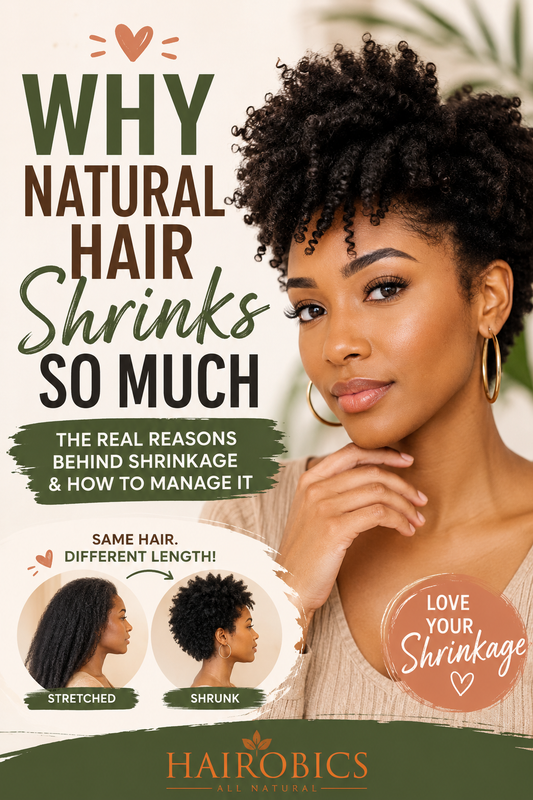
If you've ever washed your natural hair and watched it transform from shoulder-length to ear-length within minutes, you're not alone. Hair shrinkage is one of the most common experiences among people with curly, coily, and kinky hair textures. While shrinkage can sometimes feel frustrating—especially after spending hours stretching or styling your hair—it is actually a sign that your hair is healthy and elastic.
Many people new to natural hair worry that their hair is not growing because it always looks the same length. In reality, your curls may be hiding several inches of growth beneath tightly coiled strands.
In this complete guide, you'll learn:
- Why natural hair shrinks
- What determines shrinkage percentage
- Why 4C hair shrinks the most
- Whether shrinkage is healthy
- How to reduce shrinkage safely
- The biggest shrinkage mistakes
- Best products and routines
- Frequently asked questions
By the end, you'll understand why shrinkage isn't your enemy—it may actually be one of your hair's greatest strengths.
What Is Hair Shrinkage?
Hair shrinkage is the reduction in visible hair length after curly or coily hair dries naturally.
Your hair may be:
- 14 inches when stretched
- 8 inches when dry
- 6 inches immediately after washing
Your actual hair length hasn't changed.
Only the curl pattern has tightened.
How Much Can Natural Hair Shrink?
Shrinkage varies dramatically depending on curl pattern.
| Hair Type | Average Shrinkage |
|---|---|
| 2A–2C | 5–20% |
| 3A | 20–35% |
| 3B | 30–50% |
| 3C | 40–60% |
| 4A | 50–70% |
| 4B | 60–75% |
| 4C | 70–90% |
Some people with tightly coiled 4C hair experience over 90% shrinkage.
Why Does Natural Hair Shrink?
Natural hair behaves like a spring.
Imagine stretching a spring apart.
The moment you let go...
It coils back into itself.
Curly hair does exactly the same thing.
Every strand naturally wants to return to its original curl pattern.
The Science Behind Hair Shrinkage
Hair is made primarily of keratin proteins.
Inside every strand are chemical bonds that determine:
- Curl pattern
- Elasticity
- Flexibility
- Strength
When hair becomes wet:
- Hydrogen bonds temporarily break.
- Hair stretches.
- Hair becomes longer.
As hair dries:
- Hydrogen bonds reform.
- Hair curls back.
- Hair contracts.
That's shrinkage.
Curl Pattern Determines Shrinkage
The tighter your curls...
…the more shrinkage you'll experience.
Loose curls travel gently around the strand.
Coily hair bends sharply.
Kinky hair twists repeatedly.
Each bend reduces visible length.
Why 4C Hair Shrinks the Most
4C hair contains:
- Tight zig-zag bends
- Sharp angles
- Multiple coils
- Dense curl clusters
Instead of hanging downward, 4C hair grows upward and inward.
This creates maximum shrinkage.
Hair Elasticity Plays a Huge Role
Healthy hair stretches.
Damaged hair snaps.
Shrinkage is largely caused by healthy elasticity.
Hair with excellent elasticity returns to its original shape after stretching.
That same elasticity creates noticeable shrinkage.
Is Shrinkage a Good Sign?
Usually—yes.
Shrinkage often means your hair is:
- Healthy
- Moisturized
- Elastic
- Strong
- Undamaged
Hair that never shrinks may actually have:
- Heat damage
- Chemical damage
- Protein loss
- Broken curl bonds
Can Dry Hair Shrink More?
Interestingly...
Yes.
Dry hair often appears even shorter because curls become tighter without enough moisture and lubrication.
Moisturized curls usually elongate slightly.
Why Hair Looks Longer While Wet
Water adds weight.
It temporarily stretches curls downward.
Once the water evaporates...
The curls spring back.
Does Hair Growth Stop Because of Shrinkage?
Absolutely not.
One of the biggest myths in the natural hair community is:
"My hair isn't growing."
Usually...
Your hair is growing perfectly.
Shrinkage simply hides your progress.
Why People Think Their Hair Isn't Growing
You may gain:
6 inches of growth.
But if your shrinkage increases from 60% to 80%...
Your hair may actually look shorter than before.
Shrinkage vs Hair Growth
Visible length is not actual length.
Always measure stretched hair.
Not shrunken curls.
Does Longer Hair Shrink Less?
Not necessarily.
Many waist-length naturals still experience 70–80% shrinkage.
The only difference is:
The stretched length is much longer.
Why Humidity Increases Shrinkage
Humidity adds moisture to hair.
Moisture causes hydrogen bonds to reform.
Hair returns to its natural curl pattern.
That means:
- Wash-and-gos get smaller
- Twist-outs puff up
- Blowouts shrink
- Silk presses revert
Can You Permanently Stop Shrinkage?
No.
Shrinkage is part of your hair's natural structure.
The only permanent ways to eliminate it involve altering the curl pattern through chemical or heat damage—which is not recommended for healthy natural hair.
Safe Ways to Reduce Shrinkage
You can temporarily stretch your hair without damaging it.
Popular methods include:
- Twist-outs
- Braid-outs
- Banding
- African threading
- Roller sets
- Flexi rods
- Blow drying with heat protectant
- Tension drying
- Silk wrapping
Stretching With Twist-Outs
Twist-outs gently elongate curls while maintaining definition.
Benefits include:
- Less tangles
- Reduced knots
- More volume
- Controlled shrinkage
Banding Method
Banding involves wrapping soft hair ties along sections of damp hair.
As hair dries:
- Curls stretch
- Roots elongate
- Shrinkage decreases
No heat required.
African Threading
This traditional technique stretches hair using thread wrapped around sections.
Benefits include:
- Excellent stretch
- Minimal manipulation
- Heat-free
- Protective styling
Blow Drying Correctly
If using heat:
- Apply heat protectant
- Use low to medium heat
- Stretch gently
- Avoid repeated passes
Occasional blow drying does not automatically damage healthy hair.
Does Moisturizing Reduce Shrinkage?
Sometimes.
Well-moisturized curls often appear:
- Softer
- Longer
- Fuller
- More elongated
Dry curls contract more tightly.
Best Ingredients for Stretching Hair
Look for products containing:
- Aloe vera
- Marshmallow root
- Flaxseed gel
- Slippery elm
- Shea butter
- Castor oil
- Avocado oil
- Coconut oil (for hair that tolerates it)
These ingredients add slip and weight without excessive stiffness.
Oils That Help Control Shrinkage
Certain oils coat the hair shaft and help reduce excessive contraction.
Popular choices include:
- Jamaican Black Castor Oil
- Avocado oil
- Grapeseed oil
- Argan oil
- Olive oil
Remember:
Oils seal moisture.
They don't moisturize by themselves.
Does Protein Affect Shrinkage?
Yes.
Protein strengthens hair.
Too much protein, however, may make hair stiff.
Stiff hair can shrink more aggressively and feel less flexible.
Balance protein with moisture.
Does Hair Density Affect Shrinkage?
High-density hair often appears to shrink more because the curls stack on top of one another.
Low-density hair may appear longer simply because there is less volume pushing curls upward.
Does Hair Porosity Matter?
Yes.
High-porosity hair often absorbs moisture quickly.
That means:
- More swelling
- Faster curl formation
- More humidity response
Low-porosity hair may stay stretched slightly longer.
Shrinkage and Single-Strand Knots
Shrinkage can increase tangling.
As curls coil around themselves, ends may loop into tiny knots.
Reduce knots by:
- Stretching occasionally
- Trimming split ends
- Moisturizing regularly
- Sleeping with protective styles
Protective Styles That Reduce Shrinkage
Great options include:
- Two-strand twists
- Flat twists
- Braids
- Cornrows
- Bantu knots
- Mini twists
These styles help maintain stretched hair for days or weeks.
Nighttime Routine
Sleep with:
- Satin bonnet
- Satin scarf
- Silk pillowcase
For longer styles:
- Pineapple
- Loose braid
- Loose twists
This preserves stretch overnight.
Common Shrinkage Mistakes
Avoid:
Constant heat stretching
Too much heat damages curl structure.
Fighting your natural texture
Shrinkage isn't something that needs fixing.
Healthy curls naturally shrink.
Brushing dry hair
This causes:
- Breakage
- Split ends
- Frizz
Overusing heavy gels
Some gels encourage tighter curl formation.
Choose products based on your styling goals.
Comparing your hair to others
Every curl pattern behaves differently.
Your shrinkage is unique.
Myths About Hair Shrinkage
Myth: Shrinkage means your hair isn't growing.
False.
Growth and shrinkage are unrelated.
Myth: Only 4C hair shrinks.
False.
Every curl pattern shrinks.
Myth: Stretching hair makes it grow faster.
False.
Stretching only changes appearance.
Myth: Shrinkage is unhealthy.
False.
Healthy hair often shrinks the most.
Best Routine for Managing Shrinkage
Wash
Use a gentle sulfate-free shampoo.
Condition
Deep condition weekly.
Moisturize
Apply a leave-in conditioner.
Seal
Use a lightweight oil.
Stretch
Choose:
- Twist-out
- Braid-out
- Banding
- Threading
Protect
Sleep with satin every night.
Frequently Asked Questions
Can shrinkage hide six inches of hair?
Yes.
Many people discover several hidden inches after stretching their curls.
Does shrinkage mean healthy hair?
Most of the time, yes.
Healthy elasticity usually produces noticeable shrinkage.
Can I stop shrinkage forever?
No.
Shrinkage is a natural characteristic of curly and coily hair.
Why does my hair shrink immediately after drying?
As water evaporates, hydrogen bonds reform and your natural curl pattern returns.
Does trimming reduce shrinkage?
No.
Trimming removes damaged ends but doesn't change curl structure.
Why does my hair shrink more in summer?
Humidity causes curls to tighten and revert more quickly.
Should I fight shrinkage?
Not necessarily.
Learning to embrace shrinkage often leads to healthier hair practices and less heat damage.
Final Thoughts
Hair shrinkage is one of the defining characteristics of natural, curly, coily, and kinky hair. While it can sometimes make it difficult to see your true length, shrinkage is usually a sign that your curls are healthy, resilient, and full of life. Instead of viewing shrinkage as a problem, think of it as evidence that your hair's natural elasticity is doing exactly what it was designed to do.
If you prefer a longer look, use gentle stretching techniques such as twist-outs, braid-outs, banding, or African threading rather than excessive heat. Prioritize moisture, regular conditioning, and protective styling to minimize tangles and breakage while maintaining healthy curls.
With patience and the right routine, you can enjoy the versatility of natural hair—wearing it stretched when you want length and embracing its beautiful, springy texture when you want to celebrate your curls exactly as they are.