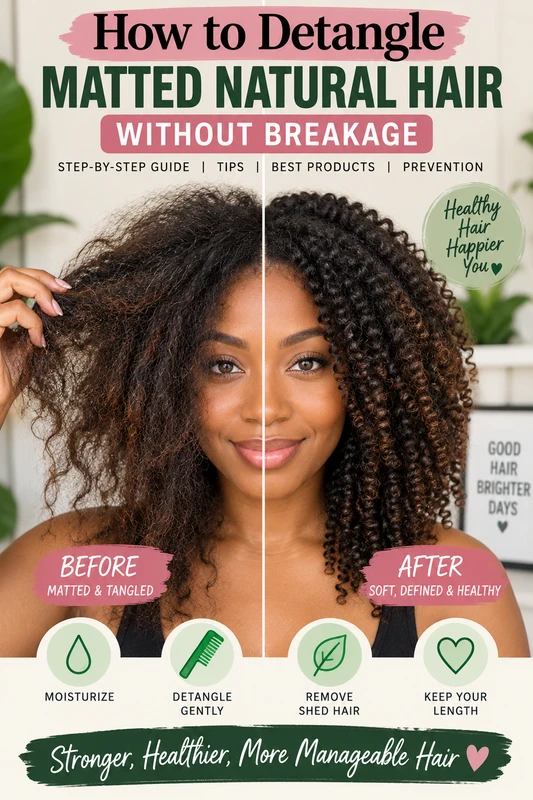
Matted natural hair can feel overwhelming. What begins as a few stubborn tangles can quickly turn into sections of hair that seem almost impossible to separate. This is especially common with tightly curled, coily, thick, or high-shrinkage hair because shed strands can become trapped within the surrounding curls.
The good news is that matted hair does not automatically mean you have to cut it off.
With patience, plenty of slip, the right detangling technique, and a section-by-section approach, it may be possible to loosen even significant tangles while preserving much of your hair.
The biggest mistake is trying to rush.
Aggressive brushing, pulling, or ripping through knots can turn a detangling problem into a breakage problem. Instead, the goal should be to soften the hair, lubricate the strands, gradually separate shed hairs, and work through the mat from the outside inward.
This complete guide explains how to detangle matted natural hair, what causes severe matting, which products can make detangling easier, what you should avoid, and how to prevent your natural hair from becoming matted again.
What Is Matted Natural Hair?
Matted hair occurs when individual strands become severely intertwined and compressed into a dense knot or cluster.
This is more serious than an ordinary tangle.
A normal tangle may involve a few strands wrapping around one another. A mat can contain dozens or even hundreds of intertwined strands, including shed hairs that have not been removed.
Natural hair can be particularly susceptible because curls and coils naturally wrap around neighboring strands.
When shed hair doesn't have a clear path out of the hairstyle, it can remain trapped inside the surrounding curls.
Over time, those strands can combine with:
- Other shed hairs
- Product buildup
- Lint
- Sebum
- Dirt
- Dry strands
- Broken hairs
- Knots
Eventually, the section can become tightly compacted.
Why Does Natural Hair Become Matted?
Understanding why your hair became matted can help you prevent the problem from happening again.
Several factors may contribute.
1. Going Too Long Without Detangling
One of the most common causes is simply waiting too long between detangling sessions.
Humans naturally shed hair every day. With straighter textures, many of these hairs simply fall away.
Curly and coily hair behaves differently.
The surrounding curls may hold onto shed strands.
If those strands aren't removed during washing and detangling, they can become wrapped around healthy hair.
The longer they remain, the greater the chance of matting.
2. Washing Severely Tangled Hair Without Detangling First
Water can sometimes cause existing tangles to tighten.
If your hair is already severely tangled, immediately shampooing and scrubbing it may make the situation more difficult.
Loose strands can wrap around neighboring hairs while you manipulate the scalp.
That's why severely tangled natural hair often benefits from some careful pre-detangling before a vigorous shampoo session.
3. Wearing Protective Styles Too Long
Braids, twists, wigs, crochet styles, and other protective hairstyles can be useful for reducing daily manipulation.
However, protective styles don't eliminate shedding.
Your scalp continues releasing shed hairs while the style is installed.
When you finally remove your braids or twists, you may see a surprisingly large amount of shed hair.
That's normal to a degree.
The problem happens when you immediately wash your hair without carefully separating and removing those shed strands.
Water, shampoo, and friction can cause them to wrap around the rest of your hair.
This can create severe matting near the roots.
4. Extreme Dryness
Dry natural hair generally creates more friction between strands.
When the cuticle surface is rough, neighboring hairs may catch against one another more easily.
Moisturized, conditioned hair generally has better lubrication and flexibility, which can make strands easier to separate.
5. Sleeping With Loose Natural Hair
Going to sleep with loose, unprotected natural hair can create significant friction.
During the night, your hair moves against:
- Pillows
- Sheets
- Clothing
- Other strands
If your hair is already dry or tangled, repeated movement can encourage knots and matting.
6. High Shrinkage
Shrinkage is a completely normal characteristic of healthy curly and coily hair.
But significant shrinkage can make tangling easier.
As curls contract, shed hairs and neighboring strands can become intertwined.
Hair that shrinks significantly may therefore require more consistent sectioning and detangling.
7. Product Buildup
Using large amounts of gels, butters, pomades, creams, and oils without adequately cleansing the hair can leave buildup.
This residue may cause strands to stick together.
Add shed hairs and lint, and the result can become a stubborn mat.
Can You Save Severely Matted Natural Hair?
Sometimes.
How much hair can be saved depends on the severity of the matting and the condition of the strands inside it.
Some tangles look much worse than they actually are.
Once enough conditioner or detangling product is added, you may discover that a large mat is primarily composed of shed hair wrapped around healthy strands.
Removing those shed hairs gradually can release much of the hair underneath.
Other mats may contain substantial breakage or become so compact that complete detangling isn't realistic.
Either way, don't immediately reach for scissors.
Try loosening the mat first.
If you're dealing with extensive matting across your entire head or you're unable to make progress without significant breakage, a professional stylist experienced in natural-hair detangling may be worth considering.
What You Need to Detangle Matted Natural Hair
Gather everything before starting.
You may need:
- Spray bottle with water
- Detangling conditioner
- Leave-in conditioner
- Hair oil
- Wide-tooth comb
- Detangling brush
- Rat-tail comb
- Hair clips
- Hair ties
- Towels
- Plenty of time
Your fingers are also one of your most valuable detangling tools.
In fact, you may want to begin with finger detangling before introducing a comb.
How to Detangle Matted Natural Hair Step by Step
The exact process will depend on how severe the matting is, but the following approach works well for many natural-hair textures.
Step 1: Don't Panic and Don't Start Pulling
Your first instinct might be to grab a comb and force it through the knot.
Don't.
Force usually creates more breakage.
Instead, examine your hair.
Determine where the worst mats are located.
Common areas include:
- Nape
- Crown
- Behind the ears
- Roots
- Ends
- Areas that experience heavy shrinkage
Once you understand where the problem areas are, you can approach them individually.
Step 2: Divide Your Hair Into Sections
Never try to detangle your entire head simultaneously.
Divide your hair into approximately four to eight sections.
If your hair is extremely dense, you may need even more.
Secure the sections you're not working on.
Sectioning helps prevent loose hair from becoming tangled again while you're working.
Step 3: Start With the Least Matted Section
This can make the process feel more manageable.
Completing one easier section gives you a better idea of which products and techniques are working before you approach the most difficult mats.
Step 4: Add Moisture Carefully
Slightly dampening the hair can make it more flexible.
Use a spray bottle to apply water gradually.
The goal isn't necessarily to soak the entire mat immediately.
You simply want enough moisture to begin softening the strands.
If plain water isn't providing enough slip, combine moisture with a slippery conditioner or detangling product.
Step 5: Saturate the Matted Section With Conditioner
This is one of the most important steps.
Apply a generous amount of conditioner or detangling product directly to the matted area.
You want the strands to feel slippery.
Don't be conservative with product when dealing with a serious mat.
Work the conditioner around the outside of the knot and gently massage it into accessible areas.
Allow the product to sit for several minutes.
This gives the hair time to soften.
Step 6: Add a Small Amount of Oil if Needed
Oil can provide additional lubrication.
Depending on your hair, you might use:
- Coconut oil
- Olive oil
- Avocado oil
- Sweet almond oil
- Grapeseed oil
- Jojoba oil
You don't necessarily need a huge amount.
The goal is to reduce friction enough that strands can slide apart more easily.
Water provides moisture, conditioner provides slip, and oil can add lubrication.
Together, these can make stubborn tangles easier to manipulate.
Step 7: Begin With Your Fingers
Before reaching for a comb, use your fingers.
Feel around the outside of the mat.
Look for loose strands.
Instead of pulling the knot apart forcefully, gently widen it.
Imagine that you're trying to make the knot bigger and looser rather than immediately trying to eliminate it.
This distinction matters.
Pulling downward compresses some knots.
Gently separating outward can create space.
Step 8: Remove Shed Hair
This can be the breakthrough step.
Many mats contain shed hairs that are wrapped around healthy strands.
Look carefully for loose hairs that seem to be running through the knot.
Slowly slide them out.
Don't yank.
You may notice that every time you remove a few shed strands, the mat becomes slightly softer.
Continue.
One strand at a time can eventually become dozens of released hairs.
Step 9: Work From the Ends Toward the Roots
Once the mat has loosened enough for a comb, begin near the ends.
Never place your comb at the roots and drag it downward through a severe tangle.
Instead, hold the section above the area you're detangling.
Begin working through the bottom inch or two.
Once those ends are clear, move slightly higher.
Continue gradually until you reach the roots.
Think:
Ends → middle → roots
rather than:
Roots → ends
This dramatically reduces unnecessary pulling.
Step 10: Use a Wide-Tooth Comb
A wide-tooth comb can be helpful once you've completed the initial finger detangling.
Take very small sections.
Hold the hair above the knot so you're not placing unnecessary tension on the scalp.
Make short, controlled movements.
If the comb stops, stop.
Don't force it.
Add more conditioner and return to finger detangling.
Step 11: Use a Detangling Brush Only After the Worst Knots Are Gone
A detangling brush can help remove remaining shed hairs and smooth the section.
However, it shouldn't necessarily be the first tool used on a tightly compacted mat.
Once the major knots have been loosened, gently brush from the ends upward.
Step 12: Twist or Braid Every Completed Section
This is extremely important.
You've spent all that time detangling your hair.
Don't allow it to tangle again.
Once a section is completely detangled, twist or braid it.
Then move to the next section.
By the time you're finished, your entire head should be divided into detangled twists or braids.
How Long Does It Take to Detangle Matted Natural Hair?
It depends entirely on the severity.
Minor matting might take 30–60 minutes.
Moderate matting could take several hours.
Severe matting across an entire head can take much longer.
Don't use speed as your measure of success.
Hair preservation is the goal.
If you become tired or frustrated, secure the section and return to it later rather than becoming increasingly aggressive.
Should You Detangle Matted Hair Wet or Dry?
Neither extreme is always ideal.
Completely dry hair may have too much friction and can snap more easily during manipulation.
On the other hand, completely saturated hair can sometimes cause existing knots to tighten, and wet hair can be vulnerable to excessive stretching.
For many people, the best approach is damp, heavily conditioned hair with plenty of slip.
You want the strands flexible and lubricated but still manageable.
Should You Shampoo Matted Hair First?
If the hair is severely matted, it's often better to remove the worst tangles before thoroughly shampooing.
Aggressive shampooing can cause shed strands to become even more intertwined.
Try loosening major mats first.
Afterward, cleanse your scalp and hair in sections.
How to Detangle Matted Hair After Braids
This situation deserves special attention.
After removing braids, you may notice what appears to be an alarming amount of hair around your roots.
Remember that hair naturally sheds over time.
If your hair has been braided for weeks, many shed hairs remain trapped inside the braids until they're removed.
The worst thing you can do is immediately jump into the shower and vigorously shampoo tangled hair.
Instead:
- Remove each braid carefully.
- Finger-detangle the section.
- Remove obvious shed hair.
- Apply detangling conditioner if necessary.
- Gently comb from ends toward roots.
- Twist the detangled section.
- Repeat throughout your head.
- Shampoo once the majority of shed hair has been removed.
This simple habit can dramatically reduce post-braid matting.
How to Detangle Matted Hair at the Roots
Root matting commonly happens after protective styles.
You'll often find a compact area of shed hair near the base of the braid.
Apply conditioner directly to the area.
Then use your fingertips to gently separate the strands.
Don't pull the entire knot downward.
Instead, slowly loosen the edges.
A rat-tail comb can sometimes help isolate individual strands, but use the tail carefully.
You're separating hair—not stabbing or ripping through the mat.
Best Products for Detangling Matted Natural Hair
The most important quality is slip.
A good detangling product should help strands glide past one another.
Look for products such as:
- Moisturizing conditioners
- Detangling conditioners
- Leave-in conditioners
- Detangling sprays
- Lightweight oils
A product doesn't have to be extremely thick to work.
Sometimes a thinner conditioner with excellent slip works better than a heavy butter.
Can Oil Detangle Matted Hair?
Oil can help, but it usually works best as part of the process rather than as the only solution.
Oil doesn't hydrate hair because it doesn't provide water.
However, it can reduce friction between strands.
Try combining:
Water + conditioner + a small amount of oil
rather than saturating the mat with oil alone.
Oils That May Help With Detangling
Coconut Oil
Coconut oil is commonly used as a pre-shampoo treatment.
A small amount may help lubricate strands before detangling.
Olive Oil
Olive oil has a rich consistency that some people find helpful for stubborn knots.
Avocado Oil
Avocado oil can provide lubrication without necessarily feeling as heavy as some thicker oils.
Grapeseed Oil
Grapeseed oil is relatively lightweight and may be useful for people who dislike heavier oils.
Jojoba Oil
Jojoba oil is another lightweight option that can help reduce friction during manipulation.
Remember: the best option is whichever provides enough slip for your hair.
Finger Detangling vs. Comb Detangling
You don't necessarily have to choose one.
They work well together.
Finger Detangling
Your fingers can feel knots before a comb reaches them.
That gives you more control.
You can identify individual strands and carefully separate them.
Finger detangling is especially useful for severe matting.
Wide-Tooth Comb
Once the largest tangles are gone, a wide-tooth comb can remove smaller knots and shed hairs more efficiently.
Detangling Brush
A brush can finish the process by separating curls and removing remaining loose strands.
A good sequence is:
Fingers → wide-tooth comb → detangling brush
You may not need all three every time.
What NOT to Do When Detangling Matted Natural Hair
Knowing what to avoid is just as important.
Don't Rip Through the Hair
If you hear strands snapping repeatedly, stop.
That's not detangling.
That's breakage.
Don't Start at the Roots
Starting at the roots can push existing knots downward until they combine into an even larger knot.
Always start near the ends.
Don't Detangle Huge Sections
Smaller sections provide more control.
Dense natural hair may require very small subsections.
Don't Keep Working When the Hair Gets Dry
If the conditioner dries while you're detangling, add more water or product.
Maintain slip throughout the process.
Don't Assume Every Shed Hair Is Breakage
Hair naturally sheds.
Shed hairs usually contain the entire strand, sometimes with a tiny bulb at one end, whereas broken hairs can appear shorter and may lack that characteristic root end.
After a long-term protective style, accumulated shedding can look dramatic.
When Should You Cut a Mat Out?
Cutting should usually be the last resort if length retention is important to you.
However, there are situations where removing a severely damaged section may be more practical than spending hours manipulating fragile hair.
Before cutting, try:
- Water
- Conditioner
- Oil
- Finger detangling
- Small sections
- Professional detangling
If you decide trimming is necessary, consider having a professional stylist evaluate the section first—especially if the mat is close to the scalp.
How to Wash Hair After Removing Mats
Once your hair is detangled, don't immediately combine all the sections.
Keep your hair divided into twists or braids.
Wash your scalp and hair in sections.
Apply shampoo primarily to the scalp and gently massage with your fingertips.
Allow the lather to move through the lengths rather than aggressively rubbing strands together.
Rinse thoroughly.
Then condition.
Deep Condition After Detangling
A difficult detangling session can involve significant manipulation.
Follow it with a moisturizing deep-conditioning treatment.
Apply the conditioner section by section and make sure the ends are thoroughly coated.
Follow the product's directions for processing time.
After rinsing, your hair should feel softer and easier to manage.
Moisturize Your Hair After Detangling
After cleansing and conditioning, restore moisture before styling.
Apply a water-based leave-in conditioner or moisturizing product to damp hair.
For people whose hair responds well to oils, a small amount can then be used to help reduce friction and support moisture retention.
Hairobics All Natural products can be incorporated into a regular natural-hair routine depending on your hair's individual needs, particularly when maintaining moisture and caring for the scalp between wash days.
The key is consistency.
Waiting until your hair becomes extremely dry and tangled makes maintenance much more difficult.
How to Prevent Natural Hair From Becoming Matted Again
Detangling severe matting once is enough motivation for most people to never experience it again.
Fortunately, prevention is much easier than removing a major mat.
1. Create a Regular Detangling Schedule
Don't wait until your hair becomes impossible to manage.
Your ideal frequency will depend on:
- Hair density
- Curl pattern
- Hairstyle
- Shrinkage
- Activity level
- Product routine
Some people detangle weekly, while others can comfortably go longer.
Pay attention to how quickly shed hair accumulates.
2. Keep Hair in Sections During Wash Day
Sectioning is one of the best habits for dense natural hair.
Try washing in four to eight twists.
Working section by section reduces opportunities for strands from different parts of your head to become intertwined.
3. Remove Shed Hair After Protective Styles
This is crucial.
When you remove braids, twists, or another long-term style, thoroughly finger-detangle each section before shampooing.
Get those shed hairs out.
It can prevent an enormous amount of matting.
4. Protect Your Hair at Night
Wear a satin or silk bonnet or scarf.
A satin pillowcase can provide additional protection.
These materials create less friction than many conventional cotton pillowcases.
For long or dense natural hair, consider putting your hair into:
- Large twists
- Braids
- Pineapple
- Banded sections
before covering it.
The goal is to prevent your strands from freely rubbing against one another all night.
5. Don't Let Your Hair Stay Extremely Dry
Dryness and friction can contribute to tangling.
Monitor your hair throughout the week.
If it feels rough, brittle, or excessively dry, refresh it before the problem becomes severe.
A light water-based moisturizing spray or leave-in can be helpful between wash days.
6. Pay Attention to Your Ends
Your ends are the oldest part of your hair.
They've experienced years of washing, styling, weather, manipulation, and friction.
Damaged or split ends can catch on neighboring strands and contribute to tangling.
Regular trims may make detangling much easier.
7. Avoid Excessive Product Buildup
More product doesn't always mean more moisture.
Repeatedly layering creams, gels, oils, and butters without adequate cleansing can create residue.
Develop a cleansing schedule that works for your scalp and hair.
8. Stretch Your Hair When Necessary
You don't have to keep natural hair stretched.
Shrinkage is normal.
However, people who experience severe tangling may find that stretched styles reduce matting.
Examples include:
- Two-strand twists
- Braids
- Banding
- Bantu knots
These styles keep strands somewhat organized and separated.
9. Don't Leave Protective Styles in Indefinitely
Protective styles still require maintenance.
Keeping braids or twists installed far beyond the point when substantial shedding, buildup, and new growth have accumulated can increase the risk of root matting.
Remove styles before tangling becomes unmanageable.
10. Develop a Consistent Natural Hair Routine
Healthy hair care doesn't have to involve 20 different products.
A simple routine can include:
Cleanse → condition → detangle → moisturize → protect
Consistency often matters more than complexity.
How to Detangle 4C Matted Hair
Type 4C hair can experience significant shrinkage and densely packed coils.
The detangling process is essentially the same, but section size becomes particularly important.
Work in very small sections.
Keep the hair damp and lubricated.
Finger-detangle first.
Carefully remove shed hairs.
Then introduce your wide-tooth comb.
Once a section is complete, immediately twist or braid it.
Don't leave the detangled section loose while you work on the rest of your head.
How to Detangle Matted Natural Hair Without Losing Length
There is no way to guarantee zero hair loss during detangling because some hair has already naturally shed.
However, you can reduce unnecessary breakage.
Focus on:
- Maximum slip
- Small sections
- Finger detangling
- Ends first
- Slow manipulation
- Removing shed hair individually
- Keeping finished sections separated
Most importantly, don't judge success by how quickly you finish.
Slow detangling is usually safer detangling.
Why So Much Hair Comes Out During Detangling
Seeing a ball of hair after detangling can be frightening.
But remember that some of it may simply be accumulated shed hair.
If you haven't thoroughly detangled for several weeks, all those shed strands may come out during one session.
Protective styles make this especially noticeable.
However, if you're consistently seeing substantial breakage, thinning areas, bald patches, scalp pain, or unusual shedding, consider speaking with a dermatologist or qualified healthcare professional.
How Often Should You Detangle Natural Hair?
There isn't one universal schedule.
For many people, detangling around wash day works well.
That might be:
- Weekly
- Every 7–10 days
- Every two weeks
Hair kept in protective styles may follow a different schedule.
Instead of following an arbitrary calendar, monitor your hair.
If you're consistently finding large knots by wash day, shorten the interval.
Can You Detangle Natural Hair Every Day?
You can, but that doesn't mean you should.
Frequent manipulation can contribute to breakage, particularly with tightly coiled textures.
If your hairstyle doesn't require daily detangling, leaving your hair alone between styling sessions may be beneficial.
Focus on keeping hair organized and protected so extensive daily detangling isn't necessary.
Frequently Asked Questions About Matted Natural Hair
Can badly matted natural hair be detangled?
Sometimes, yes. Even severe mats may contain large amounts of shed hair that can gradually be removed. Conditioner, water, lubrication, small sections, and patience are essential.
What's the easiest way to loosen matted hair?
Apply moisture and a conditioner with plenty of slip, allow the section to soften, and begin gently separating the outside of the mat with your fingers.
Should I use a comb on severely matted hair?
Eventually, yes, but finger detangling is usually a better starting point. Once the mat has loosened, use a wide-tooth comb from the ends upward.
Should I detangle before shampooing?
If your hair is severely tangled or you've just removed a protective style, removing shed hairs and major tangles before shampooing may help prevent further matting.
Can conditioner remove mats?
Conditioner doesn't magically dissolve knots, but good slip can make individual strands easier to separate.
Can coconut oil help detangle matted hair?
It may provide additional lubrication for some hair types. However, combining moisture and conditioner with a small amount of oil may work better than using oil alone.
Why does my hair mat after washing?
Your hair may already contain trapped shed strands before washing. Shampooing and manipulating those strands can cause them to wrap around neighboring hair.
Why does the back of my natural hair mat so easily?
The nape experiences frequent friction from clothing, pillows, scarves, and movement. It may also have a slightly different curl pattern than other areas of your head.
Can sleeping without a bonnet cause matting?
It can contribute. Hair rubbing against bedding throughout the night creates friction and may encourage tangling.
Is matted hair automatically damaged?
Not necessarily. Some healthy strands may simply be trapped inside a mat. However, severe matting can lead to breakage if handled aggressively.
A Simple Detangling Routine for Natural Hair
If your hair frequently tangles, try this routine.
Before Washing
Divide your hair into sections.
Lightly dampen each section.
Apply conditioner.
Finger-detangle and remove shed hair.
Twist the completed section.
During Washing
Keep the sections separated.
Cleanse the scalp gently.
Avoid piling your hair on top of your head.
Rinse thoroughly.
Conditioning
Apply conditioner section by section.
Detangle any remaining knots.
Rinse while keeping sections organized.
After Washing
Apply your preferred leave-in or moisturizer.
Seal or style according to your hair's needs.
Put your hair into a low-manipulation style.
At Night
Protect your hair with satin or silk.
If necessary, divide long or dense hair into several large twists before bed.
This routine can dramatically reduce the amount of detangling required on future wash days.
The Biggest Secret to Detangling Matted Natural Hair: Patience
There isn't a miracle product that instantly dissolves every knot.
Products help.
Tools help.
Technique helps.
But patience is what protects your length.
A mat that took weeks or months to form may not disappear in five minutes.
Slowly separate it.
Add more conditioner.
Remove a few shed hairs.
Loosen another section.
Repeat.
Eventually, you may feel the knot begin to collapse.
That's the moment when many people realize that what appeared to be one giant impossible knot was actually hundreds of strands that needed to be separated individually.
Final Thoughts: How to Detangle Matted Natural Hair
Matted natural hair can look intimidating, but scissors don't always have to be your first option.
Start by dividing your hair into manageable sections. Add moisture and plenty of conditioner for slip. Use your fingers to gently loosen the outside of each mat and remove trapped shed hairs. Once the major tangles have been separated, use a wide-tooth comb from the ends toward the roots.
Most importantly, never rush the process.
Once your hair is detangled, focus on prevention.
Keep your natural hair moisturized, remove shed strands regularly, protect your hair while sleeping, detangle before washing after long-term protective styles, and avoid allowing excessive buildup to accumulate.
Your ongoing routine can make the difference between a quick wash-day detangling session and spending hours working through severe mats.
Healthy natural-hair care doesn't require fighting your texture.
It requires understanding how your curls and coils behave and creating a routine that works with them.
When you give natural hair consistent moisture, gentle handling, regular cleansing, and protection, detangling becomes much easier—and keeping your length becomes far more achievable.