Natural hair is known for its beautiful curls, coils, kinks, volume, and versatility. But one characteristic that can surprise even experienced naturals is shrinkage. Your hair may look shoulder-length when stretched, yet appear several inches shorter once it dries in its natural state.
Shrinkage is completely normal. In fact, it often shows that your strands still have elasticity. However, there are times when you may want to temporarily stretch your natural hair to reveal more length, make detangling easier, prepare for a protective style, reduce tangling, or create a different hairstyle.
The key is learning how to stretch natural hair safely.
Stretching does not have to mean aggressively pulling your hair straight or repeatedly using high heat. There are several heat-free and low-heat techniques that can elongate curls and coils while helping you protect your hair from unnecessary breakage.
In this complete guide, we'll explore the best ways to stretch natural hair, how to stretch 4C hair, heat-free stretching methods, blow-drying techniques, nighttime maintenance, common mistakes, and how to keep stretched natural hair moisturized.
What Does It Mean to Stretch Natural Hair?
Stretching natural hair means temporarily elongating curls, coils, or kinks so that the hair appears longer and has less shrinkage.
Stretching doesn't necessarily mean straightening.
Your hair can remain textured while becoming more elongated.
For example, someone with tightly coiled natural hair may stretch their hair using braids overnight. When the braids are removed the following morning, the hair may still have texture but hang noticeably longer.
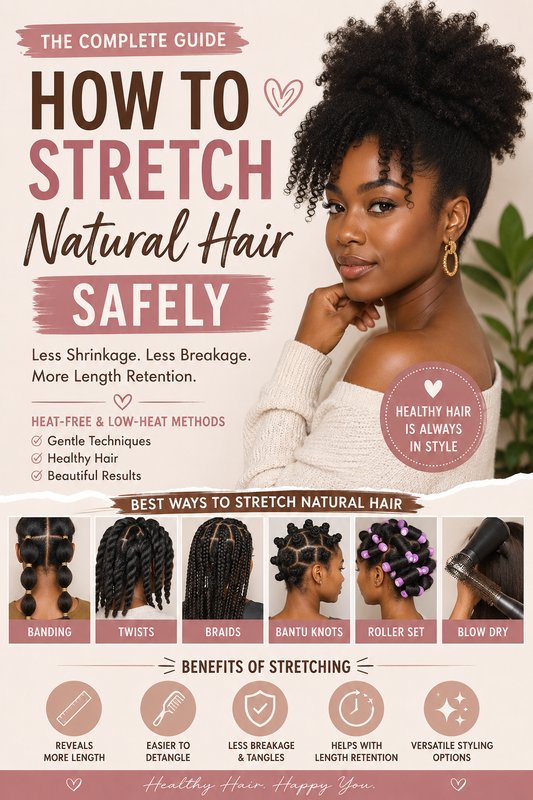
Natural hair can be stretched through several techniques, including:
- Banding
- African threading
- Braiding
- Twisting
- Bantu knots
- Roller sets
- Flexi rods
- Blow-drying
- Tension-method blow-drying
The best method depends on your hair texture, density, length, condition, desired style, and how much stretching you want.
Why Does Natural Hair Shrink?
Before learning how to stretch natural hair safely, it helps to understand why shrinkage happens.
Curly and coily strands naturally bend, spiral, or zigzag instead of growing in a straight line.
When natural hair becomes wet, the weight of the water may temporarily elongate the strands. As the hair dries, the curl pattern contracts and returns closer to its natural shape.
This contraction creates what we call shrinkage.
Depending on your curl pattern, your hair can appear significantly shorter than its actual stretched length.
Tightly coiled Type 4 hair can experience particularly noticeable shrinkage.
Shrinkage isn't automatically something that needs to be corrected. It is simply part of having textured hair.
However, excessive tangling can sometimes occur when highly shrunken strands wrap around neighboring hairs. This is one reason some people choose to keep their natural hair slightly stretched.
Is Stretching Natural Hair Bad?
Stretching natural hair isn't inherently damaging.
The problem is usually how the hair is stretched.
Gentle stretching methods can be incorporated into a healthy natural hair routine. Problems can occur when stretching involves excessive tension, rough manipulation, very high heat, repeated heat exposure, or attempting to stretch severely tangled or dehydrated hair.
Healthy stretching should focus on gradually elongating the strands rather than forcing them straight.
Your curls should not feel like they are being aggressively pulled from the scalp.
If stretching causes pain, excessive shedding, snapping, or noticeable thinning, something about the technique needs to change.
Benefits of Stretching Natural Hair
Stretching is often viewed simply as a way to make natural hair look longer, but there are several practical reasons people stretch their curls and coils.
1. Stretching Shows More of Your Hair's Length
Shrinkage can hide a significant amount of length.
Stretching allows you to see more of your true hair length without permanently altering your curl pattern.
This can be especially satisfying when you're tracking your natural hair growth journey.
2. Stretched Hair May Be Easier to Style
Some hairstyles are easier to create on elongated hair.
These may include:
- Buns
- Ponytails
- Flat twists
- Updos
- Cornrows
- Two-strand twists
- Braided styles
- Low-manipulation hairstyles
Stretching can make sectioning and parting easier as well.
3. Stretching Can Help Reduce Tangling
Highly shrunken hair can become tangled when strands curl around each other.
Keeping the hair slightly elongated may reduce the opportunity for individual strands to intertwine.
This doesn't mean stretched hair never tangles, but gentle stretching can make certain textures easier to manage.
4. It Can Make Detangling Easier
Stretched hair often separates more easily than completely shrunken hair.
This can make your next styling session more manageable, especially if your hair is very dense.
However, stretching should never replace proper detangling.
Always remove major tangles before attempting to stretch your hair.
5. Stretching Can Help With Length Retention
Hair growth and length retention are not exactly the same thing.
Your scalp produces new hair, while length retention depends on keeping the older ends from breaking faster than new growth is produced.
Gentle stretching may help some people retain length because elongated strands can experience less tangling and knotting.
The goal isn't to make your hair grow faster.
The goal is to protect the length you already have.
How to Prepare Natural Hair for Stretching
Preparation is one of the most important parts of safely stretching natural hair.
Trying to stretch dry, tangled hair can increase friction and breakage.
A better approach begins with clean or adequately moisturized, detangled hair.
Step 1: Start With Clean Hair
If you're doing a full wash-day stretch, cleanse your scalp and hair first.
Product buildup can make the strands feel stiff, coated, or difficult to manipulate.
Clean hair also allows your conditioning and moisturizing products to work more effectively.
Choose a cleansing routine appropriate for your scalp and hair needs.
Step 2: Condition Your Hair
After cleansing, apply conditioner and gently work it through your hair.
Conditioning can improve slip and make detangling easier.
Pay special attention to your ends because they're the oldest part of your hair and are usually the most vulnerable to breakage.
Step 3: Detangle Carefully
Never aggressively stretch heavily tangled natural hair.
Divide your hair into manageable sections.
Depending on your hair density, you may need:
- 4 sections
- 6 sections
- 8 sections
- 10 or more sections
Start detangling near the ends and gradually work upward.
Use your fingers first if your hair tangles easily, followed by an appropriate detangling tool if desired.
Step 4: Add Moisture
Your hair should feel soft and pliable before stretching.
A water-based leave-in or moisturizer can help provide hydration and improve manageability.
Avoid completely saturating the hair if you're using a method that works best on damp hair.
The ideal moisture level depends on the stretching technique.
Step 5: Work in Sections
Sections give you better control.
Instead of trying to stretch your entire head at once, work with one section at a time.
This reduces unnecessary pulling and makes it easier to distribute products evenly.
7 Best Ways to Stretch Natural Hair Safely
There isn't one perfect stretching technique for everyone.
Some methods provide a mild stretch, while others can produce much more elongation.
Here are several popular options.
1. The Banding Method
Banding is one of the easiest heat-free methods for stretching natural hair.
It involves placing soft hair ties or bands down the length of sections of hair.
How to Band Natural Hair
Start with clean, detangled, moisturized hair.
Divide your hair into approximately four to eight sections.
Take one section and gently smooth it.
Place a soft hair band near the base of the section without making it excessively tight.
Add additional bands down the length of the section.
Leave a small amount of space between each band.
Repeat throughout your hair.
Allow the hair to dry completely before removing the bands.
Once dry, carefully remove each band and separate the hair.
Why Banding Works
The bands prevent the curls from fully contracting while the hair dries.
This results in elongated hair without direct heat.
Banding Tip
Don't make the bands extremely tight.
Your goal is to stretch the hair—not put unnecessary tension on your scalp or edges.
2. Stretch Natural Hair With Braids
Braiding is another simple heat-free stretching method.
It's especially convenient because many people already know how to braid their natural hair.
How to Stretch Hair With Braids
After washing and conditioning:
- Detangle your hair.
- Apply your leave-in or moisturizer.
- Divide your hair into several sections.
- Braid each section from near the roots toward the ends.
- Allow the braids to dry completely.
- Carefully unravel them.
Larger braids generally create a looser result, while smaller braids may create more defined texture.
If maximum stretch is your goal, gently extend the section as you braid without pulling painfully at the roots.
3. Stretch Natural Hair With Two-Strand Twists
Twists are another excellent option.
The technique is similar to braiding but uses two sections instead of three.
After detangling and moisturizing your hair, divide it into sections and create two-strand twists.
Allow them to dry completely.
When you unravel the twists, you'll typically have elongated curls with some twist definition.
Twists can be particularly useful if you want a stretched look that still has plenty of texture and volume.
4. African Threading
African threading is a traditional stretching technique that can create impressive elongation without direct heat.
Hair is divided into sections, and thread is wrapped around the length of each section.
The wrapping keeps the strands extended while they dry.
Depending on the technique, African threading can create a very stretched result.
The biggest safety consideration is tension.
The thread should be secure enough to hold the hair but should never painfully pull your scalp.
Be especially gentle around your:
- Hairline
- Temples
- Nape
- Edges
These areas can be more vulnerable to tension-related breakage.
5. Bantu Knot Stretching
Bantu knots can stretch the hair while creating a curled finish.
Start with detangled, moisturized hair.
Divide your hair into sections.
Twist each section and wrap it around itself to create a small knot.
Secure it without excessive tension.
Allow the hair to dry thoroughly.
When the knots are removed, your hair should appear elongated with a curled or waved texture.
Bantu knots can be especially useful when you want stretching and styling at the same time.
6. Roller Sets
Roller sets are one of the classic ways to stretch natural hair.
The hair is wrapped smoothly around rollers and allowed to dry.
Depending on the roller size, tension, and technique, you can achieve a fairly elongated result.
Larger rollers generally produce more stretch and less curl, while smaller rollers create more curl definition.
When installing rollers, keep the hair smooth but don't pull excessively.
Your scalp shouldn't hurt.
7. Stretching Natural Hair With a Blow Dryer
Sometimes you want faster or greater elongation.
A blow dryer can stretch natural hair effectively, but heat requires additional precautions.
Heat damage can occur when hair is repeatedly exposed to temperatures or techniques it cannot tolerate.
For that reason, your goal should be to use the lowest effective heat and tension rather than automatically choosing the hottest setting.
How to Blow-Dry Natural Hair Safely
If you decide to stretch your natural hair using a blow dryer, preparation matters.
Step 1: Wash and Condition
Start with clean, conditioned hair.
Step 2: Detangle
Thoroughly but gently detangle your hair in sections.
Trying to blow-dry through knots can cause unnecessary breakage.
Step 3: Apply a Heat Protectant
If you're using heat, use a product intended to help protect the hair during heat styling, following its directions.
Heat protectant doesn't make hair invincible, so you still need sensible temperature control.
Step 4: Divide Your Hair Into Sections
Smaller sections make it easier to control the hair and reduce repeated passes.
Step 5: Start Conservatively
You don't necessarily need maximum heat.
Start with a lower temperature and increase only if needed.
Step 6: Keep the Dryer Moving
Avoid holding concentrated heat on the same spot for an extended period.
Step 7: Stop Once the Hair Is Stretched
Don't continue applying heat simply because you want every strand perfectly straight.
Remember: you're stretching your natural hair, not necessarily straightening it.
The Tension Method for Stretching Natural Hair
The tension method is a popular way to stretch natural hair using a blow dryer without constantly dragging a comb attachment through the strands.
After detangling and applying appropriate heat protection, take a section of hair and gently hold the ends so that the section is elongated.
Direct the airflow along the length of the hair while maintaining gentle tension.
Keep the dryer moving.
Once the section has reached your desired level of stretch, stop.
The tension method can reduce some of the mechanical manipulation associated with repeatedly combing through the hair while blow-drying.
How to Stretch 4C Natural Hair Safely
4C hair often experiences substantial shrinkage, making stretching particularly popular among people with tightly coiled textures.
The principles remain the same:
Moisture + detangling + sections + gentle tension.
Excellent options for stretching 4C hair include:
- Banding
- African threading
- Braids
- Twists
- Roller sets
- Tension-method blow-drying
Because tightly coiled strands can intertwine easily, avoid trying to stretch large, tangled sections at once.
Smaller sections usually give you better control.
Most importantly, don't confuse tight coils with "tough" hair.
4C hair can be incredibly versatile, but individual strands can still break when handled roughly.
Gentleness matters.
How to Stretch Natural Hair Without Heat
If avoiding heat is your priority, you have many options.
One simple routine is:
Wash → Condition → Detangle → Moisturize → Section → Band/Braid/Twist → Dry → Unravel
The major disadvantage of heat-free stretching is time.
Your hair needs to dry while being held in an elongated position.
Very thick or dense natural hair may take considerably longer to dry.
Whenever possible, give yourself enough time so you don't need to remove the style while the hair is still very wet.
Wet Hair vs. Damp Hair for Stretching
Should natural hair be soaking wet when you stretch it?
Not necessarily.
Many heat-free stretching techniques work well on damp hair.
Soaking-wet hair may take significantly longer to dry, especially if your hair is thick or low porosity.
On the other hand, completely dry and dehydrated hair may be harder to manipulate.
A practical middle ground is often hair that is moisturized and damp but not dripping wet.
Your ideal moisture level will depend on your texture and styling method.
Can You Stretch Dry Natural Hair?
Yes, but proceed carefully.
If your hair is already clean and relatively detangled, you may be able to lightly moisturize it and re-stretch it.
For example, you could divide stretched hair into sections, apply a small amount of moisturizing product as needed, braid or band it, and leave it overnight.
Avoid soaking the hair unless you want the curls to substantially revert.
Also avoid pulling extremely dry, brittle strands.
If your hair feels rough or stiff, address moisture and detangling before adding more tension.
How to Stretch Natural Hair Overnight
Overnight stretching is one of the most convenient methods because your hair can stretch while you sleep.
You can use:
- Large braids
- Large twists
- Banding
- African threading
- Bantu knots
Before bed, divide your hair into sections and gently secure it using your preferred method.
Protect your hair with a satin or silk scarf, bonnet, or suitable smooth sleep surface to reduce friction.
In the morning, carefully remove the stretching style.
Avoid immediately combing through the hair unless necessary.
Use your fingers to shape and separate it.
How to Keep Natural Hair Stretched at Night
Once you've achieved the perfect stretch, you probably don't want to start from scratch every morning.
Nighttime maintenance can help preserve your results.
One popular technique is to put the hair into several loose sections before bed.
Depending on your hairstyle, you can use loose braids, twists, bands, or another gentle method.
Protect the hair overnight.
The important word is loose.
You don't need to aggressively pull the hair every night to preserve your stretch.
How to Keep Stretched Natural Hair Moisturized
One common challenge with stretched hair is maintaining moisture without causing the hair to shrink immediately.
Water is important for hair care, but applying large amounts of water can cause stretched curls to revert.
Instead of completely saturating your hair every day, adjust your moisturizing routine based on how your hair actually feels.
You may apply a modest amount of an appropriate moisturizer to sections that need attention, concentrating particularly on dry ends.
Products such as the Hairobics All Natural Leave-In Treatment can fit into a natural hair routine designed to support softness and manageability.
The goal is not to avoid moisture.
The goal is to moisturize strategically so that your hair remains flexible while preserving as much of your stretched style as possible.
Stretching Natural Hair for Protective Styles
Stretching before installing certain protective styles can make sectioning and styling easier.
For example, you may choose to stretch your hair before:
- Box braids
- Cornrows
- Flat twists
- Two-strand twists
- Crochet styles
- Buns
- Updos
However, your natural hair does not always need to be bone straight before installing a protective style.
Overusing heat simply because you're preparing for braids can create unnecessary exposure.
A heat-free stretch may provide enough elongation for the stylist to work comfortably.
Stretching Natural Hair for Length Retention
One reason stretching is popular in long-hair routines is that it may help reduce some forms of tangling.
When tightly coiled hair shrinks, individual strands can wrap around neighboring strands or themselves.
This can contribute to knots.
Keeping the hair somewhat elongated may reduce this tendency for some people.
However, stretching alone won't guarantee long hair.
Length retention also depends on habits such as:
- Gentle detangling
- Protecting your ends
- Minimizing unnecessary manipulation
- Maintaining a healthy scalp
- Avoiding excessive tension
- Using heat carefully
- Conditioning appropriately
- Trimming damaged ends when needed
Think of stretching as one tool in your overall hair-care routine rather than a magic hair-growth technique.
Does Stretching Natural Hair Make It Grow Faster?
No stretching technique can dramatically change the biological rate at which hair grows from your follicles.
Hair growth occurs beneath the skin.
Stretching changes the appearance and positioning of the existing hair shaft.
However, stretching may indirectly support your length-retention goals if it helps you reduce tangles, knots, and breakage.
For example, imagine your hair grows steadily but your ends continually break.
You may feel like your hair isn't growing because you're not retaining much additional length.
A routine that reduces breakage can help more of that growth remain visible over time.
Common Mistakes When Stretching Natural Hair
Learning what not to do can be just as important as learning the correct techniques.
Mistake #1: Using Too Much Heat
More heat doesn't automatically produce a better result.
Repeated high-temperature styling can increase the risk of damage.
Use the minimum heat needed to achieve your desired stretch.
Mistake #2: Skipping Heat Protectant
When using heated styling tools, don't skip products designed for heat styling.
Follow the product's instructions carefully.
Mistake #3: Stretching Tangled Hair
This is one of the easiest ways to create unnecessary breakage.
Detangle before stretching.
Mistake #4: Pulling Too Hard
Stretching should not hurt.
Pain is not proof that the technique is working.
Excessive pulling can stress your scalp and hairline.
Mistake #5: Making Bands Too Tight
Banding should elongate the hair gently.
Extremely tight bands can create tension and may leave weak points along the strand.
Choose smooth, hair-friendly accessories whenever possible.
Mistake #6: Ignoring Your Ends
Your ends are the oldest part of your hair.
If they're dry and fragile, stretching them aggressively can cause breakage.
Handle your ends carefully throughout the entire process.
Mistake #7: Repeatedly Restretching Every Day
Constant manipulation can defeat the purpose of stretching.
Once you've stretched your hair, use nighttime preservation techniques so you don't need to completely restyle it daily.
Mistake #8: Trying to Eliminate Every Curl
Your natural hair doesn't need to become completely straight for stretching to be successful.
Even reducing some shrinkage can make styling easier.
How Often Should You Stretch Natural Hair?
There isn't a universal schedule.
How frequently you stretch depends heavily on your method.
Heat-free techniques may fit into your routine more frequently because they don't involve thermal styling, although excessive tension and manipulation can still cause problems.
Heat-based stretching should generally be approached more cautiously.
Pay attention to your hair.
If you notice increasing dryness, breakage, split ends, roughness, or a curl pattern that no longer seems to bounce back as expected, reassess your routine.
Signs You May Be Stretching Your Hair Too Aggressively
Your hair often gives you clues when your routine needs adjustment.
Watch for:
- Increased breakage
- Short broken hairs
- Excessive dryness
- Rough ends
- Thinning around the hairline
- Pain during styling
- Tender scalp
- More split ends
- Reduced elasticity
- Curl pattern changes after repeated heat use
Don't ignore these warning signs simply because the stretched hairstyle looks good.
Healthy hair should always be the priority.
Heat-Free Stretching vs. Blow-Drying
Both approaches can work.
Heat-free stretching is ideal when your priority is minimizing thermal exposure.
Banding, braiding, twisting, threading, and roller setting can all provide excellent results.
The main downside is drying time.
Blow-drying is much faster and can provide greater elongation.
The tradeoff is heat exposure.
You don't necessarily have to choose only one method forever.
You might primarily use heat-free stretching and occasionally use controlled blow-drying when you need faster or more elongated results.
Best Stretching Method for Short Natural Hair
If your natural hair is short, some methods may be easier than others.
Depending on your length, consider:
- Small braids
- Small twists
- Mini bands
- Rollers
- Gentle blow-drying
Choose a method that allows you to securely hold the hair without excessive tension.
As your hair gets longer, you'll have more stretching options.
Best Stretching Method for Long Natural Hair
Long natural hair can benefit greatly from stretching because longer strands may have more opportunities to wrap around themselves and neighboring strands.
Good options include:
- Banding
- Large braids
- Large twists
- African threading
- Roller sets
- Tension-method blow-drying
Work in enough sections to maintain control.
Trying to manipulate extremely large sections of dense, long hair can cause unnecessary pulling.
How to Stretch Natural Hair After Wash Day
Here's a simple heat-free routine you can experiment with.
Step 1: Cleanse
Wash your scalp and hair according to your normal routine.
Step 2: Condition
Apply conditioner and work it through your strands.
Step 3: Detangle
Divide the hair into sections and carefully detangle from ends upward.
Step 4: Moisturize
Apply your preferred leave-in or moisturizer.
Step 5: Choose a Stretching Method
Use braids, twists, bands, threading, rollers, or another gentle method.
Step 6: Allow the Hair to Dry
Avoid removing the stretching style too early.
Step 7: Unravel Carefully
Don't rush.
Remove bands, braids, twists, or thread slowly to avoid snagging.
Step 8: Style
Separate and shape your hair using your fingers.
Your hair should now appear more elongated while still maintaining natural texture.
How to Stretch Natural Hair Without Losing Volume
Some people want longer-looking hair but don't want it to become flat.
In this case, avoid stretching the hair too straight.
Large twists or braids can provide an excellent balance.
Once the hair is dry, unravel each section and gently separate it.
You can carefully lift the roots with your fingers to create more volume.
Avoid excessive combing, which can disturb your style and create unnecessary manipulation.
How to Stretch Natural Hair Without Ruining Your Curl Pattern
Heat-free stretching is a great option if preserving your natural curl pattern is your highest priority.
Braids, twists, bands, threading, and rollers temporarily manipulate the shape of the hair.
Once the hair becomes wet again, your natural curl pattern should generally return unless the hair has been damaged or chemically altered.
If using heat, be conservative.
Don't repeatedly chase an ultra-straight result.
The more heat and passes you use, the more stress you potentially place on your strands.
How to Prevent Breakage While Stretching Natural Hair
Breakage prevention should be part of every step.
Start with hair that is adequately conditioned and detangled.
Work in sections.
Use gentle hands.
Protect your ends.
Avoid pulling tightly around your hairline.
Limit unnecessary heat.
Use smooth hair accessories.
Don't rush.
One of the biggest causes of mechanical breakage isn't necessarily the hairstyle itself—it's rough handling while installing and removing the style.
Taking an extra few minutes can make a meaningful difference.
Should You Oil Your Hair Before Stretching?
Oil can be part of your natural hair routine, but oil and moisture are not the same thing.
Your hair doesn't necessarily need to be heavily coated with oil before stretching.
Too much product can weigh the hair down or contribute to buildup.
Instead, focus first on keeping your hair appropriately moisturized and conditioned.
If you use oils, choose the amount that works for your individual hair and overall routine.
The Hairobics All Natural Scalp Rejuvenator Oil may be incorporated into a scalp and natural hair care routine when used as directed.
How to Stretch Natural Hair Between Wash Days
You don't always have to wash your hair again to restore your stretched look.
If the hair is still relatively clean and manageable:
- Divide it into sections.
- Lightly moisturize areas that feel dry.
- Detangle only where necessary.
- Braid, twist, or band the sections.
- Protect the hair overnight.
- Unravel the following morning.
Avoid adding layer after layer of heavy products every night.
Product buildup can eventually make the hair harder to manage.
A Simple Weekly Routine for Stretched Natural Hair
A straightforward routine might look like this:
Wash Day
Cleanse, condition, detangle, moisturize, and stretch.
Days 2–3
Wear your stretched style while minimizing unnecessary manipulation.
Midweek
Check your ends and overall moisture level. Add a small amount of moisture where needed.
Nightly
Loosely braid, twist, or band the hair and protect it while sleeping.
End of Week
Evaluate your scalp and hair.
If your scalp needs cleansing or your hair has significant buildup, begin your wash routine again.
Your schedule doesn't need to match anyone else's exactly.
Adjust it according to your scalp, hair, lifestyle, workouts, styling habits, and product use.
Frequently Asked Questions About Stretching Natural Hair
Is stretching natural hair healthy?
Stretching can be part of a healthy natural hair routine when it's done gently. Avoid excessive tension, repeated high heat, and rough manipulation.
What's the safest way to stretch natural hair?
Heat-free techniques such as braiding, twisting, banding, threading, and roller setting are excellent options because they can elongate hair without direct heat.
How do I stretch 4C hair without heat?
Try banding, braiding, twisting, African threading, Bantu knots, or rollers. Start with detangled, moisturized hair and work in sections.
Can I stretch my natural hair every night?
You can preserve stretched hair at night, but avoid aggressively pulling or manipulating your hair every evening. Loose braids, twists, or bands may be enough.
Does stretching natural hair prevent breakage?
Stretching may help reduce tangling and knotting for some people, potentially supporting length retention. However, aggressive stretching can cause breakage, so technique matters.
Can stretching make natural hair grow?
Stretching doesn't directly increase follicle growth. It may help you retain more length if it reduces tangling and breakage.
Should I stretch my natural hair wet or dry?
Many heat-free methods work well on damp, moisturized hair. Your hair doesn't necessarily need to be soaking wet.
Can I stretch natural hair with a blow dryer?
Yes. Detangle first, use appropriate heat protection, work in sections, start with a conservative temperature, and avoid repeatedly passing heat over the same area.
What's the tension method?
The tension method involves gently holding a section of hair elongated while directing blow-dryer airflow along the strands instead of repeatedly combing through the section.
How long does stretched natural hair last?
It depends on humidity, moisture, exercise, weather, your curl pattern, and how you protect the style at night. Water and high humidity can cause natural hair to shrink more quickly.
Final Thoughts: Stretch Your Natural Hair Without Sacrificing Its Health
Learning how to stretch natural hair safely gives you another tool for managing and styling your curls, coils, and kinks.
You don't have to fight your shrinkage.
Shrinkage is a normal characteristic of textured hair.
Instead, think of stretching as a temporary styling option.
When you want more visible length, easier sectioning, fewer tangles, or a different look, you can gently elongate your hair using methods such as banding, braiding, twisting, African threading, roller setting, or controlled blow-drying.
The most important rule is simple:
Never sacrifice the health of your natural hair just to achieve more length.
Healthy stretching begins with properly detangled, conditioned, moisturized hair. It relies on controlled tension, gentle handling, protection of the ends, and sensible heat use.
If you have tightly coiled 4C hair, don't assume your hair needs aggressive pulling to become stretched. Patient, heat-free techniques can create impressive elongation while allowing your beautiful natural texture to remain part of the finished style.
And remember that seeing more length isn't the same thing as growing more hair.
A healthy hair journey involves caring for both your scalp and the strands you've already grown. Reducing breakage, protecting your ends, keeping your hair manageable, and avoiding unnecessary damage can all support better length retention over time.
Whether you choose braids overnight, banding after wash day, African threading, or an occasional blow-dryer stretch, listen to your hair.
If it feels soft, flexible, manageable, and strong, you're moving in the right direction.
If it feels increasingly brittle, rough, thin, or damaged, adjust your technique.
Your natural hair is versatile enough to be worn shrunken, stretched, twisted, braided, curled, or styled in countless other ways.
The goal isn't to eliminate your natural texture.
The goal is to learn how to work with it.