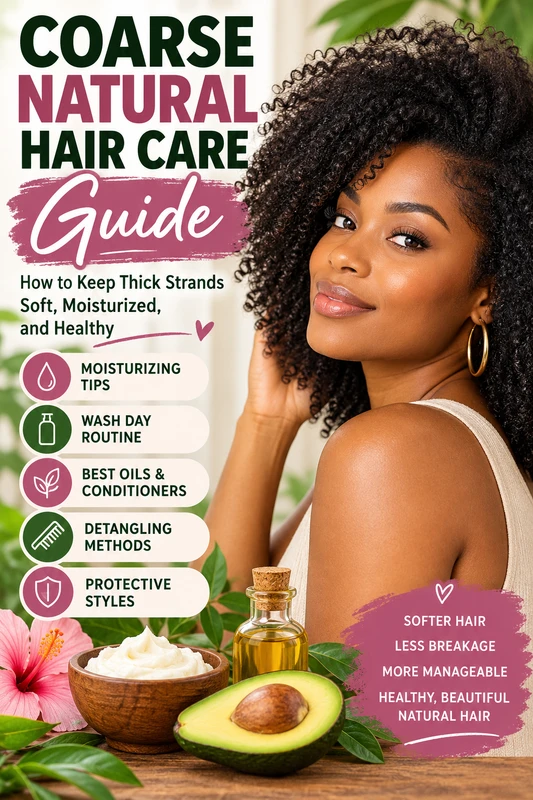
Coarse natural hair is beautiful, versatile, and full of personality. Whether you wear your hair in a big afro, defined twist-out, protective braids, wash-and-go, or elegant natural updo, learning how to properly care for coarse natural hair can make a tremendous difference in how your strands look, feel, and behave.
However, coarse hair also comes with unique challenges.
You might notice that your hair feels rough shortly after moisturizing, takes longer to detangle, becomes stiff when certain products are applied, or seems to require more conditioning than other hair types.
Some people with coarse natural hair struggle with dryness, tangling, shrinkage, breakage, or finding products that provide enough softness without leaving a greasy coating.
The good news is that coarse natural hair does not have to be difficult to manage.
With the right combination of cleansing, conditioning, moisturizing, gentle detangling, and protective styling, you can develop a routine that supports softer, healthier, more manageable strands.
The secret is understanding your individual hair rather than assuming that every coarse-haired person needs the same products.
In this complete coarse natural hair care guide, we'll explore how to identify coarse hair, the best ways to moisturize it, how to choose oils and conditioners, what to avoid, and how to create a consistent routine for maintaining healthy natural hair.
What Is Coarse Natural Hair?
Coarse natural hair refers to hair that has a relatively large individual strand diameter.
In simple terms, each hair strand is thicker than a fine or medium strand.
When you hold a single coarse strand between your fingers, you may be able to feel it more easily than a fine strand.
Coarse hair can appear substantial, strong, and full-bodied. However, it may also feel naturally textured or somewhat wiry, even when it is healthy.
One important distinction is that coarse hair does not automatically mean tightly coiled hair.
Someone with Type 3 curls can have coarse strands, just as someone with Type 4 coils can have fine strands.
Your curl pattern describes the shape of your hair, while strand thickness describes the diameter of each individual hair.
Understanding that difference is essential when selecting the best products and techniques.
For a deeper explanation, read our guide to hair density vs. hair thickness.
Coarse Hair vs. Thick Hair: What's the Difference?
Many people use the words coarse and thick interchangeably, but they are not exactly the same.
Coarse hair describes the thickness of individual strands.
Thick hair often describes the overall fullness of someone's hair, which may be influenced by density.
Hair density refers to how many strands grow within a particular area of the scalp.
This means you can have coarse strands with low-density hair or fine strands with high-density hair.
For example, someone with coarse, low-density hair may have relatively thick individual strands but fewer total strands.
Someone with coarse, high-density hair may have thick individual strands and a large number of them, creating an especially full appearance.
These differences affect how much product you need, how you section your hair, and which hairstyles work best.
If your hair is coarse but low-density, heavy creams may make your hairstyle appear flat.
If your hair is coarse and high-density, you may need additional sections to distribute conditioner evenly.
The best routine should account for both characteristics.
How to Tell if You Have Coarse Natural Hair
Identifying coarse hair is easier when you focus on individual strands rather than the appearance of your entire hairstyle.
1. Examine a single strand
Take a naturally shed strand and hold it between your fingers.
Coarse strands are often easier to feel than fine strands.
You may notice that the strand feels relatively substantial.
2. Look at the strand against a contrasting background
A coarse strand may be more visible than a fine strand under similar lighting.
However, hair color and lighting can affect visibility, so this method is not perfect.
3. Pay attention to product response
Some coarse strands respond well to richer conditioners, creams, and lubricating oils.
Others become stiff or coated when too much product is applied.
Product response alone cannot determine strand thickness, but it can help you understand your hair's needs.
4. Consider your natural texture
Coarse strands may feel less silky than fine strands, but that does not automatically mean they are damaged.
Healthy coarse hair can feel textured while remaining flexible, moisturized, and manageable.
Why Does Coarse Natural Hair Feel Dry?
One of the most common concerns among people with coarse natural hair is dryness.
You might moisturize your hair in the morning and notice that it feels rough again by the evening.
Understanding the cause is more helpful than continuously adding more oil.
Natural oils may not travel easily down curly strands
Your scalp produces sebum, a natural oil that helps lubricate hair.
On straight hair, sebum may spread more easily along the strands.
On tightly curled or coiled hair, the bends and curves can make that distribution more difficult.
As a result, the ends may receive less natural lubrication.
Hair porosity influences moisture behavior
Hair porosity describes how readily hair takes up and releases water.
Low-porosity hair may resist wetting and become coated when too many products are layered.
High-porosity hair may wet readily but can also experience faster moisture exchange.
Both can be coarse.
Product buildup can create a rough feeling
Using large amounts of creams, oils, butters, and styling products without adequate cleansing can leave a coating on the hair.
Instead of feeling soft, the strands may become waxy, stiff, dull, or heavy.
Environmental conditions matter
Dry indoor heating, low humidity, sun exposure, wind, and repeated friction can contribute to hair feeling dry or weathered.
Hair damage can increase roughness
Excessive heat, aggressive detangling, chemical treatments, and repeated mechanical stress may damage the cuticle.
When the outer surface becomes damaged, hair may feel rougher and tangle more easily.
If you're struggling with this issue, explore our detailed article on why natural hair feels rough.
How to Moisturize Coarse Natural Hair Properly
Moisturizing is one of the most important parts of a successful coarse natural hair routine.
However, using more products does not automatically produce better results.
The goal is to help your hair maintain an appropriate level of hydration, softness, and flexibility without creating unnecessary buildup.
Step 1: Begin with water or damp hair
Water is essential for hair hydration.
If your hair is completely dry, applying heavy oil alone may make the surface feel greasy without addressing the underlying dryness.
Start with freshly washed damp hair or lightly mist your strands with water.
Your hair does not need to be dripping wet.
Slightly damp hair often makes it easier to distribute leave-in conditioner and styling products.
Step 2: Apply a moisturizing leave-in conditioner
A good leave-in conditioner can improve softness, lubrication, and manageability.
Look for formulas containing ingredients such as glycerin, panthenol, fatty alcohols, or conditioning agents.
These ingredients serve different purposes.
Humectants help attract and retain water under appropriate conditions, while conditioning agents can improve slip and reduce friction.
Apply your leave-in in sections.
Concentrate on the lengths and ends rather than automatically saturating the scalp.
Step 3: Add a moisturizing cream if necessary
Some coarse natural hair responds well to a cream layered over leave-in conditioner.
A cream may help provide additional conditioning, softness, and styling control.
However, not everyone needs this step.
If your leave-in conditioner already provides enough softness, you may be able to skip the cream.
Step 4: Seal with a small amount of oil
Oil can help lubricate the strands and may slow moisture loss.
Depending on your hair, consider avocado, jojoba, sweet almond, olive, or argan oil.
Apply a small amount after your water-based products.
Pay particular attention to the ends.
Step 5: Choose a low-manipulation hairstyle
Once your hair is moisturized, consider twists, loose braids, a bun, or another comfortable style that reduces daily handling.
Avoid excessive tension around the hairline.
The purpose is to protect your strands while keeping styling manageable.
Best Moisturizing Method for Coarse Natural Hair: LOC vs. LCO
Two popular moisturizing techniques are the LOC and LCO methods.
Both involve layering products, but the order is different.
The LOC method
LOC stands for:
-
Liquid or leave-in conditioner
-
Oil
-
Cream
With this method, you begin with a water-based product, apply oil, and finish with a cream.
Some people find this approach provides a comfortable balance of softness and styling control.
The LCO method
LCO stands for:
-
Liquid or leave-in conditioner
-
Cream
-
Oil
With this method, you apply a water-based product first, follow with a moisturizing cream, and finish with oil.
People who prefer richer styling routines may enjoy this approach.
Which method works better for coarse hair?
There is no universally superior method.
Coarse hair may tolerate richer products, but porosity, density, styling preferences, and product formulation all influence the outcome.
A useful experiment is to apply LOC to one side of your head and LCO to the other.
After two or three days, compare softness, buildup, curl definition, and how quickly each side needs refreshing.
For a detailed comparison, visit our LOC vs. LCO method guide.
Best Shampoo Routine for Coarse Natural Hair
Healthy coarse hair starts with a clean scalp and properly cleansed strands.
Although natural hair often benefits from conditioning products, excessive buildup can make even healthy strands feel rough.
Choose a shampoo appropriate for your scalp
Look for a cleanser that removes dirt, sweat, excess oil, and styling residue without leaving your hair unnecessarily stripped.
A moisturizing shampoo may work well for routine cleansing.
If you regularly use heavy oils, gels, pomades, or butters, occasional clarifying may be helpful.
Wash according to your needs
Many people with natural hair find that washing approximately every seven to fourteen days works for their routine.
However, this is not a universal rule.
You may need more frequent cleansing if you exercise regularly, sweat heavily, or experience substantial product buildup.
Focus shampoo on the scalp
Apply shampoo to your scalp and gently massage using your fingertips.
Avoid aggressively scratching with your nails.
As you rinse, allow the cleanser to move through the lengths of your hair.
If the strands have heavy product buildup, gently work shampoo through them as needed.
Avoid tangling your hair during washing
Do not pile your hair into a tangled mass on top of your head.
Instead, cleanse in sections when practical.
Keep your movements gentle and organized.
Rinse thoroughly
Remaining shampoo or product residue can contribute to an uncomfortable scalp or coated-feeling hair.
Rinse until the cleanser has been removed.
How to Condition Coarse Natural Hair
Conditioning is essential for maintaining manageable coarse strands.
A good conditioner can reduce friction, improve combability, and make detangling easier.
Apply conditioner generously enough for coverage
Your goal is to coat the lengths of your hair evenly.
High-density hair may require more product simply because there are more strands to cover.
However, using excessive conditioner does not necessarily provide additional benefits.
Work in sections
Divide your hair into four to eight sections depending on its length and density.
Apply conditioner section by section.
Smooth it through the strands and gently separate larger tangles.
Focus on the ends
Your ends are usually the oldest part of your hair.
They have experienced the most washing, brushing, styling, and environmental exposure.
Give them adequate conditioning and gentle handling.
Allow the conditioner to work
Follow the manufacturer's directions.
Some conditioners are designed for a few minutes of use, while deep conditioners may require longer.
Leaving a product on far beyond the recommended time does not guarantee better results.
Detangle with adequate slip
Conditioner can make detangling easier by reducing friction.
Use your fingers or a suitable wide-tooth comb and work slowly.
Should You Deep Condition Coarse Natural Hair?
Deep conditioning can be useful when coarse natural hair feels dry, rough, difficult to detangle, or less manageable than usual.
However, deep conditioning does not need to be excessively complicated.
For many people, incorporating a deep conditioner weekly or every other wash day is a reasonable starting point.
Adjust the frequency according to your hair's condition and product directions.
Benefits of deep conditioning
A well-formulated deep conditioner may help:
-
Improve softness
-
Increase manageability
-
Reduce friction during detangling
-
Improve the feel of dry or weathered strands
-
Make styling easier
-
Temporarily smooth the hair surface
Do you need heat?
Some products are designed to work at room temperature.
Others may recommend gentle warmth.
Follow the product instructions and avoid excessive heat.
What about protein treatments?
Protein-containing products may help improve the temporary feel or strength of certain damaged hair fibers.
However, coarse hair does not automatically need frequent protein treatments.
If your hair becomes unusually stiff after using a particular treatment, reconsider its frequency and formulation.
Coarse hair needs an appropriate balance of conditioning and strength, not a rigid schedule based solely on strand thickness.
Best Oils for Coarse Natural Hair
Oils can play a valuable role in maintaining coarse natural hair, particularly when used for lubrication and reducing friction.
However, oil should complement a moisturizing routine rather than replace water and conditioner.
Avocado oil
Avocado oil is a popular option for people who prefer richer hair oils.
It can help lubricate strands and add shine.
Try applying a small amount to damp, conditioned hair.
Jojoba oil
Jojoba oil is technically a liquid wax ester.
It spreads easily and may be a good option for people who dislike very heavy oils.
Olive oil
Olive oil provides a rich coating and can be useful in pre-shampoo routines or as a light finishing product.
Use it sparingly if your hair becomes greasy easily.
Castor oil
Castor oil is thick and highly viscous.
Some people enjoy using small amounts on their ends, especially when combined with a lighter oil.
However, castor oil has not been proven to make hair grow faster.
Coconut oil
Coconut oil has been studied for its ability to reduce certain forms of hair protein loss.
It may be particularly useful as a pre-shampoo treatment for some people.
Others find that coconut oil makes their strands feel stiff.
Pay attention to your individual results.
Sweet almond oil
Sweet almond oil offers lubrication without the extremely thick consistency of castor oil.
It may work well for people who want moderate richness.
Argan oil
Argan oil is often used to improve shine and reduce friction.
A few drops may be sufficient for finishing a hairstyle.
The ideal choice depends on how your hair responds.
For a more detailed comparison, read our guide to the best oils for coarse natural hair.
How to Detangle Coarse Natural Hair Without Excessive Breakage
Detangling can be one of the most time-consuming parts of caring for coarse natural hair.
However, the correct technique can make a noticeable difference.
Begin with manageable sections
Divide your hair into sections before detangling.
Use clips or loose twists to keep completed sections separate.
Add moisture and slip
Dry detangling can increase friction for some curl patterns.
If your hair tangles easily, apply water and a slippery conditioner or detangling product.
Start at the ends
Begin removing tangles near the ends of your hair.
Gradually work upward toward the roots.
Avoid pulling a comb directly from the roots through a large knot.
Use your fingers when necessary
Finger detangling can help you identify knots before pulling on them.
Gently separate strands rather than forcing them apart.
Choose appropriate tools
A wide-tooth comb or flexible detangling brush may be helpful.
The best tool is one that removes tangles effectively without excessive pulling.
Never force stubborn knots
If a knot will not release, apply additional conditioner and work patiently.
Forcing the knot may lead to unnecessary breakage.
Keep detangled sections organized
Once a section is detangled, loosely twist or braid it.
This helps reduce immediate re-tangling.
How to Make Coarse Natural Hair Softer
One of the biggest misconceptions about coarse hair is that it must always feel hard.
Coarse describes strand diameter, not whether the hair is healthy or properly conditioned.
While you cannot permanently change your natural strand diameter with a moisturizer, you can improve how your hair feels.
Cleanse away buildup
If your hair feels waxy or coated, additional oil may make the problem worse.
Try cleansing thoroughly before applying more products.
Use conditioner consistently
Conditioning agents help improve the surface feel of the hair and reduce friction.
Avoid excessive heat
Repeated exposure to high temperatures can damage the hair cuticle.
Use heat protectant when appropriate and minimize unnecessary heat styling.
Reduce daily manipulation
Constant combing, brushing, and restyling may increase friction.
Choose hairstyles that remain comfortable and presentable for several days.
Protect your hair at night
A satin or silk bonnet, scarf, or pillowcase can help reduce friction during sleep.
Evaluate your styling products
If a gel, butter, or protein treatment consistently makes your hair feel stiff, try adjusting the amount or switching formulas.
For additional advice, see our complete guide on how to make natural hair softer.
Best Protective Hairstyles for Coarse Natural Hair
Protective and low-manipulation hairstyles can help reduce repeated handling.
However, a hairstyle is only protective when it is installed and maintained properly.
Two-strand twists
Two-strand twists are versatile and can be worn in different sizes.
They may help keep the ends organized and reduce daily detangling.
Avoid twisting too tightly.
Loose braids
Braids can help organize strands and minimize daily manipulation.
They should not create pain, bumps, or excessive tension.
Flat twists
Flat twists can provide a neat appearance while allowing you to maintain a relatively simple routine.
Loose buns
A comfortable bun may help keep your ends away from clothing.
Avoid pulling the hairline tightly.
Mini twists
Mini twists can be convenient for people who prefer a hairstyle that lasts several days or longer.
However, installation and removal should be done gently to prevent tangling and breakage.
Wigs with properly protected natural hair
Wigs can reduce daily styling, but the hair underneath still requires cleansing, conditioning, and appropriate care.
Avoid tight braiding patterns or adhesives that damage the hairline.
How to Care for Coarse Natural Hair at Night
Your nighttime routine can influence how your hair feels the next morning.
Friction against bedding may contribute to tangling, frizz, and mechanical wear.
Protect your strands
Use a satin or silk bonnet, scarf, or pillowcase.
Choose something comfortable that does not place excessive pressure on your hairline.
Keep long hair organized
Loose twists, braids, or a comfortable pineapple hairstyle may help reduce tangling.
Avoid unnecessary product layering
You do not need to apply oil every night automatically.
If your hair still feels soft and conditioned, leave it alone.
Refresh only when necessary
If your hair feels dry, lightly mist it with water and apply a small amount of leave-in conditioner if needed.
Avoid soaking the hair right before bed if it will remain wet for a prolonged period.
How to Prevent Breakage in Coarse Natural Hair
Coarse strands may have a larger diameter, but they are not immune to damage.
Breakage can occur when strands experience repeated friction, excessive tension, chemical damage, or rough handling.
Be gentle during detangling
Avoid forcing combs through knots.
Minimize tight hairstyles
Repeated tension can damage hair, particularly around the edges.
Reduce heat damage
Use lower effective temperatures and appropriate heat protection.
Condition regularly
Proper conditioning can improve slip and reduce mechanical stress during grooming.
Protect your ends
Keep the ends moisturized and reduce repeated rubbing against clothing.
Trim damaged ends when necessary
Split ends cannot be permanently repaired by ordinary conditioning products.
Trimming may be necessary when ends are severely split or damaged.
Avoid excessive manipulation
Sometimes the best way to support length retention is to stop constantly restyling your hair.
For more information, read how to protect the oldest part of your hair.
Coarse Natural Hair and Porosity
Hair porosity can influence how your coarse strands respond to water, conditioners, oils, and styling products.
Low-porosity coarse natural hair
Low-porosity hair may resist wetting and sometimes develops buildup when too many products are layered.
Helpful approaches include:
-
Applying products to thoroughly damp hair
-
Choosing conditioners that spread easily
-
Avoiding excessive heavy oils
-
Cleansing regularly
-
Using smaller amounts of styling products
High-porosity coarse natural hair
High-porosity hair may take up water readily but also experience relatively rapid moisture exchange.
Helpful approaches include:
-
Using effective conditioning products
-
Minimizing excessive heat
-
Reducing friction
-
Applying leave-in conditioner after washing
-
Using appropriate sealing products when beneficial
Medium-porosity coarse natural hair
Medium-porosity hair may respond well to a balanced routine without requiring unusually heavy or lightweight products.
However, no porosity category guarantees a particular product response.
Pay attention to how your hair actually behaves.
Common Mistakes to Avoid With Coarse Natural Hair
Even a well-intentioned routine can become ineffective when certain habits are repeated.
Mistake 1: Assuming coarse hair is automatically strong
Coarse strands can still break, split, and experience cuticle damage.
Treat them gently.
Mistake 2: Applying oil instead of moisturizer
Oil provides lubrication but is not a substitute for water-based hydration and conditioning.
Mistake 3: Using too many products
Layering several creams, oils, butters, and gels may create buildup without improving softness.
Mistake 4: Skipping wash day
A clean scalp and properly cleansed hair are essential parts of a healthy routine.
Mistake 5: Detangling aggressively
Rushing through knots can contribute to breakage.
Mistake 6: Wearing tight protective styles
Braids and twists should never cause persistent pain or excessive tension.
Mistake 7: Ignoring the ends
The ends are often the most weathered part of your hair.
Mistake 8: Copying someone else's routine exactly
Two people with coarse hair may have completely different porosity, density, curl patterns, and styling needs.
Mistake 9: Using excessive heat
Repeated high temperatures can damage the hair shaft.
Mistake 10: Expecting instant results
Improving manageability may happen quickly, but reducing accumulated damage and retaining length require consistency over time.
A Simple Weekly Coarse Natural Hair Care Routine
You do not need an overwhelming collection of products to maintain healthy coarse natural hair.
A straightforward routine can provide an excellent foundation.
Wash Day: Cleanse and condition
Start by separating your hair into manageable sections.
Cleanse your scalp thoroughly using an appropriate shampoo.
Apply conditioner to the lengths and ends.
Detangle gently while the conditioner provides slip.
If your hair needs additional conditioning, use a deep conditioner according to its instructions.
Rinse thoroughly.
After Washing: Moisturize and style
Apply a water-based leave-in conditioner to damp hair.
Add a moisturizing cream if needed.
Finish with a small amount of oil if your hair benefits from sealing.
Style your hair in twists, braids, a wash-and-go, or another comfortable low-manipulation style.
Midweek: Evaluate moisture
Check how your hair feels rather than automatically applying products.
If your strands still feel soft and flexible, you may not need to do anything.
If they feel dry, lightly mist with water and apply a small amount of moisturizer.
Pay attention to the ends.
Nightly: Protect your hairstyle
Wear a comfortable satin or silk bonnet or use a smooth pillowcase.
Avoid unnecessary brushing and combing.
Every Few Weeks: Review your routine
Ask yourself whether your hair is becoming easier to detangle, staying soft longer, and experiencing less breakage.
If your products leave heavy residue, consider simplifying your routine.
If your hair feels consistently dry, evaluate your cleansing and conditioning methods.
For a practical starting point, see our simple natural hair routine guide.
Coarse Natural Hair Care in Different Seasons
Your hair may respond differently depending on weather and environmental conditions.
Winter care
Cold weather and dry indoor heating can contribute to a dry-feeling hair surface.
You may benefit from richer conditioning products and additional attention to the ends.
Avoid assuming that adding more oil is always necessary.
Summer care
Warm weather, sweat, humidity, and outdoor activities can affect your routine.
You may prefer lighter styling products and more frequent scalp cleansing.
If you swim, rinse and care for your hair appropriately after exposure to pool or ocean water.
Humid weather
Humidity can influence frizz, shrinkage, and hairstyle longevity.
Choose styling products based on the results you want rather than trying to eliminate your natural texture.
Dry climates
In low-humidity conditions, some people find that their hair requires more frequent conditioning or refreshing.
Adjust gradually and monitor product buildup.
Can Coarse Natural Hair Grow Long?
Yes. Coarse natural hair can grow long.
Hair growth occurs at the follicle and is influenced by genetics, health, age, hormones, and other factors.
Strand thickness alone does not determine maximum hair length.
However, visible length also depends on how much hair you retain.
If your hair grows but repeatedly breaks at the ends, you may feel as though it has stopped growing.
That is why length retention is so important.
Focus on healthy hair practices
Cleanse your scalp appropriately, condition regularly, detangle gently, and avoid excessive heat or tension.
Protect the ends
Your ends are the oldest and most vulnerable part of the hair shaft.
Reducing friction and unnecessary handling may help preserve them.
Be patient with shrinkage
Curly and coily hair may appear shorter than its stretched length.
Shrinkage is a natural characteristic of textured hair and does not automatically indicate poor growth.
Avoid unrealistic growth promises
No ordinary cosmetic oil, cream, or moisturizer can guarantee dramatic hair growth within a few weeks.
The most dependable approach is to support normal hair growth while minimizing preventable breakage.
Frequently Asked Questions About Coarse Natural Hair
Is coarse natural hair the same as 4C hair?
No. Coarse refers to the diameter of individual strands, while 4C describes a tightly coiled curl pattern.
A person with 4C hair can have fine, medium, or coarse strands.
How often should I wash coarse natural hair?
Many people start with washing every seven to fourteen days, but the ideal frequency depends on scalp condition, activity level, styling products, and personal needs.
What is the best moisturizer for coarse natural hair?
A water-based leave-in conditioner that provides good slip and softness is a useful starting point.
Some people also benefit from moisturizing creams or a small amount of sealing oil.
Does coarse hair need heavy products?
Not necessarily.
Coarse strands may tolerate richer formulas, but porosity, density, and individual preferences matter.
Heavy products can cause buildup when used excessively.
Why is my coarse natural hair always dry?
Possible causes include inadequate conditioning, product buildup, environmental exposure, cuticle damage, or an ineffective moisturizing routine.
The solution depends on the underlying cause.
Can coarse hair become soft?
Yes. Coarse hair can feel soft, flexible, and manageable while maintaining its natural strand thickness.
Conditioning and gentle handling can improve its feel without changing its fundamental texture.
Is castor oil good for coarse hair?
Castor oil may help lubricate strands and seal the ends.
However, its thick consistency can feel heavy, and there is insufficient evidence that it directly accelerates hair growth.
Should I deep condition coarse natural hair every week?
Weekly deep conditioning may be useful for some people, but it is not mandatory.
Choose a schedule based on your hair's condition and the product's directions.
How can I prevent coarse hair from tangling?
Keep your hair conditioned, detangle gently in sections, reduce unnecessary manipulation, and protect your strands at night.
What hairstyles are best for coarse natural hair?
Two-strand twists, loose braids, flat twists, comfortable buns, and other low-manipulation hairstyles can work well.
The best choice depends on your length, density, lifestyle, and comfort.
Can coarse hair be low porosity?
Yes. Strand diameter and porosity describe different hair characteristics.
Coarse hair can have low, medium, or high porosity.
Why does my coarse hair feel hard after using oil?
You may be applying too much oil, using a product that leaves a heavy coating, or applying oil without sufficient hydration and conditioning.
Some oils also feel different depending on temperature and formulation.
Does coarse hair break less than fine hair?
Not necessarily.
Although thicker strands can have different mechanical properties, coarse hair can still experience breakage from rough detangling, heat, chemical damage, and excessive tension.
How do I retain length with coarse natural hair?
Focus on consistent conditioning, gentle detangling, comfortable low-manipulation styles, protecting the ends, and minimizing avoidable damage.
Final Thoughts: Healthy Coarse Natural Hair Starts With Consistency
Coarse natural hair is not a problem that needs to be fixed.
It is a natural strand characteristic that deserves a care routine designed around its individual needs.
The key to maintaining healthy coarse hair is understanding how your strands respond to water, conditioning products, oils, styling methods, and environmental conditions.
Start with a clean scalp and properly cleansed hair.
Use conditioner to improve softness and manageability.
Apply water-based moisturizing products when your hair needs hydration.
Use oils strategically for lubrication rather than relying on them as your only moisturizing step.
Detangle carefully, protect your ends, and choose hairstyles that reduce unnecessary manipulation.
Most importantly, remember that coarse hair does not need to look or feel like fine hair to be healthy.
Your natural texture can be full, strong-looking, soft, flexible, and beautiful without changing what makes it unique.
With a simple, consistent routine, you can make coarse natural hair easier to manage, reduce preventable breakage, and support the long-term health and appearance of your strands.
Healthy natural hair is not about using the most products. It is about using the right techniques consistently and learning what works best for your own hair.