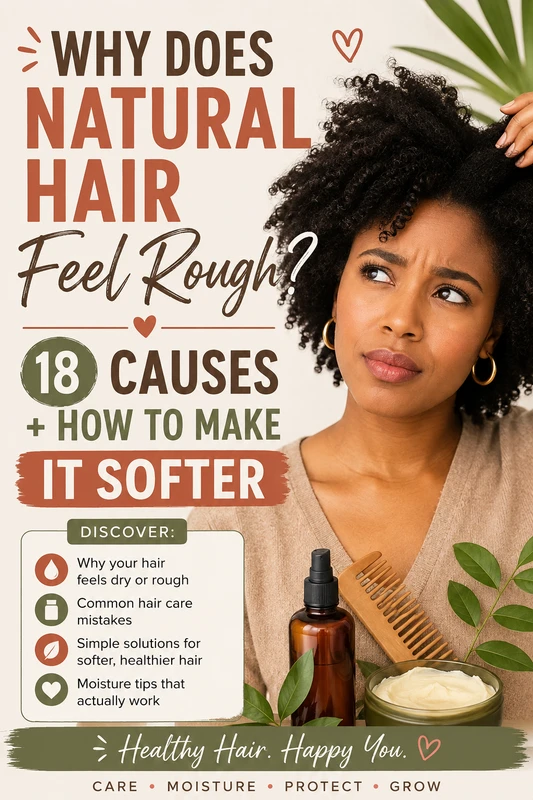
Natural hair is beautiful, versatile, and full of personality. Whether you have 3C curls, 4A coils, 4B hair, or tightly coiled 4C natural hair, maintaining softness and manageability is an important part of a healthy hair care routine.
But what happens when your natural hair feels rough, stiff, dry, or unusually hard to touch?
You might wash your hair, apply conditioner, use moisturizing creams, and finish with your favorite hair oil, only to discover that your strands still feel rough. Sometimes your hair feels soft while wet but becomes coarse and brittle as soon as it dries.
If you've been asking yourself, "Why does my natural hair feel rough even after moisturizing?" you're not alone.
Rough natural hair can develop for several reasons, including insufficient conditioning, product buildup, hair porosity, damaged cuticles, hard water, excessive heat, and everyday styling habits.
The good news is that many causes of rough-feeling natural hair can be improved by making a few adjustments to your routine.
In this complete guide from Hairobics All Natural, we'll explore why natural hair feels rough, how to identify the underlying cause, and practical ways to achieve softer, healthier-looking, more manageable curls and coils.
What Causes Natural Hair to Feel Rough?
Natural hair often feels rough because of changes in the hair's surface, moisture content, or condition.
Every hair strand has an outer protective layer called the cuticle. This layer consists of overlapping cells that protect the inner structure of the hair.
When the cuticle is relatively smooth and properly conditioned, strands tend to slide past one another more easily.
However, when the cuticle becomes damaged, weathered, or covered in excessive residue, the hair may develop a rough texture.
Curly and coily hair also has natural bends along the hair shaft. These bends create beautiful texture, but they can increase friction between strands and make it more difficult for natural scalp oils to spread toward the ends.
Importantly, naturally coarse hair is not necessarily unhealthy hair.
Some people have thick, wiry strands that naturally feel different from fine, silky strands. The goal isn't to change your natural texture. It's to improve softness, flexibility, moisture management, and overall hair condition.
Let's examine the most common causes.
1. Your Natural Hair Is Not Getting Enough Moisture
One of the most common reasons natural hair feels rough is dryness.
When hair loses too much water and lacks sufficient conditioning, it can become stiff, less flexible, and difficult to manage.
Dry natural hair may also tangle more easily because the strands experience increased friction.
Signs your natural hair may be dry
-
Your hair feels rough shortly after washing.
-
Your ends feel crispy or brittle.
-
Your curls lack flexibility.
-
Your hair tangles more than usual.
-
Your strands feel stiff when styling.
-
Your hair becomes difficult to detangle.
-
Your curls feel softer when wet but rough when dry.
How to fix it
Begin with a consistent cleansing and conditioning routine.
After shampooing, apply a moisturizing rinse-out conditioner that provides good slip. Work through your hair in sections, paying special attention to the mid-lengths and ends.
Once you've rinsed the conditioner, apply a water-based leave-in treatment to damp hair.
Water-based conditioning products can improve lubrication and manageability, while certain oils and butters may help reduce friction and slow moisture loss.
Remember that oil alone does not replace water-based conditioning.
If your hair becomes rough shortly after moisturizing, read our guide on How to Fix Hair That Won't Hold Moisture.
2. Product Buildup Is Making Your Hair Feel Hard
Sometimes rough hair isn't caused by a lack of products.
It's caused by using too many.
Natural hair routines often include leave-in conditioners, curl creams, hair oils, gels, pomades, butters, and moisturizing sprays.
Although these products can provide benefits, repeated layering without adequate cleansing may create buildup.
Over time, accumulated residue can make your strands feel coated, heavy, waxy, or stiff.
Signs of product buildup
Your hair might:
-
Feel greasy and rough simultaneously.
-
Have a waxy or coated texture.
-
Look unusually dull.
-
Feel heavy even after washing.
-
Develop visible product residue.
-
Become difficult to style.
-
Stop responding to your usual products.
How to remove buildup
Use a clarifying shampoo when you notice stubborn residue.
Clarifying shampoos are designed to remove accumulated oils, styling products, and other deposits more effectively than some gentle cleansers.
After clarifying, follow with a moisturizing conditioner.
Avoid immediately applying several heavy styling products again.
Instead, start with a lightweight leave-in conditioner and add only what your hair needs.
For a deeper explanation, visit our article on Why Does My Hair Feel Coated?.
3. Your Hair Cuticles May Be Damaged
The condition of your hair cuticle plays an important role in how your natural hair feels.
The cuticle protects the inner layers of the hair strand.
Repeated heat styling, chemical processing, friction, and aggressive detangling can gradually damage this protective surface.
When the cuticle becomes worn or chipped, strands may feel rougher and become more vulnerable to tangling and breakage.
Common causes of cuticle damage
-
Excessive flat ironing
-
High-temperature blow-drying
-
Frequent chemical treatments
-
Rough brushing
-
Tight hairstyles
-
Repeated manipulation
-
Friction from clothing and bedding
-
Environmental exposure
How to improve the condition of your hair
Reduce unnecessary heat and mechanical stress.
Use a conditioner with ingredients that provide slip and reduce friction.
When detangling, work in small sections and begin at the ends.
Consider protective hairstyles that don't place excessive tension on your scalp or strands.
Conditioning treatments can temporarily improve the feel of damaged hair, but they cannot permanently reconstruct severely damaged cuticles.
If the ends are extensively split or broken, trimming may be necessary.
To understand how the cuticle affects texture, explore Hair Cuticle Explained.
4. Your Hair Porosity May Be Affecting Softness
Hair porosity describes how readily hair takes up and releases water.
Porosity is influenced by the condition of the cuticle and the structure of the hair strand.
Both low-porosity and high-porosity hair can experience roughness, although the reasons may differ.
Low-porosity natural hair
Low-porosity hair may take longer to become thoroughly wet.
Some people notice that thick creams and heavy butters leave their strands coated rather than soft.
If you have low-porosity hair, try:
-
Applying lightweight leave-in products to damp hair.
-
Using smaller amounts of styling products.
-
Working in sections for even distribution.
-
Avoiding excessive product layering.
-
Conditioning thoroughly after cleansing.
High-porosity natural hair
High-porosity hair may take up water quickly but also lose it readily.
This is especially common when the cuticle has experienced significant wear or damage.
High-porosity strands may feel rough because the hair surface is more irregular.
Helpful strategies include using conditioning products that reduce friction, limiting excessive heat, and protecting fragile ends.
Keep in mind that porosity cannot be reliably diagnosed from one symptom or a simple floating-hair test.
Your hair's overall condition and response to products matter more than assigning yourself a porosity label.
5. You're Washing Your Natural Hair With a Shampoo That's Too Harsh
Shampoo is essential for removing dirt, excess oil, sweat, and styling residue.
However, some cleansing products may leave your hair feeling excessively stripped, particularly when used too frequently for your needs.
If your natural hair feels rough immediately after shampooing, your cleansing routine may need adjustment.
Signs your shampoo may be too stripping
-
Hair feels squeaky and tangled.
-
Strands become difficult to separate.
-
Your hair feels unusually stiff.
-
Your ends become rough after washing.
-
Your hair requires much more conditioner than usual.
How to wash natural hair without excessive dryness
Choose a shampoo suited to your scalp condition and product usage.
Focus on cleansing your scalp thoroughly while handling your lengths gently.
Allow the lather to move through the hair without aggressively rubbing the strands together.
Always follow with conditioner.
If you use heavy gels, oils, and butters, you may occasionally need a stronger cleanser to remove residue.
The objective is balance: clean hair that remains manageable after conditioning.
6. Hard Water May Be Leaving Mineral Deposits
Hard water contains relatively high concentrations of dissolved minerals, especially calcium and magnesium.
These minerals can interact with cleansing products and may contribute to deposits on the hair.
Some people notice that their hair becomes dull, tangled, or rougher when washing with hard water.
Signs hard water may be contributing
-
Hair feels different after moving to a new location.
-
Your shampoo doesn't perform as expected.
-
Your hair feels coated after washing.
-
Mineral deposits appear on faucets or shower fixtures.
-
Your usual conditioning routine becomes less effective.
These signs aren't proof that hard water is the cause, but they can provide useful clues.
How to manage hard water
Consider checking your household water hardness.
If mineral deposits are a recurring problem, a shampoo formulated to remove mineral buildup may help.
Look for chelating ingredients such as EDTA in products designed for this purpose.
Follow cleansing with conditioner.
A standard shower filter does not necessarily soften hard water, so verify what a particular filtration system actually removes before purchasing it.
7. You're Using Too Much Protein Treatment
Protein-containing hair products can help improve the feel and strength of some damaged strands.
However, not every head of natural hair benefits from frequent protein-focused treatments.
Some formulas may leave certain hair types feeling stiff or less flexible, especially when used repeatedly alongside other film-forming products.
Signs your treatment routine needs adjustment
Your hair may:
-
Feel unusually rigid after treatment.
-
Become difficult to detangle.
-
Feel rough despite conditioning.
-
Lose some of its usual flexibility.
These symptoms don't prove that your hair has "protein overload." Buildup, damage, and insufficient conditioning can produce similar results.
What to do
Review how often you use protein-focused treatments.
If your hair consistently feels worse after a particular product, reduce its frequency or temporarily stop using it.
Use a regular moisturizing conditioner and monitor how your hair responds.
Avoid assuming that all protein ingredients are harmful. Their effects depend on the formulation, concentration, and condition of your hair.
8. Your Natural Hair Ends Are Damaged
The ends of your natural hair are the oldest portions of your strands.
They've experienced months or years of washing, styling, detangling, friction, and environmental exposure.
Over time, the cuticle can become worn.
This is why your ends may feel rough even when the rest of your hair feels relatively soft.
Signs your ends need attention
-
They constantly tangle.
-
They feel rougher than your roots.
-
You notice visible split ends.
-
Small knots form repeatedly.
-
Your ends break during styling.
-
Conditioning provides only temporary improvement.
How to protect your ends
Apply conditioner carefully to the oldest portions of your hair.
Use gentle detangling techniques and avoid unnecessary manipulation.
Protect your ends from rubbing against rough clothing and bedding.
If you notice extensive splitting, consider a trim.
Trimming does not make hair grow faster from the scalp, but removing damaged ends can reduce tangling and help preserve the appearance of healthy length.
9. Excessive Heat Styling Is Changing Your Hair's Texture
Heat can temporarily make natural hair easier to straighten and style.
However, repeated exposure to excessive temperatures can damage the cuticle and internal structure of the hair.
Over time, heat damage may leave some sections feeling rough, weak, or unusually dry.
You might also notice that certain curls no longer return to their previous shape after washing.
How to reduce heat-related roughness
-
Limit unnecessary flat ironing.
-
Use the lowest effective styling temperature.
-
Apply an appropriate heat protectant.
-
Avoid repeatedly passing hot tools over the same section.
-
Keep blow-dryers moving rather than concentrating heat in one spot.
-
Never flat iron wet hair unless using a device specifically designed and approved for that purpose.
If your hair has already experienced significant heat damage, conditioning can improve manageability, but it cannot reliably reverse permanent structural damage.
10. Your Natural Hair Is Experiencing Too Much Friction
Friction is an often-overlooked reason natural hair becomes rough.
Every time strands rub against each other, clothing, towels, pillowcases, or styling tools, mechanical wear can occur.
Coily hair is particularly susceptible to tangling because individual strands naturally bend and interact with neighboring strands.
Repeated rough handling may increase breakage.
Ways to reduce friction
Try drying your hair with a soft microfiber towel or smooth cotton T-shirt rather than vigorously rubbing it.
Sleep with a satin bonnet or scarf if it helps reduce tangling.
Use gentle detangling techniques.
Avoid repeatedly pulling apart dry, tangled curls without lubrication.
When wearing your hair loose, pay attention to whether your ends rub against rough collars or fabrics.
These small adjustments can make a meaningful difference in how manageable your natural hair feels.
11. Your Styling Products May Not Work Well Together
Not every hair product combination produces the same results.
A moisturizing cream might work beautifully by itself but feel sticky or stiff when layered with a particular gel.
Similarly, applying multiple heavy oils and butters may create excessive residue.
If your natural hair feels rough after styling, evaluate the products you're combining.
Try simplifying your routine
Start with three basic steps:
-
Cleanse and condition your hair.
-
Apply a suitable water-based leave-in treatment.
-
Add one styling product if needed.
Observe how your hair feels once completely dry.
If your hair becomes softer with fewer products, unnecessary layering may have been contributing to the problem.
You can learn more in our guide to Why Do Products Sit on Top of My Hair?.
12. Your Natural Hair May Simply Have a Coarse Texture
One important fact about natural hair is that roughness and coarseness aren't always signs of damage.
Hair texture varies from person to person.
Some individuals naturally have fine strands, while others have thick, coarse strands.
Coarse hair can feel firmer or less silky than fine hair even when both are healthy.
Your curl pattern also affects how your hair feels.
Tightly coiled strands may not glide through your fingers the same way straight strands do.
That doesn't mean your natural hair is unhealthy.
What healthy coarse natural hair can look like
Healthy coarse hair may be:
-
Full and voluminous.
-
Strong and flexible.
-
Naturally textured.
-
Easy to style with appropriate conditioning.
-
Resistant to excessive breakage.
-
Capable of retaining length.
Instead of trying to make your hair feel like a different texture, focus on maintaining healthy strands and reducing unnecessary dryness, tangling, and damage.
How to Make Rough Natural Hair Feel Softer: A Step-by-Step Routine
Now that you understand the possible causes, it's time to create a practical routine.
The following steps can help improve softness and manageability without requiring an overwhelming number of products.
Step 1: Cleanse Your Hair Thoroughly
Start with a shampoo suited to your scalp and styling habits.
If your hair feels coated or heavy, consider whether you need a clarifying wash.
Work in sections if your hair is thick or dense.
Gently massage the scalp with your fingertips and rinse thoroughly.
Avoid piling your hair on top of your head and rubbing it aggressively.
Step 2: Use a Moisturizing Conditioner
After shampooing, apply conditioner to your lengths and ends.
Conditioning ingredients help reduce friction and improve how strands slide past one another.
This can make detangling easier and help hair feel smoother.
Distribute the conditioner evenly and leave it on for the time recommended by the manufacturer.
Step 3: Deep Condition When Your Hair Needs Extra Care
A deep conditioner can be useful when your hair feels particularly dry or difficult to manage.
However, deep conditioning isn't a guaranteed repair treatment, and longer processing times don't always produce better results.
Choose a product that suits your hair and follow its directions.
If your hair already feels soft and manageable with regular conditioner, you may not need an additional deep-conditioning treatment every wash day.
Step 4: Detangle With Patience
Detangling is one of the most important parts of caring for textured hair.
Start by dividing your hair into manageable sections.
Apply a conditioner or detangling product that provides adequate slip.
Begin at the ends and gradually work toward the roots.
Use your fingers or an appropriate wide-tooth comb, depending on what works best for your hair.
Avoid forcing a comb through tight knots.
If a section becomes difficult to detangle, stop and gently separate the strands.
Step 5: Apply a Water-Based Leave-In Treatment
Once your hair is clean and conditioned, apply a water-based leave-in product while your strands are still damp.
Leave-in conditioners can help improve softness, reduce friction, and support easier styling.
For those building a natural hair care routine, Hairobics All Natural Leave-In Treatment is an option to consider as part of a consistent moisturizing regimen.
Apply an appropriate amount throughout your hair, concentrating on sections that tend to become dry.
Remember that the best amount depends on your hair's length, density, and the product formulation.
Step 6: Use Oil Only When Needed
Hair oils can provide lubrication and help reduce friction.
Some oils may also reduce moisture loss or improve the appearance of dry ends.
However, applying more oil isn't always the solution to rough hair.
If your hair already feels greasy or coated, adding another layer of oil may make it heavier.
Start with a small amount, if needed, and distribute it evenly.
Step 7: Choose Low-Manipulation Hairstyles
Styles that minimize repeated combing and brushing may help reduce mechanical wear.
Examples include loose twists, braids, buns, and other comfortable low-tension styles.
The important factor is how the hairstyle is installed and maintained.
A protective style that pulls tightly on the scalp or causes breakage isn't truly protective.
Avoid excessive tension around the hairline and nape.
Step 8: Protect Your Hair at Night
Your nighttime routine can affect how your natural hair feels the next morning.
Before bed, gently secure your hair in a comfortable style.
A satin bonnet, scarf, or smooth pillowcase may help reduce friction and tangling.
Avoid sleeping with tight elastics or hairstyles that place unnecessary stress on the roots.
If your hair becomes rough overnight, review whether it needs additional conditioning or simply better protection from friction.
Why Does My Natural Hair Feel Rough After Washing?
Natural hair that feels rough immediately after washing may be responding to a cleansing product, mineral deposits, tangling, or insufficient conditioning.
Pay attention to whether the roughness begins during shampooing or after the hair dries.
If your hair feels extremely tangled while shampooing, you may benefit from a gentler washing technique.
If it feels soft after conditioning but rough once dry, evaluate your leave-in products and styling routine.
If the roughness persists despite consistent conditioning, consider whether your hair has accumulated damage or mineral deposits.
Avoid automatically applying more oil without identifying the cause.
Why Does My Natural Hair Feel Rough After Moisturizing?
If your hair feels rough even after applying moisturizer, the problem may involve product buildup, insufficient conditioning, or the formulation of the products you're using.
Sometimes a moisturizer leaves the surface of the hair feeling greasy without providing the softness you expected.
This can happen when products are applied excessively or layered over existing residue.
Try cleansing thoroughly, conditioning, and applying a smaller amount of leave-in product.
Pay attention to how your hair feels after drying completely.
If simplifying your routine improves softness, your previous product combination may have been too heavy.
Why Does My 4C Natural Hair Feel So Rough?
4C natural hair has tightly coiled strands that may experience considerable shrinkage and tangling.
The natural bends in the hair can make it more challenging for scalp oils to spread along the strand.
As a result, the ends may become dry without regular conditioning.
However, 4C hair isn't inherently unhealthy or damaged.
Many people with 4C hair have strong, healthy strands that simply require thoughtful handling.
Tips for softer 4C natural hair
Focus on consistent conditioning rather than excessive product layering.
Work in sections when washing and detangling.
Apply leave-in products evenly to damp strands.
Avoid frequent dry combing when it causes breakage.
Use comfortable low-manipulation styles and protect your ends.
Most importantly, don't compare the natural feel of tightly coiled hair with straight or loosely curled hair.
Healthy 4C hair can be soft and manageable while maintaining its natural texture.
How Long Does It Take to Make Rough Natural Hair Soft Again?
The amount of time required depends on why your hair feels rough.
If the issue involves temporary dryness or excess product buildup, you may notice improved softness after a thorough wash and conditioning session.
If roughness comes from an unsuitable product combination, simplifying your routine may produce noticeable improvements over the next several wash days.
However, significant heat damage, split ends, and cuticle deterioration cannot always be corrected with conditioning treatments.
In those cases, the goal is to protect existing hair, reduce additional damage, and gradually remove severely damaged ends as appropriate.
Consistency matters more than constantly changing products.
Common Mistakes That Keep Natural Hair Feeling Rough
Even with a dedicated hair care routine, certain habits may contribute to roughness.
Applying oil instead of conditioner: Oil can improve lubrication, but it doesn't replace cleansing and water-based conditioning.
Using too many products: Excessive layering can create buildup and leave strands feeling coated.
Skipping conditioner: Shampoo removes residue, but conditioner helps improve softness and manageability afterward.
Detangling aggressively: Rough handling can damage the cuticle and increase breakage.
Using excessive heat: Repeated high-temperature styling may permanently damage the hair structure.
Ignoring damaged ends: Split ends can continue tangling and breaking even when moisturized.
Comparing your texture to someone else's: Naturally coarse or tightly coiled hair doesn't need to feel silky to be healthy.
Correcting these habits can make your hair care routine more effective.
Frequently Asked Questions About Rough Natural Hair
Is rough natural hair always damaged?
No. Some natural hair has a naturally coarse texture. However, a sudden increase in roughness, breakage, or tangling may indicate dryness, buildup, or damage.
Can you make 4C hair soft naturally?
Yes. Appropriate cleansing, conditioning, gentle detangling, and reduced friction can improve the softness and manageability of 4C hair without changing its natural curl pattern.
Why is my natural hair soft when wet but rough when dry?
Water temporarily changes the flexibility and feel of hair. As the hair dries, underlying texture, damage, and conditioning performance become more noticeable. A suitable leave-in treatment may help improve the feel of dry strands.
Does coconut oil soften rough natural hair?
Coconut oil can help lubricate hair and reduce certain forms of protein loss, but it doesn't work equally well for everyone. Some people find that it makes their strands feel stiff or heavy. Use it according to how your hair responds.
Should I moisturize rough natural hair every day?
Not necessarily. The ideal frequency depends on your hair's condition, hairstyle, environment, and products. Daily layering can sometimes create buildup. Moisturize according to your hair's needs rather than following a rigid schedule.
Can hard water make natural hair rough?
Yes. Mineral deposits from hard water may contribute to changes in hair feel and product performance. A suitable chelating shampoo may help when mineral buildup is the problem.
Does rough hair mean my hair isn't growing?
No. Roughness alone doesn't indicate that hair growth has stopped. However, excessive breakage can make it difficult to retain visible length even when hair continues growing from the scalp.
Should I cut my hair if it feels rough?
Not automatically. If roughness is caused by temporary dryness or buildup, conditioning and cleansing adjustments may help. If the ends are severely split or damaged, trimming may be beneficial.
Build a Softer Natural Hair Routine With Hairobics All Natural
Achieving softer natural hair doesn't have to mean using a dozen different products.
A practical routine begins with cleansing, conditioning, gentle handling, and choosing products that suit your individual texture.
At Hairobics All Natural, we believe natural hair care should support the beauty and versatility of curls, coils, twists, braids, and other textured hairstyles.
Whether you're maintaining a wash-and-go, wearing two-strand twists, or growing out your natural hair, consistency and gentle care are essential.
If your hair regularly feels dry or difficult to manage, consider incorporating a suitable leave-in treatment into your wash-day routine.
The goal isn't to force your hair into a different texture. It's to help your natural strands feel comfortable, conditioned, and easier to maintain.
Final Thoughts: Why Does My Natural Hair Feel Rough?
If you've been wondering why your natural hair feels rough, remember that there isn't always one simple explanation.
Your hair may need better conditioning, more effective cleansing, gentler styling, or protection from excessive heat and friction.
Product buildup, hard water, damaged cuticles, and naturally coarse strands can also influence how your hair feels.
The most effective approach is to identify the likely cause before adding more products.
Start with a simple routine that includes regular cleansing, appropriate conditioning, gentle detangling, and protection for your ends.
If your hair becomes unusually brittle, breaks excessively, or develops sudden texture changes accompanied by scalp symptoms or hair loss, consult a dermatologist for an evaluation.
Most importantly, remember that healthy natural hair doesn't have to feel perfectly silky.
Your curls and coils have their own unique structure, and that texture deserves to be cared for rather than changed.
With consistent care and the right balance of cleansing, conditioning, and protection, you can work toward softer, more flexible, and more manageable natural hair.
Healthy natural hair starts with understanding what your strands need—and giving them the care they deserve.