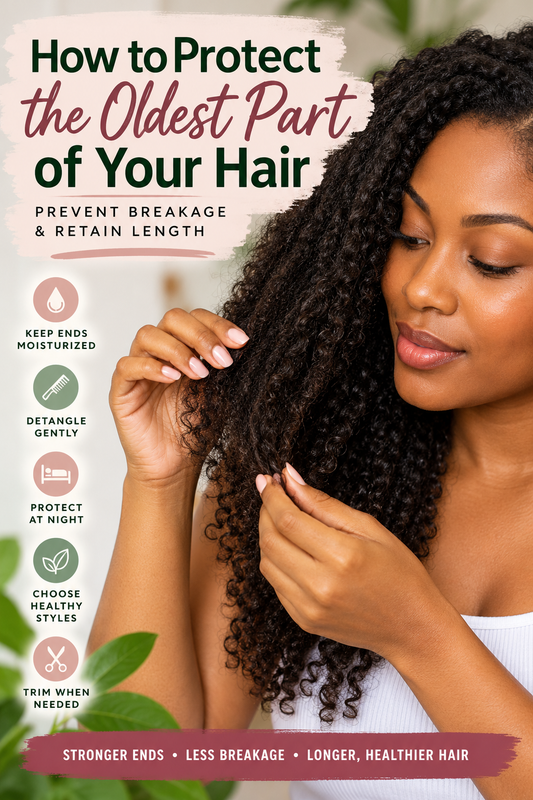
Healthy natural hair is not just about what happens at your scalp. While most people focus on growing stronger roots, stimulating their scalp, and finding the best hair growth products, one of the most important parts of maintaining long, healthy hair is often overlooked.
The oldest part of your hair is your ends.
Your hair ends have experienced more washing, brushing, styling, detangling, sunlight, friction, and environmental exposure than any other section of your strands.
For someone with shoulder-length or longer natural hair, the ends may be several years old. During that time, they have survived countless hairstyles, wash days, protective styles, and changes in moisture levels.
That repeated exposure makes your ends especially vulnerable to dryness, splitting, tangling, and breakage.
You may have healthy new growth near your scalp while the last few inches of your hair feel rough, thin, or brittle.
The frustrating part is that your hair may continue growing normally while damaged ends break off, making it appear that your hair has stopped growing.
Fortunately, understanding how to protect the oldest part of your hair can help you preserve more of the length you already have.
In this complete guide, we'll explain why older hair becomes fragile, how to protect natural hair ends, which habits cause unnecessary damage, and how to develop a routine that supports healthier-looking hair from roots to ends.
What Is the Oldest Part of Your Hair?
The oldest part of your hair is the section farthest from your scalp.
Hair grows from follicles located beneath the skin. As new hair forms at the roots, the existing strand gradually moves farther away from the scalp.
This means the hair closest to your scalp is relatively new, while the ends have been exposed to the outside environment for the longest period.
Hair commonly grows around half an inch per month, although individual growth rates vary.
If your hair is approximately 12 inches long, the oldest sections may have been growing for roughly two years, depending on your growth rate and trimming history.
For someone with 18 inches of hair, the ends may be approximately three years old.
Imagine everything those strands have experienced during that time.
They have been washed repeatedly, stretched into hairstyles, brushed, detangled, exposed to weather, and rubbed against clothing.
Each experience can contribute to gradual wear.
Unlike living skin, the visible hair shaft cannot biologically regenerate damaged tissue.
Conditioners and treatments can improve the feel, appearance, and manageability of damaged hair, but they cannot permanently rebuild a severely split strand.
This is why protecting older hair before significant damage develops is so important.
Why Is the Oldest Part of Your Hair More Fragile?
The ends of your hair are particularly vulnerable because damage accumulates over time.
Your hair shaft has an outer protective layer called the cuticle.
The cuticle consists of overlapping cells that help protect the inner structure of the strand.
When the cuticle is relatively intact, hair tends to feel smoother and experience less friction.
However, repeated washing, brushing, chemical processing, heat styling, and environmental exposure can gradually wear down this protective layer.
As the cuticle becomes damaged, hair may become rougher, more porous, and more likely to tangle.
For natural hair, the problem can become more noticeable because curls and coils create bends along the hair shaft.
These bends can increase friction and make certain sections more susceptible to mechanical stress.
Natural scalp oils may also have difficulty traveling down tightly curled strands, leaving the ends less lubricated than the roots.
If your roots feel soft but your ends constantly feel rough, read our guide on why your ends are drier than your roots.
Understanding these differences is the first step toward creating a hair routine that protects your oldest strands.
1. Make Moisture and Conditioning a Priority
One of the best ways to protect the oldest part of your hair is to keep it properly conditioned.
Hair that becomes excessively dry may feel stiff, rough, and difficult to manipulate.
When dry strands are pulled, brushed, or detangled aggressively, they may be more likely to break.
Your ends deserve special attention because they have experienced more wear than the newer hair near your scalp.
How to Moisturize Older Hair Ends
Start with clean, damp hair.
Divide your hair into manageable sections so you can distribute products evenly.
Apply an appropriate leave-in conditioner or moisturizing treatment according to its instructions.
Work gently through each section, paying particular attention to the last few inches.
Use your fingers to smooth the product along the strands without pulling or rubbing aggressively.
If your hair benefits from additional lubrication, follow with a small amount of compatible cream or oil.
The goal is not to make your hair greasy.
Instead, your ends should feel softer, more manageable, and easier to separate.
How Often Should You Moisturize Your Ends?
There is no universal schedule.
Some people need to refresh their ends every few days, while others maintain comfortable, manageable hair with less frequent application.
Your routine depends on several factors, including:
-
Hair porosity
-
Hair density
-
Strand thickness
-
Weather conditions
-
Styling habits
-
Product formulation
-
Existing hair damage
Pay attention to how your hair feels rather than following a rigid daily moisturizing rule.
If your ends repeatedly feel rough shortly after moisturizing, explore our article on why hair ends become so dry.
2. Detangle Your Hair Without Damaging the Ends
Detangling is one of the most important steps in protecting older natural hair.
Unfortunately, it can also be one of the biggest sources of unnecessary breakage.
When curls and coils become tangled, pulling a comb through them forcefully creates tension along the strands.
Older ends may not tolerate this stress as well as newer sections.
The Best Way to Detangle Natural Hair
Begin by separating your hair into sections.
Apply a conditioner or detangling product that provides enough slip to help strands move past one another.
Use your fingers to gently separate larger tangles before introducing a comb or brush.
Start near the ends and gradually work upward toward the roots.
If you encounter a stubborn knot, stop rather than pulling harder.
Carefully separate the surrounding strands and work through the knot slowly.
Once a section is detangled, place it into a loose twist or braid to prevent it from tangling again.
Avoid Detangling in a Hurry
Rushing through detangling can cause more damage than the actual tangles.
Set aside enough time to work gently, especially if you have thick, tightly coiled, or high-density hair.
If your hair becomes difficult to detangle after protective styles, take extra care because shed strands may have accumulated within the hairstyle.
For additional techniques, read why hair breaks when detangling and how to stop it.
3. Protect Your Ends While Sleeping
Your nighttime routine can influence how much friction your oldest strands experience.
While you sleep, your hair moves against your pillowcase.
Repeated rubbing can contribute to tangling, frizz, and mechanical wear.
This is especially relevant for people who sleep with loose natural hair.
Use Satin or Silk Protection
A satin bonnet, silk scarf, or smooth pillowcase can help reduce friction during sleep.
These materials allow hair to move more smoothly than many rougher fabrics.
However, the material alone is not enough.
A bonnet that is too tight can place unnecessary tension around your hairline.
Choose comfortable protection that keeps your hair contained without pulling.
Try Loose Nighttime Hairstyles
Before bed, consider placing your hair into several loose twists or braids.
This can help keep the ends organized and reduce tangling overnight.
Avoid pulling your hair into extremely tight ponytails or buns.
If your hair is long, make sure the ends are not constantly trapped beneath your shoulders or rubbing against rough bedding.
A consistent nighttime routine can reduce the amount of detangling required the following morning.
4. Choose Protective Styles That Actually Protect Your Ends
Protective hairstyles can help reduce daily manipulation.
Popular options include two-strand twists, loose braids, flat twists, tucked buns, and certain updos.
However, a hairstyle is not automatically protective simply because it has that name.
The way the style is installed and maintained matters.
What Makes a Hairstyle Protective?
A good protective style should reduce unnecessary handling while avoiding excessive tension.
Ideally, it should keep fragile ends from constantly rubbing against clothing or becoming tangled.
Your hairstyle should also allow you to maintain reasonable scalp hygiene and monitor your hair's condition.
Protective Styling Mistakes to Avoid
Avoid hairstyles that:
-
Pull tightly around the edges
-
Cause scalp pain or persistent tenderness
-
Require excessive brushing
-
Place heavy extensions on fragile strands
-
Trap hair in severe tangles
-
Remain installed beyond what your hair can comfortably tolerate
When removing protective styles, work slowly.
Do not aggressively comb through weeks of accumulated shed hair.
For more information, read why protective styles sometimes cause more breakage.
Remember that the purpose of protective styling is to preserve your existing hair, not to force faster growth.
5. Reduce Friction From Clothing
One overlooked reason older hair becomes damaged is friction from everyday clothing.
If your natural hair reaches your shoulders or back, the ends may constantly rub against sweaters, jackets, scarves, and shirt collars.
Rough fabrics can catch individual strands and create additional mechanical stress.
This does not mean you need to stop wearing your favorite clothing.
Instead, become more aware of how your hair interacts with different fabrics.
Simple Ways to Reduce Clothing Friction
Consider wearing your hair up when using thick scarves or rough sweaters.
Choose smoother fabrics when practical.
Keep long ends from repeatedly rubbing against backpack straps, coat collars, or textured clothing.
If you wear your hair loose regularly, alternate with comfortable low-manipulation styles.
These small adjustments may reduce the repeated wear your oldest strands experience.
6. Trim Split Ends Before Damage Becomes Extensive
Many people avoid trimming because they want longer hair.
However, keeping severely damaged ends does not necessarily help with length retention.
Split ends occur when the hair shaft begins to separate.
Once a strand has split, a conditioner cannot permanently fuse it back together.
Certain products may temporarily smooth the appearance of damaged hair, but trimming is the reliable way to remove the split portion.
Signs Your Ends May Need Trimming
Look for:
-
Visible split ends
-
Persistent roughness
-
Frequent knots at the bottom
-
White dots associated with breakage
-
Ends that repeatedly catch on one another
-
Excessively thin or frayed sections
-
Difficulty detangling despite adequate conditioning
Not every dry end needs to be cut.
Sometimes hair simply needs better conditioning or gentler handling.
However, visibly split or severely frayed ends should not be ignored.
How Often Should You Trim?
There is no single trimming schedule that works for everyone.
Some people benefit from checking their ends every couple of months.
Others can go longer without developing significant splitting.
Your trimming needs depend on your styling habits, chemical treatments, heat exposure, and existing damage.
If you notice that your ends are becoming increasingly thin, read our article on why hair ends become thin and how to address them.
The objective is to remove damaged sections when necessary without cutting healthy length unnecessarily.
7. Be Careful With Heat Styling
Heat styling can change the appearance of natural hair and make certain styles easier to achieve.
However, excessive heat can damage the hair shaft.
Repeated exposure to high temperatures may weaken the cuticle and alter the internal structure of the strand.
Older ends are particularly vulnerable because they may already have accumulated years of mechanical and environmental wear.
How to Reduce Heat Damage
Whenever possible, allow your hair to dry partially before using heated tools.
Use a suitable heat protectant according to its directions.
Choose the lowest effective temperature for your hair and styling goal.
Avoid repeatedly passing a flat iron over the same section.
Limit unnecessary heat sessions, especially if your ends already feel brittle.
If your hair is severely damaged, consider reducing heat styling until the affected sections have been addressed.
Heat damage is not always reversible.
Prevention is much more effective than attempting to repair heavily damaged strands afterward.
8. Deep Condition Based on Your Hair's Needs
Deep conditioning can be a helpful addition to a natural hair routine.
Conditioning treatments may improve softness, lubrication, and manageability.
This can be especially useful when older hair becomes difficult to detangle.
How to Deep Condition Properly
Begin with freshly cleansed hair.
Apply a deep conditioner according to its instructions.
Distribute the product throughout your hair, paying special attention to the ends.
Leave the treatment on for the recommended time.
Rinse thoroughly and continue with your normal styling routine.
Some people benefit from deep conditioning weekly, while others prefer every other wash day.
There is no need to assume that leaving a treatment on for several hours will produce better results.
Follow the manufacturer's directions.
Don't Confuse Conditioning With Permanent Repair
Deep conditioners can improve the way damaged hair feels and behaves.
However, they cannot permanently reverse severe splitting or restore a completely worn-away cuticle.
Use conditioning as part of a preventive maintenance routine rather than relying on it to reverse extensive damage.
9. Avoid Excessive Manipulation
Every time you brush, comb, stretch, twist, or restyle your hair, you apply some degree of mechanical stress.
Hair can tolerate normal styling, but repeated unnecessary manipulation may contribute to cumulative damage.
Older strands have already experienced years of handling.
Reducing avoidable manipulation can help preserve them.
What Is Low-Manipulation Hair Care?
Low-manipulation hair care means choosing routines that require less frequent pulling, brushing, and restyling.
Examples include wearing comfortable twists for several days, maintaining a simple wash-day routine, and refreshing styles without completely taking them apart.
It does not mean you should avoid washing or detangling indefinitely.
Allowing excessive tangling or buildup to accumulate can create different problems.
The goal is balance.
Choose hairstyles and routines that keep your hair manageable without repeatedly stressing fragile sections.
10. Protect Older Hair From Product Buildup
Applying more products does not automatically make your hair healthier.
Heavy oils, creams, gels, and butters can accumulate on the hair shaft.
When products build up, hair may begin feeling coated, sticky, stiff, or difficult to manage.
This can make it harder to evaluate whether your ends need additional conditioning or simply need cleansing.
Signs You May Be Using Too Much Product
Your hair may:
-
Feel greasy but still rough
-
Appear dull or coated
-
Become unusually heavy
-
Develop sticky tangles
-
Lose its normal movement
-
Feel worse after repeated product applications
If this happens, consider cleansing your hair appropriately before adding more products.
Choose a shampoo suitable for your hair and the amount of buildup present.
Follow with conditioner to restore manageability.
Remember that oils can help lubricate strands and influence moisture loss, but applying oil alone is not the same as adequately hydrating and conditioning hair.
11. Adjust Your Routine for Your Hair Type
Not all natural hair responds to the same products or techniques.
Your hair's density, strand thickness, porosity, and curl pattern can influence how you should protect your ends.
Fine Natural Hair
Fine strands have a smaller diameter and may be more easily weighed down by heavy products.
Choose lightweight conditioners and avoid excessive manipulation.
Use small amounts of product initially and increase only when necessary.
Coarse Natural Hair
Coarse strands may tolerate certain styling stresses differently, but they still experience weathering and split ends.
Focus on adequate conditioning and gentle detangling.
Do not assume thicker strands are immune to damage.
High-Porosity Hair
Highly porous hair may experience greater moisture exchange with the environment.
Some people benefit from richer conditioning products and routines that reduce friction.
If your hair is highly porous because of chemical or heat damage, preventing additional damage is particularly important.
Low-Porosity Hair
Low-porosity hair may become coated when too many heavy products are layered.
Use suitable cleansers and begin with modest amounts of conditioner or moisturizer.
The best routine is one that keeps your hair manageable without unnecessary buildup.
12. Build a Consistent Wash-Day Routine
Wash day provides an opportunity to care for your entire hair shaft.
A thoughtful routine can help remove buildup, reduce tangling, and prepare your ends for styling.
Step 1: Examine Your Hair
Before washing, check whether your ends feel tangled, rough, or unusually fragile.
Notice areas that require extra attention.
Step 2: Gently Separate Tangled Sections
If necessary, carefully loosen large tangles before shampooing.
Avoid pulling through stubborn knots.
Step 3: Cleanse Your Scalp and Hair
Use a suitable shampoo and gently massage your scalp with your fingertips.
Allow the cleanser to move through your lengths without aggressively rubbing the ends together.
Step 4: Apply Conditioner
Distribute conditioner through your hair, focusing on areas that need additional slip.
Step 5: Detangle Carefully
Work in sections, beginning near the ends and moving upward.
Step 6: Rinse and Remove Excess Water
Use a soft towel or cotton T-shirt to gently squeeze away excess water.
Avoid rough towel rubbing.
Step 7: Apply Leave-In Treatment
Use a suitable leave-in treatment according to its instructions.
Make sure the older sections of your hair receive appropriate attention.
Step 8: Style Without Excessive Tension
Choose a hairstyle that protects your ends and does not pull painfully on your scalp.
Following a manageable routine consistently is generally more useful than constantly switching between complicated methods.
13. Use the Right Products to Support Older Hair
Choosing products that improve softness, conditioning, and manageability can make caring for older hair easier.
One option is the Hairobics All Natural Leave-In Treatment.
This botanical hair and scalp treatment contains ingredients including aloe vera, avocado oil, jojoba oil, and other plant-derived ingredients.
It is formulated to condition hair and support a softer, more manageable feel.
When using it, follow the product's application directions and avoid unnecessary product layering.
For the oldest parts of your hair, the priority should be reducing friction, improving manageability, and maintaining an appropriate conditioning routine.
No product can permanently repair severely split ends, but suitable hair-care products can play a valuable role in preventing additional avoidable damage.
14. Understand the Difference Between Hair Growth and Length Retention
One of the biggest misunderstandings about natural hair is the belief that hair must not be growing if it is not getting longer.
Hair growth and length retention are two different processes.
Hair growth occurs within the follicles beneath your scalp.
Length retention refers to how much of that growth remains after accounting for breakage, trimming, and other losses.
For example, imagine your hair grows six inches over a year.
If approximately four inches are lost through breakage and trimming, your visible length gain may be only two inches.
This does not necessarily mean your scalp is producing hair slowly.
It may mean your hair-care routine needs to focus more on preserving existing strands.
Protecting older hair can help reduce preventable breakage and support better length retention.
For more information, explore our complete guide on how to retain length and avoid breakage on natural hair.
15. Recognize When Your Ends Need More Than Moisture
Sometimes the oldest part of your hair becomes damaged beyond what routine conditioning can meaningfully improve.
If your ends continue breaking despite gentle handling, suitable products, and consistent care, inspect them closely.
Look for visible splitting, extensive fraying, and persistent knots.
If damage is concentrated at the bottom, a careful trim may be appropriate.
If breakage occurs throughout the hair, consider other contributing factors such as heat damage, chemical processing, tight hairstyles, or excessive tension.
Sudden unexplained hair loss, scalp inflammation, or significant thinning should be evaluated by a qualified healthcare professional or dermatologist.
Understanding the cause helps you avoid wasting time and money on products that do not address the underlying problem.
A Simple Weekly Routine to Protect the Oldest Part of Your Hair
Protecting older hair does not require an expensive or complicated routine.
Here is a practical schedule you can adjust to your individual needs.
Wash Day
Cleanse your hair and scalp using a suitable shampoo.
Apply conditioner and gently detangle in sections.
Use a leave-in treatment according to its directions.
Style your hair without excessive tension.
Between Wash Days
Check whether your ends feel rough or tangled.
Refresh with an appropriate moisturizing product only when needed.
Avoid unnecessary brushing and restyling.
Every Night
Protect your hair with a comfortable satin bonnet, scarf, or smooth pillowcase.
Keep longer ends organized in loose twists or another low-tension style if helpful.
Every Few Weeks
Examine your ends for splitting, thinning, and persistent knots.
Review whether your current products are causing buildup.
Adjust your routine based on how your hair responds.
Periodically
Trim visibly damaged ends when necessary.
Reevaluate your styling habits, especially if you notice repeated breakage in the same areas.
Consistency is the foundation of a successful length-retention routine.
Common Mistakes That Damage the Oldest Part of Your Hair
Even people who follow detailed natural hair routines sometimes develop habits that place unnecessary stress on their ends.
Common mistakes include:
-
Brushing dry, tangled hair aggressively.
-
Ignoring split ends for long periods.
-
Using excessive heat without proper protection.
-
Wearing tight protective styles repeatedly.
-
Sleeping with loose hair against rough fabrics.
-
Applying heavy oils without adequate cleansing.
-
Constantly restyling fragile strands.
-
Pulling apart stubborn knots instead of loosening them carefully.
-
Assuming expensive products can permanently repair severe damage.
-
Focusing exclusively on scalp growth while neglecting length retention.
Correcting these habits can make a meaningful difference in how well your hair maintains its existing length.
Frequently Asked Questions About Protecting Older Hair
What is the oldest part of your hair?
The oldest part of your hair is the ends, which are farthest from your scalp. They have experienced the longest period of exposure to washing, styling, friction, and environmental conditions.
Why does the oldest part of my hair break?
Older hair can break because of accumulated cuticle damage, excessive friction, heat styling, chemical processing, tangling, and rough handling. Dryness and inadequate conditioning may also contribute to poor manageability.
Can you repair old hair ends?
Conditioning products can temporarily improve the appearance and feel of damaged ends. However, severely split hair cannot permanently repair itself. Trimming is necessary to remove split sections.
Should I moisturize my ends every day?
Not necessarily. Moisturizing frequency depends on your hair's condition, porosity, products, and styling habits. Apply products according to your hair's needs rather than automatically adding more every day.
Do protective styles prevent split ends?
Protective styles may reduce friction and manipulation when installed and maintained properly. However, they cannot completely prevent split ends, especially if the hair is already damaged or the style creates excessive tension.
Does trimming make hair grow faster?
No. Trimming does not change the rate of growth at your scalp. It removes damaged sections and may help prevent further breakage associated with severely split ends.
Why are my roots healthy but my ends damaged?
Your roots are newer and have experienced less environmental and mechanical wear. Your ends have accumulated more exposure over time, making them more vulnerable to dryness, roughness, and breakage.
How do I keep my natural hair ends healthy?
Use suitable conditioners, detangle gently, reduce unnecessary heat, protect your hair while sleeping, avoid tight hairstyles, minimize friction, and trim damaged ends when needed.
Is the oldest part of 4C hair more fragile?
The oldest part of 4C hair can be particularly vulnerable to tangling and mechanical wear because tightly coiled strands have numerous bends. However, fragility also depends on strand thickness, previous damage, and styling habits.
Can I grow long natural hair without protective styles?
Yes. Protective styles are optional. Consistent conditioning, gentle handling, reasonable heat use, and reduced breakage can support length retention whether you wear your hair loose, twisted, braided, or in other styles.
Final Thoughts: Protect Your Ends to Preserve Your Length
The oldest part of your hair deserves just as much attention as your scalp and roots.
While healthy scalp care supports the environment where hair grows, protecting your ends helps preserve the length you already have.
Your ends have experienced years of styling, washing, friction, and environmental exposure.
Over time, this accumulated wear can make them more vulnerable to dryness, tangling, splitting, and breakage.
The solution is not necessarily to purchase more products or create a complicated routine.
Instead, focus on consistent conditioning, gentle detangling, low-tension hairstyles, nighttime protection, and trimming when necessary.
Remember that healthy hair growth begins at the scalp, but successful length retention depends heavily on how you care for the oldest parts of your strands.
By treating your ends with patience and protecting them from unnecessary damage, you can give your natural hair a better opportunity to maintain its length, softness, and healthy appearance.
For a simple addition to your natural hair-care routine, explore the Hairobics All Natural Leave-In Treatment and discover how consistent conditioning can support softer, more manageable hair.