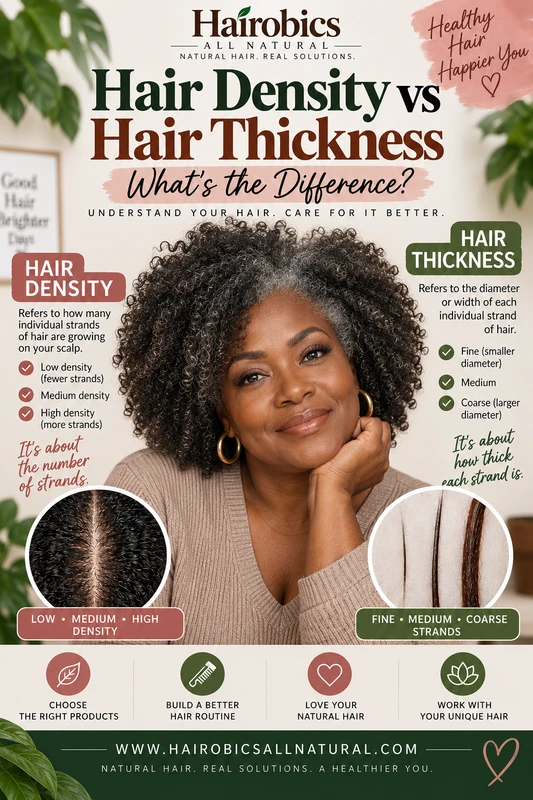
When you look at your natural hair, you may describe it as thick, thin, full, fine, coarse, or somewhere in between. But two characteristics that are often confused are hair density and hair thickness.
They may sound like the same thing, but they describe two different aspects of your hair.
Hair density refers to how many individual strands of hair are growing on your scalp, while hair thickness usually refers to the diameter or width of each individual strand.
Understanding the difference can make it much easier to choose hairstyles, products, moisturizing techniques, and wash-day routines that work with your hair instead of against it.
This distinction can be especially helpful for natural hair because curls, coils, shrinkage, and styling can make it difficult to judge how much hair you actually have or how thick individual strands really are.
For example, someone can have thousands of fine strands packed closely together, giving them high-density hair that looks extremely full. Another person might have fewer strands but each individual strand may be coarse and thick.
Both people may describe themselves as having "thick hair," even though their hair characteristics are very different.
In this complete guide, we'll explain hair density vs hair thickness, how to determine each one, why they matter, and how you can build a natural hair routine around your unique combination.
What Is Hair Density?
Hair density describes the number of hair strands growing within a particular area of your scalp.
In everyday hair care, density is usually described as:
- Low density
- Medium density
- High density
Density influences how full your hair appears, how visible your scalp is, how easily products distribute through your hair, and sometimes how long wash day takes.
A person with high-density hair simply has more individual strands growing within a given area than someone with low-density hair.
This doesn't automatically mean the strands themselves are thick.
That's where the difference between density and thickness becomes important.
What Is Hair Thickness?
Hair thickness typically refers to the diameter of an individual hair strand.
Individual strands are commonly described as:
Fine: Smaller-diameter strands that may feel delicate.
Medium: Strands that fall somewhere between fine and coarse.
Coarse: Larger-diameter strands that may feel stronger or more substantial between your fingers.
Hair thickness can influence how your hair responds to styling, manipulation, heat, heavy products, and certain hairstyles.
A person with coarse strands doesn't necessarily have high-density hair.
You could have coarse strands and low density.
Likewise, you could have very fine strands but extremely high density.
Hair Density vs Hair Thickness: The Main Difference
The simplest way to remember the difference is this:
Density = how many strands you have.
Thickness = how thick each strand is.
Imagine two people standing next to each other.
Person A has 100 imaginary strands in a small section of their scalp, but each strand is extremely fine.
Person B has 50 strands in the same-sized section, but each strand is noticeably thicker.
Person A has higher density.
Person B has thicker individual strands.
Visually, however, their hair could appear surprisingly similar.
That's one reason people often confuse the two characteristics.
Why People Often Call Both "Thick Hair"
In normal conversation, "thick hair" can mean several different things.
Someone may say:
"My hair is really thick."
They could mean that they have a lot of hair.
They could mean that their individual strands are coarse.
Or they could mean that their hair looks extremely full when styled.
Because the term is used so broadly, it isn't always helpful when you're trying to understand your actual hair characteristics.
Instead, try thinking about two separate questions:
How many strands do I appear to have?
and
How thick are my individual strands?
Answering those questions separately gives you much more useful information.
The Three Main Hair Density Categories
1. Low-Density Hair
Low-density hair has fewer strands growing within a given area of the scalp.
Common signs can include:
- Your scalp is relatively easy to see.
- Ponytails may have a smaller circumference.
- Parts tend to look wider.
- Your hair may dry relatively quickly depending on porosity and strand thickness.
- Heavy products may easily weigh down your hairstyle.
- Large sections may contain fewer strands than expected.
Having low-density hair does not automatically mean you are experiencing hair loss.
Some people naturally have lower hair density because of genetics.
Density can also vary across the scalp.
For example, you might naturally have slightly lower density around your temples than at the back of your head.
2. Medium-Density Hair
Medium-density hair falls somewhere between low and high density.
You may see some scalp when the hair is parted, but the scalp isn't particularly noticeable when your hair is loose.
Medium-density hair can often accommodate a wide variety of hairstyles and product consistencies.
However, strand thickness, curl pattern, porosity, length, and other characteristics still influence which routines work best.
3. High-Density Hair
High-density hair contains a larger number of strands within a given area.
Signs may include:
- Your scalp is difficult to see unless you deliberately part your hair.
- Your hair appears very full.
- You need several sections during wash day.
- Small styling sections contain a lot of hair.
- It can take significant time to thoroughly saturate your hair with water.
- Applying products evenly may require sectioning.
High-density natural hair can create incredible volume, but it can also require more patience during detangling, washing, conditioning, and styling.
How to Determine Your Hair Density
You don't necessarily need specialized equipment to get a general idea of your density.
There are several simple methods you can try at home.
The Scalp Visibility Test
Start with clean, dry hair without a lot of heavy styling products.
Allow your hair to fall naturally.
Look at your scalp without deliberately creating a part.
If you can easily see significant areas of your scalp, you may have lower-density hair.
If you can see some scalp but your hair still provides substantial coverage, you may have medium density.
If it's difficult to see your scalp without separating the hair, you may have high-density hair.
This test isn't perfect because curl pattern, hair color, scalp color, shrinkage, and styling can influence what you see.
Use it as a general guide rather than an exact measurement.
The Ponytail Test
If your hair is long enough, gather it into a ponytail.
Pay attention to the circumference of the ponytail.
A smaller ponytail can indicate lower density, while a larger ponytail can suggest higher density.
However, this test has an important limitation.
Someone with coarse strands can have a substantial ponytail even if their actual density isn't particularly high.
Likewise, someone with hundreds of very fine strands could have high density without an exceptionally large ponytail.
That's why it's better to use several observations instead of relying on a single test.
How to Determine Hair Thickness
Determining individual strand thickness requires looking at one strand rather than your entire head of hair.
Take a naturally shed strand and hold it between your fingers.
Fine hair may be difficult to feel.
Medium strands are usually noticeable but don't feel especially thick.
Coarse strands may be easy to feel when rolled between your fingertips.
You can also visually inspect individual strands under good lighting.
Compare several strands from different parts of your head because strand diameter isn't necessarily identical everywhere.
Fine Hair vs Thin Hair
Here's another important distinction.
Fine hair and thin hair don't necessarily mean the same thing.
Fine describes the diameter of individual strands.
Thin is often used to describe the overall amount or appearance of hair.
You could have fine hair but lots of it.
That would mean:
Fine strands + high density.
Your hair could look extremely full even though each individual strand is delicate.
Conversely, you could have:
Coarse strands + low density.
Each individual hair is thick, but there are fewer strands overall.
Understanding this distinction can dramatically improve the way you approach natural hair care.
The Different Density and Thickness Combinations
Hair characteristics don't exist independently.
Your density and strand thickness combine to influence the way your hair looks and behaves.
Let's examine some common combinations.
Low Density + Fine Strands
This combination may appear less voluminous because you have fewer strands and each strand has a relatively small diameter.
Heavy products can sometimes make this hair appear flatter.
You may benefit from lightweight moisturizers and strategic styling techniques designed to create volume.
Be especially careful with excessive tension because fine strands may be more vulnerable to breakage.
Low Density + Coarse Strands
This is a perfect example of why density and thickness shouldn't be confused.
You may have fewer hairs, but every individual strand is relatively thick.
Your hair may feel substantial even though your scalp is more visible.
Product selection will depend heavily on your porosity and moisture needs rather than density alone.
High Density + Fine Strands
This combination can produce extremely full-looking hair.
You have lots of individual strands, but each one is relatively fine.
Because there are so many strands, people may assume your hair is coarse.
However, individual strands can still be delicate.
Gentle detangling becomes particularly important.
High Density + Coarse Strands
This combination can produce extremely voluminous hair because you have both a large number of strands and larger-diameter individual strands.
Wash day may require multiple sections.
Getting water, shampoo, conditioner, and moisturizer evenly distributed throughout the hair can take additional time.
Sectioning can make this process much easier.
Does Curl Pattern Determine Hair Density?
No.
Curl pattern and density are separate characteristics.
You can have:
Type 3 curls with low density.
Type 3 curls with high density.
Type 4 coils with low density.
Type 4 coils with high density.
The same principle applies to strand thickness.
Someone with tightly coiled hair doesn't automatically have coarse strands.
Type 4 hair can have extremely fine strands.
This is one reason curl type alone doesn't tell you everything you need to know about caring for your natural hair.
Hair Density vs Hair Porosity
Density is also different from hair porosity.
Porosity describes how your hair interacts with and absorbs moisture.
Hair is commonly described as:
- Low porosity
- Medium porosity
- High porosity
You could have high-density, low-porosity hair.
You could also have high-density, high-porosity hair.
These combinations may require completely different routines.
For example, someone with high-density, low-porosity hair may find that getting water and product thoroughly distributed through all those strands takes considerable effort.
Someone with high-density, high-porosity hair may find that their hair accepts moisture readily but struggles to retain it for long periods.
That's why building a routine around only one characteristic can be limiting.
Ideally, consider your:
Density + strand thickness + porosity + curl pattern + scalp needs + lifestyle.
Together, these characteristics provide a much clearer picture of what your hair needs.
How Hair Density Affects Your Natural Hair Routine
Once you understand your density, you can make practical changes to your routine.
Washing High-Density Hair
If you have high-density hair, sectioning can be extremely helpful.
Try dividing your hair into four, six, or even eight sections before washing.
Working section by section helps ensure that water and cleanser reach your scalp instead of simply coating the outer layers of your hair.
Focus primarily on cleansing your scalp.
Allow the shampoo and water to travel through the lengths of your hair as you rinse.
Washing Low-Density Hair
Low-density hair may require fewer sections.
You may also want to pay close attention to product buildup.
If your hair is easily weighed down, heavy butters, oils, creams, and styling products can sometimes reduce volume and make strands look flatter.
Clarifying periodically may help remove accumulated product.
The appropriate frequency depends on your routine.
Moisturizing Based on Hair Density
Density influences how you apply moisturizer, but porosity often influences how well your hair absorbs and retains that moisture.
That's an important distinction.
High-Density Hair
High-density hair often benefits from sectioning during moisturizing.
If you simply apply moisturizer to the outside of your hair, the inner layers may remain dry.
Instead:
Divide your hair into sections.
Apply your moisturizing product throughout each section.
Pay attention to your ends.
Gently work the product through your strands.
You don't necessarily need enormous quantities of product.
Good distribution is often more important than simply adding more.
Low-Density Hair
Low-density hair may benefit from lighter application.
Start with a small amount of moisturizer and add more only when necessary.
Using too much product can leave some low-density hairstyles looking greasy, flat, or weighed down.
Hair Thickness and Product Selection
Individual strand thickness can also influence which products feel best.
Fine Strands
Fine strands can sometimes become overwhelmed by very heavy formulas.
You may prefer:
Lightweight leave-in conditioners
Light creams
Lightweight oils
Water-based moisturizing sprays
Flexible-hold styling products
This doesn't mean fine hair can never use butter or heavier oils.
The key is quantity and how your particular hair responds.
Coarse Strands
Coarse strands may sometimes respond well to richer products, particularly when the hair is prone to dryness.
Depending on your porosity, you might prefer:
Creamy leave-ins
Rich conditioners
Hair creams
Butters
Oils
However, coarse hair doesn't automatically require heavy products.
Porosity and personal preference still matter.
Hair Density and Protective Styling
Density should also be considered when choosing protective hairstyles.
Braids, twists, cornrows, wigs, and other protective styles can be useful, but excessive tension should always be avoided.
For lower-density hair, extremely small or heavy braids may place unnecessary stress on fewer strands.
Consider slightly larger sections and lighter extensions when appropriate.
People with high-density hair may require more sections to achieve certain looks, but adding extensions to every section can create significant overall weight.
Regardless of density, protective styling should never consistently cause pain, severe tightness, bumps, or significant scalp discomfort.
Can Hair Density Change?
Yes.
Although genetics strongly influence your natural density, the number of actively growing hairs can change throughout life.
Normal shedding occurs as hairs move through their natural growth cycle.
Density can also appear different because of changes in styling, length, shrinkage, breakage, or hair health.
However, noticeable or unexplained changes in density deserve attention.
If you suddenly notice significantly more scalp visibility, excessive shedding, bald spots, or substantial changes in your hairline, consider speaking with a dermatologist or qualified healthcare professional.
Hair-care products can improve how hair looks and feels, but sudden or significant hair loss can have causes that require professional evaluation.
Does Hair Density Change With Age?
Hair can change as we age.
Some people notice changes in overall fullness, strand diameter, texture, or growth patterns over time.
Your hair at 45 may not behave exactly like it did at 20.
This makes periodically reassessing your routine worthwhile.
Don't assume that a product or technique that worked ten years ago must still be ideal today.
Natural hair care should evolve with your hair.
Can You Increase Hair Density?
This question requires an important distinction.
You can create hairstyles that make hair look fuller, but dramatically increasing the genetically determined number of follicles on your scalp isn't something a cosmetic hair product can simply accomplish.
What you can do is focus on maintaining the hair you currently grow.
That means reducing unnecessary breakage, avoiding excessive tension, keeping your scalp clean, detangling carefully, protecting your ends, and maintaining an appropriate moisture routine.
If you're experiencing actual hair loss rather than naturally low density, determining the underlying cause is important.
Hair Density vs Hair Loss
Low-density hair and hair loss are not necessarily the same thing.
Someone can naturally have low-density hair throughout their life.
The more important question is:
Has your density changed?
If your hair has always been lower density, that may simply be your natural characteristic.
If your hair used to be noticeably fuller and has become significantly less dense, that's different.
Take photographs periodically under similar lighting and from similar angles.
This can help you observe gradual changes that may otherwise be difficult to notice.
How Breakage Can Make Hair Look Less Dense
Not every change in fullness is caused by hair shedding from the root.
Breakage can also reduce the appearance of density.
If strands repeatedly snap at different lengths, your ends may become increasingly sparse.
You might notice:
Thin-looking ends
Uneven sections
Short broken hairs
Difficulty retaining length
See-through ends
Hair that appears full near the roots but thin toward the bottom
In these cases, protecting the hair you already have becomes particularly important.
How to Protect Fine Hair
Fine strands deserve special attention because their smaller diameter can make them vulnerable to mechanical damage.
Try minimizing unnecessary manipulation.
Detangle gently.
Avoid constantly pulling your hair into extremely tight hairstyles.
Sleep with a satin or silk bonnet, scarf, or pillowcase to reduce friction.
Be cautious with excessive heat.
Keep your hair moisturized according to its needs.
And pay attention to your ends.
Your goal isn't to make each strand magically become coarse.
Your goal is to keep your fine strands healthy enough to remain on your head and retain length.
How to Care for Coarse Hair
Coarse strands can feel strong, but that doesn't make them indestructible.
Coarse hair can still experience dryness, split ends, knots, and breakage.
Moisture remains important.
Use enough water and moisturizing product to thoroughly cover your strands without automatically assuming that more product is always better.
Regular conditioning and gentle detangling can help keep coarse natural hair manageable.
Best Hairstyles for Low-Density Natural Hair
If you want your hair to appear fuller, certain hairstyles can create more visual volume.
Options may include:
Twist-outs
Braid-outs
Fluffy wash-and-gos
Bantu-knot-outs
Layered natural styles
Afros
Voluminous puffs
The goal isn't to hide your density.
It's simply to choose styles that work with the amount of hair you naturally have.
Avoid excessively separating or manipulating your hair solely to create volume if doing so causes breakage.
Best Hairstyles for High-Density Natural Hair
High-density hair gives you many styling possibilities.
Popular options include:
Afros
Two-strand twists
Braids
High puffs
Buns
Wash-and-gos
Flat twists
Cornrows
Braid-outs
Twist-outs
However, very high-density hair can become heavy when combined with long extensions.
Pay attention to how your scalp feels.
A hairstyle doesn't need to hurt to be secure.
Why Sectioning Is So Important for High-Density Hair
Sectioning is one of the simplest ways to make high-density natural hair easier to manage.
Instead of trying to wash or detangle your entire head at once, divide it into manageable sections.
For example:
Start with four large sections.
If each section still feels overwhelming, divide each one in half.
You now have eight manageable sections.
Work through one section at a time.
This technique can be used for:
Shampooing
Conditioning
Deep conditioning
Detangling
Moisturizing
Applying leave-in conditioner
Styling
Sectioning can also help prevent hidden areas of dryness because you're intentionally reaching the inner layers of your hair.
Why Your Hair May Look More or Less Dense on Different Days
Natural hair doesn't always look equally full.
Humidity, shrinkage, stretching, product buildup, styling techniques, and wash-day results can dramatically change its appearance.
A freshly stretched afro may look enormous.
The same hair may look significantly smaller when soaking wet.
Neither appearance necessarily indicates a change in the actual number of strands.
This is particularly important when tracking hair growth or density.
Compare your hair under similar conditions.
Does Shrinkage Affect Hair Density?
Shrinkage doesn't change your actual density, but it can change how dense your hair appears.
When curls and coils contract, strands become concentrated within a smaller visible area.
This can make natural hair appear fuller.
Stretching those same strands may make the overall shape appear different.
Neither state tells the complete story about your density.
Does Hair Length Affect the Appearance of Density?
Yes.
Longer hair can sometimes appear less voluminous because gravity pulls strands downward.
Shorter natural hair may stand outward from the scalp and appear extremely full.
Your ends can also become less dense over time if they experience repeated breakage.
That's why someone may have high density near the scalp but noticeably thinner-looking ends.
Why Your Ends May Be Thinner Than Your Roots
Your roots contain your newest growth.
Your ends contain the oldest part of your hair.
If your hair is several years old, those ends have survived countless wash days, hairstyles, detangling sessions, nights of sleeping, environmental exposure, and daily manipulation.
Some strands will naturally shed or break over time.
That's why protecting your ends is so important for length retention.
Use gentle detangling methods and keep the ends appropriately moisturized.
Regular trims can also help remove damaged or split ends when necessary.
Hair Density and Detangling
Your density can significantly influence how long detangling takes.
Someone with high-density hair has more individual strands to separate.
Trying to rush the process can increase tangling and breakage.
Use manageable sections.
Apply enough water or a product with good slip.
Start near the ends and gradually work upward.
Use your fingers or an appropriate detangling tool.
If you encounter a knot, don't immediately pull harder.
Slow down and work through the tangled strands carefully.
Patience can save hair.
Hair Thickness and Heat Styling
Fine strands may require particular caution with heat because they can be vulnerable to excessive temperatures.
But coarse strands can also suffer heat damage.
Always use reasonable heat settings and avoid repeatedly passing a hot tool over the same section.
Consider using a heat protectant whenever appropriate.
Remember that "coarse" doesn't mean heat-proof.
All hair can become damaged when exposed to excessive heat.
Density and Your Wash-Day Schedule
Hair density doesn't automatically determine how frequently you should wash your hair.
Your scalp, activity level, product use, protective styling habits, and personal needs matter more.
Someone with high-density hair may wash weekly.
Another person with similar density may wash every 10 days.
Pay attention to your scalp and product buildup rather than following a schedule simply because someone online has similar-looking hair.
Density, Thickness, and Product Buildup
One common natural hair mistake is assuming that extremely full hair always requires huge quantities of product.
It doesn't.
High-density hair may require careful distribution, but applying excessive amounts can create buildup.
Work in sections and begin with reasonable quantities.
Add more when your hair actually needs it.
The same principle applies to oils.
Oil can help lubricate hair or reduce moisture loss depending on how it's used, but pouring large amounts of oil onto dry hair doesn't replace water or a water-based moisturizer.
Build a Routine Around Your Hair Characteristics
Instead of copying someone else's entire natural hair routine, learn your own characteristics.
Ask yourself:
What is my density?
Are my strands fine, medium, or coarse?
What is my porosity?
How quickly does my hair lose moisture?
Which products cause buildup?
Which hairstyles create unnecessary tension?
How easily does my hair tangle?
Where do I experience the most breakage?
These questions are often more useful than simply knowing your curl type.
Sample Routine for High-Density Natural Hair
A simple routine might look like this:
Step 1: Section your hair.
Divide it into four to eight sections before washing.
Step 2: Thoroughly wet each section.
Don't assume the inner layers are saturated just because the outside feels wet.
Step 3: Cleanse the scalp.
Massage gently with your fingertips.
Step 4: Condition.
Apply conditioner throughout your sections and focus on areas prone to tangling.
Step 5: Detangle carefully.
Work from the ends upward.
Step 6: Apply leave-in or moisturizer.
Keep your hair sectioned so every area receives product.
Step 7: Seal or style as needed.
Choose products based on your porosity and preferred hairstyle.
Sample Routine for Low-Density Natural Hair
Low-density hair may benefit from a simpler, lighter routine.
Step 1: Cleanse regularly enough to control buildup.
Step 2: Condition without overwhelming the strands.
Step 3: Apply a lightweight leave-in or moisturizing product.
Step 4: Add a small amount of oil or styling product if needed.
Step 5: Choose low-tension hairstyles.
Step 6: Protect your hair overnight.
You can always add more product.
Removing excessive product usually requires another wash.
Starting lightly makes it easier to find the right balance.
Common Hair Density Mistakes
One mistake is assuming that visible scalp automatically means hair loss.
Another is assuming that high-density hair is automatically healthy.
Density describes how many strands are present, not the condition of those strands.
Someone can have high-density hair with significant breakage.
Someone else can have naturally low-density hair that's extremely healthy.
Avoid comparing your density to someone else's.
Instead, focus on maintaining your own hair.
Frequently Asked Questions About Hair Density vs Hair Thickness
Is hair density the same as hair thickness?
No.
Hair density refers to the number of strands within an area of your scalp. Hair thickness generally refers to the diameter of each individual strand.
Can you have thick hair with low density?
Yes.
You can have coarse, thick individual strands but relatively few strands overall.
Can you have thin hair with high density?
Absolutely.
You can have fine individual strands but a large number of them.
This combination can make your hair look extremely full.
Is fine hair always weak?
Not necessarily.
Fine strands have a smaller diameter and may require gentler handling, but fine hair can still be healthy and resilient.
Does high-density hair grow faster?
Not necessarily.
Density describes the number of strands, not the speed at which each strand grows.
Does cutting your hair increase density?
Cutting hair doesn't create additional follicles.
A haircut can make the ends appear fuller, especially if damaged or sparse ends are removed, but it doesn't increase the number of hairs growing from your scalp.
Can oils increase hair density?
Oils can play a useful role in a hair-care routine, but cosmetic oils don't simply create new hair follicles.
If you're experiencing unexplained hair thinning or loss, seek professional guidance rather than relying entirely on oils.
Which is more important: density or porosity?
Neither is universally more important.
They tell you different things.
Density helps you understand how much hair you're working with.
Porosity helps you understand how your hair interacts with moisture.
Strand thickness tells you about the size of individual hairs.
Considering all three can help you develop a more personalized routine.
Final Thoughts: Hair Density vs Hair Thickness
Understanding hair density vs hair thickness can completely change the way you think about your natural hair.
Remember the simplest distinction:
Hair density tells you how many strands you have.
Hair thickness tells you how thick each individual strand is.
You can have fine strands and high density.
You can have coarse strands and low density.
You can also fall somewhere in between.
Neither combination is better than another.
The goal of natural hair care isn't to force your hair to behave like someone else's. It's to understand the hair growing from your own scalp and build a routine that supports it.
Pay attention to your density, strand thickness, porosity, moisture needs, scalp condition, and styling habits.
For high-density hair, sectioning can make washing, moisturizing, and detangling much easier.
For low-density hair, lightweight products and low-tension styling can help you maintain volume without unnecessarily weighing the hair down.
Fine strands often benefit from gentle handling, while coarse strands may need adequate moisture and conditioning to remain manageable.
Most importantly, monitor changes in your hair rather than comparing yourself to other people.
Natural variation in hair density is completely normal.
But if you notice sudden thinning, bald spots, excessive shedding, or a major change in your hairline or density, consider speaking with a dermatologist or healthcare professional.
Once you understand your hair's unique combination of density, thickness, porosity, and texture, choosing products and techniques becomes much less about guessing and much more about giving your hair what it actually needs.
Your natural hair doesn't need to fit into someone else's definition of "thick" or "thin."
It simply needs a routine designed for your hair.