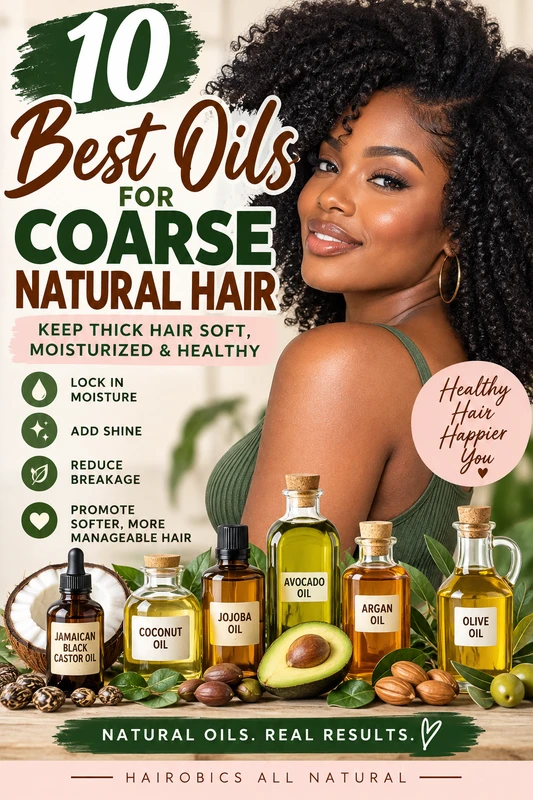
Coarse natural hair can be incredibly strong, beautiful, and versatile, but keeping it soft, moisturized, and manageable can sometimes be challenging. If your strands feel thick or wiry between your fingers, your hair may have a coarse texture—and choosing the right oils can make a noticeable difference in how your hair feels and behaves.
The best oils for coarse natural hair can help seal in moisture, reduce friction, improve softness, add shine, and protect strands from excessive dryness. However, not every oil works the same way.
Some lightweight oils spread easily over the hair without leaving it greasy, while heavier oils may provide the richer sealing and lubrication that thick, coarse strands often appreciate.
The key is understanding what your hair actually needs.
In this complete guide, we'll explore the best oils for coarse natural hair, how to use them, which oils may work better for different porosity levels, common mistakes to avoid, and how to build an effective oil routine for healthy natural hair.
What Is Coarse Natural Hair?
Before choosing an oil, it helps to understand what "coarse hair" actually means.
Coarse hair refers primarily to the diameter or thickness of an individual hair strand.
It doesn't necessarily describe your curl pattern.
A person with loose waves can have coarse strands, and someone with tightly coiled Type 4 hair can also have coarse strands.
You may have coarse hair if individual strands are easy to see and feel when you roll them between your fingers.
Coarse natural hair often feels substantial and strong. Individual strands may be more resistant to manipulation than fine hair, but that doesn't mean coarse hair cannot become dry or damaged.
In fact, coarse natural hair can sometimes feel rough even when the hair is relatively healthy.
This is why moisture, conditioning, lubrication, and proper handling are so important.
Coarse Hair vs. Thick Hair
Coarse hair and thick hair aren't exactly the same thing.
Coarse hair describes the diameter of individual strands.
Hair density describes how many strands are growing on your scalp.
This means you could have:
- Coarse strands with low-density hair
- Coarse strands with medium-density hair
- Coarse strands with high-density hair
- Fine strands with very dense hair
Understanding this difference can help you choose products more accurately.
Someone with coarse but low-density hair, for example, might enjoy nourishing oils but find extremely heavy products make the overall hairstyle look flat.
Someone with coarse, high-density natural hair may find that richer products are easier to distribute throughout the hair without making it appear weighed down.
Why Does Coarse Natural Hair Need Oil?
Natural scalp oils called sebum help lubricate the hair.
However, curls, coils, and kinks can make it more difficult for sebum to travel from the scalp all the way down to the ends.
The ends of natural hair are also the oldest part of the strand and may experience years of washing, styling, detangling, weather exposure, and friction.
That's one reason the ends can become particularly dry.
Using an appropriate hair oil can help create lubrication and reduce friction between strands.
Oil can also help seal in moisture after you've applied water or a water-based moisturizing product.
But there's an important distinction:
Oil and moisture aren't the same thing.
Does Oil Actually Moisturize Natural Hair?
One of the biggest misconceptions in natural hair care is that oil itself moisturizes dry hair.
Water provides hydration.
Oil primarily helps lubricate hair and can slow moisture loss by creating a coating around the strand.
This distinction matters.
If your coarse hair is extremely dry and you simply continue applying more oil to it, the hair may become oily while still feeling dry underneath.
A more effective approach is often:
Water or water-based moisturizer → leave-in conditioner → oil or sealing product
Depending on your hair, you may not need all three steps every time.
The goal is to determine how much product your hair actually needs.
10 Best Oils for Coarse Natural Hair
There isn't one universally perfect oil for every head of natural hair. Your porosity, density, styling routine, climate, and personal preferences all matter.
However, the following oils are excellent options to consider.
1. Avocado Oil
Avocado oil is one of the first oils to consider if you have coarse natural hair.
It has a rich but relatively smooth texture that makes it useful for thick strands that need lubrication without necessarily requiring an extremely heavy coating.
Avocado oil contains fatty acids and vitamin E and works particularly well as a finishing or sealing oil.
Benefits of avocado oil for coarse hair
Avocado oil can help:
- Lubricate dry strands
- Reduce friction during styling
- Improve the appearance of shine
- Make coarse hair feel smoother
- Seal moisture into the hair
- Protect vulnerable ends from excessive dryness
Try applying a small amount after your leave-in conditioner.
Concentrate primarily on the mid-lengths and ends instead of automatically coating your entire scalp.
Avocado oil can also be incorporated into a pre-shampoo treatment.
2. Jojoba Oil
Jojoba oil is technically a liquid wax rather than a traditional vegetable oil, but it has become extremely popular in hair-care products.
One of its greatest advantages is versatility.
It isn't usually as heavy as castor oil, making it an attractive option for coarse hair that needs lubrication but becomes weighed down easily.
Why jojoba oil works well
Jojoba oil can help provide:
- Lightweight lubrication
- Added shine
- Reduced roughness
- Easier product distribution
- A smoother feel
It can work particularly well for people who dislike the sticky or extremely rich feeling associated with heavier oils.
Jojoba can be applied by itself or combined with other carrier oils.
3. Jamaican Black Castor Oil
Jamaican black castor oil is a favorite in many natural-hair routines because of its thick consistency.
Coarse strands that seem to absorb lighter products quickly may respond well to a small amount of a heavier sealing oil.
Castor oil is rich in ricinoleic acid and has a distinctive thick texture.
Best uses for castor oil
Consider using it for:
- Sealing your ends
- Protective styles
- Twists
- Braids
- Pre-shampoo treatments
- Adding richness to lighter oils
The biggest mistake with castor oil is often using too much.
A little goes a long way.
Instead of covering your hair in a large quantity, warm a few drops between your palms and gently smooth them over damp or moisturized hair.
If pure castor oil feels too heavy, mix it with jojoba, grapeseed, sweet almond, or avocado oil.
Does castor oil make hair grow faster?
Castor oil is frequently promoted online as a hair-growth treatment, but strong clinical evidence showing that applying castor oil directly causes faster hair growth is limited.
That doesn't mean it can't have a place in a healthy hair routine.
Reducing dryness, friction, and breakage can help you retain more of the hair you grow, which can make achieving longer hair easier over time.
4. Coconut Oil
Coconut oil is unusual among popular hair oils because research suggests it can penetrate the hair shaft and reduce protein loss under certain conditions.
That makes it interesting for people concerned about damage and breakage.
However, coconut oil isn't perfect for everyone.
Some people with natural hair love it, while others report that it makes their hair feel stiff or dry.
Coconut oil may be useful for:
- Pre-shampoo treatments
- Reducing wash-day friction
- Protecting hair before shampooing
- Supporting damaged or frequently manipulated strands
Rather than immediately covering your entire head in coconut oil, test it on one section first.
If your hair feels soft and flexible afterward, it may be worth incorporating into your routine.
If your hair consistently feels hard, stiff, or coated, try another oil.
5. Olive Oil
Olive oil is another richer oil that can work beautifully on coarse strands.
Its heavier consistency makes it especially appealing to people whose hair seems to lose softness quickly after wash day.
Olive oil can provide excellent lubrication and shine.
Ways to use olive oil
Try adding a small amount to your:
- Pre-poo treatment
- Deep conditioner
- Leave-in routine
- Ends
- Twists or braids
Extra virgin olive oil is quite rich, so begin with a small amount.
More oil doesn't automatically mean healthier hair.
6. Sweet Almond Oil
Sweet almond oil provides a nice balance between lightweight and heavy oils.
It contains fatty acids and vitamin E and spreads easily across the hair.
This can be particularly useful if you have coarse strands but don't enjoy extremely thick oils.
Sweet almond oil can help:
- Add shine
- Lubricate strands
- Smooth rough-feeling hair
- Seal moisture
- Reduce friction during manipulation
It's also easy to blend with heavier oils.
For example, combining a little castor oil with sweet almond oil can create a mixture that's easier to spread.
7. Argan Oil
Argan oil has become extremely popular in commercial hair products because it provides smoothness and shine without necessarily leaving hair extremely greasy.
It can be particularly helpful as a finishing oil.
Instead of saturating your hair, use several drops after styling.
Argan oil is especially useful for:
- Finishing styles
- Smoothing frizz
- Adding shine
- Lubricating ends
- Refreshing dry-feeling strands
If your coarse hair is also low density, argan oil may be easier to use regularly than extremely heavy oils.
8. Grapeseed Oil
Grapeseed oil is one of the lighter options on this list.
That's useful because having coarse strands doesn't automatically mean your hair loves heavy products.
Someone can have coarse strands and still experience buildup very easily.
Grapeseed oil spreads well and provides lubrication without the dense consistency of castor oil.
Grapeseed oil may be a good choice if:
- Heavy oils weigh down your hair
- You have low-porosity hair
- You want a finishing oil
- You prefer lightweight products
- Your scalp becomes oily easily
- You frequently wear wash-and-go styles
Apply sparingly after moisturizing.
9. Baobab Oil
Baobab oil is derived from the seeds of the baobab tree and is used in a variety of skin and hair formulations.
Its fatty-acid profile makes it an interesting option for dry, textured hair.
Baobab oil can be used as a sealing or finishing oil to help coarse strands feel smoother.
Try it on the ends of your hair first.
Because the ends are typically the oldest portion of the strand, they often benefit most from additional lubrication.
10. Sunflower Oil
Sunflower oil is another option that sometimes gets overlooked.
It's relatively lightweight and contains a high percentage of linoleic acid, depending on the variety.
For coarse hair that dislikes very heavy oils, sunflower oil can provide lubrication while maintaining movement.
It may work especially well in oil blends.
Best Heavy Oils for Coarse Natural Hair
If your coarse hair responds particularly well to rich products, consider oils such as:
Castor oil – extremely thick and useful for sealing.
Olive oil – rich and easy to distribute.
Avocado oil – nourishing-feeling without being as sticky as castor oil.
Heavy oils can be particularly useful during colder weather when dry indoor air and environmental conditions may make hair feel rougher.
However, avoid assuming that coarse hair always needs the heaviest possible products.
Your porosity matters too.
Best Lightweight Oils for Coarse Natural Hair
Some coarse hair becomes greasy or coated quickly.
In that case, try:
Grapeseed oil
Jojoba oil
Argan oil
Sweet almond oil
Sunflower oil
These oils can provide lubrication and shine while helping you avoid the heavy feeling associated with castor oil.
Best Oil for Coarse Low-Porosity Natural Hair
Hair porosity describes how easily your hair takes in and retains water.
Low-porosity hair has a cuticle structure that can make it more difficult for water and products to move into the strand.
People with low-porosity hair frequently complain about products sitting on top of their hair.
If you have coarse, low-porosity hair, you may prefer lighter oils such as:
- Jojoba oil
- Grapeseed oil
- Argan oil
- Sweet almond oil
- Sunflower oil
Start with very small amounts.
Applying layer after layer of butter and oil may make low-porosity hair feel coated without solving the underlying dryness.
Focus first on water and conditioning.
Then use a light layer of oil if your hair benefits from it.
Best Oil for Coarse High-Porosity Natural Hair
High-porosity hair tends to take in moisture readily but may also lose it relatively quickly.
High porosity can occur naturally, but chemical processing, excessive heat, mechanical damage, and environmental wear can also increase porosity.
Coarse, high-porosity hair may appreciate richer sealing products.
Consider:
- Avocado oil
- Olive oil
- Castor oil
- Sweet almond oil
Some people also like combining a lighter oil with a heavier one.
For example:
Avocado oil + castor oil
or
Sweet almond oil + castor oil
This allows you to customize the consistency.
Best Oil for Coarse 4C Hair
Type 4C hair is known for its tight curl pattern and significant shrinkage.
However, remember that curl pattern and strand thickness aren't the same thing.
Not everyone with 4C hair has coarse strands.
If you have both coarse strands and tightly coiled 4C hair, lubrication can be especially valuable because the many bends and curves along the strand can increase opportunities for tangling and friction.
Popular options include:
- Avocado oil
- Jamaican black castor oil
- Olive oil
- Jojoba oil
- Sweet almond oil
The best one depends on your porosity and how easily your hair becomes weighed down.
Best Oil for Dry Coarse Natural Hair
If your hair feels extremely dry, don't immediately reach for more oil.
First ask yourself:
When was the last time I actually hydrated my hair?
Dry hair often needs water and conditioning before it needs another layer of oil.
Try this routine:
Step 1: Add water
Start with freshly washed damp hair or lightly mist dry hair with water.
Step 2: Apply a leave-in conditioner
Choose a product designed to provide slip and softness.
Step 3: Seal lightly
Apply a small amount of avocado, jojoba, almond, olive, or castor oil.
Step 4: Protect the ends
Pay special attention to the ends because they're usually the oldest and most vulnerable part of your hair.
Step 5: Reduce unnecessary manipulation
Constant brushing, combing, pulling, and restyling can contribute to breakage.
Sometimes the solution to dry-feeling hair isn't another product.
It may simply need less manipulation.
How to Apply Oil to Coarse Natural Hair
Technique matters almost as much as the oil itself.
Start With Damp Hair
For sealing purposes, oil is usually most useful after water or a water-based product has already been applied.
Your hair shouldn't necessarily be dripping wet.
Slightly damp hair may be enough.
Section Your Hair
Trying to apply products to a large head of thick natural hair without sectioning can result in uneven distribution.
Divide your hair into four, six, or eight sections.
Apply your moisturizer and oil one section at a time.
Start With a Small Amount
It's much easier to add more oil than remove excess oil.
Begin with several drops.
Rub the oil between your palms and smooth it over your strands.
Add more only if necessary.
Concentrate on the Ends
Your ends have been exposed to the most manipulation and environmental stress.
Give them additional attention.
Should You Oil Your Scalp?
You don't necessarily need to oil your scalp simply because you have coarse hair.
Your scalp naturally produces sebum.
Some people enjoy using small amounts of oil on their scalp, while others experience buildup, itching, or irritation.
If your scalp is healthy and comfortable without added oil, there's no requirement to oil it.
If you choose to use scalp oil, avoid saturating your scalp.
Apply small amounts and monitor how your skin responds.
Persistent itching, scaling, redness, sores, or significant flaking should not simply be covered with more oil. Consider consulting a dermatologist, especially if symptoms continue.
How Often Should You Oil Coarse Natural Hair?
There isn't a universal schedule.
Some people may use a small amount of oil several times per week.
Others may only need it on wash day.
Your hair will tell you more than an arbitrary schedule.
Look at how your hair feels.
If it's soft, flexible, and manageable, you probably don't need to keep adding oil.
If it feels dry despite being oily, adding even more oil may create buildup rather than solve the problem.
Instead, consider washing or clarifying the hair and restoring hydration with water and conditioner.
Oils for Protective Styles
Braids, twists, cornrows, and other protective styles can reduce daily manipulation, but the hair still requires appropriate care.
A light oil can help lubricate exposed sections and ends.
For protective styles, consider:
- Jojoba oil
- Grapeseed oil
- Sweet almond oil
- Avocado oil
Avoid repeatedly pouring large quantities of heavy oil onto your scalp.
Excess product mixed with sweat, dead skin cells, lint, and environmental debris can create significant buildup.
Keep your protective-style routine simple.
Oils for Coarse Natural Hair Ends
If length retention is your goal, pay particular attention to your ends.
Hair grows from your scalp, but retaining length requires preserving the hair that's already grown.
Your ends experience:
- Friction from clothing
- Detangling
- Styling
- Washing
- Weather
- Sleeping
- Heat
- Protective-style installation and removal
Applying a tiny amount of oil after moisturizing may help improve lubrication and reduce friction.
Avocado, castor, jojoba, and sweet almond oils are all worth trying.
Oil Before Shampooing
One of the most useful ways to incorporate oil into a natural-hair routine is before shampooing.
This is commonly called pre-pooing.
Apply oil to your hair before washing and allow it to sit for a short period before shampooing.
Coconut oil is particularly interesting for this purpose because of research regarding its interaction with hair proteins.
However, you can also experiment with olive or avocado oil.
Pre-shampoo treatments may be particularly helpful if your hair feels rough after washing.
Oil After Deep Conditioning
Wash day is also an excellent time to seal your hair.
A simple routine might look like:
Shampoo → conditioner/deep conditioner → leave-in → oil → styling product
You don't necessarily need every step.
For example, if your styling cream already contains plenty of oils and conditioning ingredients, adding separate oil may be unnecessary.
Pay attention to your finished result.
Your routine should be based on performance rather than the number of products you're using.
Can You Mix Oils Together?
Absolutely.
Oil blends allow you to combine different textures.
For example, if castor oil is too thick by itself, you can combine it with a lighter carrier oil.
Simple coarse-hair oil blend
Try combining:
- 2 parts jojoba or sweet almond oil
- 1 part castor oil
Adjust the proportions based on your preference.
If it's too thick, add more lightweight oil.
If it's too light, add slightly more castor oil.
You don't need an extremely complicated mixture with 15 different oils.
Simple formulations are often easier to evaluate because you can actually determine whether your hair likes the ingredients.
Essential Oils vs. Carrier Oils
It's important to distinguish between carrier oils and essential oils.
Avocado, jojoba, olive, coconut, grapeseed, sweet almond, and castor oils are commonly used as carrier oils.
Essential oils such as peppermint, rosemary, and tea tree oil are highly concentrated.
They shouldn't automatically be applied directly to your scalp undiluted.
If you use essential oils, they generally need to be properly diluted in an appropriate carrier oil or used in a professionally formulated hair product.
More isn't better.
Scalp irritation is counterproductive to a healthy hair-care routine.
Common Mistakes When Using Oil on Coarse Natural Hair
Mistake #1: Using Oil Instead of Moisture
This is probably the biggest mistake.
If your hair needs hydration, give it water or a water-based product.
Then use oil if needed.
Mistake #2: Using Too Much Oil
Coarse hair can handle richer products, but that doesn't mean it needs to be saturated.
Excessive oil can attract debris, create buildup, interfere with styling, and make wash day more difficult.
Mistake #3: Ignoring Product Buildup
If your hair suddenly stops responding to your normal products, buildup could be part of the problem.
Regular cleansing is important.
You may occasionally need a clarifying shampoo depending on your product use, water quality, and styling routine.
Mistake #4: Applying Oil to an Irritated Scalp
If your scalp is itching severely or flaking excessively, don't automatically assume it's simply dry.
Certain scalp conditions may require appropriate treatment.
Mistake #5: Believing Oil Alone Will Grow Your Hair
Healthy hair growth is influenced by many factors, including genetics, nutrition, general health, age, hormonal factors, and scalp conditions.
Oil can support your hair-care routine, but no cosmetic oil can guarantee rapid growth.
A better goal is creating conditions that support healthy hair while minimizing preventable breakage.
How to Keep Coarse Natural Hair Soft
Oil is only one piece of the puzzle.
For consistently softer natural hair, focus on your entire routine.
Cleanse regularly
Product buildup can leave hair feeling stiff, dull, or rough.
Use an appropriate shampoo often enough to keep your hair and scalp clean.
Condition thoroughly
Conditioner provides slip and helps make detangling easier.
Deep condition when needed
If your hair regularly feels dry or rough, incorporating a deep conditioner may improve softness and manageability.
Detangle gently
Work in sections and begin near your ends.
Gradually move toward the roots.
Reduce unnecessary heat
Heat isn't automatically bad, but excessive temperature or repeated use can damage the hair.
Use appropriate heat protection whenever heat styling.
Protect your hair at night
A satin or silk bonnet, scarf, or pillowcase can help reduce friction while you sleep.
Keep your ends protected
Loose hair constantly rubbing against clothing can experience mechanical wear.
Protective and low-manipulation hairstyles can help reduce friction when used properly.
Best Oils for Coarse Natural Hair in Winter
Cold weather and dry indoor heating can make natural hair feel particularly dry.
During winter, you may find that richer oils work better.
Consider:
- Avocado oil
- Olive oil
- Castor oil
- Sweet almond oil
You might also need to moisturize more frequently.
Remember that the oil should usually follow hydration rather than replace it.
Best Oils for Coarse Natural Hair in Summer
During hot, humid weather, extremely heavy oils can sometimes feel uncomfortable.
Consider switching to:
- Grapeseed oil
- Jojoba oil
- Argan oil
- Sunflower oil
You can always adjust your routine seasonally.
Your hair-care routine doesn't have to remain identical throughout the year.
Best Oils for Coarse Natural Hair Growth and Length Retention
When people search for the best oil for hair growth, they're often actually trying to accomplish two separate goals:
Grow healthy hair from the scalp
and
Keep that hair from breaking off.
Most cosmetic oils are more useful for the second goal.
They can improve lubrication and reduce friction, which may help protect your existing hair.
For length retention, consider:
Avocado oil: Excellent all-around sealing oil.
Jojoba oil: Lightweight and versatile.
Castor oil: Heavy option for sealing ends.
Coconut oil: Particularly useful as a pre-shampoo treatment for some hair types.
Sweet almond oil: Good balance between richness and spreadability.
Combine oil use with gentle detangling, regular conditioning, low-manipulation styling, nighttime protection, and appropriate trimming when necessary.
That's a much more complete length-retention strategy than relying on oil alone.
Frequently Asked Questions
What is the best oil for coarse natural hair?
Avocado oil is an excellent all-around option because it provides lubrication and richness without being as thick as castor oil. However, there isn't one oil that's best for everyone. Jojoba, sweet almond, grapeseed, olive, coconut, argan, and castor oil can all have useful roles depending on your hair's porosity and preferences.
What oil makes coarse hair softer?
Oils such as avocado, jojoba, argan, olive, and sweet almond oil may help coarse hair feel smoother by improving lubrication. For lasting softness, apply oil after hydrating and conditioning your hair rather than relying on oil alone.
Is castor oil good for coarse natural hair?
Yes, especially if your hair responds well to heavier products. Castor oil is very thick, so use small amounts. You can also dilute it with a lighter carrier oil.
Is coconut oil good for coarse natural hair?
It can be. Coconut oil may be particularly useful before shampooing, but some people find that it leaves their hair feeling stiff. Test a small section before incorporating it throughout your routine.
Is jojoba oil good for coarse hair?
Yes. Jojoba is a particularly useful option if your coarse hair needs lubrication but doesn't respond well to very heavy oils.
Which oil is best for coarse 4C hair?
Avocado, jojoba, sweet almond, olive, and castor oils are all worth considering. Choose based on your porosity, density, and how easily your hair becomes weighed down.
Should I apply oil every day?
Not necessarily. Daily oiling may be excessive for some people. Apply oil when your hair actually needs additional lubrication or sealing rather than automatically applying it every day.
Can too much oil dry out natural hair?
Oil itself doesn't necessarily "dry out" hair, but repeatedly coating dry hair with oil without adding water can leave the hair feeling dry underneath a greasy layer. Excessive oil can also contribute to buildup.
Should oil go before or after leave-in conditioner?
If your goal is to seal in moisture, applying a leave-in conditioner first and a small amount of oil afterward is a common approach.
What's the best oil for coarse low-porosity hair?
Start with lighter options such as jojoba, grapeseed, argan, sweet almond, or sunflower oil.
Creating a Simple Routine for Coarse Natural Hair
You don't need an overflowing bathroom cabinet to care for coarse natural hair.
A simple routine can be extremely effective.
Wash Day
Cleanse your scalp and hair thoroughly.
Follow with conditioner or deep conditioner.
Detangle gently while the hair has adequate slip.
Rinse and divide your hair into manageable sections.
Moisturize
Apply a water-based leave-in or moisturizer to damp hair.
Make sure the product is distributed throughout each section.
Seal
Apply a small amount of your chosen oil.
For many people, avocado or jojoba oil is a good place to start.
If you need something heavier, experiment with castor or olive oil.
Style
Choose a low-manipulation style that allows your hair to remain protected for several days.
Twists, braids, buns, and other protective or low-manipulation styles may help.
Nighttime
Protect your hair with satin or silk.
Avoid sleeping directly on rough cotton fabrics whenever possible because repeated friction can contribute to tangling and breakage.
Final Thoughts: Choosing the Best Oil for Coarse Natural Hair
The best oil for coarse natural hair isn't necessarily the thickest, most expensive, or most popular oil.
It's the one that works with your individual strands.
For many people, avocado oil is an excellent all-around starting point because it provides substantial lubrication without being as heavy as castor oil.
If you want something lighter, consider jojoba, grapeseed, argan, or sweet almond oil.
If your coarse hair loves richer products, experiment with olive or castor oil.
And if you're looking for a pre-shampoo oil, coconut oil is worth testing.
Most importantly, remember that oil should be part of a complete natural-hair routine.
Clean hair regularly. Hydrate with water. Condition thoroughly. Detangle gently. Protect your ends. Reduce unnecessary manipulation. Then use oil strategically to help lubricate your strands and seal in moisture.
When you understand your hair's strand thickness, porosity, density, and individual response to products, choosing the right oil becomes much easier.
Coarse natural hair doesn't need to be buried under heavy products to stay healthy.
It needs consistent moisture, good conditioning, gentle handling, and the right amount of lubrication.
Once you find that balance, your coarse natural hair can feel softer, look shinier, remain easier to manage, and retain more of the length you work so hard to grow.