Keeping natural hair moisturized can sometimes feel like a never-ending battle. You wash your hair, apply your favorite moisturizer, seal it with oil, and everything feels soft and hydrated. Then, a day or two later, your hair may feel dry all over again.
For many people with natural hair, the problem isn't necessarily that they aren't using enough products. It may be the order in which those products are applied.
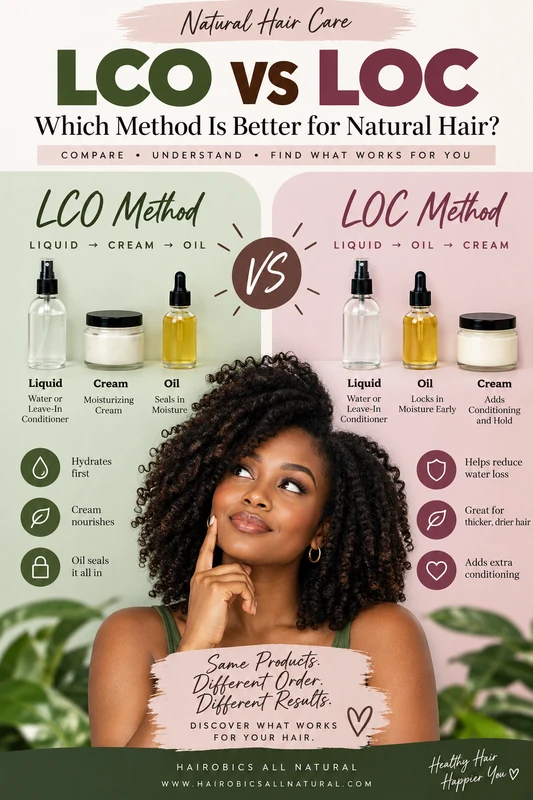
Two of the most popular techniques for maintaining moisture in natural hair are the LCO method and the LOC method.
Both techniques use three basic components: liquid, cream, and oil. The difference is simply the order in which the cream and oil are applied.
But that small difference can have a surprisingly noticeable effect on how your hair looks and feels.
Some natural hair types respond beautifully to the LOC method, while others stay softer longer using LCO. Your hair's porosity, density, strand thickness, climate, styling routine, and the products you use can all influence which method works better.
In this guide, we'll break down LCO vs LOC, explain exactly how each method works, discuss which method may work best for low-porosity and high-porosity natural hair, and show you how to build a moisture routine that keeps your curls, coils, twists, braids, and Afro feeling soft.
What Does LCO Mean?
LCO stands for:
L — Liquid or Leave-In Conditioner
C — Cream
O — Oil
With the LCO method, you first hydrate your hair with water or a water-based leave-in conditioner. Next, you apply a moisturizing cream. Finally, you apply an oil to help reduce moisture loss and add lubrication and shine.
The routine looks like this:
Water/Leave-In → Cream → Oil
For example, after washing your hair, you might apply a leave-in treatment while your hair is still damp. You would then apply a moisturizing cream or butter-based styling product. Finally, you would smooth a small amount of oil over your strands, paying particular attention to your ends.
The goal isn't for the oil to "moisturize" the hair by itself. Oils generally do not provide water to dry hair. Instead, they can help lubricate the strands and slow the loss of moisture that was introduced through water-based products.
This distinction is important because one of the biggest mistakes in natural hair care is trying to fix dehydrated hair by continuously adding oil.
If your hair needs water, adding more oil alone may simply leave you with dry hair that feels greasy.
What Does LOC Mean?
LOC stands for:
L — Liquid or Leave-In Conditioner
O — Oil
C — Cream
The LOC method uses essentially the same categories of products as LCO, but the last two steps are reversed.
The routine looks like this:
Water/Leave-In → Oil → Cream
You begin with water or a water-based leave-in conditioner. Then you apply oil. Finally, you finish with a moisturizing cream.
The theory behind LOC is that applying oil after your water-based product can help reduce water loss, while the cream adds another conditioning and styling layer over the hair.
LOC became extremely popular in the natural hair community because it provides an easy framework for layering products instead of randomly applying multiple moisturizers and oils.
However, LOC isn't automatically the best method for every person with natural hair.
That's where the LCO vs LOC debate begins.
LCO vs LOC: What's the Difference?
The only technical difference is the order of the final two products.
LCO: Liquid → Cream → Oil
LOC: Liquid → Oil → Cream
But changing that order can change the way your products interact with your hair.
With LCO, the cream is applied before the oil. This allows the water-based leave-in and moisturizing cream to contact the hair before an oily layer is added.
With LOC, oil goes on before the cream. Depending on the oil, cream, and amount used, the oil layer may affect how easily the cream spreads or deposits on the strand.
Neither method is universally superior.
Your goal is to determine which combination gives your hair the best balance of:
- Moisture retention
- Softness
- Manageability
- Definition
- Reduced breakage
- Minimal buildup
- Minimal greasiness
- Longer-lasting hydration
If LCO keeps your hair soft for four days while LOC leaves it dry after two, LCO is probably the better routine for your hair.
If LOC gives you soft, defined twists without weighing your hair down, there's little reason to switch simply because someone online prefers LCO.
Natural hair care should be based on how your own hair responds.
Why Does Natural Hair Lose Moisture?
Understanding moisture loss makes the LCO and LOC methods much easier to understand.
Natural hair—especially tightly curled and coily hair—can become dry because the shape of the strands makes it harder for natural scalp oils to travel down the entire length of the hair.
Sebum can move relatively easily along straight strands. With curls and coils, it has to travel around numerous bends before reaching the ends.
That means your ends may receive very little natural lubrication.
The ends are also the oldest part of your hair.
If your hair is 18 inches long, the ends have experienced years of washing, detangling, styling, environmental exposure, friction, and manipulation.
That's why maintaining moisture and reducing unnecessary friction are so important when you're trying to retain length.
Your hair can be growing normally at the scalp while appearing to stay at the same length because the ends are breaking at approximately the same rate.
A consistent moisturizing routine can help keep strands flexible and easier to manipulate.
What Is the "L" in LCO and LOC?
The first step is arguably the most important.
The "L" usually represents either liquid or leave-in conditioner.
Water is the primary source of hydration.
Your first product should therefore usually be water or a product where water is one of the first ingredients.
Good options include:
Plain water
Sometimes your hair simply needs water before additional products are applied.
Water-based leave-in conditioner
A leave-in can provide water along with conditioning ingredients that improve softness, slip, and manageability.
Moisturizing spray
A lightweight moisturizing spray can work particularly well for refreshing natural hair, twists, braids, and locs.
The important thing is that the first step actually provides hydration.
Putting heavy oil onto completely dry hair and expecting it to moisturize the strand often leads to disappointment.
What Is the "C" in LCO and LOC?
The "C" represents cream.
Creams are generally thicker than leave-in conditioners and may contain combinations of water, conditioning ingredients, oils, fatty alcohols, butters, and other ingredients.
Depending on the formula, your cream may function as a:
- Moisturizer
- Curl cream
- Styling cream
- Twist cream
- Hair butter
- Conditioning cream
The right cream should leave your hair soft without creating excessive buildup.
People with very fine or low-density hair may find that heavy creams flatten their styles.
Coarse or very dry hair may respond better to richer formulas.
The amount matters too.
You don't necessarily need to coat every strand with a thick visible layer of product.
Start small and add more only when necessary.
What Is the "O" in LCO and LOC?
The "O" stands for oil.
Popular oils used on natural hair include:
- Jojoba oil
- Grapeseed oil
- Avocado oil
- Sweet almond oil
- Argan oil
- Castor oil
- Olive oil
- Coconut oil
Different oils have different textures.
Grapeseed and jojoba oils, for example, can feel relatively lightweight.
Castor oil is considerably thicker.
Someone with fine natural hair may love grapeseed oil but find castor oil too heavy.
Someone with coarse, high-porosity hair may appreciate a richer oil.
The important point is that oil isn't a replacement for water.
Think of oil primarily as a conditioning, lubricating, and moisture-retention step rather than the original source of hydration.
Is LCO Better Than LOC?
For many people with natural hair, LCO can be an excellent starting point, particularly when they find that applying oil before cream makes their hair feel coated.
Why?
The cream gets direct access to the damp hair before the final oil layer is added.
Imagine dampening your hair with water, immediately coating it with a thick oil, and then trying to spread a water-based cream over it.
Depending on the formulations involved, the cream may not distribute the same way it would if applied directly to damp hair.
With LCO, the routine becomes:
Hydrate → Moisturize/condition → Seal/lubricate
This sequence feels intuitive for many people.
But that doesn't mean LOC is wrong.
Hair care isn't that simple.
Who Should Try the LCO Method?
LCO may be worth trying if your hair frequently feels dry despite using the LOC method.
It can be especially useful if you notice:
- Your cream sits on top of your hair after applying oil.
- Your hair feels greasy but still dry.
- Heavy oils make your strands feel coated.
- Your hair responds well to water-based creams.
- You have difficulty distributing cream after oil.
- Your hair becomes weighed down easily.
LCO can also be useful when you're using a very lightweight oil as the final step.
For example:
Leave-in → moisturizing cream → a few drops of jojoba or grapeseed oil
This can provide moisture without making the hair excessively oily.
Who Should Try the LOC Method?
LOC may work well for people who enjoy the way their hair feels when oil is applied immediately after their leave-in conditioner.
It may be especially worth testing if:
- Your hair loses moisture quickly.
- Your strands tolerate multiple layers of product.
- You have coarse hair.
- Your hair doesn't become greasy easily.
- Your styling cream works well over your preferred oil.
- Your current LOC routine already keeps your hair soft for several days.
If LOC already works, you don't need to change simply because another technique is trending.
Consistency often matters more than constantly switching routines.
LCO vs LOC for Low-Porosity Hair
Low-porosity hair has a cuticle structure that tends to resist rapid water absorption.
People with low-porosity hair frequently complain that products seem to sit on top of their hair.
You might notice visible white residue, greasy strands, or hair that feels coated after applying multiple products.
Because of this, many people with low-porosity hair prefer a lighter version of LCO.
For example:
Water-based leave-in → lightweight cream → small amount of lightweight oil
The key word is lightweight.
Applying a leave-in, heavy butter, thick castor oil, styling gel, edge control, and additional oil may simply be too much for some heads of hair.
If your hair takes a long time to become wet in the shower and products frequently sit on the surface, experiment with using fewer products rather than automatically adding more.
Warm water during wash day can also help thoroughly wet the hair before conditioning.
LCO vs LOC for High-Porosity Hair
High-porosity hair tends to absorb water relatively quickly but may also lose moisture quickly.
Porosity can be influenced by genetics, weathering, heat styling, chemical treatments, coloring, and physical damage.
If your hair absorbs moisture rapidly but becomes dry again soon afterward, you may need a richer layering routine.
Both LOC and LCO can work.
You might experiment with:
Leave-in → rich cream → oil
or:
Leave-in → oil → rich cream
Then compare how your hair feels over the next several days.
Don't judge the method immediately after application.
Both routines may make your hair feel amazing during the first hour.
The better test is how your hair feels two, three, or four days later.
LCO vs LOC for Type 4 Hair
People often ask whether LCO or LOC is better for 4A, 4B, or 4C hair.
Curl pattern alone can't determine the answer.
Two people with 4C hair can have completely different:
- Porosity
- Density
- Strand diameter
- Scalp condition
- Styling habits
- Climate
- Product preferences
One person may have fine, low-porosity 4C hair that becomes greasy quickly.
Another may have coarse, high-porosity 4C hair that seems to absorb everything.
Their ideal routines could be completely different.
Instead of choosing products based solely on your curl type, pay attention to how quickly your hair absorbs water, how quickly it becomes dry, and how easily products cause buildup.
How to Do the LCO Method Step by Step
Step 1: Start With Clean Hair
LCO tends to work best when you're not applying new products over weeks of buildup.
Wash your hair thoroughly according to your normal schedule.
If you've been using heavy oils, butters, gels, pomades, or edge controls, you may occasionally need a clarifying shampoo to remove buildup.
Clean hair gives your moisturizing products a fresh foundation.
Step 2: Apply Your Liquid or Leave-In
Apply your leave-in while your hair is damp.
Divide thick hair into sections so the product reaches more than the surface.
For example, you might use four, six, or eight sections.
Work the leave-in from root to tip, concentrating on areas that become dry easily.
Step 3: Apply Your Cream
Next, apply your moisturizing cream.
You don't necessarily need a huge amount.
Start with a small quantity and distribute it thoroughly.
Your hair should feel soft and moisturized—not covered in a thick white layer.
Step 4: Apply Oil
Finish with your preferred oil.
Concentrate especially on your ends.
Your ends are older and experience significant friction from clothing, pillows, detangling, and styling.
A small amount may be sufficient.
Step 5: Style Your Hair
You can now put your hair into:
- Two-strand twists
- Braids
- Bantu knots
- Flat twists
- An Afro
- A puff
- Another low-manipulation style
Protecting your hair overnight with satin or silk can also help reduce friction.
How to Do the LOC Method Step by Step
The LOC process is nearly identical except for the final two steps.
First, wash and condition your hair.
Then apply your water or water-based leave-in.
Next, apply a small amount of oil through each section.
Finally, apply your cream.
Style your hair as usual.
The important thing is to avoid using so much oil that your cream becomes difficult to distribute.
LCO vs LOC for Fine Natural Hair
Fine strands can become weighed down easily.
If your hair loses volume or looks greasy after moisturizing, your problem may not be LCO versus LOC at all.
You may simply be using too much product.
Try simplifying your routine.
You might use:
Lightweight leave-in → lightweight cream → a few drops of oil
You may even discover that you don't need all three layers every time.
A leave-in plus a light oil might be enough.
The LOC and LCO methods are frameworks—not rules.
LCO vs LOC for Coarse Natural Hair
Coarse strands often tolerate richer products better than fine strands.
You may prefer thicker creams, butters, or oils.
If your hair feels rough shortly after moisturizing, experiment with LCO first:
Leave-in → rich moisturizing cream → oil
If moisture still disappears too quickly, test LOC on the opposite side of your head.
That brings us to one of the easiest ways to settle the LCO vs LOC debate.
Try a Split-Head Test
Instead of guessing, test both methods simultaneously.
Divide your freshly washed hair into two equal halves.
On the left side, use:
LCO
On the right side, use:
LOC
Use approximately the same amount of each product.
Style both sides similarly.
Then evaluate your hair after:
24 hours
Which side feels softer?
48 hours
Which side feels more moisturized?
72 hours
Which side feels less brittle or rough?
Day 4 or 5
Which side needs refreshing first?
This simple experiment tells you far more about your hair than a general recommendation on social media.
Common LCO and LOC Mistakes
1. Using Oil Instead of Moisture
If your hair is dry, pouring oil over it isn't necessarily going to fix the problem.
Start with water.
2. Using Too Much Product
More product doesn't automatically mean more moisture.
Excess product can cause:
- Buildup
- Dullness
- Greasiness
- Flaking
- Reduced volume
- Sticky strands
Start with smaller quantities.
3. Never Clarifying Your Hair
If you've been layering creams, oils, gels, and butters for weeks, your hair may eventually need a deeper cleanse.
If water seems to stop penetrating your hair and every product sits on the surface, buildup could be contributing.
4. Ignoring Your Ends
Your ends deserve special attention.
They're usually the oldest and most fragile portion of your hair.
Work your leave-in and cream into your ends and use a small amount of oil to reduce friction.
5. Moisturizing Every Day Without Checking Your Hair
You don't automatically need to repeat the entire LCO or LOC routine daily.
Touch your hair.
If it still feels soft and flexible, leave it alone.
Excessive manipulation can sometimes create more problems than it solves.
Can You Use LCO Every Day?
You can refresh your hair when necessary, but performing a heavy three-product routine every day may create significant buildup.
Instead, pay attention to your hair.
If your curls need a little hydration, a light water-based moisturizing spray may be enough.
You can then reseal your ends with a tiny amount of oil if necessary.
Save the complete LCO process for when your hair genuinely needs it.
Can You Use LOC Every Day?
The same principle applies.
Daily LOC may be too much for many people, particularly if you're using thick oils and creams.
Your goal shouldn't be to keep adding products.
Your goal should be to keep your hair appropriately hydrated, conditioned, flexible, and manageable while avoiding unnecessary buildup.
What If LCO and LOC Both Make Your Hair Greasy?
Simplify.
Try using only:
Leave-in + cream
or:
Leave-in + lightweight oil
You don't have to follow a three-step method simply because it's popular.
Your shampoo, conditioner, leave-in, styling products, climate, and natural sebum all contribute to how your hair behaves.
Sometimes less really is more.
Can You Use LCO on Braids?
Yes, but you'll usually want a lighter version.
With box braids or other long-term protective styles, heavy cream may be difficult to distribute through the braided hair and can contribute to buildup.
Instead, consider focusing on a water-based moisturizing spray followed by a small amount of lightweight oil when necessary.
Pay attention to your actual natural hair underneath the braids, especially as new growth develops.
Avoid soaking the braids in heavy creams every day.
Can You Use LCO on Locs?
You can use the general principle of hydration followed by lightweight conditioning, but traditional heavy LCO routines may be unnecessary for locs.
Thick creams and butters can become trapped inside locs and contribute to buildup.
Many people with locs prefer a simpler routine involving:
Water or moisturizing spray → lightweight oil
The goal is hydrated locs without coating them in excessive product.
Does LCO Help Hair Grow?
LCO doesn't directly make your follicles produce hair faster.
Hair growth occurs from the follicles in your scalp.
However, a good moisturizing routine can support length retention.
That's an important distinction.
Suppose your hair grows six inches during a year but you lose four inches to breakage.
You'll only see approximately two inches of retained length.
If better moisture management and gentler styling reduce breakage, you may retain more of the hair you're already growing.
This can make your hair appear to grow faster because you're actually keeping more of your length.
How Often Should You Moisturize Natural Hair?
There's no universal schedule.
Some people need to refresh every few days.
Others can go most of the week.
Instead of following an arbitrary calendar, learn to recognize how your hair feels.
Hair that needs moisture may feel:
- Rough
- Stiff
- Brittle
- Tangled
- Less flexible than usual
But don't automatically assume every problem is caused by dryness.
Product buildup, protein overload, hard water, heat damage, split ends, and other issues can create similar symptoms.
Best LCO Routine for Natural Hair
A simple routine might look like this:
1. Shampoo
Cleanse your scalp and strands.
2. Condition
Use a rinse-out conditioner or deep conditioner as appropriate.
3. Leave-in
Apply a water-based leave-in to damp hair.
4. Cream
Work a moisturizing cream through each section.
5. Oil
Apply a small amount of oil, especially to the ends.
6. Style
Put your hair into your preferred style.
7. Protect at night
Use a satin or silk bonnet, scarf, or pillowcase to reduce friction.
You don't need 10 products to maintain healthy natural hair.
A simple routine performed consistently can be far more effective.
Best LOC Routine for Natural Hair
A basic LOC routine follows the same foundation:
1. Cleanse and condition
Start with properly cleansed hair.
2. Apply leave-in
Work your water-based leave-in through damp sections.
3. Apply oil
Smooth a small amount through the hair.
4. Apply cream
Finish with your moisturizing or styling cream.
5. Style and protect
Choose a low-manipulation style and protect your hair overnight.
Again, don't overload your strands.
LCO vs LOC in Winter
Cold weather can make natural hair care more challenging.
Indoor heating, low humidity, wind, and friction from winter clothing can leave hair feeling dry.
During winter, you may find that richer creams work better than the lightweight products you used during summer.
LCO can be especially useful if you want your richer cream to contact damp hair before sealing with oil.
Also protect your ends from rubbing constantly against wool coats, scarves, and sweaters.
LCO vs LOC in Summer
Hot, humid weather may require a lighter approach.
Heavy creams and thick oils can leave some hair feeling greasy or limp.
Consider lighter products such as moisturizing sprays and lightweight oils.
Your ideal routine can change with the seasons.
You don't have to use exactly the same products in January that you use in July.
How to Know Your Moisture Routine Is Working
Your routine doesn't need to make your hair look shiny enough to reflect light.
Healthy-feeling natural hair should generally be:
- Flexible
- Manageable
- Relatively easy to detangle
- Soft for your natural texture
- Less prone to unnecessary snapping
- Free from excessive buildup
Remember that softness varies by texture.
Coarse natural hair doesn't have to feel like fine straight hair to be healthy.
Learn your hair's normal texture.
LCO vs LOC FAQ
Is LCO better for low-porosity hair?
Some people with low-porosity hair prefer LCO because their cream is applied before the oil. However, porosity alone doesn't guarantee which method will work best.
Experiment with lightweight products and small amounts.
Is LOC better for high-porosity hair?
LOC can work well for high-porosity hair, but LCO can also be effective. Try both methods and compare how long your hair remains moisturized.
Should I use LCO on wet or dry hair?
LCO generally works best on damp hair because the first step is intended to provide hydration.
Can I use water as the L in LCO?
Yes.
Water can serve as your liquid, although many people prefer a water-based leave-in conditioner because it provides additional conditioning benefits.
What oil should I use for LCO?
It depends on your hair.
Light options include jojoba, grapeseed, and argan oil.
Richer options include castor, olive, and avocado oil.
Start with a small amount.
Why does my hair feel dry after LCO?
Possible reasons include product buildup, insufficient water, products that don't work well together, environmental conditions, damaged ends, or simply using the wrong routine for your hair.
Can LCO cause buildup?
Yes.
Any routine involving repeated layers of creams and oils can eventually contribute to buildup, particularly if your hair isn't being cleansed adequately.
Can I switch between LCO and LOC?
Absolutely.
You can even change your method depending on the season, hairstyle, or products you're using.
LCO vs LOC: Which Method Should You Choose?
There isn't one universal winner in the LCO vs LOC method debate.
Both techniques begin with the most important step: adding water or a water-based leave-in conditioner to the hair.
The difference is what comes next.
With LCO, you apply your cream before your oil:
Liquid → Cream → Oil
With LOC, you apply oil before cream:
Liquid → Oil → Cream
If your hair frequently feels greasy yet dry when you use LOC, try LCO.
If LOC already leaves your hair soft, manageable, and moisturized for several days, you may not need to change anything.
The best moisture method is ultimately the one that allows your hair to remain hydrated and manageable without excessive buildup.
Try each method for several wash days—or perform the split-head test—and pay attention to your results.
Natural hair doesn't need to follow someone else's rules.
It needs a routine that works consistently for your strands.
Build a Simple Natural Hair Moisture Routine
Whether you choose LCO or LOC, focus on hydration first.
Start with a water-based product, follow with the moisturizing and sealing products that work for your texture, and avoid piling unnecessary layers onto your hair.
If you're building a natural hair routine, explore the natural hair care products from Hairobics All Natural, including moisturizing and scalp-care options designed to complement a consistent wash-day and maintenance routine.
Visit www.hairobicsallnatural.com to explore the collection.