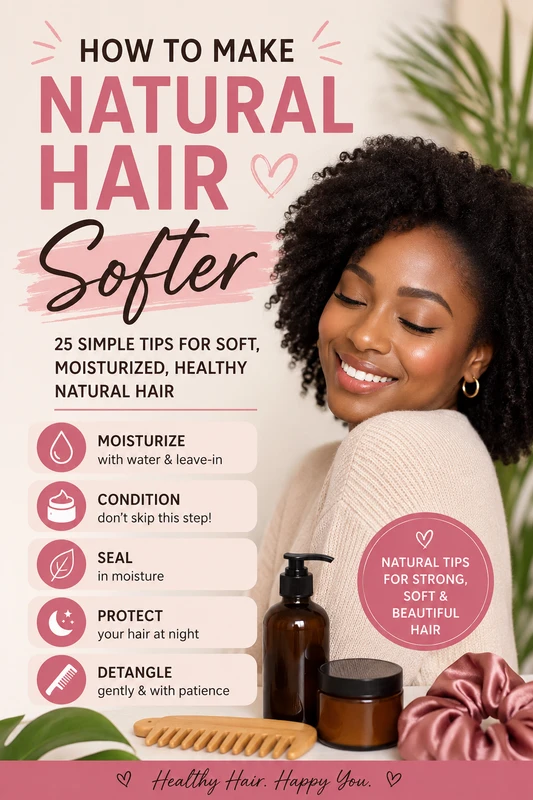
Natural hair can be beautiful, versatile, and incredibly strong, but keeping it soft, moisturized, and easy to manage can sometimes feel like a challenge. You may moisturize your hair in the morning only to notice that it feels dry or rough again later that day. Or your curls may look healthy while still feeling stiff, tangled, or difficult to style.
The good news is that naturally textured hair does not have to feel rough.
Learning how to make natural hair softer usually comes down to understanding moisture, product buildup, cleansing, conditioning, detangling, and how you protect your hair between wash days.
For Black women and men with natural hair, softness isn't necessarily about changing your natural texture. Healthy Type 3 and Type 4 hair can still have texture, density, shrinkage, and volume while feeling soft and flexible.
The goal is to help your strands retain enough moisture and maintain enough flexibility that they feel smooth, manageable, and comfortable.
In this complete guide, we'll discuss why natural hair sometimes feels hard or rough, how to soften natural hair, which habits can help maintain moisture, common mistakes to avoid, and how to create a simple routine for softer natural hair.
Why Does Natural Hair Feel Rough?
Before trying to soften your hair, it helps to understand why it feels rough in the first place.
Natural hair can feel dry or coarse for many reasons, including:
- Lack of moisture
- Product buildup
- Shampooing too frequently
- Using harsh cleansers
- Skipping conditioner
- Not deep conditioning regularly
- Excessive heat styling
- Hard water
- Environmental exposure
- Overuse of protein treatments
- Chemical damage
- Excessive manipulation
- Improper detangling
- Sleeping without protecting the hair
- Going too long between wash days
One of the most important things to understand is that hair texture and hair softness are not the same thing.
Someone can naturally have coarse strands that are still moisturized and soft. Likewise, someone with fine hair can experience extreme dryness and brittleness.
Instead of trying to make your hair feel like someone else's texture, focus on making your natural texture feel its healthiest and most manageable.
1. Start With a Good Wash-Day Routine
If you want softer natural hair, start with wash day.
A good wash-day routine removes dirt, sweat, excess oil, and product residue while preparing your hair to absorb conditioning and moisturizing products.
When too much product accumulates on the strands, your hair may feel:
- Hard
- Waxy
- Sticky
- Rough
- Heavy
- Dull
- Dry despite applying moisturizer
Adding more products isn't always the solution.
Sometimes your hair needs to be thoroughly cleansed.
Depending on your scalp, hairstyle, activity level, and product use, many people with natural hair find that washing approximately every 7–14 days works well. Your ideal schedule may be different.
Pay attention to how your scalp and hair respond.
2. Shampoo Your Scalp Thoroughly
Soft hair starts with a healthy foundation.
When shampooing, concentrate primarily on your scalp.
Massage shampoo gently into the scalp using the pads of your fingers rather than scratching aggressively with your fingernails.
As you rinse, the shampoo will travel through the length of your hair and help remove buildup.
If your hair is particularly dry, look for shampoos designed to cleanse without leaving the strands excessively stripped.
Your hair should feel clean after washing, but it shouldn't consistently feel like straw.
3. Clarify When Your Hair Has Heavy Buildup
If your natural hair suddenly stops responding to products, buildup could be responsible.
You might apply your normal leave-in conditioner and wonder:
Why is my natural hair still hard after moisturizing?
The moisturizer may be sitting on top of layers of styling products, oils, butters, silicones, or other residue.
Occasional clarifying can provide your hair with a fresh start.
Signs that you may need a deeper cleanse include:
- Hair feels coated after washing
- Products stop absorbing normally
- Curls appear dull
- Hair feels unusually heavy
- Your scalp has significant buildup
- Your normal moisturizing routine suddenly stops working
Clarifying shouldn't necessarily be done every wash day. How often you need it depends on your product use and hair needs.
4. Never Skip Conditioner
Conditioner is one of the most important steps for making natural hair feel softer.
After cleansing, conditioner helps improve manageability and makes detangling easier.
Apply conditioner throughout your hair, paying particular attention to the mid-lengths and ends.
Your ends are the oldest parts of your hair and often need additional care.
For thick natural hair, working in sections can make it easier to distribute conditioner thoroughly.
Try dividing your hair into four, six, or eight sections depending on its length and density.
5. Deep Condition Regularly
If your natural hair frequently feels dry, incorporating a deep conditioner into your routine may help improve softness and manageability.
Deep conditioning can be particularly useful when your hair has experienced:
- Excessive dryness
- Heat styling
- Protective styling
- Frequent manipulation
- Environmental exposure
- Tangling
Follow the instructions provided with your chosen deep conditioner.
Using a treatment longer than recommended doesn't automatically provide better results.
Consistency is generally more important than leaving a product on your hair for hours.
6. Moisturize Your Hair While It's Damp
One of the simplest ways to make natural hair softer is to apply moisturizing products while the hair is still damp.
Water provides moisture.
Your leave-in conditioner and styling products can then help maintain that moisturized feeling.
After washing, gently remove excess water with a microfiber towel or soft T-shirt.
Don't allow your hair to become completely dry before beginning your moisturizing routine unless your chosen style requires dry hair.
For many people, products distribute much more easily through damp natural hair.
7. Use a Leave-In Conditioner
A good leave-in conditioner can become one of the most valuable products in a natural hair routine.
Leave-in conditioner may help improve:
- Softness
- Manageability
- Slip
- Detangling
- Styling
- Moisture retention
Apply an appropriate amount throughout your damp hair.
More isn't necessarily better.
Using too much product can cause buildup and eventually make your hair feel less soft.
Start with a modest amount and increase only if your hair needs it.
8. Seal In Moisture When Needed
After applying water and a moisturizing product, some people find that a light layer of oil or another sealing product helps their hair maintain softness longer.
The important distinction is that oil itself isn't a substitute for water.
Applying oil repeatedly to extremely dry hair without adding moisture may simply coat the strands.
A basic routine might look like:
Water → Leave-in conditioner → Styling cream or light sealing product
The exact combination depends on your hair.
Fine natural hair may become weighed down by heavy butters, while thick or highly textured hair may tolerate richer products more easily.
Experiment until you discover the smallest amount of product that keeps your hair soft.
9. Try the LOC or LCO Method
Two popular approaches for moisturizing natural hair are the LOC method and LCO method.
LOC Method
LOC stands for:
Liquid → Oil → Cream
You begin with water or a water-based leave-in, follow with an oil, and finish with a cream.
LCO Method
LCO stands for:
Liquid → Cream → Oil
Here, you apply your moisturizing cream before your oil.
Neither method is automatically better.
Your hair may prefer one over the other.
Try each method separately for several wash days and compare how your hair feels after 24, 48, and 72 hours.
The method that keeps your hair softer without excessive buildup is likely the better choice for you.
10. Don't Forget Your Ends
If you're wondering how to make natural hair soft and manageable, pay special attention to your ends.
Your ends have been exposed to washing, styling, weather, clothing, and manipulation longer than the newer hair closer to your scalp.
They may therefore become dry more quickly.
When applying leave-in conditioner or moisturizer, make sure your ends receive enough product.
Keeping your ends moisturized can also make detangling and styling easier.
11. Detangle With Patience
Rough detangling can make dry natural hair even more difficult to manage.
Whenever possible, detangle when your hair has enough moisture and slip.
You can use:
- Your fingers
- A wide-tooth comb
- A detangling brush designed for textured hair
Begin near the ends and gradually work toward the roots.
Avoid aggressively pulling a comb from your roots directly through tangled hair.
Working in sections can dramatically improve the process.
12. Reduce Excessive Heat
Heat can temporarily make natural hair feel smooth, but excessive heat can eventually contribute to dryness and damage.
Be cautious with frequent use of:
- Flat irons
- Hot combs
- Curling irons
- High-temperature blow-drying
If you use heat, use an appropriate heat protectant and avoid unnecessarily high temperatures.
You don't necessarily have to eliminate heat completely to maintain healthy natural hair.
The goal is responsible use.
13. Use Low-Manipulation Hairstyles
Constant styling can make maintaining soft natural hair more difficult.
Low-manipulation hairstyles reduce how often you need to comb, brush, pull, or restyle your strands.
Options include:
- Two-strand twists
- Flat twists
- Buns
- Braids
- Cornrows
- Mini twists
- Loose updos
The style itself isn't enough, however.
Your hair still needs appropriate cleansing, moisture, and scalp care.
14. Protect Your Hair at Night
You can spend an hour moisturizing your hair and lose much of that soft feeling overnight if you don't protect it.
Cotton bedding can create friction against your strands and absorb some moisture.
Consider sleeping with:
- A satin bonnet
- Satin scarf
- Satin pillowcase
For longer hair, loosely gathering or sectioning the hair before bed can also reduce tangling.
Your nighttime routine doesn't need to be complicated.
For many people, simply protecting the hair consistently makes a noticeable difference.
15. Refresh Dry Hair Between Wash Days
You don't necessarily need to completely redo your hair whenever it begins feeling dry.
A light refresh may be enough.
Depending on your hair and hairstyle, lightly mist the sections that feel dry with water or a water-based moisturizing spray.
Follow with a small amount of leave-in conditioner or moisturizer if needed.
Concentrate on areas that dry quickly instead of automatically adding several layers of product to your entire head.
This can help prevent buildup.
16. Avoid Overloading Your Hair With Oil
Oil is popular in natural hair care, but more oil doesn't automatically mean softer hair.
Repeatedly adding heavy oils to dry hair can leave the strands greasy while they still feel dry underneath.
This is why someone can have natural hair that feels both oily and dry at the same time.
Use oils strategically rather than continuously coating your strands.
If your hair feels greasy but stiff, consider cleansing it before applying more oil.
17. Be Careful With Heavy Butters
Shea butter and other rich butters can work beautifully for some natural hair types.
For others, they create too much buildup.
If your hair becomes:
- Waxy
- Heavy
- Dull
- Stiff
after using heavy creams and butters, experiment with lighter products.
Your natural hair routine doesn't need to contain the heaviest products available simply because you have Type 4 hair.
Product selection should be based on how your individual strands respond.
18. Understand Hair Porosity
Hair porosity describes how your hair interacts with moisture.
Understanding porosity may help explain why certain routines work better than others.
Lower-Porosity Hair
Lower-porosity hair may resist water and product penetration.
Products can sometimes accumulate on the surface.
You may benefit from:
- Lighter products
- Applying products to damp hair
- Avoiding excessive layering
- Regular cleansing
Higher-Porosity Hair
Higher-porosity hair tends to lose moisture more readily.
It may benefit from:
- Consistent conditioning
- Leave-in products
- Creams
- Strategic sealing
- Reduced damage and manipulation
Porosity isn't something you need to obsess over.
Use it as one clue when building your routine.
19. Don't Overuse Protein
Protein-containing hair products can be useful in certain routines, particularly for hair that has experienced damage.
However, constantly using multiple protein-heavy treatments when your hair doesn't need them may leave some people's hair feeling stiff or less flexible.
If your hair suddenly feels hard after introducing several strengthening treatments, examine your product lineup.
You may need to balance strengthening products with moisturizing and conditioning products.
20. Protect Natural Hair From Dry Weather
Your environment can affect how your hair feels.
Cold air, indoor heating, sun exposure, wind, and low humidity can all influence moisture levels and manageability.
During particularly dry seasons, you may need to adjust your routine by:
- Conditioning consistently
- Refreshing dry sections when necessary
- Wearing protective or low-manipulation styles
- Protecting hair from harsh weather
- Paying closer attention to your ends
Your ideal summer routine may not be your ideal winter routine.
21. Consider Whether Hard Water Is Affecting Your Hair
Sometimes your products aren't the problem.
Your water could be contributing to how your hair feels.
Hard water contains higher concentrations of dissolved minerals. Over time, mineral deposits can accumulate on the hair.
If your natural hair consistently feels rough despite using a good routine, particularly after moving to a new area, water quality may be worth considering.
A suitable clarifying or chelating shampoo can be useful for mineral buildup when appropriate.
22. Trim Damaged Ends When Necessary
No moisturizer can permanently repair severely damaged or split ends.
If your ends constantly:
- Tangle
- Catch on one another
- Look extremely thin
- Feel rough
- Have visible splits
you may need a trim.
Removing damaged ends can make the overall hair feel easier to detangle and style.
Trimming doesn't make hair grow faster from the scalp, but maintaining healthier ends can help with length retention by reducing tangling and breakage.
23. Avoid Shampooing More Often Than Your Hair Needs
Cleansing is important, but the correct frequency varies from person to person.
Someone who exercises daily and uses several styling products may need a different schedule than someone wearing a low-manipulation style.
Instead of following a rigid rule, observe your scalp and hair.
Your routine should remove buildup often enough to keep the scalp clean without unnecessarily leaving your hair feeling stripped.
24. Keep Your Routine Simple
One of the biggest misconceptions about natural hair is that you need 10 or 15 products to keep it healthy.
You don't.
A basic natural hair routine may only require:
- Shampoo
- Conditioner
- Deep conditioner when needed
- Leave-in conditioner
- Styling or sealing product
- Satin nighttime protection
You can add other products when they serve a specific purpose.
But adding products simply because they're popular can make it harder to determine what's actually working.
25. Use Water as the Foundation of Moisture
When discussing how to make natural hair softer, it's important to remember one fundamental principle:
Water is moisture.
Oils and butters can have useful roles in a hair-care routine, but they don't replace water.
If your hair feels extremely dry several days after wash day, lightly reintroducing moisture before adding other products may work better than immediately reaching for another layer of oil.
How to Make 4C Hair Soft
People with Type 4C hair frequently search for ways to make their hair softer because tightly coiled strands can feel different from looser curl patterns.
But 4C hair doesn't need to become silky or loose to be healthy.
Healthy 4C hair can remain tightly coiled while feeling moisturized, flexible, and manageable.
A simple routine for softer 4C hair may include:
Step 1: Cleanse the scalp and hair thoroughly.
Step 2: Apply conditioner generously and detangle in sections.
Step 3: Deep condition when your hair needs additional conditioning.
Step 4: Apply leave-in conditioner while the hair is damp.
Step 5: Apply a cream or styling moisturizer if needed.
Step 6: Seal lightly if your hair benefits from it.
Step 7: Style in twists, braids, or another low-manipulation style.
Step 8: Protect your hair with satin every night.
Consistency matters more than having an enormous product collection.
How to Make Natural Hair Soft Without Relaxer
You do not need a relaxer to make natural hair feel softer.
Relaxers chemically alter the structure of the hair. Softness, on the other hand, can be improved through proper cleansing, conditioning, moisture, gentle handling, and styling.
If your goal is to maintain your natural texture, concentrate on making your curls and coils more moisturized and manageable rather than permanently straighter.
A consistent natural hair routine can dramatically change how your hair feels without chemically altering your curl pattern.
How to Make Natural Hair Soft Overnight
If your hair feels dry before bedtime, you can perform a quick nighttime refresh.
Step 1: Check Your Hair
Don't automatically wet your entire head.
Determine which areas actually feel dry.
Step 2: Lightly Mist Dry Sections
Use a small amount of water or a moisturizing hair mist.
Your hair should be slightly damp rather than soaking wet.
Step 3: Add Moisturizer
Apply a small amount of leave-in conditioner or moisturizing cream.
Step 4: Twist or Braid
Put the moisturized sections into loose twists or braids.
Step 5: Protect Your Hair
Cover your hair with a satin scarf or bonnet.
By morning, your hair may feel softer and easier to manipulate.
Why Is My Natural Hair Still Dry After Moisturizing?
This is one of the most frustrating natural hair problems.
You apply moisturizer, oil, cream, and leave-in conditioner, but your hair still feels dry.
There are several possible explanations.
You Have Product Buildup
Too much residue may prevent your products from distributing effectively.
Try cleansing thoroughly.
You're Applying Oil to Dry Hair
Introduce water or a water-based moisturizer before relying on oil.
You're Using Too Much Product
More product isn't always more moisture.
Heavy layering can leave hair coated and stiff.
Your Hair Needs Conditioning
A leave-in isn't necessarily a replacement for rinse-out conditioning.
Your Ends Are Damaged
Severely damaged ends may continue feeling rough despite moisturizing.
You're Not Protecting Your Hair at Night
Friction and lack of nighttime protection may leave your hair tangled and dry by morning.
Weekly Routine for Softer Natural Hair
Here's an example of a simple routine you can customize.
Wash Day
1. Shampoo
Clean your scalp and remove buildup.
2. Condition
Apply conditioner throughout your hair and gently detangle.
3. Deep Condition When Needed
Use a moisturizing deep conditioner according to its directions.
4. Apply Leave-In Conditioner
Apply while your hair is still damp.
5. Style
Choose a low-manipulation hairstyle that doesn't place unnecessary tension on your strands.
6. Protect
Sleep with satin protection.
Between Wash Days
Check your hair every few days.
If it still feels soft, leave it alone.
If certain sections feel dry, lightly refresh those areas.
Avoid adding heavy layers of product every day simply because you think natural hair must constantly be moisturized.
Ingredients Commonly Found in Products for Soft Natural Hair
When choosing hair-care products, you may encounter ingredients such as:
- Water
- Aloe vera
- Glycerin
- Panthenol
- Coconut oil
- Avocado oil
- Olive oil
- Jojoba oil
- Castor oil
- Shea butter
- Mango butter
- Fatty alcohols used in conditioners
Don't judge a product solely by one ingredient.
The entire formulation matters.
A product containing coconut oil, for example, may work wonderfully for one person's hair while another person's hair prefers a different formulation.
Pay attention to your results.
Mistakes That Can Keep Natural Hair From Feeling Soft
Sometimes improving softness is less about adding something new and more about stopping habits that work against your hair.
Common mistakes include:
- Applying oil without moisture
- Using excessive amounts of product
- Going too long without cleansing
- Skipping conditioner
- Roughly detangling dry hair
- Using too much heat
- Constantly manipulating the hair
- Sleeping without satin protection
- Ignoring damaged ends
- Overusing strengthening treatments
- Using products that are too heavy for your strands
- Neglecting your ends
Correcting even two or three of these habits can make your routine more effective.
How Long Does It Take to Make Natural Hair Softer?
You may notice an improvement immediately after a thorough wash and conditioning session.
However, if your hair has been consistently dry, damaged, or overloaded with products, improving its overall manageability may take several wash cycles.
Give a new routine time to work.
Instead of changing five products every week, maintain a simple routine for several wash days and observe:
- How your hair feels immediately after styling
- How it feels the next morning
- How long it stays moisturized
- Whether your ends remain soft
- Whether detangling becomes easier
- Whether you're experiencing less breakage
These observations can help you build a routine specifically for your hair.
Frequently Asked Questions About Making Natural Hair Softer
What makes natural hair soft?
Proper cleansing, conditioning, water-based moisture, gentle handling, and protection can all contribute to softer, more manageable natural hair.
How can I soften extremely dry natural hair?
Start with a thorough wash, follow with conditioner, deep condition if appropriate, and apply a leave-in product while your hair is damp. Avoid simply piling oil onto hair that is already dry.
Does coconut oil make natural hair soft?
Coconut oil works well in some people's routines but not everyone's. Judge it by how your own hair responds rather than assuming a particular oil is necessary.
Does water make natural hair softer?
Water is the primary source of moisture for hair. However, you may need conditioning and styling products to help maintain softness and manageability after the water begins evaporating.
Why does my natural hair feel hard?
Possible causes include dryness, product buildup, excessive protein or strengthening products, mineral buildup, heat damage, chemical damage, or unsuitable products.
How often should I moisturize natural hair?
There is no universal schedule. Moisturize when your hair needs it rather than automatically applying heavy products every day.
How do I keep my natural hair soft all week?
Start with a strong wash-day routine, apply products to damp hair, use low-manipulation styles, protect your hair at night, and lightly refresh dry sections when necessary.
Should I oil natural hair every day?
Daily oiling isn't necessary for everyone. Applying excessive oil can contribute to buildup without correcting a lack of moisture.
Can 4C hair become soft?
Absolutely. 4C hair can be soft, moisturized, flexible, and manageable while maintaining its naturally tight coil pattern.
Why is my natural hair soft when wet but hard when dry?
Your hair may need a better combination of conditioning, leave-in moisture, styling products, and moisture retention. Product buildup or the wrong products for your hair may also contribute.
The Best Routine for Soft Natural Hair
If all of this information feels overwhelming, remember that your routine doesn't need to be complicated.
Try this basic formula:
Cleanse → Condition → Moisturize → Style → Protect → Refresh as needed
That's the foundation.
From there, adjust according to your hair.
If your hair becomes greasy quickly, use lighter products.
If it loses moisture rapidly, experiment with richer moisturizing products or different layering methods.
If products sit on top of your strands, reduce the amount you're using and make sure you're cleansing adequately.
If your ends remain rough despite good care, consider whether they need trimming.
Natural hair care is about learning what your individual hair responds to—not following every trend on social media.
Final Thoughts: How to Make Natural Hair Softer
Learning how to make natural hair softer doesn't require dozens of expensive products or an exhausting daily routine.
Start with the fundamentals.
Keep your scalp and hair clean. Condition consistently. Apply moisture to damp hair. Use leave-in products strategically. Protect your ends. Reduce unnecessary manipulation. Limit excessive heat. Protect your hair at night. Most importantly, pay attention to what your own hair is telling you.
Soft natural hair doesn't mean changing your curl pattern.
Your curls, coils, kinks, shrinkage, and texture are all part of natural hair. The goal is simply to help those strands stay moisturized, flexible, manageable, and healthy-looking.
Once you develop a routine that works, maintaining softness becomes much easier.
You may also discover that you don't need nearly as many products as you thought.
A consistent routine built around cleansing, conditioning, moisture, protection, and gentle handling can go a long way toward helping natural hair feel softer from wash day to wash day.