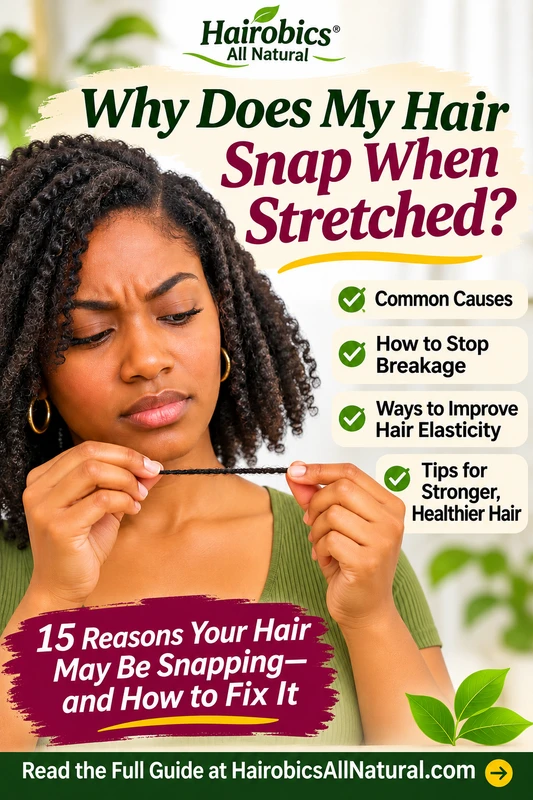
Have you ever gently stretched a strand of your natural hair, only to hear a tiny snap or watch the strand break between your fingers?
Maybe your hair breaks while detangling, washing, brushing, or styling. Perhaps your curls feel dry and stiff, or your hair seems to grow but never gets any longer.
If you're wondering, "Why does my hair snap when stretched?", you're not alone.
Hair snapping is a common concern among people with natural Black hair, especially those with tightly curled and coily textures such as 3C, 4A, 4B, and 4C hair.
Although occasional breakage can happen, hair that consistently snaps under gentle tension may be experiencing dryness, structural damage, excessive friction, or reduced elasticity.
The good news is that understanding the cause can help you make better decisions about moisturizing, conditioning, detangling, and protecting your strands.
In this complete guide, we'll explain:
-
Why hair snaps when stretched
-
What hair elasticity means
-
The difference between normal stretching and breakage
-
15 common causes of snapping hair
-
How to improve flexibility and reduce breakage
-
The role of moisture and protein
-
How to protect fragile 4C natural hair
-
Which hair care habits can help you retain length
Let's start with what your hair may be telling you.
What Does It Mean When Your Hair Snaps When Stretched?
When your hair snaps during stretching, it means the strand has experienced more tension than it can withstand.
Healthy hair has a degree of flexibility that allows it to bend and stretch before breaking.
This flexibility is called hair elasticity.
Hair elasticity depends on several factors, including the condition of the hair's internal protein structure, its water content, and the amount of damage it has experienced.
When strands become weakened, they may break with relatively little force.
For example, imagine gently pulling a dry, brittle rubber band. Instead of stretching smoothly, it cracks or breaks.
Hair can behave similarly when its structure has been compromised.
However, unlike a rubber band, hair is made primarily of keratin protein, and its behavior changes depending on whether it is wet, dry, conditioned, chemically treated, or damaged.
If your strands frequently snap, the goal should be to identify the underlying cause rather than simply applying more oil.
For a deeper explanation, read our guide on how to increase hair elasticity.
What Is Hair Elasticity and Why Does It Matter?
Hair elasticity describes the ability of a strand to stretch and recover its shape without breaking.
It is an important part of hair strength and resilience.
When hair has good elasticity, it can better tolerate normal movement during washing, detangling, and styling.
When elasticity is poor, even gentle manipulation may cause breakage.
Signs of Hair With Good Elasticity
Hair with reasonably good elasticity often:
-
Bends without immediately breaking
-
Stretches somewhat under gentle tension
-
Returns toward its original shape after stretching
-
Handles careful detangling without excessive snapping
-
Maintains its curl pattern when undamaged
-
Feels manageable after conditioning
Signs of Poor Hair Elasticity
Hair with compromised elasticity may:
-
Snap almost immediately when stretched
-
Feel unusually stiff or brittle
-
Break during gentle combing
-
Develop rough or frayed ends
-
Tangle more frequently
-
Break around the crown, edges, or nape
-
Have difficulty retaining length
It is important to remember that elasticity varies naturally among hair types. A single strand test cannot diagnose a moisture or protein deficiency.
Understanding the relationship between hair structure and moisture can help you create a more effective routine.
Learn more in our article about the difference between hair porosity, density, and elasticity.
15 Reasons Your Hair Snaps When Stretched
1. Your Hair Is Extremely Dry
Dryness is one of the most common reasons natural hair becomes stiff and breaks under tension.
Hair needs an appropriate amount of water and conditioning to remain flexible.
When strands become excessively dry, they may feel rough, resist bending, and break more easily during manipulation.
This can be especially noticeable with tightly coiled hair because natural scalp oils do not spread as easily along curved strands.
Common signs include:
-
Hair feels crunchy or straw-like
-
Ends break during detangling
-
Curls lack softness
-
Hair tangles shortly after styling
-
Strands snap with minimal stretching
What to do:
Use a gentle shampoo followed by a moisturizing rinse-out conditioner. Apply a suitable water-based leave-in product and avoid repeatedly manipulating dry hair.
The Hairobics Leave-In Treatment can be incorporated into a conditioning routine to help improve softness and manageability.
2. Your Hair Has Experienced Heat Damage
Frequent flat ironing, blow-drying at high temperatures, or curling with excessive heat can damage the hair cuticle and internal protein structure.
Over time, repeated heat exposure may reduce the strand's ability to tolerate tension.
Heat-damaged hair may appear straight in certain sections, feel rough, or break when brushed.
What to do:
Reduce the use of hot tools, use appropriate heat protection, and avoid repeatedly passing a flat iron over the same section.
Choose heat-free styles whenever possible.
Remember that conditioning can improve the feel of damaged hair, but it cannot completely restore severely damaged hair fibers.
3. Your Hair Has a Protein and Moisture Imbalance
Hair contains keratin protein, while water influences its flexibility and behavior.
Both structural strength and appropriate conditioning matter.
Hair that feels excessively stiff after frequent strengthening treatments may need a change in its conditioning routine.
Meanwhile, severely damaged hair that stretches excessively while wet may benefit from carefully selected strengthening products.
However, these symptoms do not automatically prove that your hair has too much or too little protein.
What to do:
Evaluate the products you're using.
If your hair feels hard and brittle after repeated protein treatments, reduce their frequency and focus on gentle conditioning.
If your hair is chemically damaged, consider a suitable bond-building or protein-containing treatment according to the manufacturer's instructions.
Read our complete guide on how to balance protein and moisture in natural hair.
4. Your Hair Has High Porosity
Hair porosity describes how readily hair absorbs and releases water.
High-porosity hair may have a more damaged or weathered cuticle, making it susceptible to tangling, friction, and moisture changes.
Some people naturally have more porous hair, while others develop increased porosity after bleaching, relaxing, or excessive heat styling.
Signs may include:
-
Hair wets quickly
-
Hair dries rapidly
-
Strands feel rough
-
Frizz develops easily
-
Ends tangle frequently
What to do:
Use a conditioning routine that improves slip and manageability.
Consider leave-in conditioners and lightweight oil-based products where appropriate.
Avoid aggressive brushing and unnecessary heat.
5. You're Detangling Your Hair Too Roughly
Detangling is one of the most common times for fragile natural hair to break.
When a comb or brush meets resistance, pulling harder increases tension on the strand.
Tightly coiled hair can form knots and tangles that require patience to remove.
What to do:
Divide your hair into manageable sections.
Apply a conditioner with good slip and gently separate tangles using your fingers or a suitable detangling tool.
Begin near the ends and gradually work toward the roots.
Never force a comb through a stubborn knot.
6. Your Hair Ends Are Severely Damaged
The ends of your hair are the oldest portions of each strand.
They have experienced months or years of washing, styling, environmental exposure, and friction.
As a result, the ends may become more weathered than the newer hair near your scalp.
Damaged ends can split, fray, and snap when stretched.
What to do:
Inspect your ends regularly.
Trim visibly split or severely damaged sections when necessary.
Condition your ends carefully and minimize friction against clothing.
Trimming does not make hair grow faster, but removing damaged ends can help prevent additional tangling and breakage.
7. You're Using Too Much Heat While Drying
Even if you rarely flat iron your hair, excessive blow-dryer heat can contribute to damage.
Holding a hot dryer too close to the hair or repeatedly drying the same section may increase brittleness.
What to do:
Use moderate temperatures, maintain distance between the dryer and your strands, and avoid overheating.
A diffuser or controlled-tension drying technique may be useful depending on your hair type.
8. You're Over-Manipulating Your Natural Hair
Constant styling places repeated mechanical stress on your strands.
Daily combing, brushing, pulling, twisting, and restyling may gradually weaken fragile areas.
This is particularly important when hair is already dry or damaged.
What to do:
Choose styles that require less daily handling.
Loose twists, gentle braids, and comfortable natural styles can help reduce unnecessary manipulation.
Avoid making hairstyles so tight that they pull on your scalp.
9. Your Hair Has Chemical Damage
Relaxers, permanent color, bleach, and other chemical processes can change the structure of your hair.
When these treatments are applied incorrectly or repeated too frequently, they can weaken strands.
Hair that has been chemically processed may snap during stretching because its internal structure has been compromised.
What to do:
Avoid overlapping chemical treatments.
Follow professional processing recommendations and give damaged hair a break from additional chemical services.
Severely damaged sections may eventually need trimming as healthier new hair grows.
10. You're Not Conditioning After Shampooing
Shampoo removes dirt, oil, and product buildup.
However, cleansing without appropriate conditioning may leave hair difficult to detangle.
Conditioners help reduce friction between strands, improve manageability, and make combing easier.
Skipping this step can increase the amount of force needed during detangling.
What to do:
Follow shampooing with a rinse-out conditioner suitable for your hair.
Pay particular attention to the mid-lengths and ends.
For additional guidance, explore our ultimate guide to moisturizing natural hair.
11. You're Applying Oil Without Enough Water-Based Conditioning
Oils can help lubricate hair and reduce friction, but they do not provide the same benefits as water-based conditioning products.
Applying heavy oil to already brittle hair may make it look shiny without addressing the underlying dryness or damage.
What to do:
Begin with clean, appropriately conditioned hair.
Use a water-based leave-in treatment when needed.
Then apply a small amount of an oil-based conditioning product if your hair benefits from additional lubrication.
For example, Hairobics Hair & Scalp Booster contains botanical oils and conditioning ingredients designed to help soften dry hair and scalp areas.
Use it sparingly, especially if your hair is fine or prone to buildup.
12. Your Hair Is Experiencing Excessive Friction
Friction can gradually damage the protective cuticle layer.
Common sources include rough towels, cotton pillowcases, tight headwear, and repeated rubbing against clothing.
When the cuticle becomes worn, hair may tangle and break more easily.
What to do:
Use a satin or silk bonnet, scarf, or pillowcase.
Blot excess water with a soft towel rather than rubbing aggressively.
Avoid hairstyles that repeatedly rub against rough collars or accessories.
13. You're Wearing Tight Protective Hairstyles
Protective styles are intended to reduce daily manipulation, but they can cause damage when installed too tightly.
Heavy extensions, tight braids, and excessive pulling can place stress on the hair shaft and follicles.
This may lead to breakage around the hairline, nape, or other areas.
What to do:
Choose comfortable styles that do not cause pain or tension.
Avoid excessively heavy extensions.
Remove or loosen hairstyles that pull on your scalp.
Protective styling should protect your hair, not create additional damage.
14. Product Buildup Is Affecting Your Routine
Repeatedly applying heavy creams, oils, gels, and styling products without adequate cleansing can leave hair coated.
Buildup may make strands feel stiff, sticky, or difficult to manage.
It can also interfere with the performance of conditioning products.
What to do:
Cleanse your hair as needed using a suitable shampoo.
Use clarifying shampoo occasionally if your routine produces significant buildup.
Follow with conditioner to restore manageability.
Avoid assuming that adding more product will always solve dryness.
15. Your Hair Has Become Weakened by Repeated Damage
Sometimes hair snaps because several damaging habits have occurred together.
For example, someone may frequently straighten their hair, wear tight ponytails, detangle aggressively, and skip conditioning.
Each habit contributes additional stress.
Eventually, strands may become too fragile to tolerate normal styling.
What to do:
Simplify your routine.
Focus on gentle cleansing, consistent conditioning, reduced heat, and low-tension styling.
Give new hair growth the opportunity to remain healthier while gradually trimming severely damaged lengths.
For more information, read why natural hair breaks and how to stop it.
How to Test Your Hair Elasticity at Home
A gentle stretch test can provide a rough indication of how your hair behaves under tension.
However, it is not a medical or scientific diagnosis of your hair's protein or moisture needs.
Step 1: Find a Naturally Shed Strand
Choose a strand that has already fallen out during normal washing or detangling.
Avoid pulling healthy hair from your scalp.
Step 2: Lightly Dampen the Strand
Use a small amount of water to dampen the hair.
Wet hair behaves differently from dry hair, so comparisons should be made under similar conditions.
Step 3: Gently Stretch the Strand
Hold both ends and apply very light tension.
Do not pull forcefully.
Step 4: Observe What Happens
If the strand stretches slightly and recovers, it may have reasonable flexibility.
If it breaks with very little tension, it may be damaged or naturally fragile.
If it stretches excessively and fails to recover, it may have structural weakness.
Step 5: Evaluate Your Overall Hair Condition
Do not judge your entire head of hair based on one strand.
Instead, consider whether you're experiencing repeated breakage, unusual roughness, visible damage, or difficulty retaining length.
These patterns provide more useful information than one isolated test.
How to Stop Hair From Snapping When Stretched
Once you recognize that your strands are fragile, the next step is to create a routine that reduces unnecessary stress.
Step 1: Cleanse Gently
Wash your scalp and hair using a shampoo appropriate for your hair type.
Concentrate on cleansing the scalp without aggressively rubbing or tangling the lengths.
Rinse thoroughly.
Step 2: Apply a Moisturizing Conditioner
After shampooing, apply a conditioner that provides softness and slip.
Distribute it carefully through your hair, focusing on the ends.
Allow it to remain on your hair according to the manufacturer's instructions.
Step 3: Detangle in Sections
Separate your hair into manageable sections.
Use your fingers or a suitable wide-tooth comb.
Work slowly from the ends toward the roots.
Avoid unnecessary pulling.
Step 4: Use a Water-Based Leave-In Treatment
A leave-in conditioner can provide additional manageability between wash days.
The Hairobics Leave-In Treatment contains water-based conditioning ingredients and botanical oils.
It can be incorporated into a routine for dry natural hair that needs improved softness and easier styling.
Step 5: Add an Oil-Based Conditioning Product When Needed
If your strands benefit from extra lubrication, apply a small amount of a suitable oil-based product.
The Hairobics Hair & Scalp Booster is an option for conditioning dry hair and scalp areas.
Remember that oils cannot permanently repair broken hair fibers.
Step 6: Protect Your Ends
Keep your ends conditioned and minimize unnecessary friction.
Choose comfortable styles that do not require constant brushing or pulling.
Trim severely damaged ends when necessary.
Step 7: Reduce Heat and Chemical Stress
Give fragile hair a break from repeated high-temperature styling.
Avoid overlapping chemical treatments and follow professional recommendations when using relaxers or permanent color.
Step 8: Maintain a Consistent Routine
Hair care results depend on consistent habits.
You do not need to apply dozens of products.
A simple routine built around cleansing, conditioning, gentle handling, and protection can be more useful than frequently changing products.
Why 4C Hair May Snap When Stretched
4C hair is known for its tightly coiled structure, beautiful volume, and significant shrinkage.
Its many bends and curves can make detangling more challenging, especially when the hair is dry or tangled.
However, 4C hair is not automatically unhealthy or damaged.
It simply requires techniques that respect its natural structure.
Tips for Protecting 4C Hair
Keep hair conditioned. Use products that improve softness and manageability.
Work in sections. Smaller sections make detangling more controlled.
Avoid unnecessary stretching. Do not repeatedly pull strands to check their length.
Protect the ends. Reduce friction and avoid rough handling.
Choose low-tension styles. Loose twists and comfortable protective hairstyles can reduce daily manipulation.
Avoid excessive heat. High temperatures can weaken already fragile strands.
The goal is not to change your natural curl pattern. It is to maintain healthy, manageable strands that can tolerate everyday styling.
Can Hair That Snaps Easily Become Stronger Again?
Hair that snaps easily can often become more manageable with better conditioning and reduced mechanical stress.
However, the extent of improvement depends on the cause.
If the problem is mainly dryness or friction, a better routine may significantly reduce breakage.
If the hair has experienced severe heat or chemical damage, conditioning products may temporarily improve its feel but cannot completely reverse structural damage.
Damaged lengths may need gradual trimming while new hair grows.
This distinction is important because no oil, conditioner, or treatment can permanently reconnect a strand that has already broken.
Hair Growth vs. Length Retention: Why Breakage Matters
Your hair can continue growing from the scalp even when the ends are breaking.
This is why some people feel that their hair has stopped growing.
For example, imagine your hair grows approximately half an inch in a month.
If a similar amount breaks from the ends, your overall length may appear unchanged.
The problem is not necessarily slow growth.
It may be poor length retention.
Improving your routine can help you keep more of the hair you grow.
For a more detailed explanation, read why hair grows but won't retain length.
A Simple Weekly Routine for Fragile Natural Hair
Wash Day
Cleanse your scalp gently with shampoo.
Apply a moisturizing conditioner and detangle carefully in sections.
Rinse and apply a water-based leave-in treatment as needed.
Finish with a comfortable hairstyle that minimizes tension.
Midweek Maintenance
Check whether your hair actually needs additional conditioning.
If your ends feel dry, use a small amount of suitable leave-in conditioner.
Avoid layering excessive products over buildup.
Scalp Care
If your scalp feels dry, consider a suitable scalp-conditioning product.
Hairobics Scalp Rejuvenator Oil contains botanical oils including rosemary, peppermint, tea tree, and lavender.
It is designed for scalp conditioning and gentle massage, not for repairing broken hair shafts.
Apply according to directions and avoid using it on irritated skin.
Nighttime Protection
Cover your hair with a comfortable satin or silk bonnet or scarf.
Alternatively, use a smooth pillowcase to reduce friction.
Avoid sleeping with tightly secured hairstyles.
Monthly Maintenance
Inspect your ends for visible splits or severe damage.
Review your styling habits and reduce any practices that consistently cause breakage.
Adjust your conditioning routine based on how your hair responds.
Building a Natural Hair Care Routine With Hairobics All Natural
At Hairobics All Natural, we believe that healthy-looking hair begins with consistent care.
Instead of relying on one product to solve every hair concern, consider a routine that addresses different needs.
Leave-In Treatment for Conditioning
Our Leave-In Treatment provides a water-based conditioning step for natural hair.
It can help improve softness and manageability, making it a useful addition to a gentle styling routine.
Hair & Scalp Booster for Extra Conditioning
Our Hair & Scalp Booster contains botanical oils and conditioning ingredients, including coconut oil, jojoba oil, aloe vera, and vitamin E oil.
It can help soften dry-feeling hair and scalp areas while adding shine.
Scalp Rejuvenator Oil for Scalp Care
Our Scalp Rejuvenator Oil is designed for conditioning and refreshing the scalp during gentle massage.
It complements a hair care routine focused on maintaining a comfortable scalp.
Hair Growth Bundle for a Complete Routine
If you prefer having these three products together, explore the Hairobics Hair Growth Bundle.
The bundle includes:
-
Hair & Scalp Booster
-
Leave-In Treatment
-
Scalp Rejuvenator Oil
These products provide complementary conditioning and scalp-care options.
They are not clinically proven treatments for structural hair damage or medical hair loss.
Frequently Asked Questions About Hair Snapping When Stretched
Why does my hair snap immediately when I pull it?
Hair that snaps under very gentle tension may be dry, structurally damaged, or weakened by previous styling practices. Excessive heat, chemical processing, and mechanical friction are common contributing factors.
Does hair snapping mean I need protein?
Not necessarily. Hair snapping can have several causes, and a stretch test alone cannot determine whether you need a protein treatment. Consider your hair's chemical history, conditioning routine, and overall condition.
Why does my hair snap even after moisturizing?
Moisturizing can improve flexibility and manageability, but it cannot completely reverse severe structural damage. If your hair has been weakened by bleaching, relaxers, or excessive heat, it may continue breaking despite conditioning.
Why does my 4C hair break when stretched?
Tightly coiled strands can be vulnerable to mechanical stress, particularly when tangled or handled roughly. Gentle detangling, conditioning, and low-tension styling can help reduce avoidable breakage.
Can coconut oil stop hair from snapping?
Coconut oil can help lubricate hair and may reduce certain types of protein loss, depending on how it is used. However, it cannot permanently repair severely damaged hair or guarantee that breakage will stop.
Is it normal for wet hair to stretch?
Yes. Hair generally becomes more extensible when wet. However, wet hair can also be vulnerable to damage, so avoid forceful stretching and aggressive brushing.
How long does it take to improve hair elasticity?
The timeline depends on the underlying problem. Hair that is mainly dry may feel more manageable after conditioning, while severely damaged hair may require gradual trimming and healthier new growth over time.
Should I cut my hair if it keeps snapping?
Not always. If the breakage is caused mainly by rough handling or inadequate conditioning, changing your routine may help. However, visibly split or severely damaged ends may benefit from trimming.
Why is my hair soft but still breaking?
Softness does not always mean structural strength. Hair may feel conditioned while still having damaged cuticles, weakened internal bonds, or fragile ends.
Read more in our article, Why Is My Hair Soft but Still Breaking?.
When should I see a dermatologist?
Seek professional evaluation if breakage is sudden, severe, accompanied by patchy hair loss, or associated with scalp pain, redness, scaling, or inflammation. A dermatologist can help determine whether a medical or scalp condition is contributing to the problem.
Final Thoughts: Why Does My Hair Snap When Stretched?
If your hair snaps when stretched, it may be telling you that your strands are experiencing more stress than they can tolerate.
Dryness, heat damage, chemical processing, rough detangling, excessive manipulation, and damaged ends can all contribute to breakage.
The most effective approach is to identify the likely causes and make consistent changes to your hair care routine.
Focus on gentle cleansing, appropriate conditioning, careful detangling, reduced heat, and comfortable protective styles.
Remember that healthy hair care is not just about growing new hair. It is also about protecting the strands you already have.
With patience, consistent conditioning, and less unnecessary manipulation, you can help reduce avoidable breakage and improve length retention.
Ready to simplify your natural hair care routine?
Explore the Hairobics Hair Growth Bundle and discover three complementary products for conditioning your natural hair and caring for your scalp.
Hairobics All Natural — Natural Hair Care Since 1993.
Visit www.hairobicsallnatural.com to explore our complete collection.