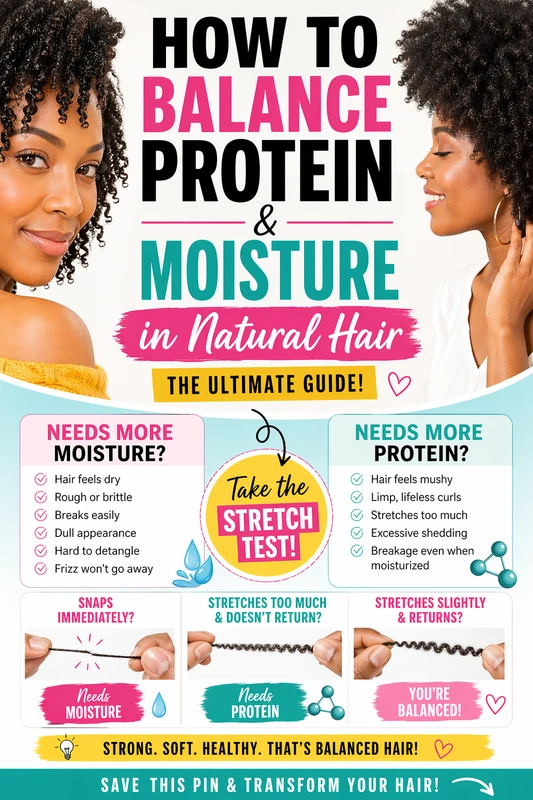
If your hair feels dry, brittle, mushy, or constantly breaking—there’s a high chance your protein-moisture balance is off.
This is one of the most important (and most misunderstood) aspects of natural hair care. Get this right, and your hair will become stronger, softer, shinier, and retain length faster. Get it wrong, and you’ll struggle with breakage, dryness, and stalled growth no matter what products you use.
In this complete guide, you’ll learn:
- What protein and moisture actually do for your hair
- Signs your hair needs protein vs moisture
- How to test your hair’s balance
- Step-by-step routines to fix imbalances
- The best ingredients and products to use
- How to maintain the perfect balance long-term
What Is Protein-Moisture Balance?
Your hair needs two key things to thrive:
1. Protein (Strength)
Hair is made of keratin protein, which gives it:
- Structure
- Strength
- Elasticity (ability to stretch without breaking)
When your hair loses protein, it becomes:
- Weak
- Limp
- Prone to breakage
2. Moisture (Flexibility & Softness)
Moisture keeps hair:
- Soft
- Flexible
- Hydrated
- Less likely to snap
Without moisture, your hair becomes:
- Dry
- Brittle
- Rough
- Hard to manage
The Balance Explained
Think of it like this:
- Too much protein = stiff, dry, snapping hair
- Too much moisture = soft, mushy, weak hair
- Balanced = strong, soft, elastic hair that grows and retains length
Why Protein-Moisture Balance Is Critical for Natural Hair
Natural hair (especially Type 3 and Type 4 textures) is more prone to imbalance because:
- The curl pattern makes it harder for natural oils to travel down the shaft
- It loses moisture faster
- It’s more fragile at bends and coils
- Protective styling can mask underlying issues
If you’re trying to:
- Grow longer hair
- Retain length
- Reduce shedding and breakage
? This balance is non-negotiable.
Signs Your Hair Needs MORE Moisture
If your hair is lacking moisture, you’ll notice:
Key Symptoms:
- Feels dry immediately after styling
- Rough or straw-like texture
- Breaks easily when touched
- Dull appearance
- Hard to detangle
- Frizz that won’t go away
What’s Happening:
Your hair doesn’t have enough water content, so it becomes brittle and snaps instead of bending.
Signs Your Hair Needs MORE Protein
If your hair is lacking protein, you’ll notice:
Key Symptoms:
- Hair feels overly soft or “mushy”
- Limp curls that won’t hold shape
- Excessive shedding
- Stretchy strands that don’t bounce back
- Breakage even when hair is moisturized
What’s Happening:
Your hair structure is weakened, so it stretches too much and breaks because it lacks strength.
The Stretch Test (Quick At-Home Diagnosis)
This is the easiest way to check your balance.
How to Do It:
- Take a clean, damp strand of hair
- Gently stretch it
Results:
- Snaps immediately → Needs moisture
- Stretches too much and doesn’t return → Needs protein
- Stretches slightly and returns → Balanced
? This test is simple but incredibly accurate.
What Causes Protein-Moisture Imbalance?
Most people unknowingly cause imbalance through their routine.
Common Causes:
1. Overusing Protein Treatments
- Too many strengthening products
- Frequent use of keratin-heavy conditioners
? Leads to stiff, brittle hair
2. Over-Moisturizing
- Constant deep conditioning without protein
- Heavy creams with no strengthening ingredients
? Leads to weak, mushy hair
3. Heat Damage
- Flat irons, blow dryers
- Breaks down protein structure
4. Chemical Treatments
- Relaxers, color, bleach
- Strip protein from hair
5. Product Buildup
- Blocks moisture from entering hair
- Throws off balance
The Perfect Protein-Moisture Routine
Here’s how to structure your routine for balanced, healthy hair.
Step 1: Cleanse Properly
Use a gentle shampoo to remove buildup.
- Wash 1x per week or every 2 weeks
- Clarify once a month
? Clean hair absorbs both protein and moisture better
Step 2: Deep Condition Based on Your Needs
If You Need Moisture:
Use a moisturizing deep conditioner with:
- Aloe vera
- Honey
- Glycerin
- Shea butter
If You Need Protein:
Use a protein treatment with:
- Hydrolyzed keratin
- Silk protein
- Wheat protein
- Collagen
Pro Tip:
Alternate between the two:
- Week 1: Moisture
- Week 2: Protein
- Week 3: Moisture
Step 3: Moisturize and Seal
After washing:
- Apply a leave-in conditioner
- Add oil to seal in moisture
- Use cream if needed
The LOC Method:
- Liquid (water or leave-in)
- Oil
- Cream
Step 4: Protect Your Hair
- Use satin bonnet or pillowcase
- Avoid excessive manipulation
- Keep ends protected
Best Ingredients for Protein-Moisture Balance
Moisturizing Ingredients
Look for:
- Aloe vera
- Coconut water
- Honey
- Glycerin
- Panthenol
Protein Ingredients
Look for:
- Hydrolyzed proteins (small enough to penetrate hair)
- Keratin
- Silk protein
- Rice protein
Oils That Help Balance Both
Some oils support both strength and moisture:
- Castor oil (strengthens + seals)
- Jojoba oil (balances scalp oils)
- Avocado oil (penetrates hair shaft)
How Often Should You Use Protein?
This depends on your hair condition.
General Guidelines:
- Low damage: every 4–6 weeks
- Moderate damage: every 2–4 weeks
- High damage: weekly (light protein only)
? Overdoing protein is one of the biggest mistakes people make.
How Often Should You Moisturize?
Moisture should be consistent.
Ideal Routine:
- Light moisture: every 2–3 days
- Deep moisture: weekly
Protein Overload vs Moisture Overload
Protein Overload
Signs:
- Hair feels hard
- Breaks easily
- No flexibility
Fix:
- Stop protein
- Use deep moisturizing treatments
- Add steam treatments
Moisture Overload
Signs:
- Hair feels too soft
- Won’t hold styles
- Excessive shedding
Fix:
- Add protein treatments
- Reduce heavy creams
- Strengthen hair structure
How to Maintain Perfect Balance
Once your hair is balanced, the goal is maintenance.
Weekly Routine Example:
Wash Day:
- Shampoo
- Deep condition (alternate protein/moisture)
Midweek:
- Light moisturizing spray
- Seal with oil
Daily:
- Protect hair at night
Seasonal Adjustments
Your hair needs change with the weather.
Winter:
- More moisture
- Heavier creams and oils
Summer:
- More protein (sun damage)
- Lightweight hydration
Common Mistakes to Avoid
1. Ignoring Your Hair’s Signals
Your hair tells you what it needs—listen to it.
2. Using the Same Routine Year-Round
Adjust based on weather and condition.
3. Layering Too Many Products
This leads to buildup and imbalance.
4. Skipping Clarifying
Buildup blocks moisture and protein absorption.
Advanced Tips for Maximum Growth
1. Use Heat or Steam
Helps treatments penetrate deeper.
2. Focus on Ends
Ends are the oldest and weakest part.
3. Keep Scalp Healthy
A healthy scalp supports balanced hair growth.
4. Stay Consistent
Balance isn’t a one-time fix—it’s a routine.
Final Thoughts: The Secret to Strong, Growing Hair
Balancing protein and moisture is the foundation of healthy natural hair.
When your hair is balanced:
- It retains length
- It resists breakage
- It feels soft AND strong
- It grows consistently
If you’ve been struggling with dryness, breakage, or slow growth…
? This is likely the missing piece.
Quick Recap
- Protein = strength
- Moisture = softness
- Balance = healthy hair
Remember:
- Dry & brittle → add moisture
- Soft & weak → add protein
- Strong & soft → you’re doing it right⁴÷