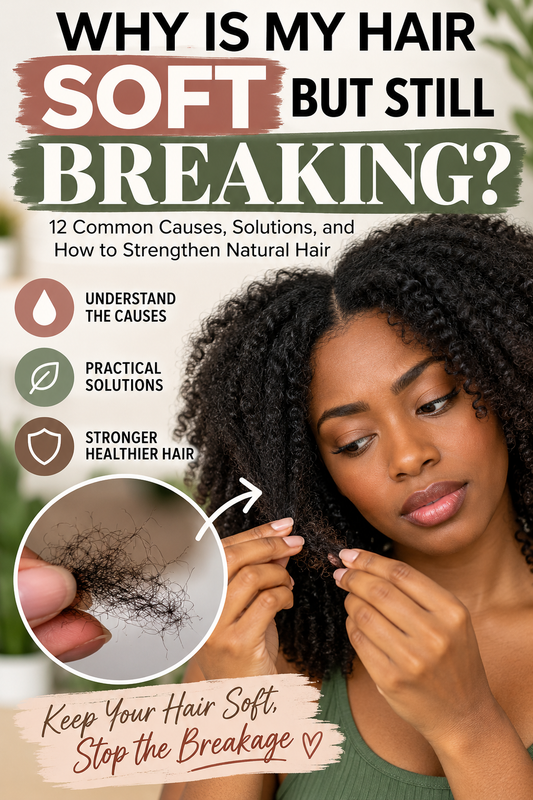
Have you ever touched your natural hair and noticed how soft, smooth, and moisturized it feels, only to discover small broken strands on your clothes, bathroom counter, or comb?
It can be confusing.
You use conditioner. You apply moisturizing products. Your curls feel soft. Your hair doesn't seem particularly dry or brittle. Yet every time you detangle, style, or wash your hair, you notice more breakage.
So, why is your hair soft but still breaking?
The answer is that soft hair isn't necessarily strong hair.
Hair can feel beautifully moisturized on the outside while still experiencing structural damage, weakened ends, excessive stretching, friction, or repeated tension.
This problem is particularly frustrating for people with natural Black hair, including 3C, 4A, 4B, and 4C textures, because curly and coily strands require both effective conditioning and gentle handling to maintain their length.
The good news is that understanding the difference between hair softness, elasticity, and strength can help you identify what's causing the breakage and make meaningful changes to your hair-care routine.
In this comprehensive guide, we'll explain why soft natural hair breaks, how to recognize damaged strands, what ingredients and styling habits can help, and how to create a healthier routine for stronger hair and better length retention.
Can Soft Hair Still Be Damaged?
Absolutely.
One of the biggest misconceptions about natural hair is that softness automatically means your hair is healthy.
Softness describes how your hair feels when you touch it.
Strength describes how well your hair strands withstand stretching, pulling, brushing, detangling, and everyday manipulation.
These characteristics are related, but they're not identical.
For example, a moisturizing conditioner may make your hair feel silky and manageable by smoothing the outer cuticle and reducing friction.
However, that conditioner cannot necessarily reverse damage caused by excessive bleaching, repeated flat ironing, chemical processing, or years of rough handling.
Your hair might feel wonderful after conditioning but still snap when you pull a comb through it.
This happens because the outer surface can feel smooth even when the inner structure of the hair has been weakened.
If you're experiencing this problem, understanding why natural hair breaks and how to stop it is an important first step toward improving your hair-care routine.
1. Your Hair May Have Lost Some of Its Structural Strength
Hair is primarily composed of keratin, a protein that helps provide strength and structure.
The hair shaft contains several layers, including the cuticle and cortex.
The cuticle forms the protective outer surface, while the cortex contributes much of the hair's mechanical strength, elasticity, and shape.
When these structures become damaged, hair may become more vulnerable to breaking.
Common causes of structural damage include:
-
Frequent heat styling
-
Bleaching and coloring
-
Chemical relaxers
-
Excessive brushing
-
Rough detangling
-
Repeated friction
-
Tight hairstyles
-
Environmental weathering
Sometimes the damage isn't immediately obvious.
You may still have shiny, soft curls, particularly after applying conditioner or styling cream.
However, damaged sections can break more easily when placed under tension.
How to Recognize Weakened Hair
Look for these warning signs:
-
Short pieces of hair appearing during styling
-
Ends that become thinner over time
-
Strands that snap with minimal tension
-
Excessive tangling despite conditioning
-
Uneven hair length
-
Hair that feels stretchy but doesn't return to its original shape
-
Breakage concentrated in previously colored or heat-styled sections
What You Can Do
Focus on preventing additional damage.
Reduce unnecessary heat styling, handle your hair gently, and choose conditioning treatments based on your hair's actual needs.
If your hair has significant chemical or heat damage, remember that products may temporarily improve its appearance and manageability, but they cannot fully restore severely damaged hair to its original condition.
Gradually trimming damaged sections may be necessary.
2. Your Hair May Be Overconditioned or Too Stretchy
Another reason soft hair can break is that it has become unusually stretchy or difficult to manage.
Conditioners are designed to improve softness, lubrication, and flexibility.
However, some people notice that their hair feels overly limp, excessively stretchy, or unable to hold a style after repeatedly using rich conditioning treatments.
This is sometimes described online as moisture overload or hygral fatigue.
It's important to understand that these terms are often used loosely. Softness alone doesn't establish that your hair has too much moisture, and there isn't a reliable at-home test that diagnoses moisture overload.
Repeated swelling and drying can contribute to hair weathering, but unusual stretchiness may also be associated with chemical damage or other changes to the hair fiber.
Signs Your Hair May Need a Different Conditioning Routine
Your hair might:
-
Feel unusually limp
-
Stretch excessively before breaking
-
Lose its normal curl definition
-
Become difficult to style
-
Feel soft but unusually weak
-
Tangle despite being well-conditioned
These signs aren't proof that you're using too much conditioner.
Instead, they suggest it's worth reviewing your entire routine.
How to Address the Problem
Start by simplifying your wash-day products.
Use a regular rinse-out conditioner and avoid stacking multiple heavy masks unless your hair benefits from them.
If you use a deep conditioner, follow the manufacturer's instructions rather than automatically leaving it on for hours.
Consider incorporating a strengthening treatment formulated for damaged hair when appropriate.
The goal isn't to make your hair hard.
It's to maintain a balance between manageability, flexibility, and resistance to breakage.
3. You May Be Detangling Your Hair Too Aggressively
One of the most common reasons soft natural hair breaks is mechanical damage.
Mechanical damage occurs when physical force causes strands to snap.
Your hair can be moisturized and still break if you repeatedly pull, stretch, or brush it too aggressively.
This is especially relevant for curly and coily textures because strands naturally bend, twist, and intertwine.
When several strands become tangled, pulling a comb through them can create more force than the individual hairs can tolerate.
Even soft hair has a breaking point.
Common Detangling Mistakes
-
Starting at the roots instead of the ends
-
Pulling through stubborn knots
-
Using fine-tooth combs on tangled curls
-
Brushing without adequate slip
-
Detangling excessively large sections
-
Rushing through wash day
-
Repeatedly brushing already-detangled hair
How to Detangle Without Breaking Soft Hair
Begin by dividing your hair into manageable sections.
Apply a conditioner or detangling product that provides enough slip for strands to separate easily.
Use your fingers to gently loosen larger knots.
Start near the ends and gradually move toward the roots.
If your comb encounters resistance, stop and carefully separate the tangled strands rather than pulling harder.
Once a section is detangled, loosely twist or braid it to prevent additional tangling.
For a more detailed explanation, read our guide on why hair breaks when detangling and how to stop it.
Remember that wet hair can also be vulnerable to damage, so avoid forceful pulling even when your strands are covered in conditioner.
4. Your Ends May Be Damaged Even When the Rest of Your Hair Feels Soft
Sometimes your hair isn't breaking everywhere.
The problem is concentrated at the ends.
Your ends are the oldest sections of your hair strands.
They've experienced months or years of washing, styling, detangling, sunlight, friction, and environmental exposure.
Over time, this repeated wear can weaken the protective cuticle.
You might notice that your roots and middle sections feel healthy and soft while the last inch or two of your hair tangles, splits, or breaks.
Signs of Damaged Ends
-
Frequent single-strand knots
-
Split or frayed ends
-
Thin-looking ends
-
Rough patches near the bottom
-
Small broken pieces after combing
-
Ends that repeatedly catch on one another
-
Hair that appears to grow but never gets longer
How to Protect Your Ends
Condition your ends regularly and avoid unnecessary friction.
Wear low-tension styles that keep your ends from rubbing constantly against clothing.
Use a satin bonnet or smooth pillowcase at night.
Detangle carefully and avoid repeatedly pulling at knots.
Most importantly, trim ends that are severely split or damaged.
A conditioner may temporarily smooth split ends, but it cannot permanently fuse them back together.
For additional techniques, explore our article on how to protect your natural hair ends and retain length.
5. Your Hair May Be Experiencing Too Much Manipulation
Natural hair doesn't need to be styled every day to look beautiful.
However, frequent manipulation can gradually contribute to breakage.
Think about everything your hair experiences during a typical week.
You might brush it in the morning, pull it into a ponytail, refresh your curls in the afternoon, twist it at night, and restyle it the following day.
Each activity creates some degree of friction or tension.
One styling session may not cause noticeable damage.
But repeated stress can gradually weaken vulnerable areas.
Hairstyles That May Increase Breakage
-
Extremely tight ponytails
-
Sleek buns with strong tension
-
Tight braids
-
Heavy extensions
-
Styles that repeatedly pull the edges
-
Frequent brushing to achieve a smooth appearance
Better Styling Habits
Try reducing how often you completely restyle your hair.
Choose loose twists, gentle braids, or other low-manipulation hairstyles.
Avoid placing repeated tension on the same sections.
When wearing ponytails, use soft hair ties and avoid pulling them too tightly.
A hairstyle should not cause pain, persistent scalp tenderness, or visible pulling.
Protective styling works best when it actually protects your hair rather than creating additional stress.
6. Your Hair May Have Heat Damage
Heat damage can be especially deceptive.
Hair that has been repeatedly straightened may still feel soft after conditioning.
However, excessive heat can weaken the hair fiber and permanently alter the curl pattern.
Flat irons, curling irons, and blow dryers can all contribute to damage when used at excessive temperatures or too frequently.
Signs of Heat Damage
-
Sections that no longer curl normally
-
Straight pieces mixed with curly strands
-
Increased breakage after styling
-
Hair that tangles more easily
-
Ends that appear thin
-
Reduced elasticity
-
Hair that feels smooth but snaps easily
How to Reduce Heat-Related Breakage
Limit the frequency of high-heat styling.
Use the lowest effective temperature and a suitable heat protectant.
Avoid repeatedly passing a flat iron over the same section.
Make sure your hair is appropriately dry before using tools designed for dry hair.
Consider heat-free stretching techniques such as loose braids, twists, or banding.
If your curls have been permanently altered by heat damage, conditioning may improve their appearance, but it may not restore the original curl pattern.
7. Your Hair May Be Breaking Because of Chemical Processing
Hair color and chemical straightening can significantly change the structure of your hair.
Bleaching, permanent coloring, relaxers, and some other chemical treatments alter components of the hair fiber.
When these treatments are repeated or performed incorrectly, the hair can become more fragile.
Interestingly, chemically processed hair can sometimes feel very soft.
That's because conditioning products may smooth the surface even when the underlying structure has been compromised.
Warning Signs
-
Breakage concentrated in colored sections
-
Hair snapping near the transition between treated and untreated hair
-
Excessive tangling after washing
-
Weak, stretchy strands
-
Hair breaking during routine styling
What Helps
Avoid overlapping chemical treatments on previously processed hair.
Follow recommended processing times and consider working with a licensed professional.
Use conditioners appropriate for chemically treated hair.
Limit additional heat exposure.
If your hair is severely damaged, gradual trimming may be the safest approach.
8. Product Buildup May Be Hiding Underneath the Softness
Sometimes hair feels soft because it's coated with conditioning agents, oils, creams, or styling products.
These ingredients aren't necessarily harmful.
Many are useful for improving manageability and reducing friction.
However, excessive product layering can make it difficult to evaluate how your hair actually behaves.
Buildup may also contribute to tangling or make strands feel heavy and coated.
Signs You May Have Too Much Product Buildup
-
Hair feels coated or waxy
-
Curls appear weighed down
-
Products stop distributing evenly
-
Hair feels sticky
-
Your scalp becomes uncomfortable
-
Strands clump together unexpectedly
How to Correct It
Wash your hair regularly with an appropriate shampoo.
If you use heavy styling products, consider an occasional clarifying shampoo when needed.
Follow cleansing with a conditioner.
Avoid applying more products simply because your hair is breaking.
Instead, determine whether the problem is caused by damaged ends, detangling, friction, or another factor.
Adding more moisture isn't always the solution to hair breakage.
Sometimes your hair needs less manipulation and a simpler routine.
9. Your Hair May Be Tangling More Than You Realize
Natural hair can feel soft while still forming knots.
This is particularly common with tightly coiled textures.
As curls shrink, individual strands can wrap around neighboring hairs.
If those tangles aren't separated carefully, they may tighten during washing, styling, or sleeping.
Eventually, the hair can break when you try to remove them.
How to Reduce Tangling
Keep your hair organized into sections during wash day.
Avoid allowing severely tangled hair to become more matted.
Use conditioning products with adequate slip.
Protect your hair while sleeping.
Consider loose twists or braids when appropriate.
Trim damaged ends that repeatedly snag other strands.
If tangling is one of your biggest challenges, read why natural hair tangles so easily and how to prevent knots.
10. Your Hair May Be Breaking Because of Friction
Friction is an overlooked cause of hair breakage.
Even soft hair can experience damage when it repeatedly rubs against rough surfaces.
Common sources of friction include:
-
Pillowcases
-
Clothing collars
-
Scarves
-
Hats
-
Hair accessories
-
Repeated brushing
-
Tight hairstyles
The nape of the neck can be particularly vulnerable because hair in this area often rubs against clothing.
How to Reduce Friction
Sleep with a properly fitted satin bonnet or use a satin pillowcase.
Avoid accessories with rough seams or exposed metal.
Choose hairstyles that minimize rubbing against clothing.
Keep your ends conditioned and avoid excessive brushing.
These adjustments may seem small, but reducing repeated mechanical stress can make a meaningful difference over time.
11. Your Hair May Need More Than Moisturizing Products
Moisturizing products are useful, but they aren't a complete solution for every type of hair damage.
Different products serve different purposes.
A conditioner may reduce friction and improve softness.
A leave-in treatment may help maintain manageability between washes.
Certain protein-containing or bond-building treatments may temporarily improve the mechanical properties of some damaged hair fibers.
However, not every person needs a protein treatment.
And using one doesn't guarantee that breakage will stop.
Should You Use a Protein Treatment?
Consider evaluating your routine if your hair has been heavily bleached, chemically treated, or heat damaged.
Choose a treatment formulated for your hair type and follow the directions carefully.
Avoid applying multiple strengthening products at once.
Observe whether your hair becomes easier to handle and whether breakage decreases over several wash days.
If a treatment leaves your hair unusually stiff or difficult to detangle, reconsider how frequently you're using it.
Healthy hair care is about responding to your hair's condition rather than following a rigid rule that everyone needs the same amount of protein or moisture.
12. Health and Nutrition Can Also Affect Hair Strength
Sometimes hair breakage is influenced by factors beyond styling.
Hair growth and fiber quality can be affected by nutritional deficiencies, certain medical conditions, medications, and changes in overall health.
For example, inadequate protein intake or iron deficiency may contribute to hair problems in some individuals.
However, these conditions cannot be diagnosed by touching your hair.
And supplements aren't automatically beneficial when a deficiency hasn't been established.
If you experience sudden widespread breakage, significant shedding, scalp inflammation, or noticeable thinning, consider consulting a dermatologist or healthcare professional.
The goal is to identify the actual cause rather than assuming every hair problem can be solved with another conditioner.
How to Stop Soft Natural Hair From Breaking: A Step-by-Step Routine
Now that you understand the possible causes, it's time to build a routine that supports both softness and strength.
Step 1: Cleanse Your Hair Regularly
Start with a gentle shampoo appropriate for your scalp and hair needs.
Focus on removing excess oil, sweat, dirt, and styling residue.
Massage your scalp with your fingertips rather than aggressively scratching.
Rinse thoroughly.
Cleansing frequency depends on your scalp, hairstyle, activity level, and product use.
Step 2: Apply a Conditioner With Good Slip
After shampooing, distribute conditioner through your hair.
Pay particular attention to the lengths and ends.
Allow it to remain on your hair for the recommended time.
Choose a product that helps your strands glide past one another during detangling.
Remember that a conditioner doesn't have to be extremely heavy to be effective.
Step 3: Detangle in Small Sections
Divide your hair into four to eight sections, depending on its thickness and length.
Gently loosen larger knots with your fingers.
Work from the ends toward the roots.
Use a wide-tooth comb or suitable detangling brush only when necessary.
Avoid pulling aggressively through resistant areas.
Step 4: Apply a Lightweight Leave-In Treatment
After washing and conditioning, consider applying a leave-in product that helps maintain softness and manageability.
A leave-in conditioner can be particularly useful for curly and coily hair that experiences frequent tangling.
At Hairobics All Natural, our Leave-In Treatment can be incorporated into a regular conditioning and styling routine to help keep natural hair manageable.
The goal is to reduce friction and make everyday styling easier, not to promise that a cosmetic product can repair every type of hair damage.
Step 5: Protect Your Ends
Apply conditioning products to your ends as needed.
Avoid repeatedly pulling at knots.
Wear low-tension hairstyles that reduce unnecessary rubbing.
Trim visibly split or severely damaged ends when necessary.
Step 6: Reduce Excessive Styling
Give your hair time between intensive styling sessions.
Avoid repeatedly brushing or combing it throughout the day.
Choose hairstyles that don't place excessive tension on your scalp or strands.
Step 7: Protect Your Hair at Night
Wear a comfortable satin bonnet or use a smooth pillowcase.
If your hair tangles easily, consider arranging it in loose twists or braids before sleeping.
Avoid tight nighttime hairstyles that pull at the roots.
Step 8: Monitor Your Breakage
Pay attention to how much hair breaks during washing and styling.
Look for short broken pieces rather than relying only on the total amount of hair collected.
Notice whether certain areas are breaking more than others.
Tracking these patterns can help you identify which changes are working.
A Simple Weekly Hair-Care Schedule for Soft but Breaking Hair
| When | What to Do |
|---|---|
| Wash day | Shampoo, condition, and gently detangle |
| After washing | Apply leave-in conditioner and style with minimal tension |
| Midweek | Check for tangles and refresh conditioning only as needed |
| Every night | Protect hair with satin and reduce friction |
| As needed | Clarify buildup, assess damaged ends, and trim when necessary |
This is a flexible example, not a requirement to wash or moisturize on a fixed schedule.
Adjust your routine based on your hair's needs.
How to Tell the Difference Between Hair Breakage and Shedding
Before making major changes to your routine, determine whether you're experiencing breakage or normal shedding.
Hair Shedding
Shedding occurs when a hair naturally leaves the follicle.
Shed hairs are often relatively long and may have a small, pale club-shaped end.
Shedding is a normal part of the hair-growth cycle.
Hair Breakage
Breakage occurs when a strand snaps somewhere along its length.
Broken hairs are often shorter than the surrounding strands and lack the club-shaped root end.
You may notice small pieces collecting around your sink or on your clothing.
However, appearance alone isn't always enough to determine the cause.
If you notice substantial hair loss, scalp symptoms, or progressive thinning, professional evaluation is worthwhile.
Can Soft Hair Still Grow Long?
Yes.
Soft hair can absolutely grow long.
The important distinction is between hair growth and length retention.
Hair grows from follicles beneath your scalp.
But if your strands repeatedly break near the ends, you may struggle to see progress in your overall length.
For example, your hair may continue growing normally while damaged ends break off at a similar rate.
This can create the impression that your hair has stopped growing.
The solution isn't necessarily to find a product that makes your hair grow faster.
Often, it's more helpful to reduce breakage so you can retain more of the length you're already growing.
Learn more in our guide to retaining length and avoiding breakage on natural hair.
Frequently Asked Questions About Soft Hair That Breaks
Why is my 4C hair soft but breaking?
4C hair can feel soft while experiencing breakage from rough detangling, excessive manipulation, tight styles, damaged ends, or chemical and heat exposure.
Its tightly coiled structure can also make tangling more challenging.
Focus on conditioning, gentle detangling, low-tension styling, and protecting your ends.
Does soft hair mean it's healthy?
Not necessarily.
Softness is one characteristic of hair condition, but it doesn't measure the strength of the entire strand.
Hair can feel smooth while still having structural damage.
Can too much conditioner cause breakage?
Conditioner generally helps reduce friction and improve manageability.
However, an unsuitable routine or excessive product layering may leave hair difficult to style.
If your hair feels unusually limp or stretchy, review your products and consider whether chemical damage or other factors may be involved.
Why does my hair break even though I moisturize every day?
Daily moisturizing doesn't eliminate damage caused by heat, chemicals, rough brushing, or tight hairstyles.
Your hair may need less manipulation rather than more product.
Should I use protein if my hair is soft but breaking?
A protein-containing treatment may be useful for some damaged hair, but it's not automatically necessary.
The best approach depends on the cause of breakage, the treatment formulation, and how your hair responds.
Can split ends make soft hair break?
Yes.
Split ends can weaken the affected part of the strand, making it more vulnerable to further splitting and breakage.
Conditioners may improve their appearance temporarily, but trimming is the most reliable way to remove severely split ends.
How long does it take to stop hair breakage?
There isn't one timeline that applies to everyone.
If breakage comes primarily from aggressive detangling, changing your technique may reduce new damage relatively quickly.
More extensive chemical or heat damage may require gradual trimming as healthier hair grows.
Does natural hair need to be hard to be strong?
No.
Healthy natural hair can be soft, flexible, and resilient.
Hardness isn't a reliable measure of strength.
The goal is hair that can tolerate ordinary styling without excessive breakage.
Can protective styles help soft hair retain length?
Yes, when they're installed and maintained gently.
Loose twists, braids, and other low-manipulation styles may help reduce friction and daily handling.
However, tight or heavy styles can create additional breakage.
Why does my hair break after deep conditioning?
Deep conditioning doesn't guarantee that existing damage has been repaired.
Breakage after conditioning may be related to detangling technique, weakened strands, damaged ends, or previous chemical and heat exposure.
Look at the entire routine rather than assuming the conditioner is responsible.
Final Thoughts: Why Is My Hair Soft but Still Breaking?
If your hair feels soft but continues breaking, don't assume you simply need another moisturizing product.
Softness is important, but healthy natural hair also needs structural integrity, manageable tangles, gentle handling, and protection from repeated damage.
Your hair may be breaking because of aggressive detangling, weakened ends, excessive heat, chemical processing, frequent styling, friction, or a combination of these factors.
The best approach is to identify where and when the breakage occurs.
Pay attention to your ends.
Evaluate your detangling technique.
Reduce unnecessary tension.
Use conditioning products that help your hair remain manageable.
And remember that damaged hair doesn't always feel rough.
Soft hair can still be fragile, but with a consistent, gentle routine, you can reduce avoidable breakage and improve your chances of retaining length.
At Hairobics All Natural, we believe caring for natural hair should focus on healthy everyday habits, thoughtful conditioning, and protecting the beautiful texture you already have.
Your goal isn't simply softer hair.
It's softer, more manageable hair that experiences less unnecessary breakage over time.