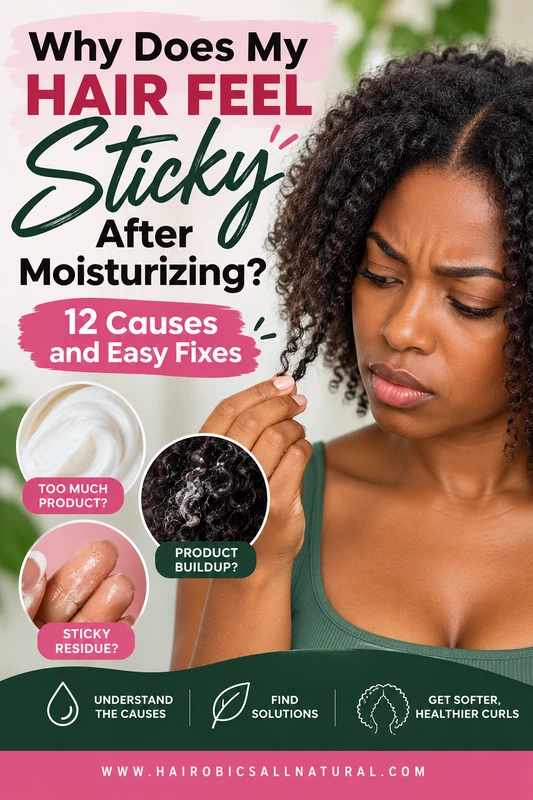
Have you ever finished moisturizing your natural hair, expecting soft, hydrated curls, only to discover that your strands feel sticky, tacky, greasy, or strangely coated?
Maybe you applied your favorite leave-in conditioner, followed it with a moisturizing cream and a little oil. Instead of leaving your hair soft and manageable, the products made your curls feel heavy, gummy, or difficult to separate.
You might even notice that your fingers feel sticky after touching your hair.
If you've been asking, "Why does my hair feel sticky after moisturizing?", you're not alone.
Sticky hair after moisturizing is a common frustration for people with natural, curly, coily, and tightly textured hair, including 3C, 4A, 4B, and 4C hair.
The good news is that sticky hair doesn't automatically mean your strands are damaged or unhealthy.
In many cases, the problem comes from applying too much moisturizer, layering incompatible products, using heavy oils, or allowing residue to accumulate between wash days.
Your hair's porosity, the ingredients in your moisturizer, and even the humidity outside can influence how your hair feels after applying products.
Understanding these factors can help you develop a moisturizing routine that leaves your natural hair feeling soft, flexible, and manageable without unwanted stickiness.
In this complete guide, we'll explain 12 reasons your hair feels sticky after moisturizing, how to identify the cause, and the best ways to restore softness without sacrificing moisture.
What Does It Mean When Your Hair Feels Sticky After Moisturizing?
Sticky hair describes a tacky or adhesive feeling that develops on the surface of your strands.
Instead of your fingers gliding smoothly through your hair, they may catch on individual strands or encounter noticeable residue.
Your curls might also clump together more than usual.
Common signs of sticky hair include:
-
Hair feels tacky immediately after applying moisturizer.
-
Fingers become sticky when touching your strands.
-
Curls feel heavy or coated.
-
Hair attracts lint or dust.
-
Strands stick together during detangling.
-
Moisturizing products remain noticeable after drying.
-
Hair feels greasy but still appears dry.
-
Twist-outs lose their natural movement.
-
Hair feels gummy when wet.
-
White residue appears after applying multiple products.
-
Curls become limp or lose volume.
-
Hair feels dirty shortly after washing.
It's important to distinguish between healthy conditioning and excessive residue.
Many conditioners and styling ingredients are designed to remain on the hair's surface. This protective coating can reduce friction, improve shine, and make detangling easier.
However, when the coating becomes excessive, your hair may feel unpleasantly sticky.
The goal isn't to eliminate every conditioning ingredient from your strands. It's to achieve the right balance between hydration, lubrication, and lightweight protection.
1. You're Applying Too Much Moisturizer
One of the most common reasons hair feels sticky after moisturizing is simply using too much product.
When natural hair feels dry, it's tempting to apply a generous amount of moisturizer.
You may assume that adding more product will create softer, healthier hair.
Unfortunately, more moisturizer doesn't always mean better results.
Hair products contain conditioning agents, oils, humectants, and other ingredients that interact with the hair's surface.
Applying excessive amounts can leave more residue than your strands need.
Signs you're using too much moisturizer
You may notice:
-
Your hair feels heavy immediately after application.
-
Moisturizer remains visible on your strands.
-
Your curls take longer than usual to dry.
-
Your hands feel sticky after styling.
-
Your hairstyle loses volume.
-
Your hair feels coated rather than soft.
How to fix it
Start with a smaller amount of moisturizer.
Divide your hair into manageable sections and apply a little product at a time.
Distribute it evenly from the mid-lengths toward the ends.
Wait until you've worked the product through each section before deciding whether you need more.
You may discover that your hair feels softer with considerably less moisturizer.
For a more detailed explanation, read our guide on How to Avoid Product Overload on Natural Hair.
2. Product Buildup Is Making Your Hair Sticky
Product buildup is another major reason natural hair develops a sticky texture.
Throughout the week, your hair can accumulate residue from leave-in conditioners, styling creams, gels, oils, butters, and other products.
Some of these ingredients are designed to remain on the strands until the next wash.
However, repeated applications can create layers of residue.
For example, imagine applying moisturizer on Monday, adding more cream on Tuesday, refreshing with oil on Wednesday, and applying another leave-in conditioner on Thursday.
By the end of the week, your hair may have accumulated several layers of product.
Instead of feeling increasingly moisturized, it begins feeling sticky and coated.
How to identify buildup
Common symptoms include:
-
Hair feels waxy or unusually slippery.
-
Curls appear dull.
-
Your usual moisturizer stops working as expected.
-
Hair feels heavy even after drying.
-
Styling products begin flaking.
-
Water doesn't wet your hair as easily as usual.
How to remove buildup
Wash your hair thoroughly with a shampoo appropriate for your scalp and styling routine.
If regular shampoo isn't removing stubborn residue, consider using a clarifying shampoo.
Clarifying shampoos are designed to remove accumulated styling products, excess oils, and other deposits.
Follow with a moisturizing conditioner to restore manageability.
Avoid immediately applying several heavy products after clarifying.
For additional information, explore Why Does My Hair Feel Coated?.
3. Your Moisturizer Contains a High Amount of Humectants
Humectants are ingredients that interact with water and help support moisture retention.
They're commonly included in leave-in conditioners, curl creams, moisturizing sprays, and styling products.
Examples include:
-
Glycerin
-
Honey
-
Sorbitol
-
Propylene glycol
-
Panthenol
These ingredients can be beneficial for dry natural hair.
However, some humectant-rich formulations may leave a tacky feeling, particularly when applied heavily or used in humid conditions.
Why glycerin can make hair sticky
Glycerin is a popular moisturizing ingredient because it readily interacts with water.
In a balanced formula, it can help maintain softness and hydration.
But high concentrations of glycerin may produce a sticky film.
This doesn't mean glycerin is harmful or unsuitable for natural hair.
The concentration, surrounding ingredients, amount applied, and environmental conditions all influence how a product performs.
How to fix it
If your hair becomes sticky after using a glycerin-rich moisturizer, try reducing the amount.
You can also experiment with a different leave-in conditioner that has a lighter texture.
Avoid applying undiluted glycerin directly to your hair in large amounts.
To understand this ingredient better, read Glycerin for Natural Hair: Benefits, How to Use It, and When to Avoid It.
4. You're Layering Too Many Hair Products
Many natural hair routines involve several products.
You might apply:
-
A moisturizing spray.
-
Leave-in conditioner.
-
Curl cream.
-
Hair butter.
-
Hair oil.
-
Styling gel.
Although each product may serve a purpose, combining all six isn't necessary for everyone.
Layering several products can create a heavy coating.
Sometimes the formulations also interact poorly, causing clumping, flaking, or an unpleasant texture.
Why product layering causes stickiness
Different products contain different conditioning agents, oils, emulsifiers, and styling polymers.
Some combinations work beautifully together.
Others may create excessive residue or fail to spread evenly.
For example, applying a thick butter over a heavy cream may leave your strands coated.
Adding gel afterward can make the texture even more noticeable.
How to fix it
Simplify your routine.
Start with a water-based leave-in conditioner.
If your hair needs additional lubrication, add a small amount of oil or styling cream.
Only introduce another product when it serves a clear purpose.
You can also test two products together in your palm before applying them throughout your hair.
If they immediately clump or form visible residue, try using them separately.
5. You're Applying Moisturizer to Hair That Needs Cleansing
Sometimes sticky hair isn't caused by the moisturizer itself.
The problem may be that you're applying moisturizer to strands already covered in residue.
When hair hasn't been cleansed adequately for its styling routine, adding another moisturizing product can increase the coated feeling.
This is particularly noticeable when using heavy oils, pomades, gels, or thick creams.
Why cleansing matters
Shampoo helps remove accumulated oils, dirt, sweat-related residue, and styling products.
Without sufficient cleansing, your hair may become increasingly difficult to manage.
A moisturizer that once worked beautifully may suddenly leave your strands feeling sticky.
How to fix it
Evaluate your washing schedule.
Some people prefer washing weekly, while others wash more or less frequently depending on their scalp and styling habits.
If you frequently exercise, use heavy products, or notice buildup, you may need more regular cleansing.
After shampooing, condition your hair thoroughly and use a modest amount of leave-in moisturizer.
Clean hair often makes it easier to evaluate how well your products are working.
6. Your Hair May Have Low Porosity
Hair porosity describes how readily hair takes up and releases water.
Low-porosity hair can be relatively resistant to wetting.
As a result, some people with low-porosity hair find that thick moisturizers and heavy creams leave noticeable residue.
However, sticky hair alone doesn't prove that you have low-porosity hair.
Product buildup, application methods, and the formulation itself can produce similar symptoms.
Possible signs of low-porosity hair
You may notice:
-
Hair takes time to become fully wet.
-
Water initially beads on your strands.
-
Heavy creams feel excessive.
-
Hair takes a long time to air-dry.
-
Lightweight products feel more comfortable.
-
Product buildup develops quickly.
How to moisturize low-porosity hair
Begin with clean, damp hair.
Apply a lightweight, water-based leave-in conditioner.
Work in sections to distribute the product evenly.
Avoid applying large amounts of thick butter or heavy oil before determining whether your hair needs them.
Gentle warmth during rinse-out conditioning may also be useful, but extreme heat is unnecessary.
For more information, read Why Do Products Sit on Top of My Hair?.
7. Heavy Oils and Butters Are Creating a Sticky Coating
Natural oils and plant butters are popular in textured hair care.
Ingredients such as castor oil, coconut oil, shea butter, olive oil, and mango butter can help improve lubrication and reduce friction.
However, applying too much can leave your hair feeling greasy, waxy, or sticky.
Why oils can make hair feel coated
Oils aren't the same as water-based hydration.
They can improve the feel of hair and help reduce moisture loss, but they don't automatically replace the need for water and conditioning.
When you apply heavy oil over hair that's already coated with moisturizer, the combined layers may become excessive.
This is especially noticeable on fine strands or hair that becomes weighed down easily.
How to fix it
Apply your water-based moisturizer first.
If your hair benefits from oil, use a small amount.
Concentrate on areas that need additional lubrication, such as dry ends.
Avoid automatically applying oil every time you refresh your hair.
If your strands already feel soft, additional oil may be unnecessary.
8. Humid Weather Is Affecting Your Moisturizer
Have you noticed that your hair feels soft after moisturizing on some days but sticky on others?
The weather may be contributing.
Humidity influences how water interacts with hair and certain styling products.
Humectant-rich formulas may behave differently in humid air than they do in dry conditions.
What happens in high humidity?
Some products remain more tacky when exposed to moisture in the air.
You may notice:
-
Hair feels sticky after going outside.
-
Curls become puffy.
-
Frizz increases.
-
Styles lose definition.
-
Moisturizing products feel heavier.
Not everyone experiences these effects, and glycerin-containing products aren't automatically unsuitable for humid weather.
The complete formulation matters.
How to fix it
Pay attention to which products perform best under different weather conditions.
If your usual moisturizer becomes sticky on humid days, try applying less.
You might also experiment with a lighter formula or a styling product designed to provide humidity resistance.
Avoid assuming that every product containing glycerin will cause frizz or stickiness.
9. Your Hair Is Still Wet When You Judge the Results
Sometimes hair feels sticky because the styling products haven't finished drying.
Certain leave-in conditioners, curl creams, and gels can feel tacky while wet.
As water evaporates, the texture may change.
A product that feels sticky immediately after application may leave hair soft once fully dry.
How to tell the difference
After moisturizing, allow your hair to dry completely.
Avoid repeatedly touching your strands during the drying process.
Once dry, gently separate a small section.
If the sticky feeling disappears, the temporary texture may simply be part of the product's normal behavior.
However, if your hair remains tacky long after drying, the amount or formulation may need adjustment.
What about styling gel?
Some gels create a firm cast around curls.
This is different from true stickiness.
A gel cast can help preserve curl definition while drying.
Once completely dry, certain gel casts can be gently softened without disrupting the hairstyle.
10. Your Hair Has Hard-Water Mineral Deposits
Hard water contains relatively high concentrations of dissolved minerals, particularly calcium and magnesium.
Over time, mineral deposits may affect how your hair feels and responds to cleansing and conditioning.
You may notice that your hair feels rough, coated, dull, or difficult to manage.
Signs hard water may be contributing
Possible clues include:
-
Hair feels coated shortly after washing.
-
Shampoo doesn't perform as expected.
-
Strands become unusually rough.
-
Conditioner seems less effective.
-
Hair tangles more easily.
-
Mineral deposits appear around faucets.
These symptoms aren't enough to confirm hard water as the cause.
How to fix it
Consider testing your household water if you suspect excessive mineral content.
A chelating shampoo may help remove certain mineral deposits.
Chelating shampoos contain ingredients designed to bind minerals so they can be washed away.
Follow with conditioner to maintain softness.
Remember that ordinary clarifying shampoos and chelating shampoos aren't necessarily interchangeable.
11. Your Moisturizer Is Too Heavy for Your Hair Density and Strand Thickness
Two people can have the same curl pattern and still need completely different moisturizing products.
One person may have thick, coarse strands that tolerate rich creams.
Another may have fine strands that become weighed down quickly.
Hair density also matters.
Low-density hair may lose volume more noticeably when coated with heavy products.
Signs your moisturizer is too heavy
You may notice:
-
Hair looks flat after application.
-
Curls lose movement.
-
Roots feel greasy.
-
Strands clump excessively.
-
Hair feels sticky despite using a small amount.
-
Your style looks less full.
How to fix it
Experiment with lighter moisturizers.
Water-based sprays and lighter leave-in treatments may be easier to distribute than thick butters.
Apply a small amount and increase only when necessary.
Remember that coarse hair doesn't always require heavy products, and fine hair doesn't automatically need to avoid oils.
The best choice depends on how your individual hair responds.
12. You're Moisturizing Too Frequently
Moisturizing natural hair is important, but that doesn't mean you must apply products every day.
Some people refresh their hair daily because they're worried about dryness.
However, applying moisturizer repeatedly without evaluating the condition of your strands can contribute to buildup.
How often should you moisturize natural hair?
There is no universal schedule.
Your needs depend on:
-
Hair porosity.
-
Hair density.
-
Strand thickness.
-
Styling habits.
-
Climate.
-
Product formulation.
-
Cleansing frequency.
-
The condition of your ends.
Some people benefit from light refreshing every few days.
Others can maintain softness for longer between applications.
How to avoid over-moisturizing
Before applying another product, touch your hair and assess its condition.
Does it feel unusually dry?
Are your ends rough?
Does your hair need more flexibility?
Or does it already feel soft and manageable?
If your hair feels good, you may not need another layer of moisturizer.
For additional guidance, explore Why Does My Hair Feel Dry Right After Moisturizing?.
How to Fix Sticky Hair After Moisturizing: A Step-by-Step Routine
If your natural hair already feels sticky, the solution isn't necessarily adding another product.
Instead, focus on removing excess residue and simplifying your moisturizing routine.
Step 1: Determine whether your hair needs washing
If your hair feels slightly tacky immediately after applying a product, allow it to dry first.
If the sticky feeling persists or your strands feel heavily coated, cleansing may be the best option.
Use a shampoo suitable for your hair and scalp.
If buildup is substantial, consider a clarifying shampoo.
Step 2: Apply a moisturizing conditioner
After shampooing, apply conditioner to your wet hair.
Focus on the lengths and ends.
Work in sections to ensure even distribution.
Allow the conditioner to remain on your hair according to the manufacturer's instructions.
Detangle gently while your hair has sufficient slip.
Step 3: Rinse thoroughly
Incomplete rinsing can leave excessive conditioner residue on your strands.
Rinse according to the product directions.
Pay attention to areas where thick products tend to accumulate.
Your hair should feel conditioned without carrying an uncomfortable coating.
Step 4: Apply a lightweight leave-in treatment
After washing, gently remove excess water.
Apply a modest amount of leave-in conditioner to damp hair.
Avoid saturating every section with product.
Distribute the treatment evenly.
If you're looking for a water-based leave-in product to incorporate into your routine, consider Hairobics All Natural Leave-In Treatment.
Its formula includes purified water and botanical ingredients. Use it according to the product directions, beginning with a small test area.
Step 5: Add oil only when needed
If your hair benefits from additional lubrication, apply a small amount of oil.
You don't necessarily need to coat your entire head.
Focus on the areas that need it most.
For scalp-focused care, Hairobics Hair & Scalp Booster contains a blend of oils and botanical ingredients.
Because it's an oil-rich formula, apply it sparingly according to the label directions, especially if you're trying to prevent excess residue.
Step 6: Avoid unnecessary styling layers
Once your hair feels conditioned, decide whether you need another styling product.
If you're creating a twist-out or braid-out, you may prefer a styling cream.
If you're wearing a wash-and-go, you might use gel for definition.
You don't automatically need both.
Step 7: Let your hair dry completely
Allow your hairstyle to dry before evaluating the final texture.
Avoid repeatedly touching your curls while they're drying.
Once dry, check whether your strands feel soft, flexible, and manageable.
If your hair remains sticky, consider reducing the amount of product during your next styling session.
Why Does My 4C Hair Feel Sticky After Moisturizing?
4C hair has tightly coiled strands that can experience significant shrinkage.
Its bends and curves also make it more difficult for natural scalp oils to travel from the roots to the ends.
As a result, some people with 4C hair rely on rich moisturizers, creams, and oils to maintain softness.
However, tightly coiled hair doesn't automatically require heavy products.
Applying excessive amounts may leave strands coated and difficult to separate.
For 4C hair that becomes sticky easily, try a simpler routine:
-
Cleanse your hair regularly.
-
Condition thoroughly.
-
Work in small sections.
-
Apply a water-based leave-in to damp strands.
-
Use oil or butter only when needed.
-
Avoid repeatedly layering products.
-
Protect your hair at night with satin or silk.
The goal is to maintain softness while reducing unnecessary buildup.
Why Does My Hair Feel Sticky but Dry at the Same Time?
This is one of the most confusing moisturizing problems.
Your hair may feel oily or sticky on the surface while still feeling rough underneath.
The explanation is that surface lubrication and water content aren't identical.
Oils and conditioning ingredients can coat the hair shaft, but that coating doesn't guarantee that your strands will feel adequately hydrated.
Additionally, excessive residue can affect how evenly new products spread.
What should you do?
Begin by cleansing away unwanted buildup.
Condition your hair thoroughly.
Apply a suitable water-based leave-in treatment.
Then evaluate whether your hair actually needs additional oil or cream.
If your hair repeatedly becomes dry shortly after moisturizing, you may need to reconsider your cleansing routine, conditioning products, styling habits, or the condition of your ends.
For more information, read Why Your Natural Hair Won't Stay Moisturized.
How to Prevent Sticky Hair Between Wash Days
Preventing stickiness often comes down to using fewer products more strategically.
Refresh with water when appropriate
If your hair only needs a light refresh, a small amount of water may be sufficient.
You don't necessarily need another full application of cream and oil.
Avoid repeatedly soaking styles that take a long time to dry.
Focus on dry areas
Your ends may need more attention than your roots.
Instead of applying moisturizer everywhere, focus on the sections that feel dry.
Keep your styling tools clean
Combs, brushes, and styling tools can accumulate product residue.
Clean them regularly so you're not transferring old product back onto freshly washed hair.
Protect your hair while sleeping
A satin bonnet, scarf, or pillowcase can help reduce friction.
This may help preserve your hairstyle and reduce the need for repeated manipulation.
Reevaluate products that consistently feel sticky
If a particular moisturizer repeatedly leaves your hair tacky despite using a small amount on clean hair, it may not be the best formulation for your routine.
Consider testing a different product.
Common Mistakes to Avoid When Moisturizing Natural Hair
Even a carefully planned routine can produce disappointing results when certain habits create excessive residue.
Mistake 1: Using more product whenever your hair feels dry.
Sometimes your hair needs cleansing or conditioning rather than another layer of moisturizer.
Mistake 2: Applying heavy oil before every leave-in conditioner.
Oil-first routines may work for some people, but thick layers can make subsequent products difficult to distribute evenly.
Mistake 3: Assuming every sticky product is harmful.
Some formulations feel temporarily tacky while drying.
Mistake 4: Skipping shampoo for too long.
Your scalp and strands need cleansing appropriate for your styling routine.
Mistake 5: Using multiple new products simultaneously.
Introducing one product at a time makes it easier to identify which formula causes unwanted residue.
Mistake 6: Ignoring your hair's changing needs.
Weather, styling, chemical treatments, and everyday wear can affect how your hair responds to products.
A routine that worked six months ago may need adjustment.
Frequently Asked Questions About Sticky Hair After Moisturizing
Why does my hair feel sticky immediately after leave-in conditioner?
You may be applying too much leave-in conditioner, using it over existing buildup, or choosing a formulation that leaves a tacky finish.
Try reducing the amount and applying it to clean, damp hair.
Does sticky hair mean I have low porosity?
Not necessarily.
Low porosity can influence how hair wets and responds to certain products, but stickiness alone isn't a reliable way to determine porosity.
Product buildup and heavy formulations can cause similar symptoms.
Can glycerin make natural hair sticky?
Yes. Some glycerin-rich formulations can feel tacky, particularly when used excessively.
However, glycerin is also a useful humectant in many well-formulated moisturizing products.
Should I wash my hair if it feels sticky?
If your hair remains sticky after drying and feels heavily coated, washing may help remove accumulated residue.
Use a shampoo appropriate for your hair and follow with conditioner.
Why does my hair feel sticky after applying oil?
Applying too much oil or layering it over heavy moisturizers can leave a greasy or tacky coating.
Try using less and applying it only where needed.
Can sticky hair cause breakage?
Stickiness itself doesn't automatically cause breakage.
However, excessive residue may make detangling more difficult. Pulling aggressively through tangled strands can increase mechanical damage.
Why does my hair feel sticky after using curl cream?
The curl cream may be too heavy, applied too generously, or incompatible with another styling product.
Try using it alone on a small section of clean hair.
Can I moisturize my natural hair every day?
You can refresh your hair as needed, but daily application of heavy products isn't necessary for everyone.
Pay attention to your hair's condition rather than following a rigid schedule.
How do I know if my moisturizer is working?
A suitable moisturizer should help your hair feel more manageable and conditioned without leaving an unpleasant coating.
Your strands should generally feel flexible and easier to handle after styling.
Will clarifying shampoo remove sticky buildup?
Clarifying shampoo can help remove many types of styling residue.
However, mineral deposits may require a chelating formula, and not every clarifying shampoo performs the same way.
Is sticky hair a sign of damaged hair?
Not automatically.
Sticky hair is frequently associated with product residue, formulation issues, or excessive layering.
If you also notice unusual breakage, severe tangling, or gummy, fragile strands after chemical processing, consider consulting a qualified hair professional.
What's the best way to moisturize natural hair without making it sticky?
Start with clean, damp hair.
Apply a modest amount of water-based leave-in conditioner.
Distribute it evenly.
Add oil or styling cream only when necessary.
Avoid repeatedly layering products before your next wash.
Final Thoughts: Why Does My Hair Feel Sticky After Moisturizing?
If your hair feels sticky after moisturizing, the answer isn't necessarily to stop using moisturizers altogether.
In most cases, the problem involves how much product you're applying, the formulas you're combining, or the amount of residue already present on your strands.
Heavy oils, rich creams, humectant-heavy products, inadequate cleansing, and certain environmental conditions can all contribute to unwanted stickiness.
The key is finding a moisturizing routine that supports hydration and manageability without excessive buildup.
Start with clean hair, use water-based conditioning products, apply modest amounts, and introduce additional oils or creams only when your hair benefits from them.
Remember that healthy natural hair doesn't need to be covered in multiple layers of product to feel soft.
A simple, consistent routine can often deliver better results than constantly adding more moisturizer.
Whether you have 3C curls, 4A coils, 4B hair, or tightly coiled 4C strands, learning how your hair responds to different products can help you maintain softness, definition, and easier styling.
Ready to simplify your natural hair care routine? Explore Hairobics All Natural's Leave-In Treatment and Hair & Scalp Booster through the product links above, and choose the products and application amounts that best suit your hair.
With proper cleansing, balanced conditioning, and thoughtful product application, you can enjoy natural hair that feels moisturized, flexible, and manageable without unwanted stickiness.