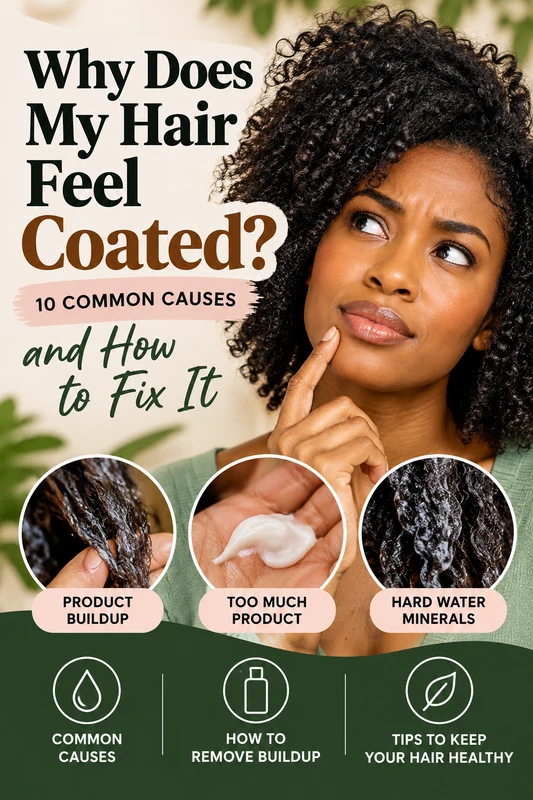
You might even notice that your curls look dull, your natural hair feels heavy, or your usual products no longer seem to work.
This experience is especially frustrating when you have spent time developing a consistent natural hair care routine.
The good news is that coated hair is usually manageable once you identify what is causing the problem.
In many cases, the issue comes down to product buildup, excess oils, hard water minerals, insufficient cleansing, or using products that do not work well together.
However, coated hair does not always mean your hair is dirty. Sometimes, the products you use are simply leaving behind more residue than your hair needs.
Understanding the difference between healthy conditioning and unwanted buildup can help you maintain softer, more manageable natural hair.
In this guide, we will explain why your hair feels coated, how to identify the underlying cause, and what you can do to restore clean, moisturized, healthy-looking curls.
What Does Coated Hair Actually Feel Like?
Coated hair occurs when substances accumulate on the surface of your strands, creating a noticeable film.
Your hair may feel as though something is sitting on top of it rather than absorbing or distributing evenly.
Depending on the cause, the coating may feel oily, waxy, sticky, slippery, or unusually stiff.
Common signs include:
-
Hair feels greasy immediately after washing.
-
Curls appear dull instead of naturally shiny.
-
Strands feel slippery even after rinsing thoroughly.
-
Hair feels dry underneath a layer of oil.
-
Styling products stop working as expected.
-
Your roots feel heavy or weighed down.
-
Hair takes longer than usual to become fully wet.
-
Your curls lose definition or appear limp.
-
Your scalp develops visible residue.
-
Your fingers feel oily or waxy after touching your hair.
For people with tightly coiled natural hair, buildup can sometimes make strands feel unusually rough or difficult to detangle.
Interestingly, coated hair can feel greasy and dry at the same time.
This happens because an oily surface does not necessarily mean your hair has adequate moisture.
Hair needs appropriate cleansing, conditioning, and protection to maintain softness and flexibility.
1. Too Much Product Buildup
One of the most common reasons your hair feels coated is product buildup.
Every time you apply a leave-in conditioner, styling cream, gel, butter, or oil, some ingredients may remain on your strands.
Many conditioning ingredients are designed to deposit onto the hair surface. This can improve softness, lubrication, and manageability.
However, repeated applications without adequate cleansing may create an excessive layer of residue.
For example, imagine applying a moisturizing cream every morning, adding oil every evening, and refreshing your curls with another styling product throughout the week.
After several days, those layers can accumulate.
Eventually, your hair may feel heavier rather than healthier.
Signs of product buildup
Product buildup commonly causes:
-
Waxy-feeling strands.
-
Reduced curl definition.
-
Dull-looking hair.
-
Hair that feels dirty shortly after washing.
-
Styling products that seem less effective.
-
Excessively heavy roots.
How to fix it
Use a clarifying shampoo when buildup becomes noticeable.
Clarifying shampoos contain cleansing ingredients designed to remove accumulated oils, styling products, and other residues.
After clarifying, follow with a moisturizing conditioner to restore softness and improve manageability.
Avoid immediately applying several heavy products afterward.
Start with a lightweight leave-in conditioner and add additional products only when necessary.
2. Using Too Many Oils and Butters
Natural oils and plant-based butters are popular ingredients in textured hair care.
Shea butter, coconut oil, castor oil, mango butter, and olive oil can help lubricate strands, reduce friction, and improve the way hair feels.
However, using excessive amounts can leave your hair feeling coated.
Heavy oils and butters are particularly noticeable when layered over creams, gels, and leave-in treatments.
Instead of feeling moisturized, your strands may feel greasy, stiff, or weighed down.
Why this happens
Oils primarily provide lubrication and help reduce moisture loss. They do not replace the water-based conditioning your hair may need.
Applying additional oil to hair that already feels dry and coated can sometimes make the problem worse.
Your hair may develop an oily surface while continuing to feel rough underneath.
What to do instead
Apply a water-based moisturizer or leave-in conditioner first.
If your hair benefits from an additional oil or butter, use a small amount and distribute it evenly.
Pay attention to how your hair responds rather than assuming that more product automatically means more moisture.
For finer strands, lightweight oils may be easier to manage than thick layers of castor oil or heavy butter.
3. Your Hair Has Low Porosity
Low-porosity hair is often associated with products sitting on the surface of the strands.
Hair porosity describes how readily hair absorbs and releases water.
Low-porosity hair generally has a cuticle structure that makes water penetration slower under certain conditions.
This can make product application challenging, especially when using rich creams, oils, and butters.
If you repeatedly apply more product because your hair does not immediately feel moisturized, buildup may develop.
However, low porosity does not automatically mean your hair will experience buildup. Product formulation, application amount, cleansing habits, and hair condition also matter.
Signs that your routine may be too heavy
-
Products remain visible on your strands.
-
Your hair takes a long time to become thoroughly wet.
-
Heavy creams make your curls limp.
-
Your hair feels waxy after moisturizing.
-
Multiple products leave a sticky residue.
How to prevent coated low-porosity hair
Try applying lightweight, water-based products to clean, damp hair.
Use smaller quantities and distribute them evenly through individual sections.
Avoid layering several heavy butters and oils during the same styling session.
Occasional clarifying can also help remove accumulated residue.
Remember that a coated feeling alone cannot determine your hair's porosity.
4. Your Shampoo Is Not Removing Enough Residue
Not every shampoo provides the same level of cleansing.
Some moisturizing shampoos are formulated to leave conditioning ingredients behind.
These formulas can be beneficial for dry, textured hair, but they may not always remove heavy styling residue effectively.
If your routine includes pomades, gels, thick creams, and oils, your regular shampoo may not provide enough cleansing for every wash.
Over time, residue may accumulate.
Why your hair feels coated after shampooing
You may notice that your hair feels unusually slippery or heavy immediately after washing.
This could indicate that some residue remains.
It can also mean that your shampoo contains conditioning ingredients that leave a noticeable film.
A conditioned feeling is not automatically a problem, but persistent waxiness, heaviness, or dullness may suggest that your cleansing routine needs adjustment.
The solution
Consider alternating between a gentle moisturizing shampoo and a clarifying shampoo.
For example, you might use your regular shampoo during most wash days and clarify when buildup becomes noticeable.
The ideal frequency depends on your styling habits, scalp condition, and product usage.
Avoid aggressive scrubbing or repeatedly washing your hair until it feels excessively stripped.
The goal is clean, manageable hair, not unnecessary dryness.
5. Hard Water Mineral Buildup
Sometimes, the problem is not your styling products.
It is your water.
Hard water contains elevated concentrations of dissolved minerals, particularly calcium and magnesium.
When you repeatedly wash your hair with hard water, mineral deposits can accumulate on the hair surface.
These deposits may contribute to roughness, dullness, tangling, and changes in how your hair feels.
They may also affect how cleansing products perform.
Signs of hard water buildup
You may experience:
-
Hair that feels rough after washing.
-
Reduced shine.
-
Difficulty distributing conditioner.
-
Hair that tangles more easily.
-
Persistent residue despite regular shampooing.
-
Mineral deposits around faucets and shower fixtures.
These symptoms are not exclusive to hard water, so consider your entire routine before assuming minerals are responsible.
How to remove mineral buildup
A chelating shampoo may help.
Chelating formulas contain ingredients designed to bind certain mineral ions and assist in their removal during cleansing.
Ingredients such as disodium EDTA and tetrasodium EDTA are commonly used for this purpose.
A regular clarifying shampoo may remove styling residue without being equally effective against mineral deposits.
If hard water is a persistent issue, consider testing your water hardness and investigating an appropriate water-treatment system.
6. Applying Too Much Leave-In Conditioner
Leave-in conditioners are valuable for natural hair because they can improve softness, manageability, and detangling.
However, applying too much may create a noticeable coating.
This is particularly common when you reapply leave-in conditioner every day without washing away previous applications.
Your hair may initially feel soft, but repeated layering can eventually create a sticky or heavy texture.
How much leave-in conditioner should you use?
There is no universal amount.
Your ideal quantity depends on hair length, density, texture, and product concentration.
Start with a modest amount and distribute it through damp hair.
Add more only where necessary.
For thick natural hair, sectioning can help distribute the product more evenly without saturating certain areas.
If your hair feels coated after using a leave-in, consider reducing the amount before abandoning the product entirely.
7. Silicone and Conditioning Ingredient Buildup
Silicones are common ingredients in conditioners, serums, and styling products.
They can provide slip, reduce friction, improve shine, and help protect strands from mechanical damage.
However, some silicone-containing products may contribute to buildup when used repeatedly without appropriate cleansing.
Examples of silicone ingredients include dimethicone and amodimethicone.
Not all silicones behave the same way.
Their deposition, water compatibility, and removal depend on their chemical structure and the overall product formulation.
Other conditioning ingredients, including certain polymers and cationic conditioning agents, can also remain on the hair surface.
Therefore, eliminating silicones does not automatically eliminate buildup.
What should you do?
Review your entire hair care routine rather than focusing on a single ingredient.
If you regularly use conditioning serums, creams, and gels, incorporate cleansing products appropriate for removing their residue.
Avoid assuming that every ingredient that forms a film is harmful.
A controlled amount of surface conditioning can actually improve the feel and manageability of natural hair.
The problem develops when the accumulated coating becomes excessive.
8. Not Rinsing Your Conditioner Thoroughly
Another reason your hair feels coated after washing is incomplete rinsing.
Traditional rinse-out conditioners are designed to be removed after the recommended processing time.
Leaving too much behind can create a heavy, slippery, or waxy feeling.
This is especially noticeable when using rich deep conditioners.
How to fix it
Divide thick natural hair into sections while rinsing.
Allow water to flow through each section and gently separate the strands with your fingers.
Pay attention to the crown, roots, and densely packed areas where conditioner may remain.
Follow the product's instructions.
If you want conditioning benefits after washing, use a product specifically formulated as a leave-in treatment instead of intentionally leaving excessive rinse-out conditioner behind.
9. Layering Products That Do Not Work Well Together
Have you ever applied a leave-in conditioner, followed by a styling cream, only to notice white flakes or sticky residue?
This may indicate that your products are not working well together.
Some formulas can form visible clumps, flakes, or films when combined.
This is sometimes called product pilling.
The issue may involve ingredient interactions, excessive product quantities, or applying another formula before the previous layer has distributed properly.
How to test product compatibility
Place a small amount of two styling products in your palm.
Mix them together.
If the mixture develops obvious clumps or an unusual texture, the combination may not perform well on your hair.
However, this test is not definitive because products may behave differently when diluted and distributed through damp strands.
Try simplifying your routine.
Use one leave-in conditioner and one styling product instead of combining several creams, gels, and oils.
If your hair feels better, gradually introduce additional products only when necessary.
10. Environmental Residue and Sweat
Your hair is exposed to environmental substances every day.
Dust, airborne particles, sweat, sebum, and styling residue can accumulate between wash days.
This is especially relevant if you exercise regularly, wear hats frequently, or go extended periods without cleansing.
Sweat itself does not necessarily create a waxy coating, but dried sweat and accumulated oils can contribute to an uncomfortable scalp and changes in how your hair feels.
What helps?
Maintain a cleansing schedule appropriate for your scalp and lifestyle.
If you exercise frequently, you may need to adjust your wash routine.
Avoid automatically adding more oil or moisturizer whenever your hair feels uncomfortable.
Sometimes, your strands need cleansing rather than another layer of product.
Why Does My Hair Feel Coated but Dry?
One of the most confusing natural hair problems is experiencing dryness and greasiness simultaneously.
You touch your hair and notice an oily film, yet your strands still feel stiff, rough, or brittle.
This happens because surface lubrication and internal hair hydration are different.
Oil can make hair feel slippery without necessarily addressing the underlying reason it feels dry.
Additionally, excessive residue may interfere with how new products spread across your strands.
Common causes include:
-
Applying oil without adequate water-based conditioning.
-
Using excessive styling products.
-
Washing too infrequently for your product routine.
-
Environmental damage.
-
Hard water deposits.
-
Using products that are too heavy for your strands.
The solution is not necessarily to stop using oils.
Instead, focus on establishing a balance between cleansing, conditioning, and product application.
For many people, simplifying their routine provides noticeable improvements.
How to Remove the Coated Feeling From Natural Hair
If your hair currently feels waxy, greasy, or unusually heavy, follow this practical reset routine.

Step 1: Cleanse thoroughly
Wet your hair completely and apply an appropriate clarifying shampoo. Massage the scalp gently and distribute the cleanser through your strands. Rinse thoroughly.

Step 2: Restore softness with conditioner
Apply a moisturizing rinse-out conditioner. Concentrate on your lengths and ends, detangle gently, and rinse according to the instructions.

Step 3: Apply a lightweight leave-in
Use a moderate amount of leave-in conditioner on damp hair. Work in sections to ensure even coverage.

Step 4: Simplify styling
Choose one additional styling product if needed. Avoid immediately layering multiple heavy oils, creams, and butters.

Step 5: Monitor your hair
Observe how your strands feel over the following days. If the coating returns quickly, evaluate your application amounts and product combinations.
How Often Should You Clarify Natural Hair?
Clarifying frequency depends on your hair care habits.
Someone who regularly uses heavy pomades, styling gels, and oils may need more frequent clarification than someone using only a lightweight leave-in conditioner.
Here is a general starting point:
|
Hair care routine |
Potential clarifying frequency |
|---|---|
|
Heavy product usage |
Every 2–4 weeks |
|
Moderate product usage |
Every 4–6 weeks |
|
Minimal styling products |
As needed |
|
Persistent hard water issues |
Use appropriate chelating care when needed |
|
Hair prone to dryness |
Clarify when buildup warrants it and condition afterward |
These are guidelines, not strict rules.
Pay attention to how your hair and scalp respond.
If your hair feels excessively stripped after clarifying, reduce the frequency or consider a gentler formula.
If you experience persistent scalp irritation, scaling, or unusual hair loss, consult a dermatologist rather than repeatedly using stronger shampoos.
How to Prevent Product Buildup on Natural Hair
Preventing buildup is usually easier than repeatedly trying to remove it.
A consistent routine can help maintain soft, manageable hair without unnecessary product layering.
Use fewer products
You do not need six different moisturizing products during every styling session.
A shampoo, conditioner, leave-in treatment, and appropriate styling product may be enough.
Avoid applying oil automatically
Before adding oil, determine what your hair actually needs.
If it feels dirty, heavy, or waxy, cleansing may be more helpful.
Apply products to damp hair
Many water-based leave-in conditioners distribute more easily through damp strands.
This can help prevent concentrated patches of product.
Maintain a consistent wash schedule
Do not wait until your hair becomes severely coated before washing it.
Choose a routine based on your scalp, lifestyle, and styling habits.
Pay attention to your ends
The ends of your hair are older and often require additional conditioning.
However, coating them with excessive butter or oil may leave them heavy without addressing damage.
Gentle handling, conditioning, and appropriate trimming remain important.
Choosing the Right Moisturizing Products for Natural Hair
If you frequently experience buildup, consider choosing products based on your hair's needs rather than simply selecting the thickest formula available.
Fine natural hair may respond well to lightweight leave-in conditioners and moderate styling product quantities.
Coarse or highly textured hair may benefit from richer conditioning formulas, but application amounts still matter.
Your hair's porosity, density, styling preferences, and cleansing schedule should all influence your routine.
Support your routine with Hairobics All Natural
Hairobics Leave-In Treatment
A leave-in treatment can be incorporated into your routine after cleansing and conditioning to help maintain softness and manageability. Apply evenly to damp hair and adjust the amount according to your hair's needs.
Explore natural hair care products at Hairobics All Natural.
Remember that even beneficial moisturizing products should be used in appropriate amounts.
Healthy natural hair care is about consistency and balance, not applying as much product as possible.
Frequently Asked Questions About Coated Hair
Why does my hair feel coated after washing?
Your hair may feel coated after washing because your shampoo did not fully remove accumulated styling products, your conditioner was not thoroughly rinsed, or your water contains mineral deposits.
Try evaluating your cleansing routine and consider occasional clarification when necessary.
Why does my natural hair feel waxy?
A waxy feeling commonly results from accumulated oils, butters, pomades, styling creams, or conditioning ingredients.
Hard water deposits and insufficient cleansing may also contribute.
Can too much conditioner make hair feel coated?
Yes. Applying excessive conditioner, particularly rich formulas, can leave your strands feeling heavy or slippery.
Rinse traditional conditioners thoroughly and use moderate quantities of leave-in treatments.
Why does my hair feel greasy but still dry?
Surface oil does not necessarily indicate adequate hydration.
Your hair may have accumulated oils while still needing appropriate cleansing and water-based conditioning.
Does low-porosity hair get product buildup more easily?
Some people with low-porosity hair notice that rich products remain on the surface and create a coated feeling.
However, buildup depends on multiple factors, including product formulation, application quantity, and cleansing habits.
Will clarifying shampoo remove a waxy coating?
Clarifying shampoo can help remove many types of styling residue, excess oils, and accumulated conditioning products.
If mineral deposits are responsible, a chelating shampoo may be more appropriate.
Can I remove buildup with apple cider vinegar?
Diluted apple cider vinegar is sometimes used in hair care, but it is not a reliable replacement for a properly formulated clarifying or chelating shampoo.
Its acidity can also irritate the scalp, especially when used at inappropriate concentrations.
Choose cleansing products specifically formulated for hair instead.
Why does my hair feel coated after using coconut oil?
Coconut oil may leave a noticeable oily film when applied excessively or layered with other rich products.
Try using less, distributing it more evenly, or adjusting how frequently you apply it.
Does coated hair mean my hair is damaged?
Not necessarily.
A coated feeling often indicates residue rather than structural damage.
However, if your hair remains unusually rough, brittle, or difficult to manage after appropriate cleansing and conditioning, consider other possible causes.
Can product buildup stop hair growth?
Product buildup does not automatically stop hair from growing.
However, excessive residue may contribute to scalp discomfort or interfere with your normal cleansing routine.
Persistent itching, inflammation, or unusual shedding deserves professional evaluation.
Final Thoughts: How to Keep Natural Hair Soft Without Feeling Coated
If you have been asking yourself, "Why does my hair feel coated?" the answer often involves excess product buildup, heavy oils, insufficient cleansing, hard water minerals, or an overly complicated moisturizing routine.
Your natural hair does not need to feel greasy or covered in product to remain moisturized.
The goal is to maintain clean strands, appropriate conditioning, and enough lubrication to support comfortable styling and reduce unnecessary friction.
Start by simplifying your routine, using the right shampoo for your product habits, and applying moisturizers in moderate amounts.
Most importantly, pay attention to how your hair responds.
When you find the right balance between cleansing and conditioning, your curls can feel softer, lighter, and easier to manage without constantly adding more products.
Discover more natural hair care tips and explore moisturizing products at Hairobics All Natural .