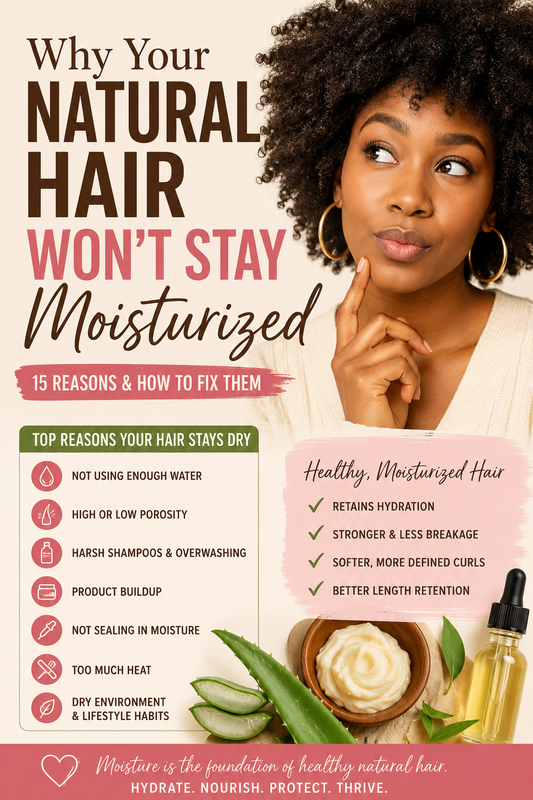
If you've ever spent 30 minutes moisturizing your natural hair only for it to feel dry again by lunchtime, you're not alone. It's one of the biggest frustrations among people with natural hair, especially those with tightly coiled, kinky, and 4C textures.
The good news is that your hair isn't "broken." In most cases, your hair can stay moisturized—you simply need to identify what's preventing it from holding onto moisture.
Many people believe dry hair is caused by not applying enough products. While that's sometimes true, the real issue usually goes much deeper. Hair porosity, damaged cuticles, product buildup, harsh shampoos, environmental conditions, and even your styling routine all play a role in how long your hair retains moisture.
Understanding these factors can completely change the way you care for your hair.
Why Natural Hair Gets Dry Faster
Natural hair has a unique curl pattern that makes it more vulnerable to dryness than straight hair.
Straight hair allows natural scalp oils (sebum) to travel easily from the roots to the ends. Every bend, twist, and coil in curly hair creates another obstacle that slows down this movement.
The tighter the curl pattern, the harder it becomes for those oils to coat the hair shaft naturally.
That's why many people with:
- 3C hair
- 4A hair
- 4B hair
- 4C hair
- Coily hair
- Afro-textured hair
find themselves needing additional moisture throughout the week.
Dryness doesn't necessarily mean your hair is unhealthy—it simply means your hair requires a different care routine than straighter textures.
Moisture vs. Hydration: They're Not the Same
One of the biggest misconceptions in natural hair care is confusing hydration with moisture.
Hydration refers to the amount of water inside the hair strand.
Moisture refers to keeping that water inside the strand long enough for the hair to remain soft and flexible.
Think of it like a sponge.
A sponge soaked with water is hydrated.
If you leave it in the sun, the water evaporates.
Now the sponge becomes dry.
Hair behaves the same way.
Your routine shouldn't focus only on adding water—it should also focus on preventing water from escaping.
Signs Your Hair Isn't Holding Moisture
Your hair may not be retaining moisture if you notice these symptoms:
- Hair feels dry a few hours after moisturizing
- Constant breakage
- Split ends
- Rough texture
- Hair appears dull instead of shiny
- Ends tangle easily
- Increased single-strand knots
- Frizz immediately after styling
- Hair snaps instead of stretching
- Difficulty detangling
Many people mistake these signs for slow hair growth when the real issue is excessive moisture loss leading to breakage.
15 Reasons Your Natural Hair Won't Stay Moisturized
1. You're Not Using Enough Water
Many people spray oil directly onto dry hair.
Oil alone cannot moisturize hair.
Oil simply slows moisture loss.
Water is the true moisturizer.
If your hair is already dry before applying products, you're sealing in dryness instead of hydration.
Fix
Begin every moisturizing session with:
- Water
- Water-based leave-in conditioner
- Moisturizing spray
Then seal everything with an oil or butter.
2. Your Hair Has High Porosity
High-porosity hair loses moisture very quickly.
The cuticle layer remains lifted, allowing water to escape almost as fast as it enters.
High-porosity hair often develops after:
- Heat damage
- Hair coloring
- Relaxers
- Frequent bleaching
- Excessive manipulation
Signs of High Porosity
- Hair dries very fast
- Products absorb immediately
- Hair feels dry within hours
- Frizz develops easily
- Hair tangles frequently
How to Help
Use richer moisturizers containing:
- Shea butter
- Aloe vera
- Avocado oil
- Coconut oil (if it works well for your hair)
- Castor oil
Finish with a sealing oil to reduce moisture loss.
3. Your Hair Has Low Porosity
Low-porosity hair struggles with the opposite problem.
Water has difficulty entering the hair strand.
Heavy creams simply sit on top.
Many people mistake this for dryness when their hair actually needs better absorption.
Signs
- Products sit on hair
- Hair takes hours to become wet
- Water beads on the surface
- Hair dries slowly
- Heavy buildup develops quickly
Best Solution
Use:
- Warm water
- Steam treatments
- Lightweight leave-ins
- Liquid-based moisturizers
Avoid layering thick butters repeatedly.
4. You're Washing Too Often
Every shampoo removes dirt—but it also removes protective oils.
If you're shampooing every day or every other day, your hair may never have time to rebuild its natural moisture balance.
Better Routine
For many natural hair types:
- Shampoo every 1–2 weeks.
- Co-wash between washes if needed.
- Follow every cleansing session with a deep conditioner.
Consistency is more important than frequent washing.
5. Product Buildup Is Blocking Moisture
Sometimes your hair isn't dry because it lacks products.
It's dry because old products are preventing water from entering the hair shaft.
Heavy layers of:
- Oils
- Waxes
- Silicones
- Butters
can create a barrier that repels water.
Signs
- Hair feels coated
- Products stop working
- Hair looks dull
- Moisturizers sit on top
Clarifying your hair occasionally can restore its ability to absorb moisture.
6. You're Skipping Deep Conditioning
Daily moisturizers only work on the surface.
Deep conditioners penetrate deeper into the hair strand, improving elasticity, softness, and moisture retention over time.
Aim to deep condition at least every one to two weeks, especially if your hair is color-treated, heat-styled, or naturally prone to dryness.
7. You're Using the Wrong Shampoo
Not all shampoos are created equal. Some are formulated to remove heavy product buildup, while others are designed to cleanse gently without stripping the hair.
Shampoos that contain harsh cleansing agents can remove too much of your scalp's natural oils, leaving your hair feeling squeaky clean—but also dry and brittle.
Signs Your Shampoo Is Too Harsh
- Hair feels rough immediately after washing
- Scalp becomes itchy within a day or two
- Hair tangles excessively after shampooing
- You need large amounts of leave-in conditioner just to soften your hair
How to Fix It
Choose a sulfate-free, moisturizing shampoo that cleanses without removing all of your hair's natural oils. Reserve clarifying shampoos for occasional use—about once a month or whenever you notice heavy buildup.
8. You're Not Sealing in Moisture
Adding moisture is only half the process. If you don't lock it in, water quickly evaporates from the hair shaft.
Many people stop after applying a leave-in conditioner, expecting it to last for days. Unfortunately, without a sealant, moisture escapes much faster.
Good Sealants Include
- Shea butter
- Jamaican black castor oil
- Avocado oil
- Grapeseed oil
- Jojoba oil
- Mango butter
The best sealant depends on your hair's porosity. High-porosity hair often benefits from richer oils and butters, while low-porosity hair usually responds better to lighter oils.
9. You're Using Too Much Heat
Heat styling may create beautiful results temporarily, but frequent exposure weakens the hair's protective cuticle.
Over time, excessive heat can permanently alter the hair structure, making it much harder for your strands to retain moisture.
Common Heat Sources
- Flat irons
- Blow dryers
- Curling irons
- Hot combs
- Heated brushes
Protect Your Hair
If you use heat:
- Always apply a heat protectant.
- Use the lowest effective temperature.
- Limit heat styling to occasional use.
- Incorporate regular deep conditioning treatments.
10. Your Ends Need Attention
The oldest part of your hair is the ends. They've experienced the most washing, styling, detangling, and environmental exposure.
Because of this, the ends usually become dry first.
Many people continue moisturizing the entire strand while ignoring damaged ends that can no longer retain moisture effectively.
How to Care for Your Ends
- Trim split ends regularly.
- Seal ends with a lightweight oil or butter.
- Keep ends tucked away in protective styles.
- Sleep with satin or silk protection.
Healthy ends make your entire head of hair appear more moisturized.
11. You're Over-Manipulating Your Hair
Every time you brush, comb, finger-detangle, or restyle your hair, you disturb the cuticle.
Excessive manipulation can lead to:
- Frizz
- Breakage
- Moisture loss
- Split ends
Reduce Daily Manipulation
Instead of styling your hair every day:
- Wear protective styles.
- Refresh curls with a moisturizing spray.
- Finger-style when possible.
- Limit unnecessary brushing.
The less your hair is disturbed, the longer it can retain moisture.
12. Your Environment Is Dry
Your surroundings have a significant impact on your hair.
Low humidity allows moisture to evaporate quickly from the hair shaft.
Common causes include:
- Winter weather
- Air conditioning
- Indoor heating
- Desert climates
- Long hours in the sun
Protect Against Environmental Dryness
- Wear hats or scarves outdoors.
- Increase deep conditioning during winter.
- Use a moisturizing spray between wash days.
- Avoid sitting directly under heating vents.
13. You're Sleeping on Cotton Pillowcases
Cotton absorbs moisture—not just from your skin, but from your hair as well.
After spending time moisturizing your hair before bed, a cotton pillowcase can undo much of that work overnight.
Better Options
Switch to:
- Satin pillowcases
- Silk pillowcases
- Satin bonnets
- Silk scarves
These smoother fabrics reduce friction while helping preserve moisture.
14. You're Ignoring Protein Balance
Hair needs both moisture and protein.
Too much protein can make hair stiff.
Too little protein can leave hair weak and unable to hold moisture effectively.
Signs of Protein Overload
- Hair feels hard
- Hair snaps easily
- Hair lacks flexibility
Signs You Need Protein
- Hair feels mushy when wet
- Hair stretches excessively before breaking
- Curls lose definition
- Breakage increases
Finding the right balance between moisture and protein is essential for healthy hair.
15. You're Expecting Products to Do Everything
Many people purchase product after product hoping to solve dryness.
However, no moisturizer can compensate for poor hair care habits.
Healthy moisture retention comes from combining:
- Proper cleansing
- Conditioning
- Sealing
- Gentle styling
- Healthy trimming
- Consistent routines
Products support your routine—they don't replace it.
Best Ingredients for Moisturized Natural Hair
When reading ingredient labels, look for ingredients that attract and retain moisture.
Humectants
These attract water to the hair.
Examples include:
- Aloe vera
- Vegetable glycerin
- Honey
- Panthenol
- Sodium PCA
Emollients
These soften and smooth the hair.
Examples include:
- Shea butter
- Cocoa butter
- Mango butter
- Avocado oil
- Olive oil
Occlusives
These slow moisture loss.
Examples include:
- Castor oil
- Jojoba oil
- Sunflower oil
- Grapeseed oil
Using products that combine humectants, emollients, and occlusives creates a balanced routine for lasting moisture.
Ingredients to Limit If Your Hair Is Always Dry
Some ingredients may contribute to dryness or buildup for certain hair types.
Consider limiting:
- High concentrations of drying alcohols
- Heavy waxes
- Excessive mineral oil (if it causes buildup for your hair)
- Strong sulfates in frequent-use shampoos
Pay attention to how your own hair responds rather than assuming one ingredient works the same for everyone.
The Ultimate Weekly Moisture Routine for Natural Hair
One of the biggest secrets to healthy natural hair isn't finding the "perfect" product—it's following a consistent routine. Hair thrives on regular care, and even the best moisturizer won't deliver lasting results if your routine is inconsistent.
The following routine works well for many people with natural, curly, coily, and 4C hair. Adjust the frequency based on your hair's needs, lifestyle, and porosity.
Wash Day (Every 7–14 Days)
Wash day lays the foundation for moisture retention.
Step 1: Detangle Before Washing
Separate your hair into 4–8 sections. Apply a conditioner or detangling product to each section and gently finger-detangle before using a wide-tooth comb.
This helps minimize breakage and makes shampooing easier.
Step 2: Cleanse the Scalp
Focus shampoo on your scalp rather than the full length of your hair.
As you rinse, the shampoo will naturally clean the strands without stripping unnecessary moisture.
Step 3: Deep Condition
Apply a moisturizing deep conditioner generously from roots to ends.
For even better results:
- Cover your hair with a plastic cap.
- Leave it on for 20–30 minutes.
- Use gentle heat or steam if desired.
- Rinse with cool or lukewarm water to help smooth the cuticle.
Deep conditioning replenishes moisture, improves softness, and boosts elasticity.
Moisturizing After Washing
Immediately after washing is the best time to lock in hydration.
Follow these steps:
Step 1: Apply Water
Your hair should remain damp—not dripping wet.
Water is the foundation of moisture.
Step 2: Apply a Leave-In Conditioner
Use a lightweight, water-based leave-in conditioner to coat each section evenly.
Step 3: Seal the Moisture
Follow with a lightweight oil or butter, depending on your hair type.
This final step helps reduce moisture loss and keeps your hair softer for longer.
The LOC and LCO Methods
Two popular methods help maximize moisture retention.
LOC Method
- L – Liquid (water or leave-in)
- O – Oil
- C – Cream
This method often works well for high-porosity hair because the oil helps slow moisture loss before the cream adds additional softness.
LCO Method
- L – Liquid
- C – Cream
- O – Oil
Some people with low-porosity hair prefer this method because the cream absorbs more easily before a light oil seals everything in.
There is no universal "best" method. Experiment to see which one your hair responds to best.
Refreshing Your Hair Between Wash Days
Many people make the mistake of adding heavy creams every day.
Instead, refresh moisture with light layers.
A simple refresh routine:
- Lightly mist hair with water or a moisturizing spray.
- Apply a small amount of leave-in conditioner if needed.
- Seal dry areas with a few drops of oil.
- Avoid reapplying heavy creams unless necessary.
This helps prevent buildup while maintaining hydration.
Protective Styles That Help Retain Moisture
Protective styles reduce daily manipulation and help preserve moisture.
Some excellent options include:
- Two-strand twists
- Flat twists
- Loose braids
- Cornrows
- Bantu knots
- Low buns
- Halo braids
Remember that a protective style only protects your hair if you continue moisturizing your scalp and strands.
Hairstyles That May Increase Dryness
Certain styles can contribute to moisture loss if worn too often.
Examples include:
- Tight ponytails
- Tight buns
- Excessively tight braids
- Tight sew-ins
- Styles with frequent brushing
Excessive tension can lead to breakage and make it harder for your hair to retain moisture.
Common Moisture Mistakes
Even experienced naturals sometimes make these mistakes.
Applying Oil to Dry Hair
Oil seals—it doesn't hydrate.
Always add water first.
Using Too Much Product
More isn't always better.
Applying multiple heavy creams can cause buildup that blocks moisture instead of improving it.
Constantly Touching Your Hair
Frequent manipulation lifts the cuticle and increases frizz.
The less you disturb your curls, the longer they stay moisturized.
Ignoring Your Scalp
Healthy hair begins with a healthy scalp.
A dry, irritated scalp can affect overall hair health and make moisturizing more challenging.
Keep your scalp clean and moisturized without overloading it with product.
Waiting Until Hair Feels Dry
Don't wait until your hair becomes extremely dry before moisturizing.
Refreshing moisture before your hair reaches that point is often more effective.
Seasonal Moisture Tips
Winter
Cold temperatures and indoor heating can pull moisture from your hair.
During winter:
- Deep condition more often.
- Wear satin-lined hats when possible.
- Seal moisture with slightly richer products.
- Reduce heat styling.
Summer
Sun, chlorine, and salt water can dry the hair.
Protect your hair by:
- Wearing protective styles.
- Rinsing hair after swimming.
- Using leave-in conditioner before outdoor activities.
- Covering hair with a hat or scarf during extended sun exposure.
Fall
As humidity drops, gradually increase moisture treatments.
This is also a great time to trim damaged ends before winter.
Spring
Spring is ideal for clarifying your hair, resetting your routine, and addressing any buildup accumulated during colder months.
How Hairobics Products Can Support a Moisture Routine
A moisture routine works best when products complement each other rather than replace healthy habits.
For example:
- A gentle shampoo helps cleanse without stripping the hair.
- A moisturizing leave-in conditioner provides hydration after washing.
- A nourishing scalp oil can help maintain a healthy scalp and seal in moisture.
- A lightweight moisturizing spray is useful for refreshing curls, coils, braids, and locs between wash days.
Using products consistently as part of a balanced routine can help improve moisture retention over time.
Frequently Asked Questions
Why does my natural hair feel dry right after I moisturize it?
If your hair feels dry shortly after moisturizing, the issue usually isn't that you're using too little product. Common causes include:
- High-porosity hair losing moisture quickly
- Product buildup preventing water absorption
- Not sealing moisture after applying a leave-in conditioner
- Heat damage or chemical damage
- Environmental dryness
Start with water, use a water-based leave-in conditioner, and then seal with an oil or butter appropriate for your hair type.
How often should I moisturize natural hair?
There isn't one schedule that works for everyone.
Many people with natural hair find success moisturizing every 2–4 days, while others may only need to refresh once or twice a week. Your routine should depend on:
- Hair porosity
- Climate
- Protective style
- Activity level
- Product choice
Instead of following a strict calendar, pay attention to how your hair feels.
Is water really the best moisturizer?
Yes. Water is the primary source of hydration for hair.
Products such as leave-in conditioners, creams, and oils help retain that hydration, but they don't replace water.
That's why applying oils to completely dry hair usually doesn't solve dryness.
Why does my 4C hair stay dry?
4C hair has the tightest curl pattern, making it harder for natural scalp oils to travel from the roots to the ends.
This doesn't mean 4C hair is unhealthy—it simply requires:
- Consistent hydration
- Gentle handling
- Deep conditioning
- Moisture-sealing products
- Protective styling
With the right routine, 4C hair can remain soft, healthy, and manageable.
Can I moisturize my hair every day?
It depends.
Daily moisturizing isn't necessary for everyone and may lead to product buildup if heavy creams are applied repeatedly.
If your hair needs a daily refresh, use a light water mist or moisturizing spray instead of layering thick products every day.
Which oils help lock in moisture?
Many natural oils can help slow moisture loss.
Popular choices include:
- Jojoba oil
- Avocado oil
- Grapeseed oil
- Jamaican black castor oil
- Sunflower oil
Remember, oils work best after you've added water or a water-based moisturizer.
Does trimming help hair stay moisturized?
Yes.
Split ends become rough and porous, allowing moisture to escape more easily. Regular trims remove damaged ends and make it easier for your hair to retain moisture.
Quick Troubleshooting Guide
| Problem | Possible Cause | Solution |
|---|---|---|
| Hair dries within hours | High porosity | Deep condition regularly and seal with oil |
| Products sit on hair | Low porosity | Use warm water, steam, and lightweight products |
| Hair feels rough | Protein imbalance or dryness | Increase moisture treatments and reassess protein use |
| Hair feels greasy but dry | Too much oil, not enough water | Hydrate first, then seal lightly |
| Constant breakage | Moisture loss and weak ends | Trim damaged ends and deep condition consistently |
| Flaky scalp | Dry scalp or product buildup | Cleanse regularly and moisturize the scalp appropriately |
| Hair won't grow long | Breakage exceeding growth | Reduce manipulation and improve moisture retention |
Moisture Retention Checklist
Use this checklist each week to stay on track:
✅ Shampoo with a gentle cleanser every 1–2 weeks.
✅ Deep condition after every wash.
✅ Apply products to damp hair.
✅ Use a water-based leave-in conditioner.
✅ Seal moisture with an appropriate oil or butter.
✅ Sleep with a satin bonnet or satin pillowcase.
✅ Avoid excessive heat styling.
✅ Minimize daily manipulation.
✅ Trim damaged ends regularly.
✅ Drink plenty of water and eat a balanced diet that supports healthy hair.
Consistency—not perfection—is what delivers lasting results.
Internal Linking Suggestions for HairobicsAllNatural.com
To strengthen your site's SEO and keep visitors engaged, link this article to related posts such as:
- Why Black Hair Needs More Moisture
- Best Nighttime Hairstyles for Black Hair
- How to Increase Hair Elasticity
- Why Your Hair Feels Greasy but Dry
- How to Fix Hair That Won't Grow Past Shoulder Length
- The Science Behind Afro Hair Texture
- Why Black Hair Shrinks So Much
- Best Oils for Winter Hair Care
- Summer Hair Routine for Natural Hair
- How to Keep Hair Healthy Under Hats
These internal links help search engines understand your site's topical authority while encouraging readers to explore more of your content.
Key Takeaways
If your natural hair won't stay moisturized, the solution isn't usually buying more products. Instead, focus on understanding your hair's needs and building a routine that supports long-term moisture retention.
Remember these essentials:
- Hydration starts with water.
- Seal moisture after applying a leave-in conditioner.
- Deep condition consistently.
- Use products that match your hair's porosity.
- Protect your hair while you sleep.
- Reduce heat and unnecessary manipulation.
- Keep your ends healthy with regular trims.
- Stay consistent with your routine.
Over time, these habits can transform dry, brittle strands into hair that feels softer, stronger, and easier to manage.
Final Thoughts
Natural hair is beautifully unique, and because of its curls and coils, it naturally requires more intentional moisture care than straighter hair types. If your hair has been struggling to stay hydrated, don't get discouraged. Small changes—like moisturizing with water first, choosing the right products for your porosity, deep conditioning regularly, and protecting your hair at night—can make a noticeable difference over time.
Healthy, moisturized hair isn't achieved overnight, but with patience and consistency, you'll likely experience less breakage, improved elasticity, better length retention, and curls that look and feel their best.
Whether you wear wash-and-gos, twists, braids, locs, or protective styles, building a moisture-focused routine is one of the best investments you can make in your natural hair journey.