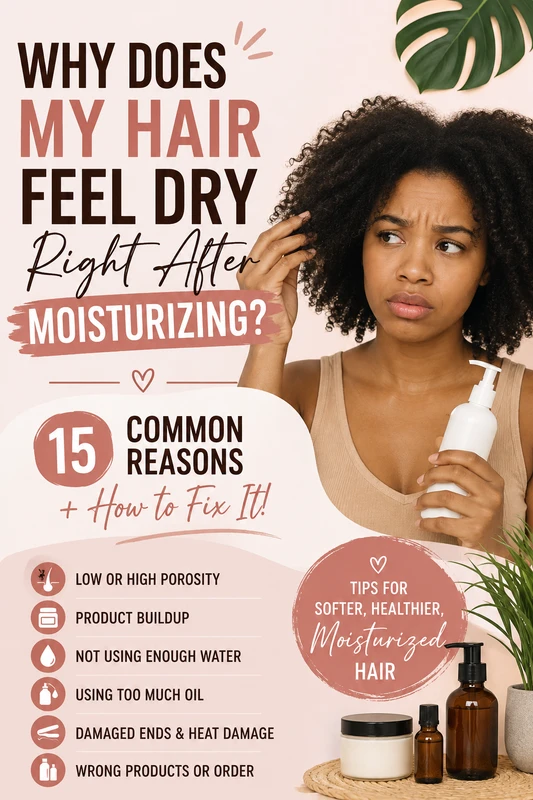
You just finished moisturizing your hair. You applied water, leave-in conditioner, cream, oil, or your favorite moisturizing products. For a few minutes, your hair may have felt soft and hydrated. But shortly afterward, you touched your hair again and wondered:
Why does my hair feel dry right after moisturizing?
This is an extremely frustrating problem, especially for people with natural, curly, coily, kinky, or textured hair. You may feel like your hair is "drinking up" every product you apply without actually becoming softer.
The good news is that dry-feeling hair after moisturizing doesn't necessarily mean you need to keep piling on more products.
Your hair may be having trouble absorbing moisture, retaining moisture, or maintaining the proper balance between water, conditioning ingredients, oils, and proteins.
Everything from your hair's porosity and product buildup to hard water and damaged ends can affect how moisturized your hair feels.
In this complete guide, we'll explain why your hair feels dry right after moisturizing, how to determine what's causing it, and what you can do to keep your hair softer and hydrated for longer.
Why Does My Hair Feel Dry Even After I Moisturize It?
Hair can feel dry immediately after moisturizing when the moisture isn't penetrating or staying inside the hair shaft effectively.
Some of the most common causes include:
- Low-porosity hair
- High-porosity or damaged hair
- Product buildup
- Using too much oil
- Not using enough water
- Applying products in the wrong order
- Protein overload
- Hard water buildup
- Using products that aren't right for your hair
- Damaged or split ends
- Overwashing
- Using harsh shampoos
- Heat damage
- Environmental conditions
- Not sealing moisture properly
Understanding which problem applies to your hair is important because simply applying more moisturizer isn't always the solution.
In some cases, adding more product can actually make the problem worse.
1. Your Hair May Have Low Porosity
Hair porosity describes how easily your hair absorbs and retains moisture.
Low-porosity hair has tightly packed cuticle layers. Because these layers lie relatively flat, water and hair products may have difficulty penetrating the hair shaft.
This can create a frustrating situation where you apply plenty of moisturizer, yet your hair still feels dry.
You may even notice products sitting on top of your strands.
Signs of low-porosity hair may include:
- Water beads on the hair instead of absorbing quickly.
- Products seem to sit on the surface.
- Hair takes a long time to become completely wet.
- Hair takes a long time to dry.
- Heavy creams leave your hair coated.
- Oils make your hair greasy without making it softer.
If you have low-porosity hair, continuously adding thick products may not solve the problem.
What to do instead
Try applying your moisturizing products while your hair is damp and warm.
Warm water can help make your moisturizing routine more effective. Lightweight, water-based leave-in products may also work better than extremely thick butters and creams.
Apply a small amount of product at a time and work it thoroughly through your hair.
More product doesn't automatically mean more moisture.
2. Your Hair May Be High Porosity
Low porosity isn't the only porosity issue associated with dryness.
High-porosity hair can have the opposite problem.
Instead of having difficulty absorbing water, high-porosity hair may absorb moisture relatively quickly but lose it just as quickly.
The cuticle can be more raised or damaged, making it difficult for the hair to retain moisture.
This is common in hair that has experienced:
- Bleaching
- Permanent coloring
- Relaxers
- Excessive heat
- Chemical treatments
- Mechanical damage
- Environmental damage
You may moisturize your hair and initially think:
"Wow, my hair feels amazing."
Then an hour or two later, it feels dry again.
How to help high-porosity hair
High-porosity hair often benefits from a routine that combines hydration, conditioning, strengthening, and sealing.
After applying a water-based moisturizer or leave-in conditioner, you may use a cream or small amount of oil to help reduce moisture loss.
Regular deep conditioning can also be beneficial.
If your hair is significantly damaged, protein-containing products may temporarily improve its strength and feel. However, protein should be used according to your hair's needs rather than automatically added to every wash day.
3. You're Putting Oil on Dry Hair
One of the biggest misconceptions in natural hair care is that oil and moisture are the same thing.
They aren't.
Water provides hydration. Oil does not replace water.
Natural oils can be useful in a hair-care routine, but covering extremely dry hair with oil won't necessarily hydrate it.
Imagine putting oil over a completely dry sponge.
The sponge is still dry underneath.
The same basic concept applies to your hair.
If your routine consists of applying oils to dry hair without first introducing water or a water-based moisturizing product, your strands may continue feeling dry.
Try this instead
Start with:
Water or a water-based leave-in → moisturizing cream if needed → small amount of oil if desired.
Your exact routine will depend on your hair.
Some people need all three steps.
Others may only need water and a good leave-in conditioner.
4. You're Not Using Enough Water
Take a look at your moisturizing routine.
How much actual water is involved?
Some people attempt to moisturize dry natural hair by applying creams, butters, pomades, and oils without introducing much water.
That can leave hair coated rather than hydrated.
Water is fundamental to hair hydration.
If your hair feels dry shortly after applying products, try lightly misting it with water before applying your leave-in or moisturizer.
Your hair doesn't necessarily need to be soaking wet.
Slightly damp hair may be enough for refreshing between wash days.
5. Product Buildup Is Blocking Moisture
This is one of the most overlooked reasons moisturized hair continues feeling dry.
If you regularly use:
- Heavy creams
- Butters
- Oils
- Gels
- Edge controls
- Pomades
- Silicone-heavy products
- Styling products
your strands can eventually accumulate residue.
When enough buildup develops, water and conditioning ingredients may not interact with your hair as effectively.
You might respond by adding even more products.
Unfortunately, this can create a cycle:
Hair feels dry → add product → more buildup → hair feels coated and dry → add more product.
Sometimes your hair doesn't need another moisturizing product.
It needs to be thoroughly cleansed.
Signs of product buildup
Your hair may:
- Feel waxy
- Feel greasy and dry simultaneously
- Look dull
- Feel unusually heavy
- Stop responding to products that previously worked
- Have visible residue
- Become difficult to wet thoroughly
- Feel coated after washing
A good clarifying shampoo can periodically remove stubborn buildup.
However, clarifying shampoos can be stronger than regular cleansers, so frequency should depend on your products, scalp, hair condition, and washing routine.
Follow cleansing with conditioner or deep conditioner as appropriate.
6. You Could Have Hard Water Buildup
Sometimes your products aren't the main problem.
Your water could be contributing.
Hard water contains higher concentrations of minerals such as calcium and magnesium. Over time, mineral deposits can accumulate on the hair.
Hair affected by mineral buildup may feel:
- Rough
- Dry
- Stiff
- Dull
- Tangled
- Difficult to moisturize
You might notice that your normal conditioner suddenly doesn't make your hair as soft as it used to.
If hard water is a significant problem in your home, consider using a shampoo formulated to remove mineral buildup when appropriate.
A regular clarifying shampoo and a chelating shampoo aren't necessarily identical. Chelating products are specifically designed to bind certain mineral deposits.
7. Your Hair Could Have Too Much Protein
Protein treatments can be valuable for damaged or weakened hair.
But more protein isn't always better.
Hair products can contain hydrolyzed proteins and other strengthening ingredients. If your routine becomes too protein-heavy for how your hair responds, your hair may begin feeling stiff, rough, or brittle.
People often mistake this stiffness for ordinary dryness.
Then they continue applying more products without identifying the underlying issue.
Signs your routine may be too protein-heavy
Your hair may feel:
- Unusually hard
- Stiff
- Straw-like
- Rough
- Brittle
- Less flexible than usual
Review your shampoo, conditioner, leave-in, styling cream, and treatment products.
You may discover that several of them contain protein.
Try simplifying your routine and focusing on conditioning and hydration for a period rather than layering multiple strengthening products.
8. Your Moisturizer May Not Be Right for Your Hair
A product labeled "moisturizing" isn't guaranteed to work perfectly for everyone.
Two people with Type 4 hair can have completely different results from the same product.
Why?
Because curl pattern isn't the only characteristic that matters.
Hair also varies by:
- Porosity
- Density
- Strand thickness
- Damage level
- Length
- Scalp condition
- Styling habits
- Climate
- Chemical treatment history
One person may love thick shea-butter creams.
Another person's hair may feel coated and stiff after using them.
One person may love lightweight sprays.
Another may feel like those products disappear within minutes.
Instead of choosing products solely according to curl type, pay attention to how your hair actually responds.
9. You're Applying Too Much Product
This sounds strange.
How could too much moisturizer make hair feel dry?
Because softness and product quantity aren't necessarily proportional.
Overloading your strands with creams, butters, oils, and gels can create buildup and stiffness.
For example, your routine might look like this:
Water.
Leave-in conditioner.
Curl cream.
Butter.
Oil.
Gel.
More oil.
Finishing product.
Your hair may end up heavily coated.
Try simplifying.
You might discover that your hair feels considerably softer with only:
Water + leave-in + styling product.
The goal isn't to use the most products.
It's to find the smallest effective routine that keeps your hair manageable.
10. You're Moisturizing Hair That Needs to Be Washed
There comes a point when refreshing isn't enough.
If you've repeatedly moisturized your hair for days or weeks without properly cleansing it, the strands may become coated with:
- Sweat
- Sebum
- Styling products
- Oils
- Environmental debris
Adding another layer of moisturizer won't necessarily help.
It may be wash day.
Cleansing creates a fresh foundation so water and conditioning products can interact more effectively with your strands.
11. Your Shampoo May Be Too Harsh
Cleansing is necessary.
Over-stripping isn't.
If your shampoo leaves your hair feeling extremely squeaky, tangled, stiff, or rough every wash day, your cleanser may be too harsh for frequent use.
This doesn't mean sulfates are automatically bad or that every strong cleanser should be avoided.
Stronger cleansing products can be useful for removing heavy buildup.
The issue is frequency and your individual hair needs.
You might use a gentler shampoo for regular wash days and reserve stronger clarifying products for occasional deeper cleansing.
12. You're Skipping Conditioner
Shampoo and conditioner perform different jobs.
Shampoo primarily removes oils, buildup, sweat, and debris.
Conditioner helps improve softness, manageability, lubrication, and detangling.
If your hair constantly feels dry after washing and you aren't conditioning it adequately, this may be part of the problem.
Apply conditioner throughout the lengths of your hair, paying particular attention to areas that feel rough or tangle easily.
For very dry hair, periodic deep conditioning may also be useful.
13. Your Ends Are Damaged
Sometimes the entire head isn't dry.
Your ends are.
The ends are the oldest portion of your hair and have been exposed to years of washing, styling, detangling, friction, weather, and manipulation.
Eventually, they may become:
- Rough
- Split
- Thin
- Frayed
- Tangled
- Difficult to moisturize
No moisturizer can permanently repair a split end.
Conditioning products can temporarily improve the appearance and feel of damaged hair, but severely split or weathered ends may need trimming.
If your roots feel soft while the last inch or two constantly feels rough, inspect your ends.
A trim may make your hair feel dramatically better.
14. Your Hair May Have Heat Damage
Frequent high-temperature styling can damage the hair's structure.
Common sources include:
- Flat irons
- Curling irons
- Hot combs
- Blow dryers
- Heated brushes
Heat damage can affect the cuticle and the hair's ability to behave normally when wet and dry.
You may notice:
- Increased dryness
- Breakage
- Split ends
- Rough texture
- Reduced elasticity
- Curls that don't fully return
- Straight pieces among curly strands
Reducing heat exposure and using appropriate heat protection can help prevent additional damage.
Existing severe heat damage generally can't be completely reversed. Gradually trimming damaged portions while protecting new growth may be necessary.
15. The Weather Is Pulling Moisture From Your Hair
Your moisturizing routine may work beautifully in May and terribly in January.
That's because environmental conditions matter.
Cold temperatures, indoor heating, low humidity, sun exposure, and wind can all affect how your hair behaves.
During dry seasons, you may need to adjust your routine.
You might need:
- More frequent hydration
- Richer conditioning
- Protective hairstyles
- Less exposure to harsh weather
- Satin or silk protection at night
- A different combination of styling products
Instead of assuming your favorite moisturizer suddenly "stopped working," consider whether your environment changed.
Why Does Natural Hair Feel Dry So Quickly?
Curly, coily, and kinky hair can be especially prone to dryness.
Sebum produced by the scalp can travel relatively easily along straight strands.
With tightly curled hair, the bends and curves make it more difficult for natural oils to travel from the scalp all the way down the hair shaft.
As a result, the ends may receive less natural lubrication.
That's one reason textured hair routines often emphasize:
hydration + conditioning + gentle handling + moisture retention.
It doesn't mean natural hair is unhealthy.
It means textured hair may require a routine designed around its structural characteristics.
Why Does Type 4 Hair Feel Dry After Moisturizing?
Type 4 hair includes tightly coiled textures that can experience significant shrinkage and may be particularly vulnerable to tangling and breakage when handled roughly.
However, curl type alone doesn't determine moisture needs.
Two people with 4C hair could have completely different porosity levels.
One may have low-porosity strands that dislike heavy products.
The other may have highly porous strands that seem to lose moisture quickly.
Instead of thinking:
"I have 4C hair, so I need the thickest moisturizer available."
Think:
"How does my individual hair respond to water and products?"
That question will usually lead you toward a more effective routine.
How to Moisturize Dry Natural Hair Properly
If your hair constantly feels dry after moisturizing, try rebuilding your routine from the basics.
Step 1: Start With Clean Hair
Regular cleansing prevents layers of buildup from interfering with your routine.
How frequently you wash depends on your scalp, hairstyle, lifestyle, and product usage.
Someone who exercises frequently and uses multiple styling products may need a different schedule from someone wearing a low-manipulation style with minimal products.
Focus on keeping your scalp and hair appropriately clean rather than following a rigid rule.
Step 2: Condition Your Hair
After shampooing, use a conditioner suitable for your hair.
Work it through the strands and gently detangle according to the product directions.
Pay extra attention to your ends.
Step 3: Apply Moisturizer to Damp Hair
For many people, damp hair provides a great foundation for moisturizing.
Don't wait until your hair becomes completely dehydrated before applying your leave-in.
Apply your water-based leave-in or moisturizer section by section.
Step 4: Add a Cream If Needed
If your hair needs additional softness or styling support, follow your leave-in with a moisturizing cream.
Low-porosity or fine hair may prefer lightweight products.
Thicker or highly porous hair may respond well to richer creams.
Step 5: Seal If Your Hair Benefits From It
A small amount of oil can help some people reduce moisture loss and improve lubrication.
Popular hair oils include:
- Jojoba oil
- Coconut oil
- Avocado oil
- Olive oil
- Argan oil
- Castor oil
However, you don't need to use every oil.
And remember:
Oil isn't a substitute for water.
Step 6: Protect Your Hair Overnight
You don't want to spend all that time moisturizing your hair only to rub it against an absorbent surface for eight hours.
Consider sleeping with a:
- Satin bonnet
- Satin scarf
- Silk scarf
- Satin pillowcase
- Silk pillowcase
Reducing nighttime friction can help protect your hairstyle and reduce tangling and breakage.
LOC vs LCO Method for Dry Hair
Two popular moisturizing methods in the natural hair community are the LOC method and LCO method.
LOC means:
Liquid → Oil → Cream
LCO means:
Liquid → Cream → Oil
Which one is better?
Neither method is universally superior.
Your hair may prefer one, the other, or neither.
For example, some people find that applying oil before cream makes their hair feel coated.
Others love it.
Experiment with both methods on separate sections of your hair.
After 24 hours, compare:
- Softness
- Shine
- Definition
- Buildup
- Greasiness
- Moisture retention
Let your hair tell you which routine works better.
How Often Should You Moisturize Natural Hair?
There isn't a universal schedule.
Some people need to refresh every day.
Others may remain comfortable for several days after wash day.
Your moisturizing frequency can depend on:
- Porosity
- Hair density
- Strand thickness
- Hairstyle
- Climate
- Product selection
- Wash frequency
- Damage
- Exercise habits
Rather than moisturizing according to the calendar, learn to recognize when your hair actually needs hydration.
If your hair still feels soft and manageable, you may not need another layer of product.
Should You Moisturize Your Hair Every Day?
Not necessarily.
Daily moisturizing may work well for some people, especially when they're using a light water-based spray.
For others, daily application creates buildup.
If you're adding thick cream and oil every single day, your hair may eventually become coated.
Instead of automatically applying more product every morning, touch and inspect your hair.
Ask:
Does my hair actually feel dry?
If the answer is no, leave it alone.
Why Does My Hair Feel Dry but Oily?
Dry and oily hair sounds contradictory, but it can happen.
Your strands can lack sufficient hydration while simultaneously being coated with oil.
This commonly happens when someone repeatedly applies oil to hair that needs water, conditioning, or cleansing.
The result may be hair that feels:
greasy on the surface but rough underneath.
If this describes your hair, don't automatically add another layer of oil.
You may need to wash your hair and restart your moisturizing routine.
Why Does My Hair Feel Hard After Applying Moisturizer?
Hardness can result from several things, including:
- Product buildup
- Excess protein in your routine
- Heavy gels
- Product combinations that don't work well together
- Mineral buildup
- Damaged strands
- Using too much product
Try eliminating products one at a time.
If you normally use five products after washing, experiment with only two or three.
This makes it much easier to identify the product causing the problem.
Why Does My Hair Absorb Moisturizer So Fast?
If your hair seems to "drink" moisturizer almost immediately, you may have highly porous hair, damaged hair, or simply hair that needs more conditioning.
But don't assume rapid product disappearance automatically means you need more product.
Evaluate how your hair feels afterward.
If it feels soft and stays soft, your routine may be working.
If it becomes rough again almost immediately, focus on moisture retention and investigate potential damage or porosity issues.
Why Does My Hair Feel Dry After Deep Conditioning?
Deep conditioning isn't guaranteed to leave every head of hair soft.
If your hair feels dry afterward, possible explanations include:
- The conditioner doesn't suit your hair.
- You're using too much protein.
- You didn't rinse appropriately.
- Your hair has significant buildup.
- You have mineral buildup.
- Your strands are damaged.
- You need a different balance of conditioning ingredients.
Don't assume a more expensive deep conditioner will automatically fix the problem.
Sometimes simplifying your routine provides better results.
How to Keep Hair Moisturized Longer
Getting moisture into your hair is only half the battle.
You also want to maintain softness.
Here are several habits that can help.
Keep Your Hair Clean
Don't continuously layer products over old buildup.
Create a consistent cleansing routine.
Deep Condition When Needed
Deep conditioning can improve softness and manageability, especially for dry or damaged hair.
Protect Your Ends
Your ends are the oldest and often most fragile part of your hair.
Low-manipulation and protective hairstyles can help reduce unnecessary friction.
Sleep on Satin or Silk
Cotton bedding can create friction against the hair.
Satin and silk surfaces generally allow strands to glide more easily.
Limit Excessive Heat
Frequent high heat can contribute to damage and dryness.
Drink Enough Water
Overall hydration is important for your body, although drinking extra water isn't a direct treatment for dry hair. Hair-care products and your routine still matter.
Trim Damaged Ends
Holding onto severely split, damaged ends can make the entire hairstyle look and feel rough.
A Simple Routine for Hair That Always Feels Dry
If you've become overwhelmed by complicated natural hair routines, start simple.
Wash Day
1. Cleanse
Wash your scalp and hair thoroughly.
2. Condition
Apply conditioner and gently detangle.
3. Deep condition if needed
Use a treatment appropriate for your hair's current condition.
4. Apply leave-in
Work a water-based leave-in through damp hair.
5. Apply styling cream
Use only enough to achieve softness and manageability.
6. Seal if necessary
Apply a small amount of oil if your hair responds well to it.
7. Style
Choose a low-manipulation style.
Between Wash Days
Don't automatically apply multiple products every morning.
If your hair needs refreshing, lightly mist it with water or a water-based moisturizing spray.
Add a small amount of moisturizer where necessary.
Focus particularly on dry areas and ends.
Common Moisturizing Mistakes to Avoid
Sometimes the biggest improvement comes from stopping habits that aren't working.
Avoid:
Applying Oil Instead of Moisture
Oil can complement a moisturizing routine but doesn't replace water.
Using Five Products When Two Will Work
More products can mean more buildup.
Ignoring Product Buildup
Hair that won't absorb moisture may need cleansing rather than another moisturizer.
Ignoring Your Ends
Dry, splitting ends won't behave like healthy new growth.
Copying Someone Else's Routine Exactly
Another person's curl pattern may look similar to yours while their porosity, density, damage, and strand thickness are completely different.
Never Clarifying Your Hair
If you frequently use heavy styling products, occasional deeper cleansing may be useful.
Using Protein Constantly
Strengthening treatments should be used according to your hair's needs.
Using Heavy Oils on Low-Porosity Hair
Heavy products may sit on some low-porosity strands rather than providing the feel you're looking for.
How Can You Tell If Your Hair Needs Moisture or Protein?
This can be confusing because both overly dry and damaged hair can feel rough.
Hair that needs better hydration and conditioning may feel:
- Dry
- Rough
- Tangled
- Less manageable
- Dull
Hair that has significant structural damage may also show:
- Excessive breakage
- Weakness
- Poor elasticity
- Changes caused by bleaching or chemical processing
- Heat-damaged areas
Avoid diagnosing your hair based on a single "strand test."
Look at your complete hair history.
If you've recently bleached your hair several times, for example, structural damage is much more plausible than if you've never chemically treated or heat styled it.
When Should You Clarify Your Hair?
There's no perfect clarifying schedule for everyone.
You may consider clarifying when:
- Your regular products suddenly stop working.
- Hair feels coated after washing.
- Water doesn't seem to wet your hair normally.
- You use heavy styling products frequently.
- Your hair feels oily and dry at the same time.
- Your curls look weighed down.
- You have visible product residue.
Some people clarify every few weeks.
Others need it less frequently.
Pay attention to your hair rather than following a strict internet schedule.
Frequently Asked Questions
Why is my hair still dry after putting moisturizer in it?
Your moisturizer may be sitting on top of your hair instead of providing the hydration and conditioning your strands need. Product buildup, porosity, damage, protein-heavy products, mineral buildup, and using oil without enough water can all contribute.
Why does my natural hair dry out so quickly?
Highly porous hair can lose moisture quickly. Environmental conditions, damaged cuticles, product selection, and styling habits can also influence how long your hair remains soft.
Does oil moisturize dry hair?
Oil doesn't replace water. Oils can provide lubrication and may help reduce moisture loss, but a good moisturizing routine typically starts with water or a water-based product.
Should I wet my natural hair every day?
Not necessarily. Some hair responds well to frequent light misting, while other hair becomes over-manipulated or experiences excessive buildup from daily refreshing. Follow your hair's response.
Why is my hair soft when wet but dry when it dries?
Water temporarily hydrates the hair and can make it feel softer. If your hair becomes rough as soon as the water evaporates, your conditioning and moisture-retention routine may need adjustment. Porosity or damage can also contribute.
Can low-porosity hair still feel dry?
Absolutely. Low-porosity hair can have difficulty allowing water and conditioning ingredients to interact effectively with the strand. Heavy products may worsen the coated feeling.
Can high-porosity hair feel dry right after moisturizing?
Yes. Highly porous or damaged strands may take up water readily but lose it relatively quickly.
Is dry hair always damaged?
No. Hair can be dry without being severely damaged. Product selection, cleansing habits, climate, porosity, and styling can all affect dryness.
Can too much oil make hair feel dry?
Yes. Repeatedly layering oils over hair can leave strands greasy or coated while the hair underneath still feels rough.
How do I make my natural hair stay moisturized for days?
Start with properly cleansed and conditioned hair, apply moisturizing products to damp strands, avoid excessive product buildup, protect your hair at night, minimize unnecessary manipulation, and adjust your routine according to your porosity and environment.
Final Thoughts: Why Does My Hair Feel Dry Right After Moisturizing?
If your hair feels dry right after moisturizing, don't immediately assume you need more moisturizer.
The real issue could be how your hair absorbs and retains moisture.
Start by examining your routine.
Are you applying oil to completely dry hair?
Are you using several heavy products?
Has it been a long time since you thoroughly cleansed your hair?
Are your products loaded with protein?
Do your ends need trimming?
Could you have hard water?
Is your hair chemically or heat damaged?
Once you identify the likely cause, fixing persistent dryness becomes much easier.
For many people, the solution is surprisingly simple:
Cleanse properly, condition thoroughly, apply a water-based moisturizer to damp hair, use only as much cream or oil as necessary, and protect your strands from unnecessary friction and damage.
Most importantly, pay attention to how your own hair responds.
Natural and textured hair doesn't need the most complicated routine. It needs the right routine.
When you understand your hair's porosity, keep buildup under control, protect your ends, and use water-based moisture strategically, you can help your hair stay softer, more manageable, and moisturized for much longer.