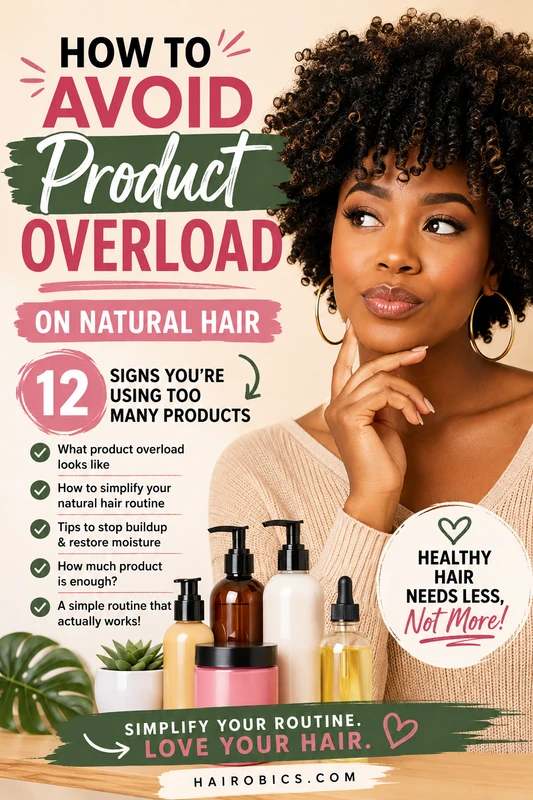
If your natural hair feels heavy, greasy, sticky, dull, coated, or strangely dry even though you are using plenty of moisturizing products, you may be dealing with product overload.
Natural hair routines can become complicated quickly. You start with shampoo and conditioner, then add a leave-in conditioner, moisturizer, curl cream, oil, butter, gel, edge control, scalp oil, refresher spray, and several treatments. Before you know it, your hair is carrying layer after layer of products.
More products do not automatically mean healthier hair.
In fact, using too many products—or simply using too much of the right products—can make natural hair more difficult to manage. Excess product can leave the strands coated, weigh down curls, contribute to buildup, reduce volume, and make freshly washed hair feel like it needs to be washed again.
The solution isn't necessarily throwing away everything in your bathroom. Instead, you need to understand what your hair actually needs, how much product to use, and when to stop layering products.
This guide explains how to avoid product overload, recognize the warning signs, simplify your natural hair routine, remove excessive buildup, and determine which products deserve a permanent place in your regimen.
What Is Product Overload?
Product overload happens when you apply more hair products—or more product quantity—than your hair and scalp can comfortably handle.
There are two common ways this happens.
The first is using too many different products at the same time.
For example, your wash day might include:
- Leave-in conditioner
- Detangling spray
- Moisturizing cream
- Curl cream
- Hair butter
- Oil
- Gel
- Edge control
- Scalp oil
Each individual product may be perfectly fine. The problem is that all of them together can create unnecessary layers on the hair.
The second type of overload happens when you use too much of a single product.
A person with short or fine natural hair, for example, may use several large handfuls of styling cream when only a small amount is necessary.
Natural hair often requires moisture, but there is a difference between properly moisturizing your strands and covering them with excessive amounts of product.
Learning that difference can completely change your hair routine.
12 Signs You May Be Using Too Many Hair Products
Product overload doesn't look exactly the same on everyone. Your hair type, density, porosity, products, styling routine, and wash frequency can all affect how buildup appears.
However, there are several common warning signs.
1. Your Hair Feels Heavy
Healthy natural hair should generally have some movement.
When strands become overloaded with creams, oils, butters, and styling products, they can feel unusually heavy.
Your curls may hang differently.
Your afro may lose some of its volume.
Your twist-out may look flatter.
If your hair feels considerably heavier immediately after styling, consider reducing the amount of product you're applying.
2. Your Curls Have Lost Definition
It sounds contradictory because curl-defining products are supposed to increase definition.
But too much product can sometimes do the opposite.
Heavy layers can weigh down your curl pattern and interfere with the way individual strands naturally group together.
You may notice that your curls aren't springing back the way they normally do.
Before buying another curl-defining product, try using less of what you already own.
3. Your Hair Looks Greasy
Natural hair needs lubrication, but it doesn't necessarily need to look oily.
If you touch your hair and your hands are covered with oil, you may be applying more than your strands need.
This is especially common when people apply an oil over several other moisturizing products.
Oil can be useful within a routine, but pouring large amounts onto the hair isn't the same thing as providing hydration.
4. Your Hair Feels Sticky
Sticky strands are another common sign of excessive styling product.
Gel, curl custard, creams, edge controls, and certain leave-ins can leave residue when they are layered excessively.
You may notice your strands sticking together even when your style isn't supposed to have that effect.
5. You See White Flakes
Not every white flake is dandruff.
Sometimes the flakes you're seeing are dried styling products.
This frequently happens when products don't work well together.
For example, applying a cream and then layering an incompatible gel over it can sometimes create white clumps or flakes.
The products may work beautifully individually but perform poorly when combined.
6. Your Hair Looks Dull
Natural hair doesn't have to look extremely shiny to be healthy.
However, excessive buildup can create a coating that makes your hair appear dull.
Ironically, repeatedly adding oils and shine products in an attempt to fix dullness may make the problem worse.
Sometimes what your hair really needs is a thorough wash.
7. Your Hair Takes Forever to Dry
Thick natural hair already requires significant drying time.
But if your hair suddenly takes considerably longer to dry after styling, examine how much product you're using.
Multiple layers of heavy creams, butters, and gels can increase drying time.
8. Your Scalp Feels Coated
Product overload doesn't only affect the strands.
It can affect your scalp as well.
Applying oils, pomades, gels, creams, butters, and other styling products directly to the scalp can leave noticeable residue.
Your scalp may feel greasy or coated soon after wash day.
Keeping the scalp clean is an important part of maintaining a comfortable hair-care routine.
9. Your Hair Feels Dirty Soon After Washing
You spent hours completing wash day.
Then, one or two days later, your hair already feels dirty.
The problem may not be your shampoo.
You might simply be putting too much product back onto freshly cleansed hair.
If you immediately cover clean strands with several heavy products, you may recreate the coated feeling you just washed away.
10. Your Hair Has Less Volume
This is particularly noticeable for people who love big natural hairstyles.
Heavy products can pull the hair downward.
Instead of a soft, fluffy twist-out, you may get a flatter style with limited movement.
Fine natural hair is particularly susceptible to being weighed down.
11. Your Hair Doesn't Respond to Moisturizer Like It Used To
You apply moisturizer, but your hair doesn't seem to absorb it.
So you apply more.
And more.
Eventually your strands feel both coated and dry.
This is an important clue.
Existing buildup may be interfering with how products distribute across your strands.
Adding another layer isn't always the solution.
Sometimes the better move is cleansing your hair and starting again.
12. You're Constantly Adding Products to Fix Other Products
This is one of the easiest ways to identify an overly complicated routine.
Your curl cream doesn't give enough definition, so you add gel.
The gel feels crunchy, so you add oil.
The oil makes your hair look flat, so you add a volumizing product.
Then your hair feels dry, so you spray moisturizer over everything.
If every product requires another product to correct it, your routine may need simplifying.
Why Natural Hair Is Vulnerable to Product Overload
Natural hair communities understandably emphasize moisture.
Curly, coily, and kinky strands can be more susceptible to dryness because natural scalp oils may have difficulty traveling along all the bends and curves of the hair shaft.
That doesn't mean unlimited amounts of product are beneficial.
Many natural hair products are extremely rich.
They may contain combinations of:
- Plant oils
- Butters
- Conditioning ingredients
- Humectants
- Styling polymers
- Waxes
- Gels
- Botanical extracts
Layer several rich formulas together and the amount accumulating on your strands can become significant.
The popularity of multi-step natural hair routines can also unintentionally encourage people to believe every step is mandatory.
It isn't.
Your routine should be based on your hair—not the number of products someone else uses.
The Difference Between Product Overload and Product Buildup
These terms are closely related, but they aren't exactly identical.
Product overload generally refers to applying an excessive quantity or number of products.
Product buildup is the residue that can accumulate on your hair or scalp over time.
Product overload can therefore contribute to buildup.
Imagine applying a heavy leave-in, cream, butter, and oil every morning without thoroughly cleansing your hair for several weeks.
Each application can leave additional residue behind.
Eventually the accumulation becomes noticeable.
The hair may become:
- Heavy
- Greasy
- Dull
- Sticky
- Difficult to moisturize
- Less responsive to styling
The good news is that the problem is usually manageable once you identify what's happening.
How to Avoid Product Overload
1. Start With Clean Hair
One of the easiest ways to avoid overload is beginning your styling routine with properly cleansed hair.
Think of wash day as a reset.
Shampoo removes sweat, oils, environmental debris, and product residue so you aren't continuously layering new products over old ones.
Your ideal wash frequency will depend on your scalp, hairstyle, lifestyle, and products.
Instead of following an arbitrary schedule, pay attention to your hair.
If your scalp feels coated and your strands are covered in residue, it may be time to cleanse.
2. Use the Minimum Effective Amount
This simple principle can save you money and improve your routine:
Start with less product than you think you need.
You can always add more.
Removing too much product after you've applied it is considerably more difficult.
Begin with a small quantity.
Spread it between your palms.
Apply it evenly.
Then evaluate your hair before adding anything else.
You may discover that half of your normal amount works just as well.
3. Apply Products in Sections
People often use excessive product because they can't tell where they've already applied it.
Sectioning solves that problem.
Divide your hair into manageable sections before moisturizing or styling.
You might use:
- 4 sections
- 6 sections
- 8 sections
- More sections for very dense hair
Work through one section at a time.
This allows you to distribute a smaller amount of product more evenly instead of repeatedly applying large handfuls to the entire head.
4. Don't Assume Every Routine Needs Three or Four Leave-In Products
A simple natural hair routine can be extremely effective.
After cleansing and conditioning, many styles may only require a moisturizer or leave-in plus an appropriate styling product.
You don't necessarily need:
Leave-in + cream + butter + oil + custard + gel.
Some people may enjoy layered routines, but layering should have a purpose.
Ask yourself what each product is doing.
If you can't explain why you're applying it, consider removing that step temporarily.
5. Learn What Your Hair Actually Needs
Hair care becomes easier when you stop treating every viral routine as a requirement.
Someone with very thick, coarse hair may love heavy creams and butters.
Someone with fine strands may find the same products overwhelming.
Pay attention to:
- Strand thickness
- Hair density
- Curl pattern
- Porosity
- Current hairstyle
- Climate
- Activity level
- Wash frequency
Your ideal product amount is personal.
6. Be Careful With Heavy Butters
Hair butters can be wonderful for certain styles and textures.
But they're concentrated.
You usually don't need huge quantities.
Applying a large amount of butter over a heavy cream and oil can quickly weigh down the hair.
Try reducing the quantity before deciding that a butter doesn't work for you.
7. Don't Drench Your Hair in Oil
More oil doesn't equal more moisture.
Water provides hydration.
Oil can help lubricate the strands and may play a useful role in reducing friction or supporting moisture retention depending on your routine.
But oil cannot replace water.
If your hair feels dry, repeatedly pouring oil onto it can eventually give you hair that feels both oily and dry.
That's not the goal.
8. Use Scalp Products Intentionally
You don't necessarily need to cover every inch of your scalp in oil every day.
If you use a scalp oil, apply it intentionally and observe how your scalp responds.
A small amount distributed properly may be enough.
This is particularly important when you're wearing braids, twists, or locs because it can be tempting to repeatedly add products between wash days.
9. Avoid Constantly Refreshing Your Hair
Refreshing curls can extend a hairstyle.
But daily refreshing can turn into daily layering.
Imagine this routine:
Monday: Leave-in + cream + gel
Tuesday: Curl refresher + cream
Wednesday: Water + leave-in + oil
Thursday: Refresher + gel
Friday: Leave-in + cream + oil
By Friday, there may be many layers of product sitting on the same strands.
Instead, try refreshing only the areas that actually need attention.
Sometimes water or a light mist is enough.
10. Pay Attention to Fine Hair
Fine strands can become weighed down faster than coarse strands.
If you have fine natural hair, consider experimenting with:
- Lightweight leave-ins
- Lightweight moisturizers
- Mousses
- Foams
- Light gels
- Small amounts of oil
Heavy butter isn't automatically bad for fine hair, but you may need much less than someone with thicker strands.
11. Watch Your Roots
People tend to focus on their ends when discussing product buildup, but the roots matter too.
Applying excessive styling products near your roots can reduce volume and make freshly washed hair look greasy.
For styles where volume is important, consider concentrating richer products more heavily toward the areas that actually need them rather than saturating your roots.
12. Give Products Time to Work
You apply moisturizer.
Ten seconds later your hair still feels dry.
So you apply more.
Wait.
Give the product time to distribute through your hair before deciding you need another handful.
When applying moisturizer to slightly damp hair in sections, massage or smooth it through thoroughly.
Then reassess.
13. Don't Confuse Slip With Moisture
A product can make your hair feel extremely slippery without necessarily meaning you need to keep applying it.
Many conditioners and detanglers are formulated to provide slip so strands can move past each other more easily.
Once you have enough slip to detangle effectively, adding more may simply waste product.
14. Check Product Compatibility
Sometimes your problem isn't the quantity.
It's the combination.
Certain styling products simply don't layer well together.
One popular trick is testing products in your hand before putting them throughout your hair.
Mix a tiny amount of your leave-in with your gel.
If the mixture immediately becomes chunky, clumpy, or unusually white, the combination may not perform well when layered.
This isn't a perfect scientific test, but it can sometimes help you spot obvious compatibility problems before styling your entire head.
15. Simplify Your Routine for Two Weeks
If you don't know which product is causing the problem, conduct a routine reset.
For two weeks, simplify.
You might use:
Wash Day
Shampoo → Conditioner → Leave-in → Styler
That's it.
Observe your hair.
Does it feel lighter?
Does your style last longer?
Do your curls have more movement?
Is your scalp more comfortable?
If your hair improves, gradually introduce other products one at a time.
This makes it easier to determine which products actually benefit your routine.
A Simple Natural Hair Routine Without Product Overload
You don't need a 12-step routine to maintain natural hair.
Here's a straightforward framework.
Step 1: Cleanse
Use shampoo to clean your scalp and strands.
Concentrate primarily on the scalp while allowing the lather to travel down the hair during rinsing.
Step 2: Condition
Apply conditioner to restore softness and improve manageability.
Detangle gently when appropriate for your routine.
Rinse according to the product instructions.
Step 3: Add Moisture
Apply a leave-in conditioner or moisturizer.
You don't necessarily need both.
Choose the product that gives your hair the softness and manageability you're looking for.
Step 4: Style
Choose a styling product based on the hairstyle.
For a wash-and-go, that might be gel.
For twists, you might prefer a twisting cream.
For a lightweight style, mousse may be sufficient.
Use products according to function instead of simply layering everything you own.
Step 5: Seal or Finish if Needed
If your hair responds well to a small amount of oil, you can incorporate it strategically.
The key words are small amount.
Your hair should not necessarily drip with oil.
How Much Hair Product Should You Use?
There isn't one universal measurement.
Someone with waist-length, high-density hair will naturally use more product than someone with a short tapered cut.
Instead of following rigid measurements, look for even coverage.
Your hair should feel coated enough for the product to perform its intended function without feeling saturated in residue.
Start small.
Add more only when necessary.
Over time, you'll learn approximately how much each section of your hair requires.
How to Fix Product Overload
Already used too much?
Don't panic and don't immediately add another product.
Try these steps.
Step 1: Stop Adding More Products
This sounds obvious, but it's important.
If your hair feels greasy, sticky, and heavy, another moisturizer probably isn't going to solve the issue.
Stop layering.
Step 2: Wash Your Hair
A proper shampoo session may be all you need.
Focus on thoroughly cleansing your scalp and allowing the shampoo to work through your strands.
If your hair contains substantial buildup, you may need a more thorough cleansing session than usual.
Always follow the directions on the cleansing product you're using.
Step 3: Condition
After cleansing, condition your hair as appropriate.
The goal isn't stripping your hair repeatedly until it feels rough.
You want clean, manageable strands.
Step 4: Restart With Less
This is the most important part.
If you immediately recreate the exact same product combination after washing, you'll likely end up in the same situation.
Reduce your routine.
For example:
Before
Leave-in → moisturizer → cream → butter → oil → gel
After
Leave-in → styler
Compare the results.
You might be surprised.
Product Overload on Low-Porosity Hair
People with low-porosity hair frequently report that products seem to sit on top of their strands.
Because of this, heavy layering can become noticeable quickly.
If your hair tends to become coated easily, you may benefit from experimenting with lighter products and smaller amounts.
Applying products to damp hair and distributing them thoroughly can also help.
You don't need to force five products onto your strands just because a particular routine is popular.
Product Overload on High-Porosity Hair
High-porosity hair may tolerate richer routines differently, particularly when strands have experienced damage.
But high porosity doesn't mean unlimited product is necessary.
You can still overload highly porous strands.
The goal remains the same:
Provide enough product to support softness, manageability, and styling without unnecessarily coating the hair.
Product Overload With Braids
Braids create a unique challenge.
Because your hair may remain braided for several weeks, products can accumulate between wash days.
People often use:
- Braid spray
- Scalp oil
- Edge control
- Mousse
- Moisturizing spray
- Dry shampoo or scalp cleansers
- Gel
All of these can accumulate.
Try to keep your braid-care routine simple.
Focus on maintaining your scalp and hair rather than making your braids wet or greasy with product every day.
Product Overload With Locs
Locs also require thoughtful product use.
Very heavy creams, waxes, and butters can potentially leave residue that becomes difficult to remove from inside mature locs.
Many people with locs prefer lighter products for this reason.
Keeping your loc routine simple can reduce unnecessary accumulation.
When applying products, focus on what your hair and scalp genuinely need instead of automatically adding more each day.
Product Overload on Kids' Natural Hair
Children's natural hair routines can often be simpler than adults' routines.
You usually don't need to apply several heavy products to a child's hair every day.
Focus on gentle cleansing, conditioning, detangling, moisturizing, and low-manipulation styling.
A simple routine is also easier for parents to maintain consistently.
Does Product Buildup Stop Hair Growth?
Product buildup doesn't magically switch off the biological process that produces hair.
Hair grows from follicles beneath the skin.
However, maintaining a clean, comfortable scalp and reducing unnecessary residue are sensible parts of an overall healthy hair-care routine.
If you're experiencing unusual or persistent hair loss, bald patches, scalp pain, sores, or severe irritation, consider speaking with a dermatologist or other qualified healthcare professional rather than assuming hair products are the only cause.
Can Too Much Moisturizer Make Hair Dry?
It can certainly make hair feel coated without solving the underlying dryness.
This is where many people get trapped.
Hair feels dry.
You add moisturizer.
It still feels dry.
You add cream.
Then oil.
Then butter.
Eventually the outside of the strand is coated, but the hair still doesn't feel the way you want it to.
Instead of continuously layering products, consider resetting with a wash and reevaluating your routine.
Is It Better to Use Fewer Hair Products?
Not automatically.
The objective isn't having the smallest product collection possible.
The objective is having a purposeful routine.
If five products each provide a meaningful benefit and your hair responds beautifully, that's fine.
If you're using ten products simply because social media convinced you that every natural hair routine needs ten steps, simplify.
Ask these questions about every product:
What does this product do?
Do I notice a difference when I use it?
Does another product already perform the same function?
Does my hair feel better with it or without it?
Am I using this because my hair needs it—or because it's part of someone else's routine?
Your answers can help you eliminate unnecessary steps.
The One-Product-at-a-Time Rule
If you're trying new products, avoid introducing five new ones simultaneously.
Why?
Because if your hair suddenly looks amazing, you won't know which product deserves the credit.
And if your hair suddenly feels terrible, you won't know which product caused the problem.
Introduce products individually whenever possible.
Use the new product several times.
Observe:
- Softness
- Definition
- Moisture retention
- Buildup
- Flaking
- Scalp response
- Style longevity
- Ease of detangling
Then decide whether it deserves a permanent place in your routine.
Stop Chasing Every Natural Hair Trend
Natural hair trends change constantly.
One month everyone is using hair butter.
The next month it's gel.
Then mousse.
Then botanical gel.
Then hair grease returns.
Then everyone is talking about minimalist routines.
Your hair doesn't know what's trending.
It only responds to how you treat it.
Instead of rebuilding your routine every time a new TikTok, Instagram, Pinterest, or YouTube trend appears, establish a reliable foundation.
Once you know what works, trends become optional experiments rather than instructions.
Create a Hair Product Audit
Take every hair product you own and place it in front of you.
Divide everything into four categories:
1. Cleansing
Shampoos and scalp cleansers.
2. Conditioning
Rinse-out conditioners and deep conditioners.
3. Moisturizing
Leave-ins, moisturizing sprays, creams, and lotions.
4. Styling/Finishing
Gels, mousses, twisting creams, oils, edge controls, pomades, and finishing products.
Now look for duplicates.
Do you own six leave-in conditioners?
Four twisting creams?
Seven oils?
Five gels?
You don't necessarily need to throw them away, but you probably don't need to use all of them simultaneously.
Choose your favorites.
Finish them before constantly purchasing replacements.
Your bathroom—and your wallet—may appreciate the change.
How Product Overload Costs You Money
There's another major benefit to simplifying your hair routine:
You spend less money.
Suppose you're using eight products every wash day.
If each costs $12, replacing the entire routine costs almost $100.
If you discover that four carefully selected products give you equally good—or better—results, your ongoing hair-care expenses can drop substantially.
Using appropriate quantities also makes products last longer.
A jar that lasts three weeks when you scoop out huge handfuls might last considerably longer when you apply only what your hair actually needs.
Good hair care isn't about using as much product as possible.
It's about using products effectively.
Frequently Asked Questions About Product Overload
How do I know if I have too much product in my hair?
Common signs include heavy strands, excessive greasiness, sticky hair, visible residue, reduced volume, flaking, dullness, and hair that feels dirty soon after washing.
Should I wash my hair if I used too much product?
If the amount is minor, you may be able to leave your hair alone and avoid adding more.
If your hair is heavily coated, greasy, sticky, or uncomfortable, washing and restarting may be the simplest option.
Why does my natural hair feel greasy but dry?
Your strands can have oily product sitting on the outside while still feeling dry or rough.
Adding more oil may worsen the coated feeling.
Consider cleansing your hair and rebuilding your moisturizing routine using smaller quantities.
Can too much leave-in conditioner cause buildup?
Yes. Leave-in conditioner is designed to remain on the hair, so repeated heavy applications without adequate cleansing can contribute to residue.
Use enough to achieve the desired effect without unnecessarily saturating your strands.
How often should I clarify natural hair?
There is no universal schedule that works for everyone.
Clarifying frequency depends on your styling products, scalp condition, wash frequency, activity level, and how easily buildup develops.
If your normal shampoo no longer seems to remove residue effectively, an occasional clarifying wash may be useful.
Follow the manufacturer's instructions and avoid excessive cleansing that leaves your hair unnecessarily dry.
Why do my curls look better when I use less product?
Your curls may have more movement because they aren't being weighed down by heavy layers of creams, oils, butters, and gels.
Sometimes reducing product allows the natural curl pattern to appear fuller and more defined.
Can I use leave-in conditioner every day?
It depends on your hair, hairstyle, and product.
Some people can refresh with a small amount regularly without problems.
Others experience buildup quickly.
Don't automatically apply leave-in every day. Check whether your hair actually needs it first.
Do I need both hair cream and oil?
Not necessarily.
Some routines work well with both, while others don't need the combination.
Experiment and evaluate the results rather than treating oil as a mandatory final step.
Why is my hair white after applying gel?
White residue may occur when too much styling product is applied or when products layered underneath the gel don't interact well with it.
Try reducing the amount and testing the gel with your other products.
Can product overload make natural hair look thin?
Heavy product can reduce volume and make curls or coils clump differently, which may temporarily make the hairstyle appear flatter.
However, sudden or progressive hair thinning should not automatically be blamed on product buildup. Consider professional evaluation if you're experiencing genuine hair loss.
A Better Philosophy for Natural Hair Care
Natural hair doesn't need the largest possible collection of products.
It needs consistency.
A strong routine can be surprisingly simple:
Cleanse properly.
Condition consistently.
Moisturize according to your hair's needs.
Protect your strands from unnecessary damage.
Choose styling products intentionally.
Avoid excessive buildup.
That's the foundation.
Products are tools.
They shouldn't become the routine itself.
When you find something that works, give it time before replacing it with the next trending formula.
Learn how your hair behaves after wash day.
Learn how much moisturizer each section needs.
Learn which styling products give you the best definition.
Learn how long you can comfortably go before cleansing.
These observations are more useful than owning 50 products.
Final Thoughts: Your Hair May Need Less, Not More
When natural hair isn't cooperating, our first instinct is often to add something.
More moisturizer.
More oil.
More cream.
More gel.
More conditioner.
But sometimes the best thing you can do is remove the excess and simplify.
If your hair constantly feels greasy, coated, heavy, sticky, dull, or difficult to style, take a closer look at your product routine.
Wash away the buildup.
Reduce the number of products you're layering.
Use smaller amounts.
Apply products in sections.
Choose products according to your actual hair needs.
Then observe what happens.
You may discover that your curls have more bounce, your twist-outs have more volume, your scalp feels fresher, and your wash-day products last much longer.
The perfect natural hair routine isn't the one with the most steps.
It's the one where every step has a purpose.