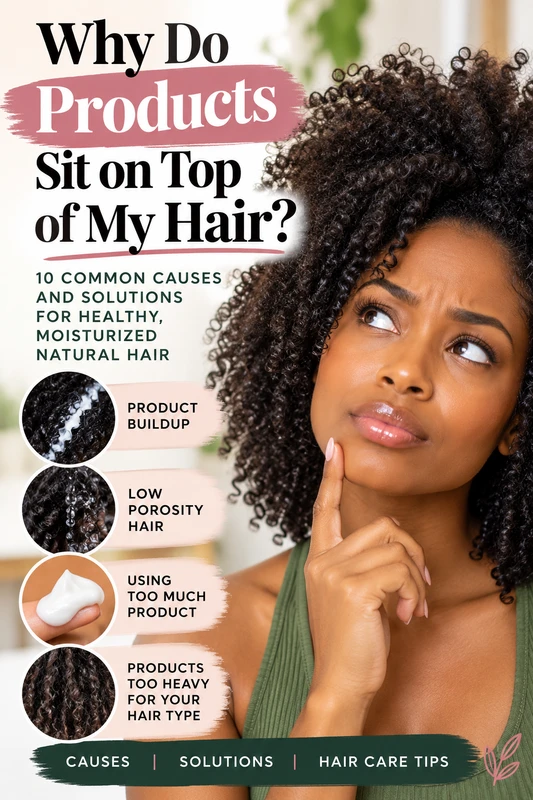
Have you ever applied your favorite leave-in conditioner, moisturizing cream, or hair oil, only to notice that the product seems to sit on top of your hair instead of absorbing? Your strands may feel coated, greasy, sticky, or weighed down, even though they still feel dry underneath.
This is a common frustration among people with natural hair, particularly those with tightly coiled textures, low-porosity hair, or strands that experience frequent product buildup.
You might notice white residue after applying styling products, water droplets sitting on your strands, or moisturizing creams taking an unusually long time to spread evenly throughout your hair.
But why does this happen?
The answer often involves several factors, including hair porosity, product formulation, buildup, application techniques, and the condition of your hair's outer protective layer.
Understanding how hair interacts with water, oils, and conditioning ingredients can help you create a routine that delivers softness, manageability, and lasting hydration without leaving behind unwanted residue.
In this guide, we'll explore why products sit on top of your hair, how to recognize the underlying causes, and practical ways to help your natural hair retain moisture more effectively.
1. What Does It Mean When Products Sit on Top of Your Hair?
When someone says their hair isn't absorbing products, they're usually describing a situation where conditioners, creams, oils, or styling products remain noticeably visible or detectable on the hair's surface.
Instead of leaving your strands feeling soft and manageable, products may create a heavy coating.
Common signs include:
-
White residue after applying leave-in conditioner.
-
Hair that feels greasy but remains dry.
-
Water droplets that bead up on the strands.
-
Moisturizing products that take a long time to spread.
-
Hair that feels sticky or coated after styling.
-
Curls that appear weighed down.
-
Products that flake after drying.
-
A waxy feeling when touching your hair.
However, it's important to understand that not every hair product is supposed to penetrate deeply into the hair shaft.
Many conditioners, oils, and styling ingredients are specifically designed to remain on the hair's surface. They help lubricate strands, reduce friction, improve shine, and minimize moisture loss.
The problem arises when excessive product accumulation interferes with your desired results.
The goal isn't necessarily to make every ingredient penetrate your hair. Instead, it's to achieve the right balance between hydration, conditioning, and lightweight protection.
2. You May Have Low-Porosity Hair
One of the most commonly discussed reasons products appear to sit on top of natural hair is low porosity.
Hair porosity describes how readily hair takes up and releases water.
Low-porosity hair generally has a relatively resistant outer structure that can make wetting and certain conditioning processes slower.

Signs of low-porosity hair
You might notice:
-
Hair takes longer to become completely saturated.
-
Water initially beads on your strands.
-
Heavy creams leave noticeable residue.
-
Hair takes a long time to air-dry.
-
Lightweight conditioners feel better than thick butters.
-
Products accumulate quickly between wash days.
These observations can suggest low porosity, but none is a definitive test by itself. Product buildup, styling treatments, and hair density can create similar effects.
Why low-porosity hair can resist wetting
The cuticle forms the outer protective layer of each hair strand. Its structure and surface chemistry influence how water and conditioning ingredients interact with the hair.
When hair is relatively resistant to wetting, applying large amounts of thick moisturizer may produce a coated feeling rather than the softness you're looking for.
How to fix it
Start by applying lightweight, water-based products to clean, damp hair.
Work in small sections and distribute each product thoroughly before adding more.
You can also use gentle warmth during conditioning. A warm towel or conditioning cap may help make the treatment more comfortable and improve product distribution.
Avoid extremely hot water or excessive heat, which can damage your strands.
For more information, read our guide on How to Determine Hair Porosity .
3. Product Buildup Is Preventing Proper Wetting
Product buildup is another major reason your hair may feel like it refuses to absorb moisture.
Throughout the week, your strands can accumulate residue from:
-
Leave-in conditioners.
-
Styling creams.
-
Hair oils.
-
Butters.
-
Edge-control products.
-
Gels.
-
Dry shampoo.
-
Environmental particles.
As these substances accumulate, they may leave your hair feeling coated and make it more difficult for water to wet the strands evenly.
Signs of product buildup
You may notice your hair feels unusually heavy, dull, sticky, or waxy.
Your curls may lose definition, and products that previously worked well may suddenly stop delivering the same results.
Another common sign is needing increasingly large amounts of moisturizer to achieve temporary softness.
How to remove buildup
Introduce a clarifying shampoo when needed.
Clarifying shampoos contain cleansing ingredients designed to remove accumulated oils, styling residue, and other deposits.
Depending on your routine, clarifying every three to six weeks may be a useful starting point. People using heavier products frequently may need to clarify more often.
Follow with a moisturizing conditioner to restore softness and manageability.
Remember that clarifying shampoo should complement your regular cleansing routine rather than replace it entirely.
4. You're Applying Too Much Product
Sometimes the problem isn't your hair porosity or the product itself.
It's simply the amount you're using.
Natural hair often benefits from moisture-rich products, but applying multiple generous layers of conditioner, butter, cream, and oil can leave your strands overloaded.
More product doesn't automatically mean more hydration.
For example, applying a large amount of leave-in conditioner followed by a thick styling butter and heavy oil may create a coating that makes your hair feel greasy.
What to do instead
Start with a small amount and gradually increase it as needed.
Divide your hair into manageable sections and distribute products from the mid-lengths toward the ends.
Pay particular attention to areas that experience dryness or tangling.
If your hair feels soft after applying one product, you may not need several additional layers.
A simple routine often produces better results than an unnecessarily complicated one.
5. You're Applying Products to Completely Dry Hair
Water plays an important role in keeping natural hair hydrated.
While oils and butters can improve lubrication and help reduce moisture loss, they do not replace water.
Applying thick creams or oils to extremely dry strands may temporarily create shine without addressing the underlying lack of hydration.
This can produce the familiar experience of hair that feels oily on the outside but rough underneath.
The solution
Apply your moisturizing products to clean, slightly damp hair.
A practical routine involves:
-
Lightly dampening your hair with water.
-
Applying a water-based leave-in conditioner.
-
Distributing the product evenly.
-
Adding a small amount of oil if your hair benefits from it.
-
Styling as desired.
You don't need to soak your hair every time you moisturize it.
A light mist may be sufficient for refreshing your strands between wash days.
The important thing is to observe how your hair responds and adjust your routine accordingly.
6. Your Products Are Too Heavy for Your Hair Type
Not every natural hair product works equally well for every person.
Some formulations contain higher concentrations of thick butters, waxes, oils, and film-forming ingredients.
These can be useful for reducing friction, improving manageability, and protecting hair during styling.
However, they may feel excessive on fine strands or hair that becomes coated easily.
Heavy ingredients to evaluate
Examples include:
-
Shea butter.
-
Cocoa butter.
-
Castor oil.
-
Petrolatum.
-
Certain waxes.
-
Thick pomades.
These ingredients aren't inherently bad for natural hair. Their effectiveness depends on the formulation, concentration, application amount, and your individual needs.
Try lightweight alternatives
If your hair becomes weighed down easily, consider products featuring:
-
Water.
-
Aloe vera.
-
Glycerin.
-
Panthenol.
-
Lightweight conditioning agents.
-
Jojoba oil.
-
Grapeseed oil.
A water-based leave-in conditioner may offer the softness you need without requiring several additional products.
For those who enjoy oils, applying just a few drops after moisturizing may be enough.
7. Your Hair May Have Hard-Water Buildup
Sometimes the issue isn't caused by your styling products at all.
Hard water contains elevated levels of dissolved minerals, particularly calcium and magnesium.
Over time, mineral deposits can contribute to changes in how hair feels and responds to washing and conditioning.
You might notice that your hair feels rough, dull, or unusually difficult to manage.
Common signs
-
Hair feels coated after washing.
-
Shampoo doesn't perform as expected.
-
Strands feel rough despite conditioning.
-
Hair appears dull.
-
Detangling becomes more difficult.
These symptoms can have multiple causes, so they don't prove that hard water is responsible.
What can help?
Consider using a chelating shampoo formulated to address mineral deposits.
Chelating shampoos contain ingredients that bind certain minerals and help remove them during cleansing.
They are different from ordinary clarifying shampoos, although some products perform both functions.
Follow with conditioner, and avoid overusing stronger cleansing treatments.
If hard water is a recurring concern, testing your household water can help determine whether mineral content may be contributing to the problem.
8. Your Products May Not Work Well Together
Have you ever applied one product successfully, only to notice white flakes or residue after adding another?
This may be a product compatibility issue.
Certain styling products don't layer well together.
For example, combining particular gels and conditioning creams can sometimes cause visible clumping, pilling, or flaking.
This doesn't necessarily mean either product is ineffective when used independently.
Try the product mixing test
Before layering two products throughout your hair:
-
Place a small amount of each product in your palm.
-
Rub them together gently.
-
Observe whether they form clumps or separate.
-
Test the combination on a small section of hair.
A smooth mixture is encouraging, although it doesn't guarantee the products will behave perfectly once dry.
If you notice persistent flaking, try using the products separately.
You may discover that your hair responds better to fewer styling layers.
9. Your Hair Needs a More Consistent Cleansing Routine
Many people focus heavily on moisturizing natural hair while overlooking the importance of regular cleansing.
However, healthy hair maintenance requires both.
If you continuously apply oils and creams without washing away accumulated residue, your strands may eventually feel coated.
This can make it difficult to determine whether your moisturizer is actually working.
How often should natural hair be washed?
There is no universal schedule.
Many people find washing every seven to fourteen days manageable, while others benefit from more frequent cleansing.
Your ideal routine depends on:
-
Scalp oil production.
-
Exercise and sweating.
-
Styling habits.
-
Product usage.
-
Hair density.
-
Protective hairstyles.
The objective is to maintain a clean scalp and manageable strands without using unnecessarily harsh cleansing methods.
If your hair starts feeling coated shortly after moisturizing, evaluate whether your current wash schedule is sufficient.
10. Your Hair May Be Damaged or Weathered
Although low porosity receives considerable attention, damaged hair can also behave unpredictably when exposed to conditioning products.
Repeated chemical treatments, excessive heat, aggressive detangling, and environmental exposure can alter the hair cuticle.
Damaged strands may lose moisture quickly, become rough, or develop uneven conditioning needs.
This can create a situation where some sections feel coated while others remain dry.
Signs of damaged hair
-
Increased breakage.
-
Rough or uneven texture.
-
Persistent tangling.
-
Split ends.
-
Reduced elasticity.
-
Uneven moisture retention.
If your hair has experienced substantial damage, adding increasingly heavy products may not solve the problem.
Instead, focus on gentle handling, regular conditioning, reducing excessive heat, and trimming severely damaged ends when necessary.
Conditioners can temporarily improve the feel and appearance of damaged strands, but they cannot permanently reconstruct severely compromised hair.
How to Get Hair Products to Work Better: A Step-by-Step Routine
Now that we've explored the common causes, let's discuss how to create a practical moisturizing routine.

Step 1: Start with clean hair
Use a shampoo appropriate for your scalp and hair needs.
If your hair feels particularly coated, consider whether occasional clarifying is necessary.
Thoroughly rinse away shampoo residue before applying conditioner.
Step 2: Condition thoroughly
Apply conditioner to wet hair, focusing on the lengths and ends.
Divide your hair into sections to ensure even coverage.
Allow the conditioner to remain on your hair according to its instructions.
Detangle gently while your strands have sufficient slip.
Step 3: Apply leave-in conditioner to damp hair
After rinsing, remove excess water without aggressively rubbing your hair.
Apply a water-based leave-in conditioner while your strands are still slightly damp.
Start with a modest amount.
Distribute the product using your fingers or a suitable detangling tool.
Step 4: Add oil only if needed
If your hair benefits from additional lubrication or protection, apply a small amount of oil.
Concentrate on the lengths and ends rather than automatically coating your entire scalp.
Remember that oil isn't a substitute for water-based moisture.
Step 5: Style without overloading your strands
Choose styling products according to your desired hairstyle.
If you're wearing a twist-out, braid-out, wash-and-go, or protective style, avoid adding unnecessary layers.
Observe whether your hair feels soft and manageable before introducing another product.
Step 6: Refresh strategically
Between wash days, lightly mist your hair if it needs refreshing.
Add a small amount of moisturizer only where necessary.
Avoid repeatedly applying heavy products to hair that already feels coated.
How to Choose the Right Moisturizer for Hair That Doesn't Absorb Products Easily
Selecting the right moisturizer can make a noticeable difference.
Rather than choosing products solely because they're marketed for natural hair, pay attention to their consistency, ingredient composition, and performance.
A good starting point is a lightweight leave-in conditioner containing water as a primary ingredient.
Water-based formulations can help hydrate hair while conditioning ingredients improve softness and manageability.
For hair that becomes coated easily, avoid introducing multiple heavy products simultaneously.
Instead, experiment with one product at a time.
This approach makes it easier to identify which formulas genuinely improve your routine.
Try Hairobics All Natural Leave-In Treatment
If your natural hair needs additional softness and manageability, consider incorporating Hairobics All Natural Leave-In Treatment into your moisturizing routine.
Apply according to the product directions and distribute evenly, starting with a small amount to avoid unnecessary buildup.
The right leave-in conditioner should complement your hair's needs without requiring excessive layering.
Does Low-Porosity Hair Need Oil?
Yes, low-porosity hair can benefit from oil, but the amount and type matter.
Oils can improve lubrication, enhance shine, and reduce friction between strands.
However, applying too much oil may create an undesirable coating, particularly when combined with multiple heavy styling products.
Consider starting with a small amount of a lightweight oil.
Jojoba and grapeseed oils are popular options for people who prefer lighter-feeling formulations.
Heavier oils, such as castor oil, may work better when applied sparingly or used for specific styling purposes.
The key is to choose products based on how your hair responds rather than assuming one oil is universally suitable for every hair type.
Should You Use Heat to Help Products Absorb?
Gentle warmth can be useful during certain conditioning treatments.
A warm towel or conditioning cap may improve the conditioning experience and help distribute products more evenly.
However, extreme heat is unnecessary and can damage hair.
You also don't need to apply heat every time you use a leave-in conditioner.
For everyday moisturizing, clean, damp hair and proper product distribution are usually practical starting points.
If your hair continues to feel coated, evaluate the formulation and quantity before introducing additional heat.
How Long Does It Take for Hair to Absorb Products?
There isn't a universal absorption time.
Different ingredients interact with hair in different ways.
Water may enter the hair fiber, while many oils, conditioning agents, and styling polymers primarily remain on or near its surface.
A product remaining detectable on your strands doesn't automatically mean it isn't working.
For example, conditioners often leave a beneficial film that helps reduce friction and improve manageability.
Instead of judging a product solely by how quickly it disappears, consider whether your hair feels soft, flexible, and manageable after application and drying.
If a product leaves excessive residue or makes your hair feel unpleasantly coated, adjust the amount or try another formulation.
Common Mistakes That Make Product Buildup Worse
Even with quality hair products, certain habits can contribute to persistent residue.
Applying oil before every moisturizer
Oil-first routines can work for some people, but heavy oil application may make subsequent water-based products harder to distribute evenly.
Experiment with applying your leave-in conditioner before oil.
Using too many products at once
Layering multiple creams, oils, butters, and gels makes it difficult to identify what's working.
Start with a simplified routine.
Skipping shampoo
Conditioner alone may not adequately remove certain oils, styling products, and accumulated residue.
Include appropriate cleansing in your routine.
Applying products without sectioning
Uneven distribution can cause some areas to become overloaded while others receive insufficient conditioning.
Work in manageable sections.
Ignoring changes in your hair
Your hair's needs can change with weather, styling, chemical treatments, and daily activities.
A routine that worked previously may require adjustments.
Pay attention to how your hair responds rather than automatically repeating the same application amounts.
Frequently Asked Questions
Why does my hair feel dry even after applying moisturizer?
Your hair may need additional water-based hydration, more consistent conditioning, or improved cleansing.
Applying heavy oils to dry strands can create shine without adequately addressing dryness.
Try moisturizing clean, slightly damp hair with a water-based leave-in conditioner.
Why does leave-in conditioner turn white on my hair?
White residue may occur when too much product is applied, products are incompatible, or the formulation doesn't distribute well under your application conditions.
Try reducing the amount, applying it to damp hair, and testing it separately from your styling gel.
Does product sitting on top of hair mean low porosity?
Not necessarily.
Low porosity is one possible explanation, but buildup, product quantity, formulation, and application techniques can produce similar results.
Consider several signs rather than relying on one observation.
Can high-porosity hair experience product buildup?
Absolutely.
High-porosity hair can accumulate styling residue just like any other hair type.
Porosity doesn't eliminate the need for regular cleansing.
Should I stop using shea butter if it sits on my hair?
Not automatically.
Try using a smaller amount or choosing a formulation containing shea butter at a lower concentration.
If your hair consistently feels weighed down, a lighter product may better suit your preferences.
Why does my hair absorb water but not conditioner?
Water and conditioning ingredients interact with hair differently.
Many conditioning ingredients are designed to deposit on the hair's surface rather than penetrate deeply.
If your conditioner leaves excessive residue, consider using less or selecting a lighter formulation.
Can I moisturize my natural hair every day?
You can refresh your hair as needed, but daily application of heavy products isn't necessary for everyone.
If your strands remain soft and manageable, you may not need additional moisturizer.
How do I know if my hair has too much product?
Common signs include a waxy texture, dull appearance, excessive heaviness, visible residue, and styling products that begin flaking.
If these symptoms develop, consider cleansing your hair before adding more products.
Final Thoughts: Why Do Products Sit on Top of My Hair?
When hair products seem to sit on top of your strands, the solution isn't necessarily to purchase more moisturizing products or apply larger amounts.
The underlying issue may involve low porosity, product buildup, heavy formulations, mineral deposits, or improper application techniques.
Understanding how your hair responds to different ingredients allows you to develop a simpler, more effective routine.
Start with clean hair, apply lightweight moisturizers to damp strands, distribute products evenly, and avoid unnecessary layering.
Most importantly, remember that many conditioning ingredients are supposed to remain on the hair's surface. The goal is to achieve softness, manageability, and balanced hydration without excessive residue.
With consistent care and the right products, you can maintain natural hair that feels moisturized, manageable, and comfortable throughout your styling routine.
Discover natural hair care products at Hairobics All Natural and build a routine that works with your hair's unique needs.