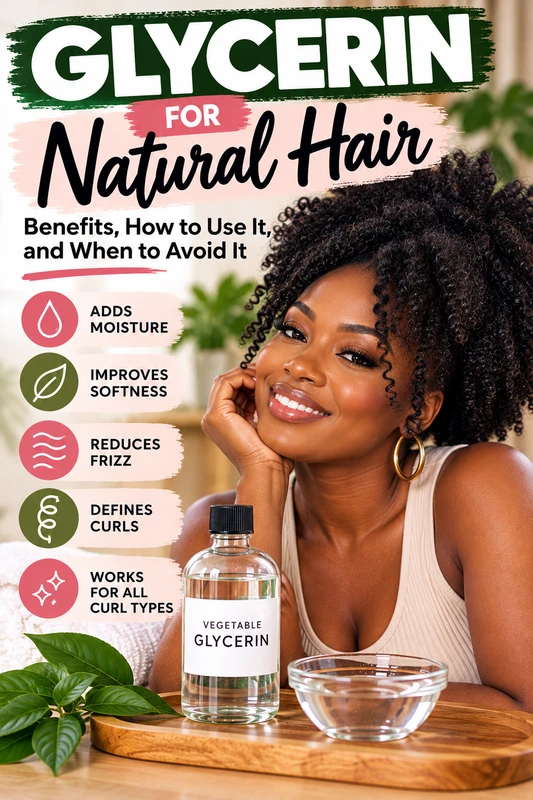
If you have natural hair, you have probably seen glycerin listed as an ingredient in leave-in conditioners, moisturizing sprays, curl creams, gels, shampoos, and deep conditioners. It is one of the most common moisturizing ingredients used in hair-care products, but it is also one of the most misunderstood.
Some people with natural hair love glycerin because it helps their curls feel soft, hydrated, and flexible. Others notice that products containing glycerin seem to make their hair frizzy, sticky, dry, or difficult to manage—especially when the weather changes.
So, is glycerin actually good for natural hair?
For many people, glycerin can be an excellent ingredient for helping natural hair retain moisture and feel softer. However, how well it works can depend on your hair, the product formulation, your styling routine, and environmental conditions such as humidity.
Understanding how glycerin works can help you decide when to use it, how much you need, and which types of products may work best for your natural hair.
In this guide, we'll cover everything you need to know about glycerin for natural hair, including its benefits, how it affects different hair types, glycerin and humidity, low-porosity versus high-porosity hair, and how to incorporate glycerin into your natural hair routine.
What Is Glycerin?
Glycerin, sometimes listed as glycerol on ingredient labels, is a clear, odorless liquid commonly used in cosmetic and personal-care products.
One of the reasons glycerin is so popular in hair products is because it functions as a humectant.
Humectants are ingredients that help attract and hold water.
Natural hair often benefits from products designed to support moisture retention because curly, coily, and kinky hair can have difficulty staying moisturized from roots to ends. The twists and bends in textured hair can make it harder for natural scalp oils to travel down the entire hair shaft.
Glycerin is therefore commonly included in products designed for dry, curly, coily, and textured hair.
You may find it in:
- Leave-in conditioners
- Moisturizing sprays
- Curl creams
- Styling gels
- Deep conditioners
- Hair masks
- Shampoos
- Rinse-out conditioners
- Edge products
- Detanglers
- Hair lotions
However, the presence of glycerin doesn't automatically mean a product will behave the same way as another glycerin-containing product. The complete formula matters.
Is Glycerin Good for Natural Hair?
Glycerin can be beneficial for natural hair, particularly when your goal is maintaining soft, hydrated, flexible strands.
One of the biggest challenges with natural hair is preventing excessive dryness. Hair that becomes very dry can feel rough, become difficult to detangle, and may be more vulnerable to mechanical breakage during styling.
A properly formulated moisturizing product containing glycerin can help support hydration.
Glycerin may be especially useful for people who experience:
- Dry-feeling natural hair
- Rough strands
- Curls that lose softness quickly
- Difficulty maintaining moisture between wash days
- Hair that becomes stiff after styling
- Excessive frizz in certain conditions
However, glycerin isn't a magic hair-growth ingredient.
It does not automatically make your hair grow faster.
Instead, its value comes primarily from its role in moisture management. Keeping natural hair properly conditioned and reducing excessive dryness can help you maintain healthier-feeling strands and potentially retain more length by reducing unnecessary breakage.
How Does Glycerin Work on Natural Hair?
Glycerin is hygroscopic, meaning it interacts readily with water.
In a well-formulated hair product, glycerin can help water remain associated with the hair and product film, contributing to a softer and more moisturized feel.
Imagine washing your hair and applying a moisturizing leave-in conditioner.
Water provides the initial hydration. Conditioning ingredients help improve softness and manageability. Humectants such as glycerin can support the product's moisture-retention properties.
This is why glycerin often appears alongside ingredients such as:
- Aloe vera
- Panthenol
- Propylene glycol
- Fatty alcohols
- Plant oils
- Botanical extracts
- Conditioning agents
A balanced formulation is usually more important than any single ingredient.
Benefits of Glycerin for Natural Hair
1. Helps Hair Stay Moisturized
The most obvious benefit of glycerin is moisture support.
Natural hair often loses moisture between wash days, particularly if it is exposed to dry air, frequent manipulation, heat, or friction.
Products containing glycerin can help hair maintain a softer, more hydrated feel.
This can be particularly useful for people whose natural hair feels dry only a day or two after wash day.
2. Can Improve Hair Softness
Dry natural hair often feels rough or crunchy.
A good moisturizing routine can improve the flexibility and softness of your strands, and glycerin may contribute to that effect.
Soft hair is generally easier to manipulate than extremely dry, rigid hair.
That can make everyday styling more comfortable.
3. May Improve Manageability
When natural hair becomes extremely dry, simple tasks such as sectioning, detangling, twisting, or braiding can become more difficult.
Moisturized hair generally has better slip and flexibility.
Although glycerin isn't a detangler by itself, it is often included in conditioners and detangling products containing other ingredients that improve slip.
4. Can Help Reduce the Appearance of Dry, Dull Hair
Natural hair doesn't always reflect light in the same way straight hair does because of its curl pattern.
When the hair is also dehydrated, it can look even duller.
Moisturizing products containing glycerin can help hair look and feel more conditioned.
For additional shine, some people follow their moisturizing product with a small amount of oil or another finishing product.
5. Supports Curl Flexibility
Well-hydrated curls generally feel more flexible than severely dry curls.
That flexibility can help curls move naturally instead of feeling stiff.
This can be particularly beneficial when wearing styles such as:
- Wash-and-gos
- Twist-outs
- Braid-outs
- Finger coils
- Rod sets
- Natural afros
6. May Help With Length Retention
Glycerin doesn't directly cause faster hair growth.
However, maintaining moisture and reducing excessive dryness may indirectly support length retention.
There is an important difference between hair growth and length retention.
Hair grows from the scalp, while length retention refers to keeping the hair that has already grown without losing excessive length to breakage.
A moisturizing routine can be an important part of protecting your existing strands.
Glycerin and Humidity
This is where glycerin becomes slightly more complicated.
Because glycerin interacts strongly with water, environmental humidity can influence how glycerin-containing styling products behave on your hair.
High Humidity
High humidity means the surrounding air contains a relatively large amount of moisture.
People wearing defined natural hairstyles may notice more:
- Frizz
- Swelling
- Shrinkage
- Loss of definition
- Puffiness
This doesn't necessarily mean glycerin is damaging your hair.
Rather, humidity itself can change the way textured hair behaves, and strongly humectant formulations may not always give you the styling results you want under those conditions.
For example, your twist-out might look perfectly defined indoors but begin expanding after spending several hours outside on a very humid day.
If definition is your priority, you may prefer styling products specifically formulated for humidity resistance.
Very Dry Weather
Extremely dry conditions can create a different challenge.
Natural hair may already lose moisture more quickly in dry environments, particularly during winter or in heavily heated indoor spaces.
Some people find that their normal glycerin-heavy product performs differently during these conditions.
Instead of eliminating glycerin automatically, look at your entire routine.
You may need:
- A richer leave-in conditioner
- A cream layered over your moisturizer
- More frequent moisturizing
- A protective hairstyle
- Less manipulation
- A different product formulation
Your hair's response is ultimately more useful than a rigid rule based on weather alone.
Does Glycerin Cause Frizz?
Glycerin doesn't automatically cause frizz.
However, products containing glycerin may contribute to styling changes under certain environmental conditions.
Humidity itself is a major factor in frizz.
Natural hair naturally responds to water in the environment. Depending on your hairstyle, this can cause the hair fibers to swell or your curl pattern to lose some of its temporary styling definition.
If your wash-and-go becomes extremely frizzy every time you use a particular glycerin-heavy gel, try a different styling product and compare your results.
Keep the rest of your routine similar.
This can help you determine whether that particular formula is contributing to your problem.
Glycerin for Low-Porosity Hair
Low-porosity hair has a structure that can make it more resistant to taking up water and certain products.
People with low-porosity hair frequently complain about:
- Product buildup
- Products sitting on top of the hair
- Hair taking a long time to become thoroughly wet
- Heavy creams making hair greasy
- Difficulty maintaining the right moisture balance
Glycerin can still work for low-porosity natural hair.
The key is often choosing lightweight formulations rather than extremely heavy products.
A lightweight moisturizing spray or leave-in containing glycerin may feel better than layering several thick creams, butters, and oils.
Try applying your moisturizer while your hair is damp.
Then evaluate how your hair feels after it dries.
If it feels soft and flexible without a coated or sticky feeling, the product may be a good match.
Glycerin for High-Porosity Hair
High-porosity hair tends to absorb water readily but may also lose moisture relatively quickly.
Hair can naturally have higher porosity, but chemical processing, heat, weathering, and mechanical damage can also increase porosity.
People with high-porosity hair may experience:
- Hair that becomes wet quickly
- Fast drying
- Persistent dryness
- Frizz
- Rough-feeling strands
- Difficulty keeping hair moisturized
A glycerin-containing moisturizing product can be useful as part of a broader routine.
High-porosity hair may also benefit from conditioning products that contain ingredients designed to smooth, lubricate, and protect the hair fiber.
Depending on your hair, you might use a routine such as:
Water → leave-in conditioner → cream → light oil or styling product
You don't necessarily need every layer. Use only what your hair requires.
Vegetable Glycerin for Natural Hair
When natural hair enthusiasts talk about glycerin, they often refer to vegetable glycerin.
Vegetable glycerin is glycerin produced from plant-derived raw materials.
It is commonly used in personal-care formulations.
Some people purchase pure vegetable glycerin and add it to homemade hair mixtures.
However, more glycerin is not necessarily better.
Pure glycerin is extremely concentrated compared with the amount typically used in professionally formulated hair products.
Using too much can leave hair feeling:
- Sticky
- Tacky
- Coated
- Heavy
- Frizzy
For most people, using a professionally formulated moisturizing product containing glycerin is simpler than trying to formulate a DIY product.
Can You Put Pure Glycerin Directly on Natural Hair?
It generally makes more sense to use glycerin as part of a balanced hair-care formula rather than applying large amounts of undiluted glycerin directly to your hair.
Pure glycerin can be extremely sticky.
Hair-care manufacturers formulate glycerin alongside water, conditioners, emollients, preservatives, stabilizers, and other ingredients to create a product that performs consistently.
If you experiment with homemade mixtures, avoid making large batches of water-based DIY products without understanding preservation.
Any product containing significant amounts of water can potentially support microbial growth if it isn't properly preserved.
Glycerin vs Oil for Natural Hair
Glycerin and hair oils perform different functions.
Glycerin is primarily a humectant.
Hair oils are primarily emollient or occlusive ingredients, depending on the oil and formulation.
This is why applying oil alone to extremely dry hair doesn't necessarily provide the same effect as using a water-based moisturizing product.
If your hair is thirsty, start with hydration.
Then use other products as needed to improve softness, lubrication, shine, or moisture retention.
Think of it this way:
Water provides hydration.
Humectants help support moisture retention.
Conditioners improve softness and manageability.
Oils can help lubricate and reduce moisture loss depending on how they're used.
A successful natural hair routine often combines several of these functions.
Glycerin for 4C Hair
Glycerin can work very well for 4C natural hair.
4C hair has tight coils and can experience significant shrinkage. Because natural scalp oils have difficulty traveling down tightly coiled strands, the ends may become dry relatively easily.
Moisture management is therefore especially important.
If you have 4C hair, consider using glycerin-containing products during:
- Wash day
- Detangling
- Twist preparation
- Braid preparation
- Midweek moisturizing
- Protective styling
Focus particularly on your ends because they are the oldest part of your hair and have experienced the most cumulative manipulation.
How to Use Glycerin in a Natural Hair Routine
You don't need to buy pure glycerin to benefit from it.
An easier approach is selecting a quality product that already contains glycerin.
Step 1: Cleanse Your Hair
Start with a clean scalp and hair.
Product buildup can interfere with how your moisturizing products feel and perform.
Use a shampoo appropriate for your scalp and hair needs.
Step 2: Condition
Follow shampooing with conditioner.
Conditioning improves softness, slip, and manageability.
Detangle gently while your hair has adequate slip rather than aggressively combing through dry strands.
Step 3: Apply a Leave-In
After rinsing your conditioner, apply your leave-in or moisturizing product to damp hair.
If glycerin appears on the ingredient list, it is already incorporated into the formula.
Work in sections so the product reaches your entire head.
Pay special attention to your ends.
Step 4: Add a Styling Product
Depending on your hairstyle, you may follow with:
- Curl cream
- Styling gel
- Mousse
- Twisting cream
- Pomade
Avoid automatically layering five or six products.
Too much product can create buildup without improving moisture.
Step 5: Protect Your Hair at Night
Your nighttime routine can determine how long your hair remains moisturized.
Use a satin or silk bonnet, scarf, or pillowcase to reduce friction.
Cotton pillowcases can absorb some moisture and create additional friction against natural hair.
How Often Should You Use Glycerin on Natural Hair?
There is no universal schedule.
If glycerin is simply an ingredient in your regular leave-in conditioner or moisturizing spray, you can use the product according to your hair's needs and the manufacturer's directions.
Some people moisturize every day.
Others may only need additional moisture every few days.
Still others find that their hair stays soft until the next wash day.
Instead of following an arbitrary schedule, evaluate your hair.
Ask yourself:
Does my hair feel dry?
Do my ends feel rough?
Is my hair becoming difficult to manipulate?
Does my hair still feel moisturized from my previous application?
Adding more product when your hair already feels moisturized may simply create buildup.
Signs You May Be Using Too Much Glycerin or Too Much Product
Your hair may not like every glycerin-containing formula.
Watch for:
- Sticky hair
- Tacky strands
- Excessive frizz
- Heavy buildup
- Limp curls
- Hair that feels coated
- Styling products that don't dry properly
- Excessive product residue
If this happens, don't assume glycerin itself is always the problem.
You could simply be using too much of the product.
Try reducing the amount first.
If your hair still doesn't respond well, switch to another formulation.
Glycerin and Protective Styles
Glycerin-containing moisturizing sprays can be useful while wearing protective hairstyles.
This may include:
- Box braids
- Knotless braids
- Cornrows
- Mini twists
- Two-strand twists
- Locs
The goal is to moisturize your natural hair without saturating the style with excessive product.
A lightweight moisturizing mist can often be easier to distribute than a heavy cream.
Focus on the hair itself rather than constantly coating the scalp with heavy products.
Is Glycerin Good for Locs?
Glycerin can be used in products intended for locs, but formulation matters.
People with locs often want moisture without excessive buildup.
Heavy creams, waxes, and poorly rinsed products may accumulate inside locs over time.
A lightweight water-based moisturizing spray can therefore be preferable.
If your locs frequently feel dry, look for a moisturizing product that provides hydration without leaving a thick residue.
Does Glycerin Help Hair Grow?
Glycerin should not be treated as a miracle hair-growth ingredient.
Hair growth occurs at the follicle beneath the skin.
Glycerin primarily affects the condition and moisture characteristics of the hair fiber.
However, healthy-looking length isn't just about how quickly your hair grows.
You also need to retain that growth.
For example, imagine your hair is growing normally but your ends are constantly breaking.
You may feel like your hair isn't growing because you're losing length almost as quickly as you're gaining it.
Keeping your strands moisturized, conditioned, and protected can help minimize preventable breakage.
That is where ingredients such as glycerin can become useful.
Glycerin and Natural Hair Breakage
Extremely dry hair can become less flexible and more difficult to manipulate.
If you're constantly combing, brushing, or styling dry hair, you may experience unnecessary breakage.
Moisturizing products can help improve flexibility and manageability.
However, glycerin won't repair every cause of breakage.
Breakage may also be related to:
- Excessive heat
- Tight hairstyles
- Rough detangling
- Chemical damage
- Split ends
- Constant manipulation
- Improper use of extensions
- Lack of conditioning
If your hair is breaking severely or you notice sudden or unexplained hair loss, consider speaking with a dermatologist or other qualified healthcare professional.
Should You Avoid Glycerin in Summer?
Not necessarily.
You don't automatically need to eliminate glycerin because it's summer.
Instead, pay attention to humidity and your styling results.
If your favorite glycerin-containing moisturizer keeps your hair soft throughout summer, there is little reason to stop using it simply because of a general internet rule.
On the other hand, if your carefully defined twist-out turns into a large cloud of frizz every humid afternoon, experiment with a different styling formula.
Your hair is the best test.
Should You Avoid Glycerin in Winter?
Again, not necessarily.
Winter conditions can be extremely drying, particularly when you spend significant time indoors with heating systems running.
A balanced moisturizing routine becomes especially important.
You might need to adjust your product combinations rather than completely avoiding glycerin.
For example:
Summer: lightweight moisturizer + humidity-resistant styler.
Winter: moisturizing leave-in + richer cream or protective styling.
The exact combination will depend on your hair.
How to Choose a Glycerin Hair Product
Don't evaluate a hair product based solely on whether glycerin appears on the ingredient list.
Consider the entire formulation.
A good moisturizing product for natural hair may combine glycerin with ingredients that support:
- Hydration
- Conditioning
- Slip
- Softness
- Manageability
- Shine
- Styling performance
Your hair texture, porosity, density, hairstyle, climate, and product preferences all matter.
Sometimes a product that works beautifully for one person will perform poorly for another.
That doesn't necessarily make the product good or bad—it may simply be a poor match for that person's routine.
Building a Moisture Routine for Natural Hair
Instead of searching for one miracle ingredient, build a complete moisture routine.
A simple routine might look like this:
1. Shampoo
Clean your scalp and remove excessive buildup.
2. Condition
Restore softness and make detangling easier.
3. Moisturize
Apply a water-based leave-in or moisturizing product.
4. Style
Use an appropriate styling product for your desired hairstyle.
5. Protect
Reduce nighttime friction with satin or silk.
6. Refresh when necessary
Add moisture when your hair actually feels dry rather than following a rigid schedule.
Consistency usually matters more than chasing every new ingredient trend.
Frequently Asked Questions About Glycerin for Natural Hair
Is glycerin good for dry natural hair?
It can be. Glycerin is a humectant commonly included in moisturizing hair products and can contribute to softer, more hydrated-feeling hair when used in a balanced formulation.
Is glycerin good for 4C hair?
Yes, glycerin-containing products can work well for 4C hair. Look for formulas that provide adequate moisture without leaving your hair sticky or excessively coated.
Does glycerin make natural hair frizzy?
Not automatically. However, environmental humidity and the overall product formula can affect frizz and styling definition.
Can I use glycerin every day?
A product containing glycerin may be used as often as appropriate according to its directions and your hair's needs. You don't necessarily need to moisturize daily if your hair still feels adequately conditioned.
Can glycerin dry out natural hair?
Glycerin's behavior depends on the formula and environment. Rather than labeling it universally moisturizing or drying, evaluate how the complete product performs on your hair under your typical conditions.
Can I mix glycerin with water?
Some people make DIY glycerin sprays, but water-based homemade products introduce preservation and contamination concerns. A professionally formulated moisturizing product is generally easier and more predictable.
Is glycerin good for low-porosity hair?
It can be. People with low-porosity hair may prefer lightweight glycerin-containing products that don't leave excessive buildup.
Is glycerin good for high-porosity hair?
Yes, it may be useful as part of a broader moisturizing and conditioning routine. High-porosity hair may require additional conditioning and protective ingredients to maintain softness.
Is vegetable glycerin natural?
Vegetable glycerin is glycerin derived from plant-based raw materials. It is commonly used in cosmetic and hair-care formulations.
Does glycerin grow hair faster?
There isn't good evidence that glycerin directly increases the rate of hair growth. Its primary hair-care role is as a humectant that can support moisture management.
Final Thoughts: Is Glycerin Worth Using on Natural Hair?
For many people, glycerin can be a valuable ingredient in a natural hair routine.
Its ability to attract and hold water makes it useful in moisturizing products designed to keep curls, coils, and kinks feeling soft and manageable.
However, glycerin shouldn't be viewed in isolation.
Your results depend on the complete product formulation, how much product you apply, your hair's characteristics, your styling method, and environmental conditions.
If a glycerin-containing product leaves your natural hair soft, moisturized, and manageable, there is no need to avoid it simply because you've heard glycerin is "bad" in certain weather.
If it consistently leaves your hair sticky, excessively frizzy, or difficult to style, try adjusting the amount or switching formulas.
The goal isn't to follow rigid natural-hair rules.
The goal is to understand what your hair responds to best and build a consistent routine around it.
Whether you have loose curls, tight 4C coils, locs, braids, or a natural afro, maintaining proper moisture is one of the foundations of healthy-looking natural hair.
And when it's used in the right formula, glycerin can be a useful part of that moisture routine.