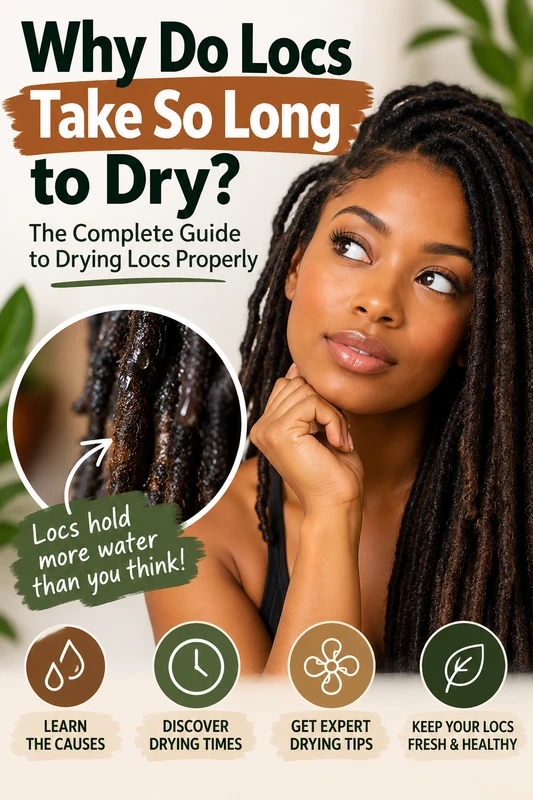
If you have locs, you may have noticed something surprising after wash day: your locs can stay wet for hours.
You wash your hair in the morning, squeeze out the excess water, towel-dry it, and several hours later your locs may still feel damp—especially in the middle.
So, why do locs take so long to dry?
The main reason is their structure. Unlike loose natural hair, locs are made from many strands of hair intertwined and compacted together. Water can travel deep inside a loc during washing, where it takes much longer to evaporate.
The thicker, longer, denser, and more mature your locs become, the more noticeable this can be.
Your drying routine matters too.
Product buildup, excessive oil, humid weather, thick locs, poor airflow, covering damp hair, and not removing enough water after washing can all increase drying time.
More importantly, locs that remain damp for too long can eventually develop an unpleasant musty odor.
That makes proper drying an important part of maintaining clean, fresh, healthy-looking locs.
In this complete guide, we'll explain:
- Why locs take so long to dry
- Why mature locs can hold so much water
- How long locs may take to dry
- How loc thickness affects drying time
- Why the outside can feel dry while the inside is still wet
- The best ways to dry locs faster
- Common drying mistakes to avoid
- How to prevent musty-smelling locs
- How to build a better wash-day routine
Let's get started.
Why Do Locs Take So Long to Dry?
The biggest reason is simple:
Locs are dense.
Think about the difference between a single loose strand of hair and hundreds of strands compressed together.
With loose natural hair, individual strands are more exposed to the surrounding air. After washing, water has many opportunities to evaporate from those exposed surfaces.
A mature loc is different.
Hundreds or even thousands of individual hairs may be intertwined within a relatively small space.
During washing, water doesn't simply wet the outside.
It can move between the intertwined hairs and penetrate deeper into the loc.
Once that happens, the moisture trapped near the center has less exposure to moving air.
The outside therefore dries first.
The center dries last.
This is why touching the surface of your locs isn't always an accurate way to determine whether they're completely dry.
You may think:
"My locs feel dry."
But squeeze a thick loc several hours later and you may discover that the center is still cool or damp.
That's completely different from simply having a little surface moisture.
1. Thick Locs Hold More Water
Loc thickness is one of the biggest factors affecting drying time.
Generally, a very small loc has less internal mass than a thick traditional loc.
The thicker the loc becomes, the farther moisture trapped near its center must travel before it can evaporate.
Think about drying two towels.
One towel is extremely thin.
The other is folded over itself several times.
Even if both contain a similar material, the folded towel usually takes considerably longer to dry because water is trapped between layers.
Your locs can behave similarly.
This is why people with:
- Thick locs
- Wicks
- Large traditional locs
- Very dense mature locs
may need to pay especially close attention to drying.
The surface isn't the only area that matters.
You want the entire loc to dry.
2. Mature Locs Can Be Very Dense
Starter locs and mature locs don't have exactly the same structure.
During the early stages of the loc journey, the hair may still be relatively loose, fluffy, or open.
Over time, the hair tangles, mats, intertwines, and becomes increasingly compact.
That's part of the maturation process.
If you're still early in your journey, our guide to why locs may take time to mature explains the maturation process in greater detail.
As locs mature, their compact structure can make them extremely strong.
But that same density can also mean water has more difficulty escaping from the center.
This doesn't mean mature locs shouldn't be washed.
Clean hair and a clean scalp remain important.
It simply means your drying routine needs to evolve with your locs.
The routine that worked when your locs were six months old may not be enough several years later when they're thicker, longer, and more compact.
3. Long Locs Naturally Take More Time to Dry
Length also matters.
Imagine someone with locs reaching only a few inches from the scalp.
Now compare that with someone whose locs reach their waist.
There is simply much more wet hair to dry.
Long locs can also become extremely heavy when saturated.
After washing, water may remain trapped throughout the length of each loc.
This makes it especially important to remove as much excess water as possible before beginning the actual drying process.
Don't violently wring your locs like a wet towel.
Instead, gently squeeze sections of locs to encourage excess water to drain.
Then use an absorbent microfiber towel or clean soft T-shirt to remove additional moisture.
Every bit of excess water you remove safely at the beginning can shorten the remaining drying process.
4. Your Hair Density Matters Too
Loc thickness and overall hair density aren't exactly the same thing.
Someone can have relatively small locs but a large number of them.
If your scalp contains many locs packed closely together, airflow between them may be limited.
The roots can remain damp because surrounding locs block air circulation.
This is especially noticeable near areas where locs naturally cluster together.
You may notice that the ends feel completely dry while the roots remain damp.
When drying your hair, therefore, don't focus exclusively on the ends.
Pay attention to:
- Roots
- Crown
- Back of the head
- Areas behind the ears
- Locs near the nape
- Thick individual locs
Separate sections periodically so air can reach areas that would otherwise remain covered.
5. Locs Absorb Water During Washing
Have you ever noticed how heavy your locs become in the shower?
That's because they can absorb and retain a considerable amount of water.
At the beginning of your shower, water may initially run across the surface.
As you continue saturating the hair, water penetrates farther into the locs.
This is actually important for cleansing.
You want enough water moving through the locs to help shampoo loosen and remove sweat, oil, residue, and debris.
In our complete guide on how often you should wash locs, we explain why thoroughly saturating and rinsing locs is an important part of wash day.
But once your locs become fully saturated, all that water eventually has to come back out.
And that's where patience becomes important.
6. Product Buildup Can Make Drying More Difficult
Another possible contributor to slow-drying locs is product buildup.
Locs can trap substances inside their structure.
These may include:
- Heavy oils
- Waxes
- Thick creams
- Butters
- Styling gels
- Pomades
- Conditioner residue
- Shampoo residue
- Environmental debris
Repeatedly applying heavy products without thoroughly cleansing them away can leave the loc coated internally and externally.
That coating can interfere with the way water moves through the hair and may contribute to locs feeling heavy, coated, or stiff.
This is one reason we generally recommend keeping a loc routine relatively simple.
More product doesn't automatically mean healthier hair.
If you're concerned about residue, read our guide to why locs feel stiff and how to make them soft again.
Clean, properly moisturized locs generally don't need layer after layer of heavy styling products.
7. Heavy Oils Can Work Against You
Oil can have a place in a loc-care routine, but excessive amounts can create problems.
One common mistake is repeatedly applying oil because locs feel dry.
The person applies oil.
The loc still feels dry.
So they apply more oil.
Eventually, the loc may become heavily coated without actually feeling properly hydrated.
Remember:
Oil and water aren't the same thing.
If your locs need hydration, consider a lightweight, water-based moisturizing approach instead of automatically reaching for another layer of oil.
Our complete guide to moisturizing locs properly explains the difference in greater detail.
Heavy product layering can also make wash day more difficult because those products need to be thoroughly removed.
8. Humidity Can Slow Evaporation
Sometimes your routine isn't the main problem.
The weather can affect drying time too.
Water evaporates more slowly when the surrounding air already contains substantial moisture.
That's why locs may dry differently depending on:
- Humidity
- Temperature
- Indoor ventilation
- Season
- Air movement
You might find that your locs air-dry reasonably quickly on a warm, dry day but take much longer during humid weather.
Indoor conditions matter as well.
Sitting in a warm room with good air circulation is different from sitting in a cool, damp bathroom immediately after your shower.
When air-drying, improve circulation around the hair whenever possible.
9. Tying Wet Locs Together Slows Drying
This is an extremely common mistake.
You finish washing your locs and immediately pull them into a ponytail or bun.
That may be convenient, but you're grouping wet locs together.
Now less air can circulate around each individual loc.
Instead, allow freshly washed locs to hang relatively freely while they're drying.
If necessary, divide them into loose sections so air can reach the roots.
Avoid compressing soaking-wet locs into tight hairstyles.
Give them room to breathe.
10. Covering Damp Locs Can Trap Moisture
Another habit to avoid is covering wet locs for long periods.
Putting on a bonnet, durag, scarf, hat, hood, or other covering while your locs are still very damp can restrict airflow.
This is especially important at night.
Don't assume that putting a satin bonnet over wet locs solves the problem because satin is good for protecting hair.
Satin is useful for reducing friction against dry hair.
But wet locs still need to dry.
Allow them to dry thoroughly before covering them for the night whenever possible.
Why You Shouldn't Go to Bed With Wet Locs
Sometimes wash day runs later than expected.
You look at the clock and realize it's almost midnight.
Your locs are still wet.
Going directly to sleep may be tempting.
But regularly sleeping with wet locs isn't a good drying strategy.
Your head presses against your pillow for hours.
The locs at the back and sides of your head become compressed between your scalp and pillow.
Airflow is dramatically reduced.
The hair may remain damp much longer than it would if you were awake with your locs exposed.
That's why scheduling can make a major difference.
Whenever possible, wash locs earlier in the day.
Give yourself several hours for drying instead of beginning wash day shortly before bed.
Can Wet Locs Develop a Musty Smell?
Yes.
Locs that remain damp internally for extended periods can develop an unpleasant musty odor.
This can be confusing because someone may have washed their hair thoroughly.
They think:
"How can my freshly washed locs smell bad?"
The problem may not be that the locs weren't washed.
They may not have been dried completely.
Repeatedly allowing dense locs to remain damp for very long periods can create conditions where odor becomes more likely.
This is one reason thorough drying should be considered part of wash day—not an optional step after wash day.
Your wash routine isn't finished simply because you rinsed out the shampoo.
It's finished when your locs are clean and dry.
How Long Do Locs Take to Dry?
There isn't one universal drying time.
It depends on several variables:
- Loc thickness
- Loc length
- Number of locs
- Hair density
- Loc maturity
- Amount of water retained
- Products in the hair
- Drying method
- Temperature
- Humidity
- Air circulation
Small, shorter locs may dry relatively quickly.
Very long, thick mature locs can take several hours or potentially much longer to become completely dry when relying only on air-drying.
Instead of focusing exclusively on a specific number of hours, focus on the result.
Are your locs actually dry throughout?
That's more important than following someone else's exact drying schedule.
Why Do My Locs Feel Dry Outside but Wet Inside?
Because drying occurs from the exposed surfaces inward.
The outer hairs have direct contact with air.
Moisture evaporates from them first.
The center of a thick loc has considerably less airflow.
Water trapped there must gradually migrate outward before evaporating.
That's why a loc can feel dry when you lightly touch the surface while still containing moisture internally.
Thicker locs deserve extra attention for this reason.
Gently squeeze several of your thickest locs.
Check areas close to the roots.
If they feel cool, heavy, or damp internally, continue drying.
The Best Way to Dry Locs After Washing
Now let's build a better drying routine.
Step 1: Rinse Extremely Well
Before worrying about drying, make sure your locs are thoroughly rinsed.
Shampoo or conditioner residue trapped inside locs can contribute to buildup.
Allow plenty of clean water to move through your hair.
Don't rush the final rinse.
Step 2: Gently Squeeze Out Water
Once you turn off the shower, don't immediately wrap dripping-wet locs in a towel.
Divide them into sections.
Gently squeeze each section from higher up toward the ends.
You're trying to remove free water without aggressively twisting or pulling the hair.
Repeat several times if necessary.
You'll be surprised how much water comes out.
Step 3: Use an Absorbent Towel
A microfiber towel can help remove substantial surface water.
A clean, soft T-shirt can also work.
Press and squeeze.
Avoid aggressive rubbing.
Rough towel-drying can increase frizz and unnecessary friction.
Traditional fuzzy towels can also contribute fibers to the hair.
That's especially relevant because lint can become embedded in mature locs.
For more prevention tips, see our guide to why locs collect lint and how to prevent it.
Step 4: Separate Your Locs
Don't leave all your wet locs piled together.
Separate them so air can circulate.
Pay particular attention to the roots.
You can periodically move the locs from one side to another while drying.
The goal is exposure.
The more air that can circulate around the hair, the easier evaporation becomes.
Step 5: Air-Dry When You Have Enough Time
Air-drying can work perfectly well for many people.
The key is allowing enough time.
Wash earlier in the day.
Keep your locs loose.
Sit in a well-ventilated area.
Allow air to move around the roots and lengths.
If your locs are extremely thick or long, air-drying alone may take considerable time.
Plan accordingly.
Can You Use a Hooded Dryer on Locs?
A hooded dryer can be extremely helpful, especially for thick or mature locs.
The advantage is that it provides consistent airflow around the entire head.
This can be especially useful for the roots and middle sections.
You don't need to blast your hair with extreme heat.
Moderate warmth and sufficient airflow can be more useful than excessive temperature.
Drying should be effective without making your scalp painfully hot or leaving your hair feeling scorched.
If your locs are long, reposition them periodically so the ends and lower sections receive adequate airflow too.
Can You Use a Blow Dryer on Locs?
Yes, a blow dryer can help.
Again, you don't need the hottest possible setting.
Use comfortable heat and airflow.
Move the dryer around instead of holding intense heat on one location for an extended period.
Separate locs into sections and concentrate on areas that retain moisture.
A diffuser attachment may also help distribute airflow.
For very thick locs, however, remember that drying the surface isn't enough.
Continue until the inside has had sufficient time to dry too.
Should You Use High Heat to Make Locs Dry Faster?
Faster isn't always better.
Extremely high heat can dry the outer surface quickly while making hair feel excessively dry.
Your goal isn't to cook the water out of your locs.
It's to encourage steady evaporation.
Think:
airflow + time + moderate warmth
rather than:
maximum heat.
If your locs regularly feel hard, rough, or brittle after drying, excessive heat may be one factor worth examining.
Our guide to why locs feel hard and brittle covers other potential causes.
How to Make Locs Dry Faster
If drying takes all day, make a few adjustments.
Remove More Water First
Don't go directly from the shower to air-drying.
The more free water you gently squeeze and blot away, the less water needs to evaporate.
Wash Earlier
Give yourself time.
Morning or early-afternoon wash days are usually easier than late-night wash days.
Increase Airflow
A fan, open environment, hooded dryer, or blow dryer can improve evaporation.
Separate the Locs
Don't keep them bundled together.
Focus on the Roots
The roots are easily overlooked and may remain damp underneath layers of locs.
Avoid Heavy Products Immediately
Don't coat freshly washed, soaking-wet locs with large amounts of oil, butter, cream, or wax.
Keep your routine light.
Don't Cover Them Too Soon
Wait until your locs are completely dry before putting on your nighttime covering.
Moisturizing Locs Without Creating Heavy Buildup
Drying your locs properly doesn't mean you should allow them to become chronically dry.
Locs still need appropriate moisture.
The key is choosing products and amounts that work with locs rather than constantly coating them.
Featured Hairobics Product: Raaw Roots Antiseptic Moisturizer Spray
For people looking for a convenient way to refresh locs between wash days, Hairobics All Natural Raaw Roots Antiseptic Moisturizer Spray is designed for locs, braids, twists, and natural hair.
Its spray format makes it easy to apply moisture without having to coat locs with thick creams and heavy butters.
Use an appropriate amount rather than completely saturating your locs every time you moisturize.
Remember that moisture maintenance and wash-day saturation are different things.
Your locs don't need to become soaking wet every time you refresh them.
If dryness continues to be a problem, read our guide on why locs become dry and how to fix them.
Common Loc-Drying Mistakes
Even people who have had locs for years can develop drying habits that aren't ideal.
Avoid these common mistakes:
Washing Right Before Bed
This gives thick locs very little time to dry.
Assuming Surface Dryness Means Complete Dryness
Always remember that the center dries more slowly.
Immediately Putting Wet Locs Into a Bun
Bundling locs reduces airflow.
Covering Damp Locs
Scarves, bonnets, hats, and durags can trap moisture when worn too early.
Using Too Much Product
Heavy product layers can contribute to buildup and make your loc-care routine unnecessarily complicated.
Ignoring the Roots
Ends may dry before the roots.
Check both.
Using Extreme Heat
You need effective drying—not excessive heat.
Rubbing With a Rough Towel
Squeezing and blotting are generally gentler.
A Simple Wash-Day Drying Routine
Here's an easy routine you can follow.
Morning: Wash and thoroughly rinse your scalp and locs.
Immediately afterward: Gently squeeze excess water from your locs in sections.
Next: Blot and squeeze with a clean microfiber towel or soft T-shirt.
Then: Separate the locs and allow them to hang freely.
During drying: Use air circulation, a hooded dryer, or comfortable blow-dryer airflow when needed.
Later: Check your roots and several of your thickest locs for internal dampness.
Only after they're dry: Style, tie up, or cover your locs for the night.
Simple.
You don't need a 15-product routine.
You need clean locs, adequate moisture, sufficient airflow, and enough drying time.
Frequently Asked Questions About Drying Locs
Why do my locs take all day to dry?
Your locs may be thick, long, mature, or densely packed. These characteristics allow them to hold substantial amounts of water internally. Humidity, limited airflow, heavy products, and your drying technique can further increase drying time.
Do thicker locs take longer to dry?
Generally, yes. Thick locs have more internal hair mass, meaning water trapped near the center has farther to travel before evaporating.
Do mature locs take longer to dry?
They can. Mature locs tend to become increasingly compact, which can allow moisture to remain inside even after the surface feels dry.
Is it okay to let locs air-dry?
Yes, provided they have enough time and airflow to dry thoroughly. People with extremely thick or long locs may find that a hooded dryer or blow dryer helps complete the process.
Can I sleep with slightly damp locs?
It's better to allow locs to dry completely whenever possible. Sleeping compresses the hair against the pillow and reduces airflow, potentially allowing internal moisture to remain much longer.
Why do my locs smell after washing?
If freshly washed locs develop a musty smell, one possibility is that they remained damp internally for too long. Make thorough drying part of every wash day.
How do I know if my locs are completely dry?
Don't judge only by the outside. Check the roots and gently squeeze some of your thickest locs. They shouldn't feel unusually cool, heavy, or damp internally.
Can I put oil on wet locs?
A small amount may work for some routines, but avoid heavily coating soaking-wet locs. Excess product can contribute to residue and unnecessary weight. Let your routine stay lightweight.
Should I towel-dry my locs?
Yes, but use a gentle technique. Squeeze and blot with an absorbent microfiber towel or soft T-shirt rather than aggressively rubbing the locs.
Why are my roots still wet when my ends are dry?
The roots often receive less airflow because neighboring locs overlap and cover them. Separate sections during drying so air can circulate near the scalp.
Can product buildup make locs take longer to dry?
Heavy layers of waxes, creams, butters, oils, and other residue can change how water moves through your locs and make them feel heavy or coated. Keeping buildup under control is an important part of maintaining locs.
Final Thoughts: Give Your Locs Enough Time to Dry
So, why do locs take so long to dry?
It mainly comes down to structure.
A loc isn't one strand of hair.
It's a dense collection of intertwined hairs capable of holding water deep inside.
The thicker, longer, denser, and more mature your locs become, the more important your drying routine becomes.
Remember the basics:
Wash thoroughly.
Rinse completely.
Gently squeeze out excess water.
Blot with an absorbent towel.
Separate your locs.
Increase airflow.
Avoid bundling or covering wet hair.
Give thick locs enough time to dry internally.
And whenever possible, don't wait until bedtime to wash your locs.
Proper drying isn't just about convenience.
It's part of maintaining clean, fresh, healthy-looking locs.
Keep Your Locs Fresh and Moisturized With Hairobics All Natural
After your locs are properly cleaned and dried, keeping them appropriately moisturized can help them remain soft, flexible, and easier to maintain.
Hairobics All Natural Raaw Roots Antiseptic Moisturizer Spray provides a lightweight way to refresh locs, braids, twists, and natural hair without relying on layers of thick creams or heavy styling products.
A healthy loc routine doesn't need to be complicated.
Clean thoroughly. Dry completely. Moisturize lightly. Protect consistently.