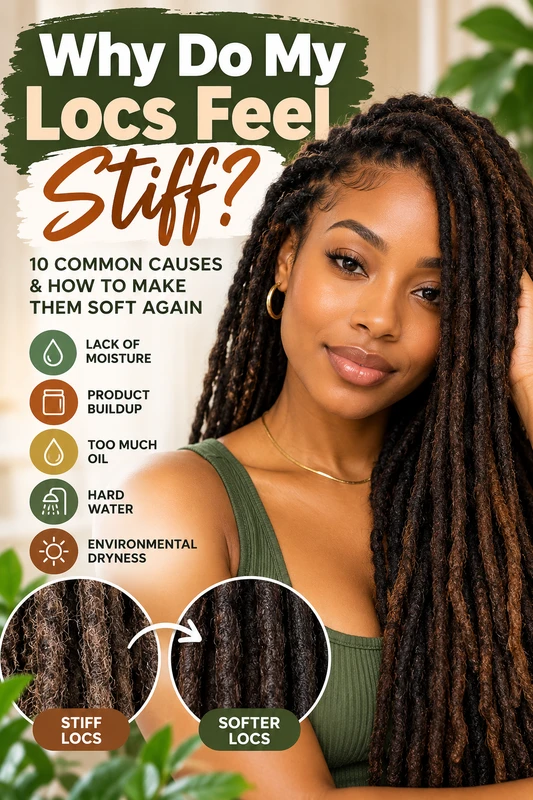
Locs can look strong and healthy while still feeling surprisingly stiff, rough, hard, or crunchy. Maybe your locs no longer move as freely as they used to. Perhaps they feel especially stiff after washing, or they soften temporarily after moisturizing only to become hard again a few hours later.
So, why do my locs feel stiff?
In many cases, stiff locs are caused by lack of moisture, product buildup, hard-water minerals, excessive oil, harsh cleansing, environmental dryness, or products that coat the hair instead of hydrating it.
Mature locs naturally become more compact as they develop, but mature does not have to mean rock-hard. Healthy locs should generally have some flexibility and movement. If your locs suddenly feel noticeably stiffer, rougher, or more brittle than usual, your routine may need an adjustment.
The good news is that you don't necessarily need a complicated loc routine or dozens of products.
This guide explains the most common reasons locs become stiff, how to tell the difference between normal loc firmness and excessive dryness, and what you can do to help your locs feel softer and more flexible again.
What Should Healthy Locs Feel Like?
There isn't one universal texture that every healthy set of locs should have.
Your locs can feel different depending on:
- Hair texture
- Loc size
- Loc maturity
- Hair density
- Products used
- Moisture level
- Climate
- Color treatments
- Washing routine
Starter locs often feel much softer and fluffier because the individual hairs haven't completely intertwined.
As locs mature, they naturally become more compact.
That increased firmness is normal.
However, there is a difference between firm mature locs and excessively stiff locs.
Healthy mature locs should generally still have some flexibility when you bend or move them. Locs that feel extremely hard, crunchy, straw-like, unusually rough, or brittle may be telling you that they need attention.
If stiffness is accompanied by snapping or breakage, it becomes even more important to identify the cause.
For a deeper look at this problem, read our guide on why locs feel hard and brittle.
10 Reasons Your Locs May Feel Stiff
Several different issues can produce the same stiff feeling. Before applying more products, try to determine what's actually happening.
1. Your Locs Need More Moisture
Dryness is one of the first things to consider when locs begin feeling stiff.
Hair needs water-based hydration to remain flexible.
When locs continually lose moisture without having it replenished, they may gradually begin feeling:
- Rough
- Hard
- Dry
- Dull
- Crunchy
- Brittle
- Less flexible
This is particularly noticeable toward the ends because the ends are the oldest part of your hair.
One common mistake is waiting until locs become extremely dry before moisturizing them.
Instead, pay attention to how your locs feel throughout the week.
Do they move easily?
Do the ends feel soft?
Do they feel rough shortly after wash day?
Your hair can often tell you when your current routine isn't providing enough hydration.
If dryness is an ongoing problem, our article on why your locs are dry and how to fix it explains the issue in greater detail.
2. You're Using Oil Instead of Moisture
This is one of the biggest sources of confusion in loc care.
Oil and water do different things.
Applying oil can lubricate hair, add shine, and help reduce friction, but repeatedly applying oil to dry locs doesn't necessarily give the hair the water-based hydration it's missing.
Imagine having dry skin and continually applying an oily coating without addressing hydration.
Your hair can experience something similar.
You may end up with locs that are:
oily on the outside but still stiff underneath.
This can lead people into a cycle:
Locs feel dry → add oil → locs still feel stiff → add more oil → locs become coated → moisture has an even harder time reaching the hair.
Instead of automatically reaching for another oil whenever your locs feel stiff, consider whether they actually need lightweight, water-based moisture.
Learn more about the difference between the two in our guide on how to moisturize locs properly.
3. Product Buildup Is Making Your Locs Hard
If your locs feel heavy, coated and stiff at the same time, buildup should be high on your list of possible causes.
Locs are different from loose hair.
Individual strands are intertwined inside the loc. Products that don't rinse away easily can gradually become trapped within that structure.
Common sources of buildup include:
- Wax
- Thick gels
- Heavy creams
- Butters
- Pomades
- Excessive oil
- Edge-control products
- Shampoo that wasn't completely rinsed out
Using one of these products once doesn't automatically cause a problem.
The issue is repeated layering.
For example, suppose you moisturize your locs every day but rarely cleanse them thoroughly. Every application can leave a small amount of residue behind.
After weeks or months, those small amounts can add up.
Your locs may begin feeling harder and heavier.
You might also notice dullness or visible residue.
At that point, adding even more moisturizer may not solve the underlying problem.
You may need to remove the buildup first.
4. You're Using Too Much Oil
Oil can have a place in a loc routine, but more isn't automatically better.
Continually saturating locs with oil can make them:
- Heavy
- Greasy
- Sticky
- Coated
- Difficult to cleanse
- More likely to attract lint and debris
It can also contribute to that strange combination where locs feel oily but somehow still dry and stiff.
If you've been oiling your scalp or locs every day, consider reducing the amount.
You don't need your locs dripping with oil.
Our complete guide on how often you should oil your scalp explains why the right amount depends on your individual scalp and routine.
5. Hard Water May Be Coating Your Locs
Does your hair feel unusually stiff after washing it?
The problem may not be your moisturizer.
It could be your water.
Hard water contains higher concentrations of dissolved minerals, particularly calcium and magnesium.
Over time, mineral deposits can accumulate on hair.
Because locs contain densely intertwined strands, mineral buildup can become particularly frustrating.
You might notice:
- Stiff locs
- Rough texture
- Dullness
- Reduced softness
- Hair that doesn't seem to absorb moisture easily
- Locs that feel coated after washing
If your locs feel significantly different after moving to another home or city, changing shower water may be one factor worth investigating.
A shower filter may help with some water contaminants, although not every basic shower filter actually softens hard water.
For significant mineral buildup, talk with an experienced loctician about an appropriate clarifying or chelating routine rather than repeatedly using aggressive DIY treatments.
6. You're Not Washing Your Locs Enough
Some people with locs are afraid of washing too frequently.
This is especially common during the starter-loc stage because people worry about unraveling.
But avoiding cleansing for too long can create another problem:
buildup.
Your scalp and locs accumulate:
- Sweat
- Sebum
- Dead skin
- Dust
- Environmental debris
- Hair products
When these materials combine with oils and styling products, locs can begin feeling coated and stiff.
There isn't one perfect washing schedule for everyone. Your lifestyle, scalp, loc maturity, exercise habits and product usage all matter.
For established locs, approximately every 1–2 weeks can be a practical starting point for many people, although your individual routine may differ.
Read our detailed guide on how often you should wash locs to help determine a schedule that works for you.
7. You're Washing Your Locs Too Aggressively
The opposite problem can happen too.
If you shampoo very frequently with a strong cleanser, your locs may feel extremely dry afterward.
Pay attention to how your hair responds on wash day.
Do your locs feel:
- Extremely rough?
- Squeaky?
- Tangled?
- Straw-like?
- Stiffer immediately after drying?
If so, look at your cleansing routine.
A clarifying shampoo can be useful when you genuinely need to remove buildup, but that doesn't mean you need aggressive clarification every few days.
Your regular wash routine should remove sweat, dirt, oil and product residue without leaving your hair unnecessarily dry.
8. Shampoo May Still Be Inside Your Locs
This is easy to overlook.
Locs can hold onto products because of their dense structure.
If shampoo isn't rinsed out completely, residue can remain behind after your hair dries.
That residue may contribute to:
- Stiffness
- Dullness
- Flaking
- Itching
- A coated texture
Don't rush your rinse.
Allow water to move completely through your locs and gently squeeze sections while rinsing.
Watch the runoff.
If you still see suds appearing when you squeeze your locs, keep rinsing.
Sometimes improving your rinse technique makes a bigger difference than buying another product.
9. Weather Can Make Locs Feel Stiffer
Your environment affects how quickly hair loses moisture.
Locs may become noticeably drier during periods of:
- Cold weather
- Low humidity
- Strong wind
- Intense sun exposure
- Indoor heating
- Constant air conditioning
You may therefore need to change your moisturizing frequency during different seasons.
The routine that works during humid summer weather may not provide enough hydration during winter.
Instead of following exactly the same routine 365 days a year, pay attention to your hair.
10. Chemical Processing or Hair Color Can Contribute to Dryness
Colored locs can look incredible, but chemical processing may change the condition of the hair.
Bleaching and certain coloring processes can increase dryness and weaken hair if they're not handled properly.
Processed locs may require more careful moisture management.
Pay particular attention to:
- Ends
- Previously lightened sections
- Weak areas
- Areas that feel dramatically rougher than the rest
If you're experiencing substantial breakage following chemical processing, consider consulting a professional who has experience working with colored locs.
Are Stiff Locs the Same as Mature Locs?
No.
This distinction is important.
Mature locs naturally become firmer and more compact as the strands intertwine.
That doesn't necessarily mean something is wrong.
However, maturity alone shouldn't automatically make your locs feel extremely brittle.
Ask yourself:
Have my locs always felt this way, or is this new?
A sudden texture change provides an important clue.
For example:
If your locs felt flexible six months ago and now feel unusually hard, examine what changed.
Did you:
- Start using a new gel?
- Increase your oil usage?
- Stop moisturizing regularly?
- Change shampoos?
- Move somewhere with different water?
- Start coloring your hair?
- Begin swimming frequently?
- Start spending more time in the sun?
- Stop covering your locs at night?
Your answer may reveal the cause.
How to Make Stiff Locs Feel Softer
Once you've identified likely causes, you can begin simplifying and rebuilding your routine.
Step 1: Start With Clean Locs
Don't continuously layer moisturizing products over months of residue.
Clean your locs appropriately.
Concentrate shampoo primarily on your scalp while allowing the lather and water to travel through the locs.
If substantial buildup is present, you may need a deeper cleansing approach.
However, aggressive DIY detoxing isn't something you necessarily need to do routinely. If buildup appears deeply embedded in mature locs, an experienced loctician can help determine the safest approach.
Step 2: Rinse Extremely Well
Take your time.
Locs can hold shampoo much longer than loose hair.
Rinse until the water runs clear and you're confident the product has been removed.
This simple step can prevent another layer of residue from being left behind.
Step 3: Dry Your Locs Properly
After washing, remove excess water gently.
Don't aggressively rub your locs with a rough towel.
Depending on the thickness and length of your locs, drying may take considerable time.
Most importantly, make sure your locs dry completely.
Thick locs can retain moisture internally much longer than the outside appearance suggests.
Step 4: Introduce Lightweight Moisture
After you've addressed buildup, concentrate on hydration rather than coating the hair in heavy products.
This is where a lightweight water-based moisturizing product can be useful.
Hairobics offers the Raaw Roots Locs & Braids Moisturizer Spray, formulated specifically for locs, braids and natural hair.
The formula begins with purified water and contains a blend of botanical ingredients and oils including jojoba, rosemary, almond, apricot kernel and castor oils.
Instead of saturating your locs, lightly apply the spray where moisture is needed and work it into the hair.
The goal is soft, flexible locs—not wet, product-coated locs.
Step 5: Give Extra Attention to Your Ends
The ends of your locs are the oldest hair on your head.
They're exposed to:
- Clothing
- Bedding
- Sun
- Wind
- Styling
- Washing
- Everyday friction
That means the ends may become rough before the rest of the loc.
When moisturizing, don't automatically concentrate everything around your roots.
Feel the length of your locs.
If the ends feel dry, give them some attention too.
Step 6: Stop Layering Heavy Products
If you're trying to fix stiff locs, simplify.
You probably don't need:
Water + moisturizing spray + cream + butter + gel + wax + multiple oils.
Using everything at once makes it difficult to determine what your hair actually responds to.
It also increases the possibility of residue.
A simpler routine might be:
Cleanse → hydrate → lightly seal if needed → protect.
Then monitor how your locs respond.
Step 7: Protect Your Locs at Night
Nighttime friction can contribute to moisture loss and roughness.
Cotton bedding can absorb moisture from your hair while your locs rub against the pillow.
Consider sleeping with:
- A satin bonnet
- Satin scarf
- Silk scarf
- Satin pillowcase
People with very long locs may find an extra-long bonnet particularly convenient because it keeps the entire length protected.
How Often Should You Moisturize Stiff Locs?
There is no universal number.
Some locs may respond well to light moisturizing every couple of days.
Others need less frequent application.
Climate matters too.
Instead of automatically applying product every morning, perform a quick loc check.
Touch several locs.
Ask:
Do they feel flexible?
Do they feel rough?
Are the ends dry?
Does the hair feel coated?
If your locs feel soft and flexible, you may not need more product.
If they feel dry and rough, light hydration may help.
Our article on how to fix hair that won't hold moisture can help if your locs repeatedly become dry soon after moisturizing.
Can Too Much Moisture Be a Problem?
Yes.
Healthy loc care is about balance.
Constantly soaking mature locs without allowing them to dry properly isn't a good solution to stiffness.
Locs are dense.
The outside can feel dry while the inside remains damp.
That's why you want enough hydration to maintain flexibility without keeping your locs continually wet.
Moisturize lightly and allow your hair to dry properly.
Should You Detox Stiff Locs?
Not automatically.
Stiffness doesn't always equal buildup.
If your locs are stiff because they're dehydrated, an aggressive detox may make them feel even drier.
Consider buildup more strongly when stiffness is accompanied by:
- Heavy feeling
- Visible residue
- Sticky texture
- Dull coating
- Products that no longer seem to absorb
- Long-term wax or gel use
If your locs simply feel dry and lightweight, hydration may be the more obvious issue.
That's why identifying the cause matters before choosing the treatment.
How Can You Prevent Stiff Locs?
Prevention is much easier than trying to correct years of accumulated residue.
Build your routine around a few basic principles.
Keep your locs clean.
Don't allow months of sweat, oil and styling products to accumulate.
Use lightweight moisture.
Your locs need hydration, but they don't need to be smothered in product.
Use oil strategically.
More oil isn't necessarily more moisture.
Avoid unnecessary product layering.
Simple routines generally make buildup easier to control.
Rinse thoroughly.
Shampoo residue shouldn't be left inside your locs.
Dry completely after washing.
Pay particular attention to thick or long mature locs.
Protect your hair at night.
Reduce friction and unnecessary moisture loss.
Pay attention to changes.
If your locs suddenly become stiff, investigate what's changed rather than automatically applying more products.
For a broader maintenance routine, read our Ultimate Loc Maintenance Guide.
Signs Stiffness May Be Turning Into Breakage
Stiffness itself doesn't necessarily mean your locs are damaged.
However, extremely dry hair can become more vulnerable to breakage.
Pay closer attention if you're noticing:
- Locs snapping
- Weak spots along the loc
- Thinning sections
- Breaking ends
- Excessive shedding
- Locs becoming dramatically narrower
- Hair breaking near the roots
Don't simply keep adding oil to a loc that's structurally weakening.
Investigate tension, moisture, retwisting frequency, product buildup and the condition of the hair.
If thinning is becoming noticeable, early intervention is especially important.
Frequently Asked Questions About Stiff Locs
Why do my locs feel stiff after washing?
Several factors are possible.
Your shampoo may be too harsh, shampoo may not have been completely rinsed out, hard-water minerals may be coating your hair, or your locs may need moisture after cleansing.
Consider when the stiffness begins.
If they're flexible before shampooing but extremely stiff every time they dry after washing, examine your wash-day routine first.
Why are my locs stiff even though I oil them?
Because oil isn't the same thing as water-based hydration.
You can have oily locs that still feel dry.
Try evaluating whether your locs need lightweight hydration rather than another layer of oil.
Why do my locs feel hard and heavy?
Hardness combined with heaviness can indicate product accumulation.
Heavy waxes, creams, gels, oils and butters can gradually build up inside locs.
A thorough cleansing routine may help.
Should mature locs feel hard?
Mature locs naturally become compact and firm, but they should not necessarily feel excessively brittle or crunchy.
Firmness and brittleness are different.
How do I soften stiff locs naturally?
Start by identifying the cause.
If they're dirty or coated, cleanse them appropriately.
If they're clean but dehydrated, introduce lightweight water-based hydration.
Reduce heavy products and protect the hair at night.
Can hard water make locs stiff?
Yes. Mineral deposits can accumulate on hair and may contribute to a coated, rough or stiff feeling.
If your stiffness began after moving or changing water sources, consider investigating your water quality.
Can too much gel make locs stiff?
Yes.
Strong-hold gels and repeated product application can leave locs feeling hard, especially when products aren't completely removed between retwists.
Use the smallest amount necessary and cleanse regularly.
Should I spray my locs with water every day?
Not everyone needs daily spraying.
Your climate, loc density, hair condition and drying time all matter.
Some people benefit from frequent light hydration, while others need it less often.
Let your hair's condition guide your frequency.
A Simple Routine for Softer, More Flexible Locs
If your current loc routine has become complicated, simplify it for several weeks.
Wash day: Clean your scalp and locs thoroughly and rinse extremely well.
After washing: Dry appropriately and apply lightweight moisture according to your hair's needs.
Between washes: Check your locs every few days. Lightly moisturize when they begin feeling dry rather than automatically piling on products.
Oil: Use modest amounts only when needed rather than saturating the hair daily.
Night: Protect your locs with satin or silk.
Next wash: Pay attention to whether your hair feels softer and whether less residue is present.
Consistency matters more than constantly changing products.
Final Thoughts: Why Do My Locs Feel Stiff?
If you've been wondering, "Why do my locs feel stiff?", don't immediately assume something is permanently wrong with your hair.
Start with the most common causes:
- Lack of moisture
- Excessive oil
- Product buildup
- Hard water
- Shampoo residue
- Harsh cleansing
- Environmental dryness
- Chemical processing
- Inadequate nighttime protection
Then simplify your routine.
Healthy loc care doesn't require coating your hair with product every day.
Focus on clean hair, lightweight hydration, minimal buildup, complete drying and consistent maintenance.
And remember that oil and moisture aren't interchangeable.
If your locs are dry, stiff and rough, repeatedly pouring oil over them may not address what they're actually missing. A lightweight water-based moisturizer can make more sense when hydration is the goal.
For an easy way to refresh dry locs between wash days, try Hairobics Raaw Roots Locs & Braids Moisturizer Spray. It is formulated for locs, braids and natural hair and can help keep hair moisturized, soft and manageable without relying on heavy waxes or creams.
The goal isn't simply locs that look shiny.
The goal is clean, flexible, moisturized locs that feel as healthy as they look.