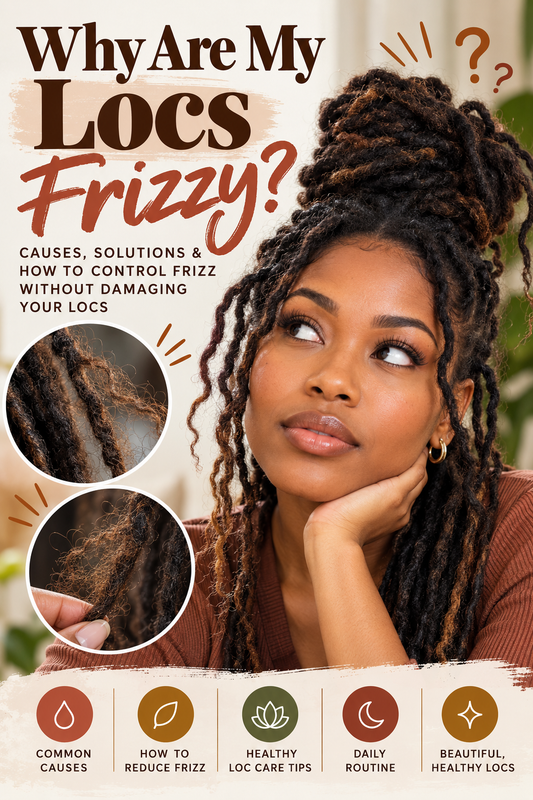
If you have locs, you've probably looked in the mirror at some point and wondered:
Why are my locs so frizzy?
Maybe you recently had a retwist, but loose hairs are already sticking out. Perhaps your roots look fuzzy only a few days after maintenance. Or maybe the entire length of your mature locs seems covered in frizz no matter what products you use.
The first thing to understand is that some frizz is completely normal with locs.
Locs are created as individual strands of hair intertwine, tangle, shed, and become incorporated into the loc. Because your hair is constantly growing and going through its natural cycle, every strand will not remain perfectly tucked inside a loc.
However, excessive frizz can sometimes be connected to dryness, humidity, washing techniques, frequent manipulation, friction, your loc stage, or the products you're using.
The goal shouldn't necessarily be to eliminate every loose hair.
Instead, the goal is to maintain healthy, moisturized, strong locs while keeping excessive frizz manageable.
In this complete guide, we'll explain why locs become frizzy, when frizz is completely normal, mistakes that can make frizz worse, and how to develop a simple routine that keeps your locs looking healthy without constantly retwisting them.
Is Frizz Normal With Locs?
Yes.
Frizz is a natural part of having locs.
In fact, trying to maintain perfectly smooth locs every single day can lead some people to over-manipulate their hair.
Your hair is constantly growing.
New hairs emerge from the scalp, while shorter hairs and previously shed strands may stick out from the surface of the loc.
This means even healthy mature locs can have some fuzziness.
Frizz is particularly common during the early stages of the loc journey.
If you're just beginning, read our Starter Locs Guide for a deeper explanation of how locs develop.
As starter locs mature, they go through several visual changes.
They may become:
- Puffy
- Fuzzy
- Uneven
- Frizzy
- Larger in certain areas
- Looser at the roots
- Tighter in other sections
That doesn't automatically mean something is wrong.
Your hair is changing structure.
Why Are My Locs Frizzy? 12 Common Reasons
Let's look at some of the biggest reasons you may be seeing more frizz.
1. Your Locs Are Still Maturing
If you have starter locs, frizz may actually be part of the locking process.
Loose strands must gradually intertwine with neighboring hairs.
During this process, the loc may not look perfectly cylindrical or smooth.
Instead, you might notice hairs sticking out along the entire loc.
You might also see budding or swelling.
Many people panic when their starter locs stop looking as neat as they did on the first day.
But remember:
Your original coils or twists are not the finished loc.
They're simply the foundation.
As your hair begins locking, its appearance changes.
You may even notice significant puffiness. Our guide explaining why new locs feel puffy covers this stage in greater detail.
Give your locs time.
Trying to force every loose hair back into place can create unnecessary manipulation.
2. Your Locs Are Dry
Dryness can make frizz considerably more noticeable.
When your hair lacks moisture, it can feel rough rather than flexible and soft.
You might notice:
- Rough locs
- Dull-looking hair
- Frizzy ends
- Flyaways
- Stiffness
- Brittleness
- Increased breakage
Your first reaction may be to add more oil.
But oil isn't the same thing as water-based moisture.
If your locs are dry, repeatedly coating them with heavy oil may make them greasy without addressing the hydration they're missing.
Our complete guide on how to moisturize locs properly explains how to build a balanced moisture routine.
You can also read Why Your Locs Are Dry and How to Fix It if dryness is one of your biggest loc concerns.
3. Humidity Is Making Your Locs Frizz
Humidity can dramatically change the appearance of textured hair.
Hair interacts with moisture in the surrounding air.
When humidity rises, your locs may appear:
- Puffier
- Fuzzier
- Less defined
- Less freshly retwisted
You might leave your loctician with smooth roots and notice fuzziness appearing shortly afterward on a humid day.
That doesn't necessarily mean your retwist was done incorrectly.
And it doesn't necessarily mean you need another retwist.
Weather affects hair.
The important thing is resisting the temptation to constantly manipulate your roots simply because humidity created a little frizz.
4. Washing Your Locs Can Create Temporary Frizz
Water causes your hair to swell.
Washing also loosens hairs that were temporarily lying flat against your locs.
After shampooing, your roots may look fuzzier.
This is especially common with starter locs.
Some people become afraid to wash their hair because they want to preserve the perfectly retwisted appearance.
That's not a good long-term strategy.
Clean locs are more important than permanently neat locs.
Your scalp still accumulates:
- Sweat
- Sebum
- Dead skin
- Dirt
- Environmental debris
- Styling products
Washing is an important part of loc maintenance.
If you're uncertain about your schedule, read our guide on how often you should wash locs.
A little temporary frizz after washing isn't necessarily a problem.
5. You're Rubbing Your Locs With a Towel
Your drying technique could be contributing to frizz.
Aggressively rubbing locs with a rough bath towel creates friction.
That friction can disturb loose hairs on the surface of the loc.
Traditional towels may also leave fibers behind.
Instead of aggressively rubbing your hair, gently squeeze or blot excess water.
A microfiber towel or clean, smooth T-shirt may create less friction.
This can also help reduce lint exposure.
If lint has become a problem, see our guide on why locs collect lint and how to prevent it.
6. You're Sleeping Without Protecting Your Locs
Your nighttime routine matters.
Think about what happens when you sleep.
For six, seven, or eight hours, your locs may repeatedly rub against your pillowcase, sheets, blankets, clothing, or headboard.
That creates friction.
Friction can encourage loose hairs and fuzziness.
Cotton bedding may also absorb some moisture from your hair.
Consider protecting your locs with:
- A satin bonnet
- Satin scarf
- Silk scarf
- Satin pillowcase
Long locs may need a larger bonnet or another protective method that prevents them from constantly rubbing against bedding.
Nighttime protection won't make every loose hair disappear, but reducing unnecessary friction can help your locs retain moisture and maintain a neater appearance.
7. You're Manipulating Your Locs Too Much
Do you constantly touch your locs?
Many people do it without realizing it.
You may:
- Twist them around your fingers
- Pull at the ends
- Separate them repeatedly
- Rub the roots
- Play with loose hairs
- Constantly restyle them
Occasional touching isn't going to destroy your hair.
But repeated manipulation creates friction.
Over time, excessive manipulation may contribute to more fuzziness and possibly breakage.
One of the advantages of locs is that they can be relatively low manipulation.
Allow them to be.
8. You're Retwisting Too Often
This is where appearance and hair health can come into conflict.
A fresh retwist can make the roots appear extremely neat.
When new growth starts becoming fuzzy again, you may immediately want another retwist.
But you shouldn't automatically retwist your hair every time you see frizz.
Constantly pulling, twisting, or tightening the same root area can place unnecessary stress on the hair.
A slightly fuzzy root is usually preferable to repeatedly stressing your hair just to maintain a freshly retwisted appearance.
Pay particular attention if you're also noticing:
- Tenderness
- Redness
- Thin roots
- Weak locs
- Breakage
- Receding areas
- Locs hanging from very small sections of hair
Those symptoms deserve more attention than cosmetic frizz.
If your roots appear to be getting thinner, read Why Are My Locs Thinning at the Roots?.
9. Your Styling Products May Be Making Things Worse
When people see frizz, they often apply more product.
Then more product.
Then even more.
This can become a cycle.
You might use:
- Thick gel
- Wax
- Edge control
- Heavy cream
- Butter
- Pomade
Your locs temporarily look smoother.
A few days later, frizz returns.
So you add another layer.
Over time, product residue can accumulate inside and around your locs.
Now instead of simply having frizz, you may have frizz plus buildup.
Locs don't need to be covered with heavy styling products to be healthy.
When choosing products, consider whether they rinse cleanly and whether you actually need them.
Sometimes a simpler routine is better.
10. Your New Growth Is Naturally Frizzy
Your roots aren't locs yet.
They're new hair.
Depending on your natural texture, density, curl pattern, humidity, activity level, and time since your last maintenance session, your new growth may appear very fluffy.
That's normal.
The hair growing from your scalp needs time before it becomes incorporated into your existing loc.
Don't mistake normal new growth for damaged hair.
A full, fuzzy root can actually look very different from a thinning root.
Thinning means the amount of hair supporting a loc is decreasing.
Frizz means individual hairs aren't lying perfectly smooth.
Those are two very different issues.
11. Exercise and Sweat Can Make Your Roots Fuzzy
If you exercise frequently, you may notice your retwist doesn't stay perfectly neat as long.
Sweat introduces moisture around your scalp.
Your roots can swell and revert toward their natural texture.
That's normal.
Don't avoid exercise just to preserve your hairstyle.
Instead, develop a loc routine that fits your lifestyle.
If you sweat heavily, you may need to cleanse your scalp more frequently than someone with a sedentary lifestyle.
Healthy hair care should work with your life—not control it.
12. Your Hair Texture Naturally Produces Frizz
Not everyone's locs will look the same.
Hair texture influences how locs form and mature.
Some people's locs naturally develop a smoother surface.
Others may have a softer, fuzzier appearance.
Hair density, strand thickness, curl pattern, loc size, maintenance method, and age of the locs can all affect their appearance.
This is why comparing your locs to someone's highly edited social-media picture can create unrealistic expectations.
Healthy locs do not have to be perfectly smooth.
How to Reduce Frizz in Locs Without Damaging Them
Now that you know what may be causing the frizz, let's talk about controlling it.
Step 1: Keep Your Locs Moisturized
Start with hydration.
When your locs become excessively dry, they can feel rough and frizz may become more noticeable.
Use a lightweight water-based moisturizer rather than constantly applying thick creams.
For a convenient way to refresh locs between wash days, consider Hairobics Raaw Roots Locs & Braids Moisturizer Spray.
It's designed for locs, braids, and natural hair and can be incorporated into a lightweight moisture routine without relying on thick waxes or heavy creams.
Lightly mist your locs rather than saturating them.
The goal is moisture—not soaking-wet hair.
Step 2: Stop Fighting Every Loose Hair
This may be one of the most important tips in this article.
You don't need to fix every loose hair.
If you constantly:
- Twist loose hairs
- Cut them
- Pull them
- Gel them
- Retwist them
- Crochet them
you can end up manipulating your locs far more than necessary.
Some loose hairs will eventually become incorporated into the loc.
Others may simply remain part of your loc's natural appearance.
Frizz doesn't automatically mean your hair needs fixing.
Step 3: Protect Your Locs at Night
Before bed, cover your hair.
A satin bonnet or scarf can reduce friction between your locs and bedding.
If bonnets constantly fall off, consider using a satin pillowcase as additional protection.
For long locs, make sure your nighttime covering is large enough that you're not tightly folding or compressing your hair every night.
Step 4: Wash Your Hair Properly
Don't stop washing your hair because you're afraid of frizz.
Instead, improve your technique.
When washing:
- Thoroughly wet your scalp and locs.
- Apply shampoo primarily around your scalp.
- Massage gently with your fingertips.
- Allow the cleanser to travel through the locs.
- Rinse thoroughly.
- Gently squeeze out excess water.
- Dry completely.
Avoid aggressively rubbing your locs together.
And don't scratch your scalp harshly with your fingernails.
A clean scalp should remain a priority even when you're trying to preserve a neat appearance.
How to Keep Frizz Down After Washing Locs
Wash day is one of the times frizz becomes most noticeable.
After washing, gently remove excess water instead of rubbing your locs.
Allow your hair to dry thoroughly.
Once your locs are no longer dripping wet, apply your normal lightweight moisture routine as appropriate.
Avoid immediately coating your locs with thick gel simply because washing loosened some hairs.
Remember:
Freshly washed locs may naturally look fuller and fuzzier than freshly retwisted locs.
That's okay.
Should You Retwist Frizzy Locs?
Not automatically.
The presence of frizz alone doesn't tell you it's time for maintenance.
Consider:
- How long it's been since your previous retwist
- The condition of your roots
- Your loc maturity
- Your maintenance method
- Your scalp health
- Whether your locs are thinning
- Whether you have significant new growth
If you're constantly retwisting because you can't tolerate seeing loose roots, you may be prioritizing neatness over the long-term condition of your hair.
Give your roots appropriate time between maintenance sessions.
Should You Cut Frizz Off Your Locs?
Be careful.
Those fuzzy hairs are still part of your hair.
Constantly trimming the outside of a loc simply to make it appear smooth can gradually remove hair that contributes to its structure.
If you're considering significant trimming or loc repair, particularly on thin or damaged locs, consult an experienced loctician.
Don't repeatedly shave or cut the surface of your locs simply because you see flyaways.
Is Frizz a Sign Your Locs Are Locking?
For starter locs, frizz can be part of the locking process.
Your strands are moving, tangling, intertwining, and becoming more compact.
Starter locs often progress through periods where they appear less neat before becoming more established.
You might experience:
Fresh starter stage: Locs resemble twists or coils.
Early frizz stage: Loose hairs begin appearing.
Budding stage: Portions become thicker or puffier.
Developing stage: The structure becomes more established.
Mature stage: Locs become increasingly compact.
These stages aren't identical for everyone.
Your texture, starter method, maintenance routine, and individual hair characteristics influence the process.
That's why patience is one of the most valuable parts of a loc journey.
Frizz vs. Damage: Know the Difference
Frizz alone isn't necessarily damage.
But you should learn how to recognize when something more serious may be happening.
Normal frizz may look like:
- Fuzzy roots
- Flyaways
- Loose hairs
- Puffy starter locs
- Frizz after washing
- Frizz caused by humidity
Potential damage may look like:
- Locs getting progressively thinner
- Extremely weak roots
- Sections snapping
- Significant breakage
- Bald or sparse areas
- Painful scalp
- Persistent inflammation
- Locs hanging by a few strands
If you're noticing breakage rather than simple frizz, read our guide to locs and breakage.
And if your locs feel hard in addition to looking frizzy, our recent guide on why locs feel stiff can help you troubleshoot the problem.
A Simple Anti-Frizz Loc Routine
You don't need fifteen products.
Consistency usually matters more than complexity.
Daily or As Needed
Check how your locs feel.
If they feel dry, lightly mist them with a water-based moisturizing product.
Avoid repeatedly applying product simply because you're trying to make every loose hair disappear.
At Night
Cover your locs with satin or silk.
This reduces friction and helps protect your hair while sleeping.
On Wash Day
Clean your scalp thoroughly.
Rinse your locs extremely well.
Gently remove excess water and allow your locs to dry completely.
Between Retwists
Leave your roots alone as much as possible.
Separate locs carefully when necessary to prevent unwanted marrying, but don't continuously twist the roots just to make them look freshly maintained.
During Maintenance
Prioritize healthy roots over an extremely tight retwist.
Your locs shouldn't need to hurt to look neat.
Frequently Asked Questions About Frizzy Locs
Why are my locs frizzy after washing?
Water can cause the hair to swell and loosen hairs that were lying flat against your locs. This can make locs temporarily appear fuzzier after washing.
Don't stop washing simply to prevent this.
Proper cleansing is an important part of maintaining healthy locs.
Why are my starter locs extremely frizzy?
Starter locs haven't fully matured.
Your strands are still intertwining and forming the internal structure of the loc.
Frizz, puffiness, budding, and unevenness can all occur during this period.
Be patient with the process.
How do I stop my locs from frizzing?
You may not be able—or need—to eliminate frizz completely.
Instead, focus on reducing excessive frizz by:
- Keeping locs appropriately moisturized
- Reducing friction
- Protecting them at night
- Avoiding unnecessary manipulation
- Using lightweight products
- Washing gently
- Avoiding excessive retwisting
The objective should be healthy locs rather than perfectly smooth locs 24 hours a day.
Does moisturizing locs reduce frizz?
It can help when dryness is contributing to the problem.
Hydrated hair generally feels more flexible and manageable than severely dry hair.
But don't confuse moisturizing with coating your hair in heavy products.
Use lightweight water-based hydration and adjust the frequency according to how your hair responds.
Why do my locs get frizzy so quickly after a retwist?
New growth, humidity, sweat, exercise, washing, sleeping, and your natural texture can all cause roots to become fuzzy.
A retwist isn't permanent.
Your hair continues growing and interacting with moisture immediately after maintenance.
Should I use gel to control loc frizz?
A small amount of an appropriate styling product may be used during maintenance, but continuously layering gel onto your locs simply to hide frizz can contribute to residue.
Use products intentionally rather than automatically.
Do mature locs still get frizzy?
Yes.
Mature locs can still develop loose hairs.
New hair continues growing from the scalp, and environmental conditions, washing, friction, dryness, and manipulation can all affect how smooth your locs look.
Maturity doesn't mean you'll never see frizz again.
Can I crochet frizzy hairs back into my locs?
Crochet maintenance is one technique used to incorporate loose hairs, but improper or excessive crocheting can potentially weaken or damage hair.
If you're unfamiliar with the technique, consider having an experienced loctician perform the maintenance instead of repeatedly trying to eliminate every flyaway yourself.
Don't Sacrifice Healthy Locs for Perfectly Neat Locs
One of the biggest lessons of maintaining locs is learning the difference between healthy and perfectly neat.
Social media can make it seem as though beautiful locs should always have:
- Perfect parts
- Zero flyaways
- Smooth roots
- No visible frizz
- Freshly retwisted edges
That's unrealistic.
Your hair grows.
You sweat.
You sleep.
You wash your hair.
You experience humidity.
Your locs move against clothing.
New hairs emerge.
Frizz happens.
Constantly trying to recreate the appearance of a fresh retwist can lead to excessive manipulation.
Instead, concentrate on the fundamentals.
For a broader routine, see our Ultimate Loc Maintenance Guide.
Healthy loc maintenance should prioritize:
- Clean hair
- A healthy scalp
- Adequate moisture
- Strong roots
- Minimal buildup
- Appropriate maintenance
- Nighttime protection
- Reduced manipulation
Final Thoughts: Why Are My Locs Frizzy?
So, why are your locs frizzy?
In many cases, frizz is simply part of having locs.
Starter locs become frizzy as hairs begin intertwining and locking. Mature locs develop frizz because new hair continues growing and individual strands don't always remain perfectly tucked inside the loc.
Dryness, humidity, washing, sweat, friction, sleeping without protection, frequent manipulation, and your natural hair texture can make frizz more noticeable.
Instead of trying to eliminate every flyaway, focus on creating the healthiest environment possible for your locs.
Keep your scalp clean.
Maintain lightweight hydration.
Protect your hair while sleeping.
Avoid unnecessary product buildup.
Don't retwist your hair simply because you see a little new growth.
And most importantly, don't confuse frizz with unhealthy hair.
Your locs can be fuzzy and still be beautiful, strong, growing, and healthy.
For a simple way to refresh dry or frizzy locs between wash days, try Hairobics Raaw Roots Locs & Braids Moisturizer Spray. A light application can fit naturally into a moisture-focused loc routine without requiring layers of heavy styling products.
Your loc journey doesn't need to be perfectly smooth.
It needs to be healthy, consistent, and yours.