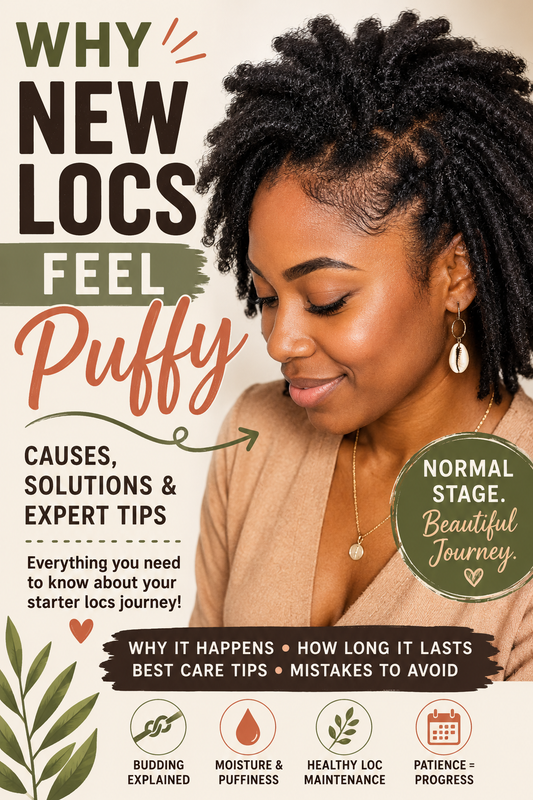
Starting your loc journey is exciting. Every twist, coil, or braid represents the beginning of healthier, stronger hair. However, many people become concerned a few weeks into the process when their new locs suddenly begin looking larger, softer, or puffier than expected.
If you're wondering:
- Why do my new locs feel puffy?
- Are puffy locs normal?
- Will my locs stay this thick forever?
- Am I doing something wrong?
The good news is that puffy starter locs are completely normal in most cases.
Puffiness is actually one of the most important stages of the locking process. It usually means your hair is beginning to mesh together naturally instead of remaining neatly twisted.
Understanding why this happens can help you avoid unnecessary worry—and prevent mistakes that may actually slow down your loc journey.
What Does "Puffy Locs" Mean?
Puffy locs refer to sections of a starter loc that appear:
- Wider than expected
- Soft to the touch
- Fluffy
- Swollen
- Less compact
- Fuzzy around the surface
Instead of looking like smooth ropes, the loc may resemble a soft cotton cylinder.
Many people think this means their locs are coming apart.
Usually, the exact opposite is happening.
The hair fibers are beginning to intertwine.
The Five Stages of Loc Development
Understanding the loc timeline explains why puffiness occurs.
Stage 1: Starter Locs
This stage begins immediately after installation.
Starter locs can be created using:
- Two-strand twists
- Coils
- Braids
- Interlocking
- Crochet methods
At first, the pattern looks neat and defined.
Hair hasn't begun locking yet.
Instead, it's simply held in place.
Stage 2: Budding Stage
This is where puffiness begins.
Individual hair strands start wrapping around each other.
Hair expands outward instead of remaining tightly twisted.
This creates:
- Puffy sections
- Soft bumps
- Uneven thickness
- Small knots inside the loc
This is completely normal.
Stage 3: Teenage Stage
Many people call this the "ugly phase."
Your locs may appear:
- Puffy
- Frizzy
- Uneven
- Thick in some places
- Thin in others
Although it can be frustrating, this is when real locking happens.
Stage 4: Mature Locs
Over time, loose strands tighten naturally.
The puffiness slowly compresses.
Locs become:
- Firmer
- Denser
- More uniform
Stage 5: Fully Mature Locs
After one to two years (sometimes longer), most locs become fully compact.
The fluffy appearance disappears naturally.
Why Hair Expands During the Locking Process
Hair isn't naturally designed to stay twisted forever.
Every strand has tiny outer scales called the cuticle.
As hair rubs together daily:
- The cuticles lift
- Individual strands catch
- Hair tangles
- Fibers intertwine
This natural tangling causes expansion before compression.
Think of a ball of cotton.
Before it's compressed into a firm shape, it first becomes fluffy.
Locs work the same way.
Puffy Locs Are Actually a Sign of Progress
Many beginners mistake puffiness for failure.
In reality, puffiness often means:
- Hair is locking correctly
- New knots are forming
- Internal structure is developing
- Locs are gaining density
Without this stage, mature locs wouldn't exist.
Common Reasons New Locs Feel Puffy
1. Your Hair Texture Naturally Expands
Coily hair naturally expands when moisture enters the strand.
Type 4 hair especially tends to:
- Swell
- Shrink
- Puff outward
This is one reason textured hair forms beautiful locs.
The expansion helps strands grab onto one another.
2. Moisture Causes Temporary Swelling
Hair absorbs water like a sponge.
After:
- Washing
- Sweating
- Swimming
- Humid weather
Starter locs often appear larger.
As they dry, some swelling disappears.
3. Hair Is Beginning to Bud
Budding is one of the biggest reasons new locs become puffy.
During budding:
- Loose hairs migrate inward
- Knots begin forming
- Fibers wrap together
This creates thicker sections that feel soft.
Budding usually starts within the first few months depending on hair type and maintenance.
4. Frizz Adds Volume
Frizz isn't your enemy.
Loose hairs surrounding each loc create the appearance of puffiness.
Eventually, many of these hairs become part of the loc itself.
5. Retwists Are Growing Out
Fresh retwists look sleek.
As new growth appears, hair expands naturally.
This makes locs appear puffier between maintenance appointments.
This doesn't mean your retwist failed.
It's simply new growth doing its job.
Hair Type Makes a Huge Difference
Some textures experience much more puffiness than others.
Type 4A Hair
Usually develops moderate puffiness.
Locs begin tightening fairly quickly.
Type 4B Hair
Often experiences significant swelling.
The zigzag pattern expands outward before compressing.
Type 4C Hair
Often experiences the most dramatic puffiness.
Because of the tight coils, hair naturally expands before locking into dense mature locs.
This is perfectly normal.
Can Products Cause Puffy Locs?
Yes.
Heavy products may temporarily swell the hair.
Examples include:
- Thick creams
- Heavy butters
- Sticky gels
- Excess oils
- Wax-based loc products
Too much product can also trap lint and buildup, making locs appear larger than necessary.
Keeping your routine simple allows the hair to lock more naturally.
Is Puffiness Permanent?
No.
Most starter locs become significantly more compact as they mature.
Depending on:
- Hair texture
- Maintenance routine
- Washing schedule
- Lifestyle
- Patience
Your locs gradually tighten over several months.
Many people are surprised at how much slimmer mature locs become compared to the early stages.
Should You Try to Flatten Puffy Locs?
Generally, no.
Trying to squeeze, roll, or compress your locs too early can interfere with the natural locking process.
Instead, allow your hair to develop at its own pace while maintaining a consistent care routine.
Remember, healthy locs are formed through patience—not force.
Is It Bad If Your New Locs Feel Puffy?
One of the biggest misconceptions about starter locs is that puffiness means something has gone wrong.
In reality, puffiness is often a sign that your locs are progressing through one of the most important stages of development.
During the first several months, your hair is learning to "lock." Individual strands begin wrapping around one another, creating tiny knots that eventually become dense, mature locs.
Think of building a rope. Before the fibers become tightly wound together, they first spread out and overlap. Your locs go through a very similar process.
Unless your hair is unraveling excessively due to improper maintenance or manipulation, puffiness alone is not a cause for concern.
Signs Your Puffy Locs Are Healthy
Healthy puffy locs usually have these characteristics:
- Soft but not mushy
- Expanding evenly
- Gradually becoming firmer over time
- Minimal product buildup
- Healthy scalp
- No unusual odor
- No excessive breakage
- New growth remains attached
If your locs meet most of these signs, they're likely developing exactly as they should.
When Puffiness May Be a Problem
Although puffiness is normal, excessive swelling can sometimes indicate an issue.
Watch for:
- Large weak spots in the middle of the loc
- Sections that feel extremely loose months after installation
- Product buildup causing sticky hair
- Constant unraveling
- Moldy smell after washing
- Severe thinning near the roots
- Breakage around the middle
These issues often result from maintenance problems rather than the locking process itself.
Mistakes That Make Puffy Locs Worse
1. Retwisting Too Often
Many beginners believe frequent retwists keep locs neat.
Actually, over-retwisting can:
- Stress the roots
- Cause thinning
- Delay natural locking
- Increase breakage
Most starter locs benefit from allowing enough time between retwists for the hair to naturally mat together.
2. Using Too Much Product
A common mistake is applying several products every day.
Examples include:
- Thick oils
- Hair grease
- Heavy creams
- Waxes
- Styling gels
These products coat the hair instead of allowing strands to interlock naturally.
Less is often more during the starter loc stage.
3. Constantly Touching Your Locs
Many new loc wearers can't stop checking their progress.
Unfortunately, excessive touching:
- Separates developing knots
- Creates frizz
- Causes unraveling
- Interrupts the locking process
Try to admire your progress in the mirror instead of handling your locs throughout the day.
4. Skipping Wash Days
Some people avoid washing because they're afraid their locs will unravel.
In reality, a healthy scalp supports healthy locs.
A clean scalp helps prevent:
- Buildup
- Excess oil
- Dandruff
- Itching
- Inflammation
Always follow the washing schedule recommended by your loctician or based on your hair's needs.
5. Sleeping Without Protection
Cotton pillowcases absorb moisture and create friction.
This friction increases:
- Frizz
- Puffiness
- Dryness
- Lint buildup
A satin or silk bonnet, scarf, or pillowcase helps preserve moisture while reducing unnecessary friction.
How to Reduce Excessive Puffiness Naturally
If your locs are puffier than you'd like, avoid trying to force them flat.
Instead, focus on healthy maintenance.
Keep Your Hair Clean
Clean hair locks more efficiently than hair coated in buildup.
Use a gentle shampoo designed to cleanse without leaving residue.
Moisturize Lightly
Hydrated hair is healthier, but over-moisturizing can leave locs feeling overly soft.
Choose lightweight moisture instead of heavy creams.
Separate Your Roots
After washing, gently separate neighboring locs near the roots if they begin joining together.
This helps maintain clean sections without disturbing the rest of the loc.
Allow Time
Patience is one of the most important parts of every successful loc journey.
Many people notice significant changes after several months of consistent care.
How Long Does the Puffy Stage Last?
Every person is different.
Several factors influence how long your locs remain puffy.
These include:
- Hair texture
- Hair density
- Washing routine
- Retwist schedule
- Activity level
- Humidity
- Genetics
Generally, many people notice the puffiest stage during the first several months before their locs begin becoming denser and more compact.
Does Washing Make Locs Puffier?
Yes—but only temporarily.
Water causes hair strands to swell.
After washing, you may notice:
- Increased volume
- More frizz
- Softer texture
- Larger appearance
As your hair dries and continues locking, much of this temporary expansion settles down.
Regular washing actually supports healthy loc development.
Does Humidity Affect Puffy Locs?
Absolutely.
Humid environments increase moisture absorption.
This causes hair to:
- Expand
- Frizz
- Swell
People living in humid climates often notice their starter locs appear fuller than those in drier regions.
This effect is temporary and doesn't usually affect the long-term maturity of your locs.
Can Exercise Make Locs Puffier?
Sweat introduces moisture into your hair.
If you exercise frequently, your locs may temporarily appear:
- Larger
- Softer
- More frizzy
This is completely normal.
Keeping your scalp clean after workouts helps maintain healthy locs.
Foods That Support Healthy Loc Development
Healthy hair begins from within.
A balanced diet rich in nutrients supports stronger hair growth.
Focus on foods rich in:
- Protein
- Iron
- Zinc
- Vitamin D
- Vitamin C
- Omega-3 fatty acids
- Biotin-rich whole foods
Drinking enough water also supports healthy hair and scalp function.
Daily Routine for Healthy Starter Locs
Morning:
- Remove satin bonnet or scarf.
- Lightly fluff your roots if needed.
- Avoid excessive touching.
- Keep your scalp clean and comfortable.
Throughout the Day:
- Minimize manipulation.
- Protect your locs during physical activity if needed.
- Avoid unnecessary product application.
Evening:
- Check for lint or debris.
- Cover your locs with a satin bonnet or scarf.
- Sleep on a satin pillowcase for added protection.
Consistency matters more than complexity.
Patience Is the Secret Ingredient
Nearly every person with beautiful mature locs has experienced:
- Puffy locs
- Frizz
- Budding
- Uneven sizes
- Loose hairs
- Awkward stages
These changes are part of the journey—not signs of failure.
Resisting the urge to over-correct your hair gives your locs the best opportunity to mature into strong, healthy, beautiful locs.
Frequently Asked Questions
Are puffy starter locs normal?
Yes. Puffy starter locs are one of the most common stages of the locking process. As your hair begins to knot and mesh together, it naturally expands before becoming denser. For most people, this is a sign that their locs are progressing as expected.
Will my locs stay puffy forever?
No. Most starter locs gradually become firmer and more compact over time. Depending on your hair texture, maintenance routine, and individual hair growth, this process can take several months to over a year.
Should I retwist my locs more often to reduce puffiness?
No. Retwisting too frequently can place unnecessary tension on your roots and may contribute to thinning or breakage over time. Follow a consistent maintenance schedule rather than retwisting simply to reduce puffiness.
Why are some of my locs puffier than others?
Hair does not lock at the same speed across your entire head. Differences in hair texture, density, scalp oil production, sleeping habits, and daily manipulation can all affect how quickly individual locs mature.
Is frizz the same as puffiness?
Not exactly.
Frizz refers to loose hairs sticking out from the loc.
Puffiness refers to the entire loc expanding as it begins to mature.
Both are completely normal during the early stages.
Can I palm roll puffy locs every day?
Daily palm rolling is unnecessary.
Occasional palm rolling after washing or maintenance can help maintain shape, but excessive rolling may interfere with the natural locking process.
Does washing slow down the locking process?
No.
Clean hair actually locks very well.
A healthy scalp provides the best environment for strong, healthy locs.
Why do my locs look bigger after washing?
Hair absorbs water and temporarily expands.
Once dry, your locs will usually shrink back somewhat while continuing to mature internally.
Can products stop my locs from becoming puffy?
No product can eliminate the natural budding stage.
Heavy waxes or creams may temporarily flatten the appearance but often lead to buildup that can slow healthy loc development.
Will my mature locs be thinner than my starter locs?
Many people are surprised to find that mature locs become noticeably denser and often slimmer than they looked during the puffy budding phase.
Puffy Locs: Myths vs. Facts
| Myth | Fact |
|---|---|
| Puffy locs mean they're unraveling. | Puffiness is usually a normal part of budding. |
| Frizz ruins locs. | Frizz often becomes part of the mature loc. |
| More retwists equal healthier locs. | Over-retwisting can weaken your roots. |
| You shouldn't wash starter locs. | A clean scalp supports healthy loc development. |
| Thick products help locs mature faster. | Excess product often causes buildup instead of better locking. |
| Every loc should mature at the same speed. | Hair naturally locks at different rates across the scalp. |
Expert Tips for Beautiful Mature Locs
Trust the Process
Every mature set of locs began as awkward, fluffy, and frizzy starter locs.
Patience produces better results than constantly trying to "fix" normal stages.
Protect Your Hair at Night
Sleeping with a satin bonnet or satin pillowcase reduces:
- Friction
- Moisture loss
- Frizz
- Lint accumulation
Nighttime protection is one of the easiest ways to keep your locs healthy.
Keep Your Scalp Healthy
Healthy locs begin with a healthy scalp.
Maintain a scalp care routine that includes:
- Gentle cleansing
- Light moisturizing
- Avoiding excessive buildup
- Staying hydrated
Avoid Comparing Your Journey
Social media often showcases only perfectly mature locs.
Remember:
Everyone's timeline is different.
Your friend's locs may mature faster—or slower—than yours.
Focus on healthy progress instead of perfection.
Healthy Habits That Encourage Strong Locs
Healthy lifestyle habits can support stronger hair over time:
- Eat a balanced diet with adequate protein.
- Stay hydrated throughout the day.
- Get enough sleep.
- Manage stress through healthy coping strategies.
- Protect your hair during workouts and while sleeping.
- Avoid excessive heat and harsh chemical treatments.
While these habits don't instantly change the appearance of your locs, they contribute to overall hair and scalp health.
Final Thoughts
Puffy starter locs are one of the most misunderstood parts of the loc journey. While they may seem messy or unpredictable, they often signal that your hair is beginning to lock exactly as it should.
The early months require patience, consistency, and gentle care. Avoid the temptation to over-style, over-retwist, or overload your hair with products in an attempt to speed up the process.
With time, your fluffy, budding locs will become denser, stronger, and more defined.
Celebrate each stage of the journey, knowing that every mature set of beautiful locs once went through this same phase.
Conclusion
If your new locs feel puffy, take it as encouragement rather than frustration. Puffiness is typically a natural stage of loc development that reflects your hair's transition from loose strands into tightly interwoven locs.
Maintain a clean scalp, use lightweight products sparingly, protect your hair while you sleep, and allow your locs to mature at their own pace. Consistent care and patience are the true keys to healthy, long-lasting locs.