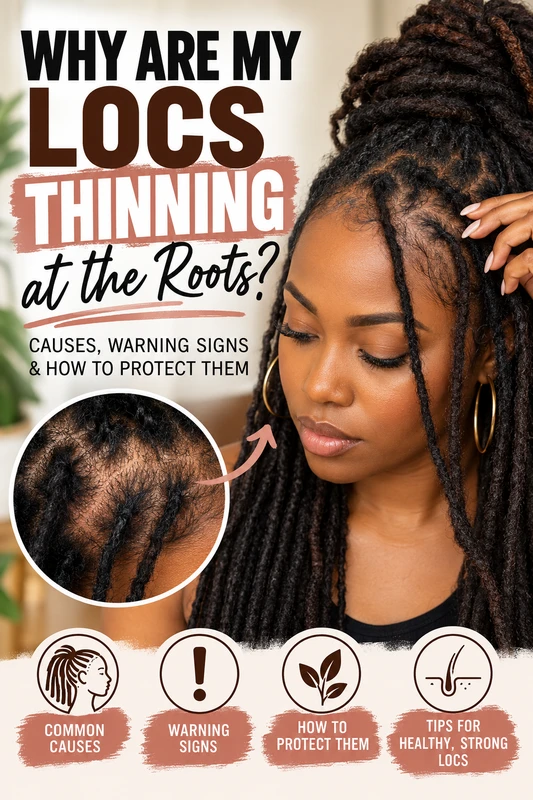
Locs can become stronger, longer, and more established as they mature, which is why noticing one or more locs suddenly becoming thin at the roots can be alarming.
Maybe one loc near your temple looks much smaller than it used to. Maybe the roots around your crown seem weak. Perhaps several mature locs feel as though they're hanging from only a small amount of hair.
You may immediately wonder:
Why are my locs thinning at the roots?
There isn't one single answer.
Loc thinning can be associated with excessive tension, frequent retwisting, dryness, breakage, heavy locs, manipulation, scalp problems, or changes occurring within the hair-growth cycle. In some cases, thinning may also be related to a form of hair loss that needs professional evaluation.
The important thing is to pay attention early.
A loc that becomes progressively thinner at its base may eventually weaken enough to break. More importantly, if the underlying problem is occurring at the scalp rather than simply within the loc, repairing the loc itself won't address the cause.
In this guide, we'll look at the most common reasons locs become thin at the roots, early warning signs to watch for, habits that may make thinning worse, and ways to build a gentler loc-care routine.
What Do Thinning Locs Look Like?
Not every small loc is a thinning loc.
Some people intentionally have locs of different sizes because of their original parting pattern, hair density, or texture.
The concern is usually change.
For example, imagine a loc that has been approximately the same thickness for two years. The body of the loc still looks full, but suddenly the newest inch of hair growing from the scalp appears considerably smaller.
That deserves attention.
Other possible signs include:
- A loc becoming noticeably narrower close to the scalp
- Weak spots developing along the loc
- Locs breaking unexpectedly
- Increased shedding around a particular section
- Several locs around the hairline becoming smaller
- A widening part between locs
- Reduced density around the crown
- Locs feeling unusually fragile
- New growth appearing unable to support the weight of a mature loc
- Tenderness or irritation around thinning areas
Inspect your locs periodically instead of waiting for one to break.
Early detection gives you an opportunity to change potentially damaging habits before the problem progresses.
For a broader look at maintaining healthy locs, read our Ultimate Loc Maintenance Guide.
1. Your Retwists May Be Too Tight
One of the first things to examine is your retwisting routine.
A fresh retwist can make locs look neat and defined, but your scalp should not have to endure excessive pulling to achieve that appearance.
Constant tension on the same sections of hair may contribute to breakage and, over time, traction-related hair loss.
Warning signs that your retwist or style may be applying too much tension include:
- Scalp soreness
- Headaches
- Redness
- Small bumps
- A pulling sensation
- Difficulty moving the locs comfortably
- Tenderness that lasts after the appointment
- Hairline thinning
Your retwist does not need to hurt to be effective.
If your scalp feels as though it is being pulled tightly after every appointment, talk to your loctician.
2. You May Be Retwisting Too Frequently
Even if each individual retwist doesn't feel extremely tight, constantly manipulating your new growth can become a problem.
New growth needs time.
Retwisting too frequently means repeatedly pulling, twisting, separating, and manipulating the same hair before it has had much opportunity to grow.
Some people become uncomfortable as soon as their roots start looking fuzzy and immediately schedule another retwist.
But fuzziness isn't automatically a sign that your locs need maintenance.
Healthy locs don't have to look freshly retwisted every day.
Giving your roots reasonable time between maintenance sessions can help reduce unnecessary manipulation.
The appropriate schedule depends on your hair, loc stage, maintenance technique, and professional guidance, so there isn't a universal calendar that works for everyone.
3. Tight Loc Hairstyles Can Stress Your Roots
Retwisting isn't the only source of tension.
Think about how you wear your locs between appointments.
Do you constantly pull them into:
- High ponytails?
- Tight buns?
- Loc barrels?
- Tight updos?
- Styles pulling backward from the hairline?
- Styles that place most of the weight on only a few locs?
Long locs can become surprisingly heavy.
Pulling that weight tightly into the same hairstyle day after day may put additional stress on the roots.
Alternate your hairstyles.
Wear your locs down when practical. Choose looser styles. Avoid constantly pulling your temples and edges backward.
If a hairstyle hurts, feels excessively tight, or makes your scalp feel tender, loosen it.
4. Your Locs May Be Getting Heavy
Length is one of the goals many people have when starting locs.
But extremely long mature locs also weigh more than shorter locs.
If an individual loc has a relatively small base supporting considerable length and weight, the difference can become noticeable.
This is especially important if the root was already weakened by tension, breakage, or hair loss.
A loctician may recommend different options depending on the condition of your locs. These could include reducing unnecessary tension, combining certain weak locs, repairing damaged sections, or in some situations shortening excessively heavy locs.
Don't wait until a loc is attached by only a few strands before addressing it.
5. Dryness Can Contribute to Breakage
A thinning loc doesn't always mean hair is falling directly from the follicle.
Sometimes the hair is breaking.
Chronically dry hair can become brittle and less flexible. As individual hairs break around the root or within the loc, the affected area may gradually become smaller.
Signs of excessive dryness can include:
- Rough texture
- Stiff locs
- Brittle strands
- Snapping
- Dull appearance
- Locs that don't bend easily
If this sounds familiar, read Why Your Locs Are Dry and How to Fix It and our complete guide on How to Moisturize Locs Properly.
Remember that oil and water do different things in a hair-care routine.
Applying more and more oil to hair that needs hydration can simply leave the locs coated without addressing how dry they feel.
6. Hard, Brittle Locs May Be More Vulnerable to Damage
Pay attention to the way your locs feel.
Healthy mature locs can be firm without feeling rock-hard or excessively brittle.
If your locs feel stiff, crunchy, rough, or inflexible, something in your routine may need adjusting.
Potential contributors include dryness, excessive product accumulation, environmental exposure, or a routine that isn't providing an appropriate balance of cleansing and moisture.
We cover this issue in greater detail in Why Your Locs Feel Hard and Brittle.
Reducing breakage matters because loc thickness depends on retaining the individual hairs making up each loc.
7. Product Buildup Can Complicate Your Loc Routine
More product doesn't necessarily mean healthier locs.
Locs can hold onto residue from:
- Heavy waxes
- Thick creams
- Butters
- Gels
- Oils
- Edge-control products
- Shampoo that wasn't completely rinsed out
When you're worried about thinning, it's tempting to apply multiple products every day.
That can become counterproductive.
Your scalp still needs regular cleansing.
Instead of continuously layering products onto your scalp, maintain a balanced routine involving cleansing, moisture, minimal tension, and moderate product use.
For more guidance, see How Often Should You Wash Locs?.
8. Scratching an Itchy Scalp Can Cause Additional Damage
Do you constantly scratch between your locs?
Itching may seem harmless, but aggressive scratching with fingernails can irritate the scalp and create additional mechanical stress around already fragile hair.
Instead of automatically applying more oil whenever your scalp itches, determine why it's itching.
Possible contributors can include:
- Dryness
- Sweat
- Product residue
- Dandruff
- Irritation
- Sensitivity to a product
- Infrequent cleansing
Read our complete guide on How to Stop Itchy Scalp With Locs for a closer look at common causes.
Persistent itching, inflammation, scaling, sores, pain, or unexplained hair loss deserves professional attention rather than repeated scratching or experimentation with products.
9. Your Locs May Be Breaking Instead of Shedding From the Root
This distinction is important.
Shedding occurs when a hair completes its growth cycle and releases from the follicle.
Breakage occurs when the hair strand snaps somewhere along its length.
With locs, shed hairs often remain incorporated into the loc instead of falling onto your shirt or shower floor the way loose hair might.
But breakage can gradually reduce the number of intact hairs supporting a loc.
Look closely at the thin section.
Is the scalp itself becoming more visible?
Or does the loc have one narrow, damaged section while the surrounding scalp density appears unchanged?
Those situations can require different approaches.
Our guide to Locs and Breakage: Why Dreadlocks Break and How to Prevent Damage explains this distinction in more detail.
10. Your Hairline May Be Experiencing More Tension Than the Rest of Your Head
Thinning often becomes noticeable around the temples first.
Hair around the hairline can be more vulnerable to repeated tension, particularly if you're constantly:
- Retwisting the edges tightly
- Pulling locs backward
- Wearing tight ponytails
- Sleeping in tight hairstyles
- Using clips or bands in the same place
- Creating elaborate loc styles frequently
If your temple locs are becoming thinner, consider giving that area a break.
A perfectly laid hairline isn't worth sacrificing healthy hair.
11. Friction Can Contribute to Breakage
Your locs come into contact with clothing, pillows, car seats, hoodies, coats, towels, and furniture every day.
Long locs experience even more contact.
Repeated friction can weaken hair over time, particularly when the loc is already dry.
Nighttime protection may help reduce unnecessary rubbing.
Consider using a satin or silk bonnet, scarf, or smooth pillowcase.
Also pay attention to clothing.
If your locs constantly rub against rough sweaters, jacket collars, or lint-producing materials, that friction may affect the ends and lengths over time.
12. Nutrition and Overall Health Can Affect Hair
Hair doesn't exist separately from the rest of your body.
Adequate nutrition is important for normal hair growth.
Protein, iron, zinc, vitamin D, and other nutrients play roles in normal biological processes associated with healthy hair.
This does not mean you should immediately buy a cabinet full of supplements because your locs look thin.
Hair thinning can have many causes, and taking unnecessary supplements isn't automatically beneficial.
If your thinning appeared suddenly, is progressing quickly, or is accompanied by other symptoms, talk with a healthcare professional. They can determine whether nutritional deficiencies or another medical issue should be investigated.
13. Stress and Hormonal Changes May Affect Hair Growth
Not all loc thinning is caused by your hairstyle.
Changes in the normal hair-growth cycle can cause increased shedding.
Significant stress, hormonal changes, certain medications, nutritional deficiencies, illness, postpartum changes, and other health-related factors can sometimes be associated with increased shedding or hair loss.
That's why it's important not to assume that every thinning loc can be fixed by retwisting differently or applying a new oil.
If multiple areas are thinning simultaneously despite gentle loc care, consider talking with a dermatologist or qualified healthcare professional.
14. Certain Types of Hair Loss Require Professional Evaluation
Some thinning patterns should not be treated as ordinary loc maintenance problems.
Consider professional evaluation if you notice:
- Smooth bald patches
- Rapidly expanding thinning
- Significant crown thinning
- Receding areas
- Scalp pain
- Burning
- Persistent redness
- Sores
- Significant scaling
- Pus or drainage
- Sudden excessive shedding
- Hair loss continuing after tension has been removed
A dermatologist can examine your scalp and determine whether the problem is related to breakage, traction, inflammation, infection, alopecia, or another condition.
Early evaluation can be especially important with certain forms of hair loss because some conditions can become more difficult to address once follicles have been permanently damaged.
How to Protect Thinning Locs
Once you notice thinning, resist the urge to immediately twist, style, glue, crochet, or manipulate the weak area repeatedly.
Start with the fundamentals.
Reduce Tension
Stop putting unnecessary pulling force on the affected locs.
Choose loose hairstyles and avoid repeatedly pulling weak locs into ponytails and buns.
Space Out Manipulation
You don't need to retwist your hair every time your roots become fuzzy.
Allow reasonable new growth between maintenance sessions.
Keep Your Scalp Clean
A clean scalp makes it easier to observe what's actually happening.
Wash according to your scalp, activity level, product use, and loc maturity rather than allowing months of residue to accumulate.
Keep Locs Appropriately Moisturized
Dryness and brittleness can contribute to breakage.
Use lightweight moisture and avoid coating locs with excessive layers of heavy products.
Protect Your Locs at Night
Reduce friction by covering your hair with satin or silk.
Examine Your Roots
Take photos every few weeks under similar lighting.
That can make it easier to determine whether the area is improving, stable, or becoming progressively thinner.
Get Professional Help When Necessary
A skilled loctician can evaluate the physical condition of the loc.
A dermatologist can evaluate the scalp and hair follicles.
Those are different roles, and sometimes you need both.
Can a Thin Loc Become Thick Again?
It depends on why the loc became thin.
If the problem is primarily breakage or excessive manipulation and there is healthy new growth at the scalp, changing your routine may allow stronger hair to grow into the area over time.
But hair doesn't transform overnight.
You have to allow new hair to grow.
If actual hair loss is occurring at the follicle, the outcome depends on the underlying cause. That's another reason not to delay professional evaluation when thinning is significant or progressive.
Be especially cautious with claims that a product can instantly repair a damaged follicle or guarantee that every type of hair loss will grow back.
No cosmetic hair product can promise that result for every person.
Should You Combine Thin Locs?
Combining locs is one technique sometimes used when an individual loc has become too small to comfortably support its length.
For example, a loctician may determine that two neighboring locs can be combined to create a stronger structure.
However, combining locs doesn't fix active hair loss.
Imagine that a thinning loc is being caused by constant tension.
You combine it with another loc but continue wearing extremely tight hairstyles.
The underlying problem remains.
The same principle applies if thinning is related to a scalp or medical condition.
Structural repair and scalp treatment are not necessarily the same thing.
Determine why the loc became thin before focusing only on making it look thicker.
Hairobics Products for a Gentle Loc-Care Routine
Products can complement a healthy routine, but they should be used alongside appropriate cleansing, moisture, low-tension styling, and professional care when needed.
Hairobics Raaw Roots Locs & Braids Moisturizer Spray
For locs that need lightweight moisture between wash days, Hairobics Raaw Roots Locs & Braids Moisturizer Spray is formulated for locs, braids, extensions, twists, and natural hair.
The water-based spray format makes it convenient for applying moisture without coating mature locs in heavy creams.
Apply according to the product directions and avoid oversaturating your locs simply because they are thinning. More product isn't necessarily better.
Hairobics Hair & Scalp Booster
You can also incorporate Hairobics Hair & Scalp Booster into your scalp-care routine.
The formula contains oils including coconut, olive, jojoba, rosemary, lavender, peppermint, almond, apricot kernel, and vitamin E oils. The product directions recommend testing a small area first and massaging the product into the scalp, paying particular attention to the temple, crown, and frontal areas.
Remember: products can support a consistent hair-care routine, but they should not be used as substitutes for medical evaluation when you're experiencing unexplained or progressive hair loss.
A Simple Routine for Thinning Locs
When your locs are already fragile, simpler is often better.
On wash day: Cleanse your scalp thoroughly but gently. Avoid aggressive scratching. Rinse your locs completely and allow them to dry thoroughly.
Between washes: Monitor moisture and use a lightweight moisturizer when your locs need it. Avoid continuously layering multiple products.
During styling: Keep tension low. Don't force thinning locs into tight ponytails, buns, barrels, or updos.
At night: Protect your locs from excessive friction with satin or silk.
During maintenance: Tell your loctician exactly which locs concern you. Don't allow fragile roots to be aggressively twisted simply to make them appear neater.
Monthly: Photograph your scalp and compare density. Look particularly at your temples, crown, nape, and any individual locs you've identified as weak.
What NOT to Do When Your Locs Are Thinning
Panic can lead people to make thinning worse.
Avoid automatically:
- Retwisting the weak loc tighter
- Applying huge amounts of oil
- Scratching the scalp aggressively
- Hiding thinning under tight styles
- Constantly touching the weak loc
- Pulling it to check whether it's still attached
- Ignoring scalp inflammation
- Waiting until the loc completely breaks before changing your routine
- Assuming every case of thinning has the same cause
And don't mistake appearance for recovery.
A crochet repair might make a loc look thicker, but if hairs are still being lost from the root, the underlying issue hasn't necessarily been solved.
Frequently Asked Questions About Thinning Locs
Why are my locs thinning at the roots?
Common possibilities include excessive tension, frequent retwisting, tight hairstyles, breakage, dryness, heavy mature locs, repeated manipulation, or an underlying hair-loss condition.
The location and pattern of thinning can provide clues, but persistent or unexplained thinning should be evaluated professionally.
Can over-retwisting thin locs?
Repeatedly manipulating and placing tension on new growth can contribute to breakage and unnecessary stress on the roots. Give your hair adequate time between maintenance sessions and avoid painfully tight retwists.
Why are my locs thinning around my edges?
Your edges may experience more tension from ponytails, retwists, buns, updos, and other styles that pull hair backward. Reduce tension immediately if you notice your temple locs becoming smaller.
Why are my locs thinning in the middle?
A narrow section in the middle of a loc can indicate breakage or structural weakness rather than thinning directly from the scalp. Dryness, friction, manipulation, previous damage, or weak spots may contribute.
Should I cut a thinning loc off?
Not automatically.
Have the loc evaluated first. Depending on the cause and severity, a professional may recommend leaving it alone, combining it, repairing it, shortening it, or taking another approach.
Can I regrow a thinning loc?
If healthy hair is still growing from the follicle, reducing breakage and unnecessary tension may allow stronger new growth to develop over time.
If the thinning is caused by an underlying form of hair loss, treatment and prognosis depend on the specific condition.
Should I oil thinning locs every day?
Not necessarily.
More oil doesn't automatically mean more growth.
Keep your routine balanced and pay attention to how your scalp and locs respond. Hair that needs water-based hydration won't necessarily benefit from continuously adding oil.
When should I see a dermatologist?
Consider professional evaluation when thinning is sudden, unexplained, worsening, widespread, producing bald areas, or accompanied by pain, burning, inflammation, scaling, sores, or other scalp changes.
Final Thoughts: Don't Ignore Thinning Locs
If you've been asking, “Why are my locs thinning at the roots?”, your hair may be giving you an early warning that something in your routine—or at your scalp—needs attention.
Start by looking at the basics.
Are you retwisting too tightly?
Are you retwisting too frequently?
Do you constantly wear tight ponytails or buns?
Are your locs extremely dry or brittle?
Are mature locs becoming too heavy for their bases?
Are you experiencing scalp irritation or unusual hair loss?
The earlier you identify the cause, the sooner you can make appropriate changes.
Keep your scalp clean. Maintain appropriate moisture. Reduce unnecessary tension. Protect your hair from friction. Give your roots time between maintenance sessions. And when thinning is significant, progressive, or unexplained, get professional help instead of trying to hide it beneath another hairstyle.
Your goal shouldn't simply be long locs.
It should be healthy roots strong enough to support those locs for years to come.