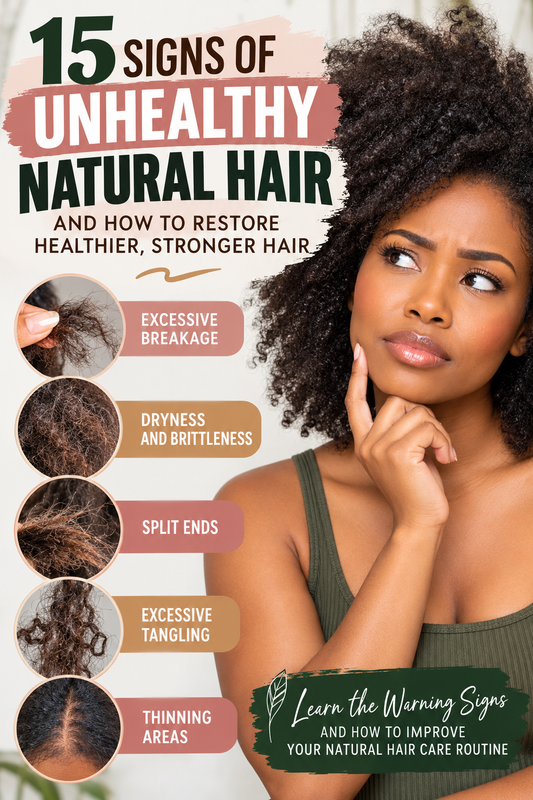
Natural hair is beautiful, versatile, and unique, but even the most carefully maintained curls and coils can experience damage. Whether you have 3C curls, 4A coils, 4B hair, or tightly coiled 4C natural hair, understanding the signs of unhealthy natural hair can help you prevent unnecessary breakage, improve moisture retention, and maintain stronger strands.
Sometimes the warning signs are obvious. Your hair may break whenever you comb it, feel unusually brittle, or develop noticeable split ends. Other times, the changes are more subtle. Your curls may become harder to manage, your ends may constantly tangle, or your hair may seem unable to retain length despite consistent growth.
One important thing to understand is that unhealthy natural hair does not always look damaged.
Hair can appear thick, shiny, and beautifully styled while experiencing breakage underneath. Similarly, naturally coarse hair, tightly coiled strands, shrinkage, and low shine are not signs of unhealthy hair.
The key is recognizing changes in your hair's condition, strength, manageability, and scalp health.
In this complete guide, we'll explore 15 signs of unhealthy natural hair, what causes them, how to distinguish damage from normal hair characteristics, and practical ways to improve your natural hair care routine.
What Does Unhealthy Natural Hair Look Like?
Unhealthy natural hair may show signs of excessive breakage, persistent dryness, weakened strands, damaged ends, unusual tangling, or scalp problems.
However, no single characteristic automatically means your hair is unhealthy.
For example, naturally coarse 4C hair may feel different from fine 3C curls. Some hair textures reflect less light, making them appear less shiny even when they are in excellent condition.
Healthy natural hair is not defined by straightness, looseness of curl pattern, or length.
Instead, look for these characteristics:
-
Strands that tolerate normal, gentle handling
-
Manageable amounts of shedding and breakage
-
Ends without extensive splitting or fraying
-
A comfortable scalp without persistent irritation
-
Hair that responds reasonably well to cleansing and conditioning
-
Consistent length retention over time
-
A relatively stable curl pattern outside of styling changes
If several of these characteristics begin changing, your hair may need additional attention.
For a comparison, read our guide on How to Tell if Natural Hair Is Healthy.
1. Your Natural Hair Breaks Excessively
One of the clearest signs of unhealthy natural hair is frequent, excessive breakage.
Breakage occurs when a hair strand snaps somewhere along its length rather than naturally shedding from the follicle.
You might notice tiny pieces of hair collecting on your bathroom counter, clothing, pillowcase, or comb.
Some breakage can occur through ordinary wear and handling. However, persistent breakage that leaves your ends thin or creates uneven areas deserves attention.
Common Signs of Hair Breakage
-
Short pieces of hair appearing during detangling
-
Hair snapping with gentle manipulation
-
Uneven sections throughout your hairstyle
-
Ends becoming noticeably thinner
-
Small broken strands collecting after wash day
-
Difficulty retaining length
Why Natural Hair Breaks
Several factors can contribute to breakage, including excessive heat, rough detangling, chemical processing, friction, tight hairstyles, and weakened ends.
Curly and coily hair can be especially vulnerable to mechanical damage because strands bend and intertwine.
How to Reduce Breakage
Begin by reducing unnecessary manipulation.
Detangle with a conditioner that provides adequate slip, work in small sections, and start near the ends before moving toward the roots.
Avoid pulling aggressively through knots.
Limit high-temperature styling and choose hairstyles that do not place excessive tension on your strands.
For additional techniques, explore How to Stop Natural Hair From Breaking.
2. Your Hair Feels Extremely Dry and Brittle
Natural hair often requires consistent conditioning because scalp oils do not always travel easily along tightly curled strands.
However, there is a difference between naturally coarse hair and hair that has become unusually dry or brittle.
Brittle hair may feel rough, rigid, or fragile. It may snap more easily when manipulated and become difficult to detangle.
Signs of Excessive Dryness
-
Hair feels unusually rough after washing
-
Ends become stiff between wash days
-
Strands tangle more easily than before
-
Hair breaks during ordinary styling
-
Conditioning provides only temporary improvement
-
Your hair feels increasingly fragile
Dryness may result from insufficient conditioning, harsh cleansing, environmental exposure, chemical processing, or existing damage to the hair's protective cuticle.
How to Improve Dry Natural Hair
Start with a gentle shampoo suitable for your scalp and hair.
Follow with a rinse-out conditioner, paying special attention to the older, more vulnerable ends.
A water-based leave-in conditioner can help improve manageability between washes.
You can also use a small amount of oil or cream when appropriate to reduce friction and help slow moisture loss.
Remember that oil alone does not replace water-based conditioning.
For a more detailed routine, read Why Is My Natural Hair So Dry?.
3. Your Ends Are Split, Frayed, or Thin
The ends of your natural hair are generally the oldest portions of each strand.
They have experienced repeated washing, styling, friction, sunlight, and environmental exposure.
Over time, this accumulated wear can weaken the protective outer layer of the hair.
Split ends develop when the hair shaft begins separating or fraying.
What Damaged Ends Look Like
You may notice:
-
Ends separating into two or more pieces
-
White-looking dots at breakage points
-
Frayed or feathered strand tips
-
Thin, transparent-looking ends
-
Ends that catch on neighboring strands
-
Repeated knots concentrated near the tips
Split ends cannot be permanently repaired by conditioner or oil.
Products may temporarily smooth their appearance and reduce friction, but severely split sections usually need trimming.
How to Protect Your Ends
Handle your ends gently and avoid repeatedly combing them when dry and tangled.
Keep them conditioned and reduce unnecessary friction from clothing, rough fabrics, and frequent styling.
Trim visibly damaged ends as needed rather than following a rigid trimming schedule that may not suit your hair.
Maintaining healthy ends is particularly important when your goal is retaining natural hair length.
4. Your Hair Tangles More Than Usual
Some tangling is completely normal with natural hair.
Curly and coily strands naturally wrap around one another, particularly when the hair is worn loose.
However, a sudden increase in severe tangling can indicate damaged ends, inadequate conditioning, product buildup, or changes in your styling routine.
Warning Signs of Excessive Tangling
-
Hair knots almost immediately after detangling
-
Your ends constantly catch together
-
Detangling takes significantly longer than usual
-
You experience more breakage while removing knots
-
Sections become difficult to separate
-
Hair repeatedly mats near the roots
What Causes Excessive Tangling?
Damaged cuticles can create additional friction between neighboring strands.
Dryness and insufficient lubrication may also make it harder for strands to slide past one another.
Another common problem is waiting too long to detangle loose hair, allowing shed strands to accumulate.
How to Prevent Unnecessary Knots
Use a slippery conditioner, detangle in sections, and avoid forcing tools through resistant areas.
Keep detangled sections separated with loose twists or braids.
If tangling happens primarily near your scalp, read Why Does My Hair Tangle at the Roots?.
5. Your Hair Has Lost Its Usual Flexibility
Hair strands have a certain amount of flexibility.
When healthy hair is gently stretched, it can extend somewhat before returning toward its original shape.
However, excessive damage may change how strands behave.
Some damaged strands snap with relatively little tension, while others stretch unusually far before breaking.
These changes may result from heat exposure, chemical processing, or structural damage.
Signs of Weakened Hair
-
Hair snaps with very little manipulation
-
Strands feel unusually rigid
-
Hair becomes excessively stretchy
-
Wet hair feels abnormally fragile
-
Curls fail to behave as they previously did
Avoid repeatedly stretching individual hairs to test their strength. Informal stretch tests are not reliable diagnoses and can create additional damage.
Instead, evaluate how your hair behaves during normal, gentle washing and styling.
If your hair feels soft but continues breaking, read Why Is My Hair Soft but Still Breaking?.
6. Your Natural Hair Looks Dull and Feels Coated
Shine is not a reliable measurement of natural hair health.
Tightly coiled hair often reflects light differently from straighter textures.
Therefore, a beautiful, healthy afro may appear less shiny than a freshly straightened hairstyle.
However, a noticeable change in appearance combined with a waxy, sticky, or coated feeling may suggest product residue.
Signs of Product Buildup
-
Hair feels unusually heavy
-
Products seem to sit on the surface
-
Strands become sticky or waxy
-
Curls appear weighed down
-
Hair feels coated after washing
-
Styling products stop performing as expected
Buildup can develop from repeatedly layering creams, gels, oils, and other styling products without adequate cleansing.
How to Remove Buildup
Use a shampoo that effectively cleanses your scalp and hair.
If your usual cleanser is not removing residue, an occasional clarifying shampoo may help.
Follow with conditioner to improve manageability.
Avoid repeatedly applying additional oil to hair that already feels coated.
Sometimes the solution is using fewer products rather than adding more.
7. Your Scalp Is Constantly Itchy or Irritated
Healthy natural hair begins with appropriate scalp care.
Your scalp contains hair follicles, oil glands, and skin cells that require regular cleansing and a healthy environment.
Occasional itching can occur for many reasons, but persistent itching, burning, tenderness, or inflammation should not be ignored.
Possible Warning Signs
-
Frequent itching
-
Redness or irritation
-
Burning sensations
-
Persistent flakes
-
Tender or painful areas
-
Sores or crusting
-
Unusual scalp odor
These symptoms may be associated with dandruff, seborrheic dermatitis, contact dermatitis, psoriasis, infections, or other scalp conditions.
They do not necessarily mean your hair shafts are damaged.
What Should You Do?
Wash your scalp as needed and avoid repeatedly applying irritating products.
If you notice burning after using a particular product, stop using it.
Avoid scratching aggressively or picking at flakes.
Persistent irritation, sores, pain, or associated hair loss should be evaluated by a dermatologist.
Scalp oil may help with lubrication or dryness for some people, but it is not a treatment for every scalp condition.
8. Your Hair Is Thinning in Certain Areas
Noticeable thinning can be an important warning sign, particularly when it develops around your edges, crown, temples, or nape.
Hair thinning is different from ordinary breakage.
Breakage affects the hair shaft, while hair loss may involve changes at the follicle.
Signs to Watch For
-
Your part becomes progressively wider
-
The crown appears less dense
-
Your edges become noticeably thinner
-
Small bald patches develop
-
Your ponytail becomes smaller
-
The scalp becomes more visible over time
Potential causes include traction from tight hairstyles, hereditary hair loss, hormonal changes, nutritional deficiencies, and inflammatory scalp conditions.
Some forms of hair loss can cause permanent follicle damage if treatment is delayed.
How to Respond
Avoid tight braids, ponytails, extensions, or other hairstyles that pull on vulnerable areas.
Do not assume that oil alone can reverse thinning.
If you experience progressive thinning, smooth or shiny areas of hair loss, scalp pain, or sudden shedding, consult a dermatologist promptly.
Early evaluation can make a meaningful difference, especially for conditions that may cause scarring.
9. Your Natural Hair Never Seems to Retain Length
Have you been growing your natural hair for months but feel that it never gets longer?
This does not automatically mean your follicles have stopped producing hair.
In many cases, the problem is length retention.
Your hair may continue growing from the scalp while older sections break off at the ends.
Signs of Poor Length Retention
-
Your roots show new growth
-
Your overall length remains unchanged
-
Your ends look progressively thinner
-
Short pieces appear during styling
-
You repeatedly experience knots and splitting
How to Improve Length Retention
Focus on preserving the hair you already have.
Use gentle detangling techniques, minimize high heat, avoid tight hairstyles, and keep your ends conditioned.
Protective styles may reduce daily manipulation, but they should not create tension, pain, or neglect of scalp hygiene.
Consistent habits are usually more useful than frequently switching products.
Remember that hair growth rate varies between individuals. Length retention should be evaluated over several months rather than a few days.
10. Your Hair Has Experienced Heat Damage
Heat damage can change the appearance and behavior of natural curls.
Repeated exposure to excessive temperatures may weaken the hair shaft and alter the proteins responsible for its structure.
Some people first notice damage after flat ironing, blow-drying, or using heated styling tools without appropriate precautions.
Signs of Heat-Damaged Natural Hair
-
Sections remain unusually straight after washing
-
Curls no longer return to their previous pattern
-
Ends appear limp or stretched
-
Hair breaks more easily
-
Certain sections feel rough or fragile
-
Curl definition becomes noticeably inconsistent
Not every temporary change in curl pattern means permanent damage.
However, sections that remain straight after repeated washing may have experienced lasting structural changes.
How to Prevent Additional Heat Damage
Reduce the frequency of heated styling.
Use a heat protectant and select the lowest effective temperature for your hair and desired style.
Avoid repeatedly passing a flat iron over the same section.
Never use a flat iron on wet hair unless the device is specifically designed for that purpose.
Conditioning can improve the appearance and manageability of damaged hair, but it cannot guarantee restoration of a permanently altered curl pattern.
11. Your Hair Feels Rough Even After Conditioning
Natural hair does not need to feel silky to be healthy.
Coarse strands and tightly coiled textures may naturally have a different tactile feel than fine or straight hair.
However, hair that becomes dramatically rougher than usual may be experiencing cuticle damage, dryness, buildup, or excessive friction.
Common Causes
-
Heat damage
-
Harsh cleansing
-
Chemical processing
-
Damaged ends
-
Insufficient conditioning
-
Environmental exposure
-
Repeated friction
How to Improve Hair Manageability
Use a conditioner formulated for your hair's needs.
Apply it evenly and allow it to remain on your hair according to the product instructions.
Detangle gently while the hair has sufficient slip.
Consider whether your routine contains too many harsh cleansing or styling steps.
Avoid judging hair health based only on softness. Strong, healthy strands can have a naturally coarse texture.
12. Your Hair Breaks During Detangling
Detangling is one of the most important parts of a natural hair routine, but it can also cause unnecessary damage when performed aggressively.
If you repeatedly find short broken strands after combing, examine your technique.
Common Detangling Mistakes
-
Starting at the roots
-
Using a fine-tooth comb on severe knots
-
Pulling too forcefully
-
Detangling without enough lubrication
-
Working with excessively large sections
-
Rushing through tangled areas
-
Repeatedly brushing the same section
A Gentler Detangling Method
First, divide your hair into manageable sections.
Apply a conditioner or detangling product that provides sufficient slip.
Use your fingers to separate larger tangles before introducing a wide-tooth comb or suitable detangling brush.
Begin near the ends and gradually work upward.
If you encounter a knot, stop and loosen it carefully rather than pulling harder.
After detangling, loosely twist the section to prevent it from becoming tangled again.
For more information, read Why Does My Hair Break When Detangling?.
13. Your Hair Feels Sticky After Moisturizing
Moisturizing products should generally make hair easier to manage.
If your hair becomes sticky, gummy, or unusually heavy after applying them, your routine may need adjusting.
This does not necessarily mean the hair itself is unhealthy.
Sometimes the problem is simply product buildup or using more product than your hair requires.
Why Hair Becomes Sticky
Possible explanations include:
-
Applying excessive leave-in conditioner
-
Layering multiple thick creams
-
Using too much styling gel
-
Combining products that leave residue
-
Inadequate cleansing
-
Using heavy products on fine strands
How to Fix Sticky Natural Hair
Start by washing away excess residue.
Use a manageable amount of conditioner and rinse as directed.
When styling, apply one product at a time and observe how your hair responds.
If your hair feels adequately conditioned, avoid adding extra layers simply because your routine usually includes them.
A simple routine may be more effective than using several products together.
For a deeper explanation, read Why Does My Hair Feel Sticky After Moisturizing?.
14. Your Hair Has Frequent Single-Strand Knots
Single-strand knots, sometimes called fairy knots, occur when an individual hair strand loops around itself and forms a knot.
They are especially common with tightly curled and coily textures.
Occasional single-strand knots do not mean your hair is unhealthy.
However, a large increase in knots, particularly when accompanied by splitting and breakage, may indicate that your ends need attention.
Why Fairy Knots Develop
Curly strands naturally bend and coil.
When the ends move freely, individual strands can wrap around themselves.
Dryness, damaged ends, friction, and frequent manipulation may make knots more troublesome.
How to Reduce Single-Strand Knots
Keep your ends conditioned and avoid unnecessary friction.
Try low-tension twists, braids, or stretched styles when they suit your hair.
Avoid repeatedly pulling knots apart with excessive force.
Trim damaged ends when necessary.
Do not feel pressured to eliminate every knot. The goal is reducing damage, not achieving perfectly knot-free natural hair.
15. Your Hair and Scalp Have Changed Suddenly
One of the most important warning signs is a noticeable change from your hair's normal condition.
Natural hair varies significantly between individuals.
Some people naturally have fine strands, while others have coarse strands. Some experience considerable shrinkage, while others have looser curls.
These differences are not problems.
However, sudden changes may deserve investigation.
Changes That Should Get Your Attention
-
Unexpected hair shedding
-
Rapid thinning
-
New bald patches
-
Persistent scalp pain
-
Unusual scalp redness or scaling
-
Dramatically increased breakage
-
Changes following chemical treatments
-
Hair loss accompanied by other physical symptoms
Changes in health, medications, hormones, nutrition, and stress can sometimes affect hair growth and shedding.
If you experience sudden hair loss or persistent scalp symptoms, consult a qualified healthcare professional rather than assuming that a new moisturizer or oil will solve the problem.
How to Tell the Difference Between Hair Breakage and Hair Shedding
Understanding breakage and shedding can help you determine what your hair needs.
Hair shedding occurs when a hair naturally leaves its follicle as part of the growth cycle. Shed hairs are often relatively long and may have a tiny bulb at one end.
Hair breakage occurs when the hair shaft snaps before completing its natural growth and shedding cycle.
Broken hairs are often shorter than the surrounding strands and may have frayed ends.
Both can occur simultaneously.
If you wear protective styles for several weeks, accumulated shed hairs may become noticeable when you remove the style.
That does not automatically mean the hairstyle caused abnormal hair loss.
However, persistent excessive shedding, visible thinning, or scalp symptoms should be professionally evaluated.
How to Improve Unhealthy Natural Hair
Improving the condition of damaged natural hair requires a consistent approach.
While severely damaged portions of the hair shaft cannot always be restored, you can reduce additional damage and support healthier new growth.
Step 1: Cleanse Your Hair and Scalp Consistently
Use a shampoo appropriate for your scalp condition and styling habits.
The ideal washing frequency varies based on sweat, buildup, scalp needs, and hairstyle.
Avoid allowing heavy residue to accumulate for extended periods.
Step 2: Condition After Washing
Conditioning helps reduce friction, improve manageability, and make detangling easier.
Concentrate on the lengths and ends, which generally experience the greatest accumulated wear.
Step 3: Use a Water-Based Leave-In Product When Needed
A suitable leave-in conditioner can help improve softness and manageability between wash days.
Apply a reasonable amount rather than saturating the hair with multiple products.
Step 4: Reduce Mechanical Damage
Be gentle when combing, brushing, and styling.
Avoid tight hairstyles that cause discomfort or pull at the edges.
Use protective styles to reduce manipulation, not as an excuse to ignore your hair and scalp.
Step 5: Protect Your Hair at Night
A satin bonnet, satin scarf, or smooth pillowcase may help reduce friction while sleeping.
Avoid tying your hair so tightly that it places tension on your scalp.
Step 6: Address Damaged Ends
Trim sections that are severely split, frayed, or repeatedly breaking.
You do not need to remove large amounts of healthy hair unnecessarily.
Step 7: Be Consistent
Healthy hair maintenance requires patience.
Evaluate your routine over several weeks and months rather than expecting damaged hair to transform overnight.
Building a Simple Natural Hair Care Routine
You do not need an expensive collection of products to care for natural hair.
A manageable routine can include:
Wash day: Cleanse your scalp, condition thoroughly, and detangle gently.
After washing: Apply a suitable leave-in product and style with minimal tension.
Between washes: Refresh dry sections as needed without repeatedly layering heavy products.
At bedtime: Protect your hair from excessive friction.
Periodically: Examine your ends, review your styling habits, and address persistent scalp concerns.
The best routine is one you can maintain consistently without causing unnecessary manipulation.
Supporting Your Natural Hair With Hairobics All Natural
At Hairobics All Natural, we believe natural hair care should focus on consistency, gentle handling, moisture management, and protecting the strands you already have.
Whether you wear an afro, two-strand twists, braids, or wash-and-go curls, maintaining a manageable routine can help reduce unnecessary damage.
If your hair needs additional attention between wash days, consider incorporating suitable conditioning and moisturizing products into your routine.
For those looking to complement their regular hair and scalp care routine, explore the Hairobics All Natural hair care collection.
Remember that no cosmetic hair product can guarantee regrowth, permanently repair severely damaged strands, or treat every underlying scalp condition.
The most effective approach combines appropriate products with healthy styling practices and professional care when needed.
Frequently Asked Questions About Unhealthy Natural Hair
What are the first signs of unhealthy natural hair?
Early warning signs may include increasing breakage, unusually dry ends, persistent tangling, and changes in manageability. Scalp irritation or noticeable thinning can also signal a problem requiring attention.
Can unhealthy natural hair become healthy again?
You can often improve manageability, reduce breakage, and support healthier new growth by changing damaging habits. However, severely split or structurally damaged hair cannot always be permanently repaired and may require trimming.
Does dry natural hair mean it is damaged?
Not necessarily. Curly and coily hair often feels drier because natural oils do not distribute as easily along the strands. Persistent brittleness, excessive breakage, and frayed ends are more concerning than dryness alone.
Is 4C hair naturally unhealthy because it feels coarse?
No. Coarseness and tight coils are natural hair characteristics, not signs of damage. Healthy 4C hair can have considerable strength, density, and versatility.
Why does my natural hair keep breaking even when I moisturize it?
Moisture is only one part of hair care. Breakage may also result from heat damage, split ends, rough detangling, chemical processing, or excessive tension.
Can oil repair unhealthy natural hair?
Oil may improve lubrication, reduce friction, or help slow moisture loss. However, oil cannot permanently fuse split ends, reverse significant structural damage, or reliably treat medical causes of hair loss.
How often should I trim unhealthy natural hair?
There is no universal trimming schedule. Trim when you notice significant splitting, fraying, or damaged ends that are contributing to tangling and breakage.
What is the biggest sign of damaged natural hair?
Persistent excessive breakage is one of the clearest practical signs of hair-shaft damage, especially when accompanied by thin ends, unusual tangling, or changes in hair strength.
Can unhealthy hair stop growing?
Damaged hair shafts can break faster than you retain length, making growth difficult to notice. Some scalp or medical conditions can also affect follicle activity and hair growth.
How long does it take to improve unhealthy natural hair?
Some improvements in softness and manageability may occur after a few washes. Reducing breakage and retaining noticeable new length generally requires more time. The timeline depends on the underlying cause and extent of damage.
Final Thoughts: Recognizing the Signs of Unhealthy Natural Hair
Understanding the signs of unhealthy natural hair is an important step toward building a better hair care routine.
Excessive breakage, persistent brittleness, damaged ends, severe tangling, unusual changes in flexibility, and scalp problems can all indicate that your hair needs attention.
However, natural texture, shrinkage, coarseness, and lower shine are not signs of unhealthy hair.
The goal is not to make your natural hair behave like someone else's.
It is to understand your own hair, recognize meaningful changes, and develop habits that help preserve its strength and manageability.
Focus on gentle cleansing, effective conditioning, careful detangling, low-tension styling, and protecting your ends.
Most importantly, remember that healthy natural hair is not defined by length or curl pattern.
Healthy natural hair is hair that is cared for appropriately, protected from unnecessary damage, and supported by a healthy scalp.
Hairobics All Natural — Helping You Care for Your Natural Hair With Confidence.