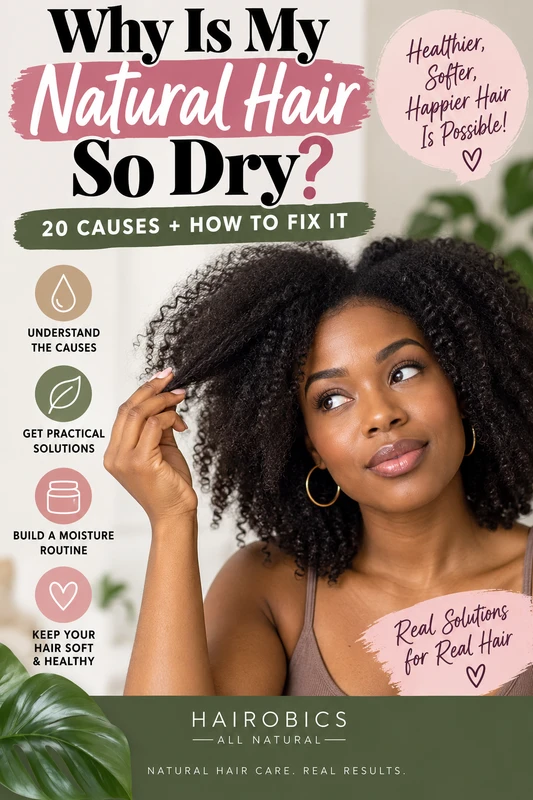
Natural hair can look healthy, full, and beautiful yet still feel dry only hours after wash day. You may apply a leave-in conditioner, seal your hair with oil, put it into a protective style, and still wonder: Why is my natural hair so dry?
Dryness is one of the most common challenges for people with natural, curly, coily, and kinky hair. The problem is not necessarily that you aren't using enough products. Your hair's texture, porosity, wash routine, environment, styling habits, and the way you layer products can all influence how well your strands retain moisture.
The key is understanding the difference between adding moisture and keeping moisture in your hair.
In this guide, we'll explore why natural hair gets so dry, signs that your hair needs more moisture, common mistakes that make dryness worse, and how to build a consistent natural hair moisture routine.
Why Is My Natural Hair So Dry?
Natural hair can become dry when the strands don't receive enough moisture or have difficulty retaining the moisture they receive.
Curly and coily hair can be especially prone to dryness because natural scalp oils have a more difficult path traveling from the roots to the ends.
On straighter hair, sebum produced by the scalp can move relatively easily down the hair shaft. With curls, coils, bends, and twists, that journey becomes more difficult.
As a result, the ends of natural hair may receive less natural lubrication.
This is why someone can have a relatively oily scalp while still having dry ends.
However, texture isn't the only reason.
Your hair may also feel excessively dry because of:
- High hair porosity
- Product buildup
- Washing too frequently
- Using harsh shampoos
- Not conditioning properly
- Heat damage
- Chemical processing
- Environmental conditions
- Hard water
- Excessive manipulation
- Improper product layering
- Waiting too long between moisturizing sessions
- Sleeping without protecting your hair
- Split or weathered ends
For many people, several factors are happening at the same time.
1. Natural Hair Is Naturally More Prone to Dryness
The structure of curly and coily hair plays an important role in moisture retention.
The scalp produces sebum, an oily substance that helps lubricate the scalp and hair. Because natural hair bends and curves repeatedly along the strand, sebum may not coat the entire length as easily as it can with straighter textures.
The ends are particularly vulnerable.
Your ends are the oldest portion of your hair and have experienced months or years of washing, detangling, styling, friction, weather exposure, and manipulation.
This helps explain why your roots might feel moisturized while your ends feel rough.
It doesn't mean healthy natural hair has to feel chronically dry. It means natural hair often benefits from a routine designed specifically around maintaining moisture.
2. You May Not Be Using Enough Water
One of the biggest misconceptions about natural hair is that oil equals moisture.
It doesn't.
Water provides moisture.
Oils can lubricate the hair and, depending on the product and routine, help reduce moisture loss. But applying oil to extremely dry hair doesn't automatically hydrate the strand.
Imagine applying oil to a dry sponge.
The sponge is still dry underneath.
Natural hair generally responds better when moisture-containing products are applied to hair that is damp or has recently been conditioned.
If your routine consists primarily of applying oils and butters to completely dry hair, this may be one reason your hair continues to feel dry.
Try this instead:
Start with water or a water-based moisturizing product.
Then apply your leave-in or moisturizer.
If your hair responds well to oils, use a small amount afterward.
The goal isn't to make your hair greasy.
The goal is to help your strands remain soft and manageable.
3. Your Hair May Have High Porosity
Hair porosity describes how readily your hair interacts with water and hair products.
High-porosity hair may absorb moisture quickly but can also lose it relatively quickly.
High porosity can occur naturally, but chemical processing, excessive heat, mechanical damage, and environmental wear can also affect the hair's outer structure.
Possible signs of high-porosity hair include:
- Hair gets wet very quickly.
- Hair dries quickly after washing.
- Moisture seems to disappear soon after application.
- Hair frequently feels rough.
- Hair tangles easily.
- You experience frequent breakage.
- Your ends feel especially dry.
If this sounds familiar, repeatedly spraying your hair with water may provide only temporary relief.
You need a routine focused on moisture retention.
Moisture routine for high-porosity hair
After washing:
- Apply a moisturizing conditioner.
- Detangle carefully.
- Apply a water-based leave-in conditioner.
- Follow with a cream or moisturizer if needed.
- Apply a light oil or butter if your hair responds well to sealing.
- Style your hair in a low-manipulation style.
- Protect it at night.
You may need to refresh your hair between wash days rather than waiting until it becomes extremely dry.
4. Low-Porosity Hair Can Feel Dry Too
Low-porosity hair is sometimes misunderstood.
People often assume low-porosity hair should automatically stay moisturized because its cuticle layers are relatively compact.
But low-porosity hair can still feel very dry.
The challenge may be getting water and conditioning products to thoroughly wet and coat the strands without creating heavy buildup.
Common signs associated with low-porosity hair include:
- Water initially beads on the hair.
- Hair takes a long time to become fully saturated.
- Heavy products sit on the strands.
- Hair becomes coated easily.
- Products seem to accumulate quickly.
- Hair can take a long time to dry.
If you have low-porosity hair, applying more and more heavy butter may make the problem worse.
The buildup can leave your hair feeling coated rather than soft.
Try:
Use warm—not excessively hot—water during wash day.
Work water into your hair thoroughly.
Use lighter moisturizing products.
Clarify periodically when buildup becomes noticeable.
Apply products in smaller amounts and give each layer time to distribute.
Your hair shouldn't need to be covered in product to feel moisturized.
5. Product Buildup May Be Blocking Your Routine
Sometimes dry natural hair doesn't need another moisturizer.
It needs a proper wash.
Natural hair routines can involve:
- Leave-in conditioner
- Curl cream
- Gel
- Edge control
- Oil
- Butter
- Pomade
- Styling foam
- Scalp products
- Dry shampoo
Layer these repeatedly without thoroughly cleansing the hair and buildup can develop.
The hair may begin feeling:
- Dull
- Heavy
- Sticky
- Greasy yet dry
- Rough
- Difficult to wet
This creates a frustrating cycle.
Your hair feels dry, so you add another product.
It still feels dry, so you add another.
Eventually you're layering fresh products over old products.
The solution
Wash your hair thoroughly and clarify periodically when your regular cleansing routine isn't removing enough residue.
How often you need a clarifying shampoo depends on your hair, products, water quality, and styling routine.
You don't necessarily need to clarify every wash day.
Instead, watch how your hair behaves.
If water no longer seems to saturate your strands easily and products aren't performing like they normally do, buildup may be involved.
6. You May Be Washing Your Hair Too Often
Cleansing is important for scalp and hair hygiene, but excessive washing can leave some people's natural hair feeling dry.
This is especially likely when frequent washing is combined with a strong cleanser and inadequate conditioning.
There is no universal wash schedule that works for everyone.
Some people prefer weekly cleansing. Others may need to wash more or less frequently depending on scalp needs, exercise, product usage, hairstyle, and personal preference.
The key is paying attention to how your hair responds.
If your hair feels increasingly rough immediately after every shampoo, examine your cleanser and post-shampoo routine.
7. Your Shampoo May Be Too Harsh
Not all shampoos cleanse with the same intensity.
A stronger shampoo can be useful when you need to remove significant buildup, but it may not be necessary every time you wash your hair.
After shampooing, your hair should feel clean.
It doesn't necessarily need to feel extremely stripped or squeaky.
If your strands consistently feel tangled, rough, and brittle immediately after shampooing, consider whether your cleanser is appropriate for your routine.
You might benefit from alternating between:
Regular shampoo: For routine cleansing.
Clarifying shampoo: For periodic deeper cleansing when buildup is present.
Follow shampoo with an appropriate conditioner to restore softness and improve manageability.
8. You're Skipping Conditioner
Shampoo and conditioner perform different jobs.
Shampoo primarily cleanses.
Conditioner improves softness, lubrication, and manageability.
Skipping conditioner may leave natural hair more difficult to detangle and style.
A good conditioning session is particularly helpful if your hair is:
- Thick
- Coily
- Long
- Color-treated
- Tangle-prone
- Frequently manipulated
Apply conditioner generously enough to coat your strands, paying special attention to the lengths and ends.
Use this stage to carefully detangle.
9. Your Ends Are Dry and Damaged
If most of your hair feels healthy but the last inch or two constantly feels rough, your ends may be the real problem.
Remember that your ends are the oldest part of your hair.
Over time they experience:
- Friction
- Detangling
- Combing
- Brushing
- Heat
- Styling
- Clothing friction
- Weather
- Washing
- Protective styles
Eventually, severely weathered or split ends may need trimming.
Products can temporarily improve how damaged ends feel, but they cannot permanently fuse severely split hair back into pristine condition.
Trimming compromised ends can make the rest of your routine easier.
10. Heat Styling Can Increase Dryness
Frequent use of flat irons, curling irons, blow dryers, and other high-temperature tools can alter the hair fiber.
Excessive heat exposure can contribute to:
- Roughness
- Breakage
- Reduced elasticity
- Split ends
- Changes in curl pattern
This doesn't mean you can never use heat.
The key is moderation.
Use an appropriate heat protectant, avoid unnecessarily high temperatures, and reduce repeated passes over the same section.
If your natural hair became noticeably drier after a period of frequent straightening, heat damage could be part of the problem.
11. Chemical Treatments Can Affect Moisture Retention
Hair color, relaxers, texturizers, bleaching, and other chemical processes alter the hair structure.
Processed hair may require more careful conditioning and handling.
Bleached or heavily processed hair can become particularly fragile.
If you color your natural hair, pay close attention to:
- Conditioning
- Detangling
- Heat exposure
- Protein-moisture balance
- Split ends
- Breakage
If your hair suddenly becomes extremely brittle following a chemical service, consider consulting a qualified cosmetologist.
12. Hard Water May Be Contributing to Dry Hair
Sometimes your hair routine isn't the only factor.
Your water can matter.
Hard water contains relatively high levels of dissolved minerals such as calcium and magnesium.
Mineral accumulation can affect how hair feels and how well products perform.
Possible signs of a hard-water issue include:
- Hair feels coated after washing.
- Hair gradually becomes dull.
- Your normal shampoo doesn't seem as effective.
- You notice mineral deposits around faucets or shower fixtures.
- Your hair behaves differently after moving.
A clarifying or chelating shampoo designed to address mineral buildup may be useful periodically.
A shower filter may help with certain water contaminants, but ordinary filters do not necessarily soften genuinely hard water. A true water-softening system works differently.
13. Your Hair Is Drying Out While You Sleep
You can follow the perfect daytime routine and undo part of your work every night.
Cotton bedding can create friction against your hair while you move during sleep.
For natural hair, repeated friction may contribute to:
- Frizz
- Tangling
- Dry-feeling strands
- Breakage
Consider sleeping with a satin or silk bonnet, scarf, or pillowcase.
You don't necessarily need all three.
Choose a method you'll consistently use.
For long hair, twists, braids, or locs, make sure your nighttime protection isn't excessively tight.
14. You're Wearing Your Hair Loose Too Often
There's nothing wrong with wearing your natural hair out.
Afros, twist-outs, braid-outs, wash-and-gos, and defined curls can all be beautiful.
However, loose hair may experience more exposure to:
- Dry air
- Clothing
- Wind
- Sun
- Tangling
- Manipulation
If you're struggling with extreme dryness and breakage, incorporating low-manipulation styles can help.
Examples include:
- Two-strand twists
- Braids without extensions
- Buns
- Flat twists
- Tucked styles
The goal isn't to hide your hair constantly.
It's to give your strands periods of reduced manipulation.
15. Protective Styles Can Still Cause Dryness
Braids, twists, wigs, and other protective styles don't automatically keep hair moisturized.
Your natural hair still needs attention underneath the style.
One common mistake is installing braids and ignoring the hair for six or eight weeks.
Your scalp may still need cleansing, and your hair may benefit from appropriate moisture during that period.
When wearing braids:
- Keep the scalp clean.
- Moisturize as needed.
- Avoid excessive product buildup.
- Protect the style at night.
- Don't keep overly tight or deteriorating braids installed indefinitely.
- Give your hair careful attention during takedown.
Protective styling works best when the hair underneath remains a priority.
16. You're Using Too Much Protein
Protein treatments can be useful for some hair routines, especially when the hair is damaged.
But more isn't automatically better.
If you continuously use protein-heavy treatments while neglecting moisture and conditioning, your hair may begin feeling stiff or rough.
Check your products.
You may be unknowingly layering several protein-containing products during the same routine.
Hair needs balance.
If your hair feels unusually stiff after frequent protein treatments, consider reducing their frequency and focusing on a moisturizing routine.
17. Your Moisturizer Isn't Right for Your Hair
A product can have excellent reviews and still not work well for your hair.
Natural hair varies tremendously.
What works for one person's curls may leave someone else's hair feeling:
- Greasy
- Sticky
- Coated
- Crunchy
- Dry
Don't judge a moisturizer solely by popularity.
Judge it by results.
Ask yourself:
Does my hair feel softer?
Is detangling easier?
Does the softness last?
Does the product create excessive buildup?
Do I have to reapply it constantly?
Your hair's response is more useful than a viral recommendation.
18. You May Be Applying Products in the Wrong Order
Product layering can make a noticeable difference.
Two popular methods are:
LOC Method
L – Liquid or Leave-In
O – Oil
C – Cream
LCO Method
L – Liquid or Leave-In
C – Cream
O – Oil
Neither method is automatically superior.
Try both and see which leaves your hair softer for longer without excessive buildup.
Some people don't need three separate products at all.
A leave-in followed by a small amount of oil may be enough.
Others prefer a leave-in and cream without oil.
Your ideal routine is the simplest routine that keeps your hair manageable and comfortable.
19. You're Waiting Until Your Hair Is Extremely Dry
Moisture maintenance is easier than moisture rescue.
If your hair feels good on Monday but you know it becomes extremely dry by Thursday, don't necessarily wait until Thursday night.
Refresh it earlier.
Your refresh routine doesn't need to resemble wash day.
You might simply:
- Lightly dampen the hair.
- Apply a small amount of moisturizing product.
- Focus on your driest areas.
- Put the hair into twists or another low-manipulation style.
- Cover it before sleeping.
The goal is consistency.
20. Weather Can Dry Out Natural Hair
Your environment can influence your hair.
Cold winter air, indoor heating, wind, intense sun, and low-humidity conditions may change how quickly your hair loses moisture or how your styling products behave.
You may need different routines during different seasons.
During dry weather:
Consider richer conditioning products and protective or low-manipulation styles.
During hot weather:
Keep your scalp clean, especially if you're sweating frequently, and use products that don't create excessive buildup.
Your natural hair routine doesn't need to remain identical all year.
How to Tell If Your Natural Hair Is Dry
Dryness can appear differently depending on your texture and hairstyle.
Common signs include:
- Rough texture
- Excessive tangling
- Dull appearance
- Ends that feel brittle
- Hair that doesn't stay soft after moisturizing
- Increased breakage
- Difficulty styling
- Frizz
- Stiffness
- Frequent single-strand knots
Remember that frizz alone doesn't automatically mean unhealthy hair.
Natural curls and coils naturally have texture and may not appear perfectly smooth.
Focus on how your hair feels and behaves, not simply whether every strand is perfectly defined.
Dry Hair vs. Damaged Hair
Dryness and damage aren't necessarily the same thing.
Dry hair may improve considerably after cleansing, conditioning, moisturizing, and reducing friction.
Damaged hair may involve structural changes caused by:
- Excessive heat
- Bleaching
- Chemical processing
- Mechanical wear
- Severe split ends
Signs that could indicate damage rather than simple dryness include:
- Persistent breakage
- Severe split ends
- Sections that no longer curl normally
- Unusual weakness when wet
- Significant changes after bleaching or heat styling
Moisturizer can improve the feel of damaged hair, but it cannot reverse every form of structural damage.
Sometimes trimming damaged portions is the most effective long-term solution.
How to Moisturize Extremely Dry Natural Hair
If your hair currently feels extremely dry, don't immediately cover it with heavy oil.
Start fresh.
Step 1: Cleanse Your Hair
If you have significant buildup, thoroughly cleansing the hair may help your moisturizing products work more effectively.
Use a shampoo appropriate for your needs.
Focus on cleansing your scalp while allowing the shampoo to move through the lengths as you rinse.
Avoid aggressively piling your hair on top of your head.
Step 2: Condition
Apply conditioner from roots or mid-lengths through the ends according to your scalp needs and product instructions.
Focus especially on your ends.
Work in sections if you have thick or long hair.
Step 3: Detangle Carefully
Detangle while your hair has adequate slip.
Start near the ends and gradually work upward.
Use your fingers, a wide-tooth comb, or a detangling brush that works well for your texture.
Avoid ripping through knots.
Breakage makes moisture retention and length retention more difficult.
Step 4: Rinse Thoroughly
Unless you're using a conditioner specifically designed to remain in the hair, rinse it according to the manufacturer's instructions.
Leaving ordinary rinse-out conditioner in your hair isn't necessarily better.
Step 5: Apply Leave-In Conditioner
Apply a leave-in to damp hair.
Work in sections so the product reaches more than the outermost layer of your hairstyle.
Pay particular attention to dry areas and ends.
Step 6: Add a Cream If Needed
Thicker or highly textured hair may benefit from an additional moisturizing cream.
Fine hair may not.
Experiment.
If your hair becomes limp or heavily coated, you may be using too much product.
Step 7: Seal If Your Hair Responds Well to It
Apply a small amount of oil or butter if this improves your moisture retention.
You don't need to saturate your hair.
More oil doesn't equal more moisture.
Step 8: Choose a Low-Manipulation Style
Twists, braids, buns, and other low-manipulation styles can help reduce daily handling.
Less manipulation can mean fewer opportunities for tangling and breakage.
Step 9: Protect Your Hair at Night
Use satin or silk protection.
This simple habit can make your wash-day results last longer.
A Weekly Routine for Dry Natural Hair
Here's a simple example routine.
Wash Day
Cleanse your scalp and hair.
Condition thoroughly.
Detangle gently.
Apply a leave-in moisturizer.
Add a cream or light sealant if needed.
Style your hair.
Midweek
Evaluate your hair rather than automatically adding products.
If it still feels soft, leave it alone.
If it feels dry, lightly refresh it.
Focus on the ends.
Every Night
Protect your hair with satin or silk.
If you have long natural hair, loosely sectioning or twisting it before bed may also help reduce tangling.
Periodically
Check for buildup.
Clarify when necessary.
Evaluate your ends and trim them when needed.
Adjust your routine when seasons change.
How Often Should You Moisturize Natural Hair?
There is no universal schedule.
Some people need moisture every couple of days.
Others can go much longer.
Instead of following an arbitrary calendar, learn how your hair behaves.
Moisturize when your strands begin losing softness and manageability—not simply because a social media routine says you should moisturize every day.
Overloading the hair with products every morning and night can create buildup.
Your goal should be effective moisture, not maximum product usage.
Best Ingredients for Dry Natural Hair
When shopping for moisturizing hair products, look for formulas designed to hydrate, condition, lubricate, and improve manageability.
Depending on the formula, useful ingredients may include:
Water
Water is usually the foundation of a moisturizing leave-in or spray.
Aloe Vera
Aloe is commonly included in moisturizing hair products.
Glycerin
Glycerin is a humectant that attracts water, although its performance can vary depending on the formula and environmental conditions.
Panthenol
Panthenol is commonly used in hair products for conditioning and moisture-related benefits.
Fatty Alcohols
Don't assume every ingredient containing the word "alcohol" is drying.
Fatty alcohols such as cetyl alcohol and cetearyl alcohol are commonly used in conditioners to improve softness and texture.
Plant Oils
Oils such as jojoba, avocado, coconut, olive, and grapeseed oil are commonly incorporated into natural hair routines.
Different oils behave differently, so experimentation matters.
Shea Butter
Shea butter is popular for thicker, coily hair because it provides richness and lubrication.
However, it may be too heavy for some fine or low-porosity hair.
Common Mistakes That Keep Natural Hair Dry
If your hair never seems to stay moisturized, examine your entire routine.
Some of the biggest mistakes include:
Using oil instead of moisturizer.
Oil isn't a replacement for water.
Applying products over buildup.
Eventually, your hair needs to be cleansed.
Using too much product.
More isn't always better.
Ignoring your ends.
Your oldest hair often needs the most attention.
Never conditioning.
Cleansing without adequate conditioning can make detangling more difficult.
Using excessive heat.
Repeated high-temperature styling can contribute to damage.
Sleeping without protection.
Nightly friction adds up.
Manipulating your hair constantly.
Daily combing, brushing, and restyling can contribute to breakage.
Keeping protective styles installed too long.
Protective styles still require scalp and hair care.
Copying someone else's routine exactly.
Their hair isn't your hair.
Why Does My Natural Hair Feel Dry After Moisturizing?
This is particularly frustrating.
You moisturize your hair, wait an hour, and somehow it feels dry again.
Several things may be happening.
Your hair could have high porosity and lose moisture quickly.
You might have product buildup preventing effective wetting.
You may not have applied enough water before your styling products.
Your product might be too lightweight for your hair.
Or the product may simply not work well with your texture and routine.
Instead of immediately adding more product, evaluate the pattern.
If your hair hasn't been thoroughly washed recently, start there.
If it is freshly washed, experiment with your product layering.
Why Is My Natural Hair Dry Even After Deep Conditioning?
Deep conditioning doesn't automatically solve every dryness problem.
If your hair still feels dry afterward, possible explanations include:
- Significant buildup
- Mineral buildup from hard water
- A conditioner that doesn't suit your hair
- Severe weathering or damaged ends
- Excessive heat or chemical damage
- Poor post-wash moisture retention
- Too much protein for your current routine
Try changing one variable at a time.
If you replace your shampoo, conditioner, leave-in, oil, and styling cream simultaneously, you won't know which change helped.
How to Keep Natural Hair Moisturized Longer
Long-lasting moisture usually comes from a combination of habits rather than one miracle product.
Focus on these fundamentals:
- Cleanse regularly enough to prevent excessive buildup.
- Condition after shampooing.
- Detangle carefully.
- Apply moisturizing products to damp hair.
- Experiment with LOC or LCO layering.
- Focus on your ends.
- Reduce unnecessary heat.
- Use low-manipulation styles when appropriate.
- Protect your hair while sleeping.
- Refresh your hair before it becomes extremely dry.
- Clarify when buildup interferes with your routine.
- Trim damaged ends when necessary.
Consistency usually matters more than having a bathroom full of products.
Frequently Asked Questions About Dry Natural Hair
Why is my natural hair always dry?
Natural hair may remain dry because of its curl pattern, hair porosity, product buildup, cleansing habits, environmental conditions, damage, or an ineffective moisturizing routine. Determine whether your hair is actually receiving enough water and whether it can retain that moisture.
Why is my 4C hair so dry?
Tightly coiled hair can be especially prone to dry-feeling lengths and ends because scalp oils have difficulty traveling along all the bends in the strand. Consistent conditioning, moisturizing, gentle handling, and nighttime protection can help.
Should I moisturize my natural hair every day?
Not necessarily. Moisturize according to your hair's needs. If your hair remains soft for several days, adding more product daily may only create buildup.
Is oil good for dry natural hair?
Oil can be useful for lubrication and as part of a moisture-retention routine, but oil alone isn't the same as hydrating the hair with water or a water-based product.
Why is my natural hair dry after washing?
Your cleanser may be too strong, you may need better conditioning, or your post-wash routine may not provide enough moisture retention. Hard-water or product buildup can also influence how hair feels.
Why are the ends of my natural hair always dry?
The ends are the oldest and most weathered portion of your hair. They experience more cumulative damage and friction. Focus moisturizing products on the ends and trim severely split or damaged hair when necessary.
Does dry natural hair mean my hair is unhealthy?
Not automatically. Natural hair can occasionally feel dry without being severely damaged. Persistent brittleness, excessive breakage, severe split ends, or dramatic texture changes deserve closer attention.
Can I just spray water on dry natural hair?
Water can temporarily hydrate your hair, but many people find that following it with an appropriate leave-in, cream, or sealant helps the softness last longer.
What is the best method for moisturizing natural hair?
There isn't one method that works for everyone. Applying a water-based leave-in to damp, freshly cleansed hair and following with additional products as needed is a practical starting point.
The Bottom Line: Why Is My Natural Hair So Dry?
If you've been asking, "Why is my natural hair so dry?", the answer probably isn't that you need to pour more oil on it.
Natural hair needs a balanced routine.
Your strands need to be cleansed so buildup doesn't interfere with your products. They need water and conditioning. They need gentle detangling. They need protection from unnecessary heat and friction. And depending on your texture and porosity, they may benefit from creams, oils, or butters that help maintain softness between wash days.
Pay particular attention to your ends.
Protect your hair while you sleep.
Don't wait until your strands feel extremely brittle before refreshing them.
And remember that healthy natural hair doesn't have to look perfectly shiny or remain completely frizz-free.
The objective is hair that feels soft, manageable, flexible, and resilient.
Once you understand how your individual hair absorbs and retains moisture, maintaining hydrated natural hair becomes much easier.
A simple, consistent routine will usually serve you better than constantly chasing the newest product or social media hair trend.
Your natural hair is unique. Build your moisture routine around what your strands actually need, and adjust it as your hair, hairstyle, environment, and seasons change.