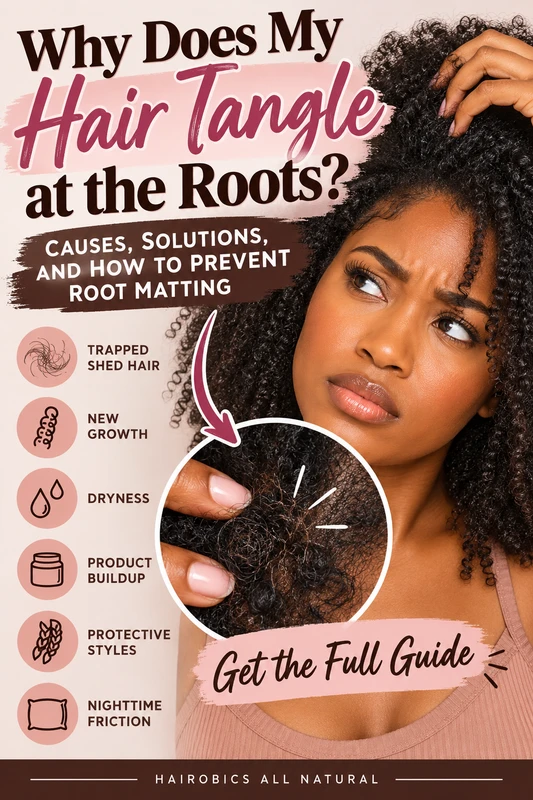
Have you ever tried running your fingers through your natural hair, only to discover stubborn tangles forming right near your scalp? Maybe your ends feel soft and manageable, but your roots seem to be constantly knotted together. Or perhaps you've just removed your braids and noticed that your new growth has become tangled, making detangling frustrating and time-consuming.
If you've been asking yourself, "Why does my hair tangle at the roots?", you're not alone.
Root tangling is a common concern for people with natural, curly, coily, kinky, and textured hair. It can be particularly noticeable in 4A, 4B, and 4C hair, where tightly curled strands naturally intertwine as they grow.
Although some tangling is normal, excessive knots near the scalp can lead to unnecessary breakage, painful detangling sessions, and even severe matting if left unaddressed.
The good news is that you don't have to struggle with tangled roots every wash day.
Understanding why your roots become tangled, how to safely remove knots, and what changes you can make to your hair care routine can help you maintain softer, more manageable natural hair.
In this complete guide, we'll explain the most common causes of tangled roots, how to detangle natural hair without excessive breakage, and the best ways to prevent root matting.
What Causes Hair to Tangle at the Roots?
Hair tangles at the roots when individual strands near the scalp become intertwined, twisted, or trapped together.
Unlike tangles at the ends, which frequently develop because of split ends and accumulated damage, root tangles are often associated with new growth, trapped shed hair, shrinkage, friction, and improper detangling.
Your hair grows from follicles beneath the scalp. As new strands emerge, they interact with surrounding hair.
For people with tightly coiled natural hair, these strands don't necessarily grow in the same direction. They bend, curl, and wrap around neighboring strands.
Over time, this movement can create knots close to the scalp.
Several factors can make the problem worse, including:
-
Accumulated shed hair
-
Tight natural curl patterns
-
Significant shrinkage
-
Long-term protective hairstyles
-
Infrequent detangling
-
Product buildup
-
Dryness and insufficient conditioning
-
Improper shampooing techniques
-
Excessive friction
-
Sleeping without protecting your hair
Identifying which factors affect your hair is the first step toward preventing recurring tangles.
For a broader explanation of knots throughout the hair, read our guide on why hair tangles so easily.
1. Trapped Shed Hair Is One of the Biggest Causes of Root Tangling
One of the most overlooked reasons natural hair tangles at the roots is accumulated shed hair.
Hair naturally goes through a growth cycle that includes growing, resting, and shedding.
Many people shed approximately 50 to 100 hairs per day, although individual amounts vary.
When your hair is straight or worn loose, shed strands may fall away relatively easily.
However, tightly coiled natural hair behaves differently.
Because curls and coils wrap around one another, shed hairs may remain trapped among attached strands.
Over several days or weeks, these loose hairs can accumulate near your scalp.
Eventually, they become intertwined with neighboring strands, creating knots that are difficult to separate.
Signs that trapped shed hair is causing tangles
You may notice:
-
Small clusters of hair near your scalp
-
Roots that feel connected or stuck together
-
Large amounts of loose hair during detangling
-
Knots appearing after protective style removal
-
Difficulty separating your hair into sections
-
Hair that becomes tangled again shortly after washing
How to fix it
Remove shed hair regularly without overmanipulating your strands.
During wash day, divide your hair into manageable sections and gently finger-detangle before using a comb.
Pay attention to the area near your scalp, but avoid aggressively pulling through resistant knots.
If your hair is particularly dense, work in smaller sections so you can identify trapped strands more easily.
The goal is to remove loose hair before it becomes tightly intertwined with healthy strands.
2. New Growth Can Become Tangled Near the Scalp
New growth is another common reason hair tangles at the roots.
This is especially noticeable after wearing braids, twists, cornrows, or other long-term protective styles.
While your hair is styled, new strands continue growing from your scalp.
These new strands may not remain neatly separated in the same sections as the original hairstyle.
Instead, neighboring hairs can begin wrapping around one another.
The longer you leave a protective style installed, the more noticeable this intertwining may become.
Why new growth tangles
Imagine wearing box braids for several weeks.
At the beginning, each braid is neatly separated.
As your hair grows, the sections near your scalp gradually become less defined.
Loose shed hairs may also accumulate around the new growth.
When you eventually remove your braids, the roots may appear tangled or slightly matted.
This doesn't automatically mean your hair is damaged.
However, it does mean you should approach detangling carefully.
How to prevent new growth tangles
Avoid leaving protective styles installed beyond what your hair and scalp can comfortably tolerate.
When removing braids, work through each section individually.
Separate accumulated shed hairs before combining multiple sections.
For detailed instructions, read how to detangle hair after braids without breakage.
3. Natural Hair Shrinkage Can Cause Roots to Intertwine
Shrinkage is a normal characteristic of curly and coily hair.
When textured hair becomes wet and then dries, the curls contract toward their natural shape.
Depending on your curl pattern, your hair may appear significantly shorter than its stretched length.
Although shrinkage is not inherently harmful, it can make root tangling more noticeable.
As strands contract, neighboring curls move closer together.
Some hairs may wrap around others, particularly when your hair is left loose.
This is especially common with tightly coiled 4B and 4C natural hair.
How to manage shrinkage-related tangling
You don't need to eliminate shrinkage completely.
Instead, consider hairstyles that help keep your strands organized.
Examples include:
-
Two-strand twists
-
Loose braids
-
Flat twists
-
Banding
-
Low-tension stretched styles
-
Twist-outs maintained in sections
These hairstyles can help reduce how frequently neighboring strands become intertwined.
Avoid excessively tight styling techniques, which can place unnecessary tension on your scalp.
4. Dry Hair Can Make Root Tangling Worse
Dryness can contribute to root tangling by increasing friction between strands.
When hair feels rough, stiff, or brittle, neighboring strands may not slide past one another easily.
Instead, they catch and wrap together.
Natural hair can be particularly susceptible to dryness because scalp oils do not travel as easily along tightly curved strands.
However, even hair near the scalp can become difficult to manage if it is inadequately conditioned.
Signs your hair needs better conditioning
You may notice:
-
Roots that feel stiff or rough
-
Hair that is difficult to separate
-
Increased friction while finger-detangling
-
Knots forming shortly after styling
-
Hair that snaps during manipulation
-
Strands that feel dry despite applying oil
How to improve moisture and manageability
Start with a consistent cleansing and conditioning routine.
Use a conditioner that provides enough slip to help your strands separate.
After washing, apply a suitable water-based leave-in product to your hair.
Focus on distributing the product evenly instead of applying excessive amounts directly to your scalp.
A lightweight leave-in treatment may help improve softness and reduce friction during styling.
Remember that oil alone does not replace water-based conditioning.
For more information about the relationship between dryness and texture, explore our article on why natural hair feels rough.
5. Product Buildup Can Make Roots Feel Sticky and Tangled
Using too many hair products can sometimes make root tangling worse.
Leave-in conditioners, styling creams, gels, pomades, oils, and butters may leave residue on your hair.
Some conditioning ingredients are beneficial because they improve lubrication and manageability.
However, excessive accumulation can make strands feel coated, sticky, or heavy.
When neighboring strands stick together, separating them becomes more difficult.
Common signs of buildup
-
Roots feel waxy or greasy
-
Hair looks dull
-
Strands feel sticky when separated
-
Your scalp has visible product residue
-
Hair feels coated even after moisturizing
-
Styling products seem less effective
How to remove buildup
Use an appropriate shampoo to cleanse your scalp and hair.
If ordinary cleansing doesn't remove accumulated residue, an occasional clarifying shampoo may help.
Follow cleansing with a conditioner that provides good slip.
Avoid immediately applying several heavy products afterward.
Start with a simple routine and add products only when your hair needs them.
Our article on why hair feels coated explains how to recognize buildup and restore manageability.
6. Protective Styles Can Contribute to Root Matting
Protective styles are popular because they reduce daily manipulation and make natural hair easier to maintain.
However, they are not completely maintenance-free.
Braids, twists, wigs, sew-ins, and cornrows can contribute to root tangling when shed hair accumulates or sections begin merging.
This is particularly noticeable when styles remain installed for extended periods.
Why braids sometimes cause tangled roots
During protective styling:
-
Your hair continues growing.
-
Shed strands may remain trapped.
-
New growth becomes less organized.
-
Neighboring sections may intertwine.
-
Product residue can accumulate.
-
Removal may become more difficult.
When you finally take down the hairstyle, the roots may contain a mixture of shed hair, new growth, and accumulated tangles.
How to protect your roots
Keep your scalp reasonably clean while wearing protective styles.
Avoid excessive tension and monitor your hair for discomfort, buildup, and matting.
During removal, take down one braid or twist at a time.
Gently separate the roots before moving to the next section.
Never assume that protective styling means you can ignore the condition of your natural hair.
7. Washing Your Hair Incorrectly Can Create More Tangles
Your shampooing technique may be contributing to tangled roots.
One common mistake is gathering all your hair into a large pile and aggressively scrubbing it together.
This can cause strands to cross, twist, and wrap around one another.
For tightly coiled natural hair, the result may be a frustrating collection of knots.
Better shampooing technique
Before washing, separate your hair into manageable sections.
Gently remove obvious tangles.
Apply shampoo primarily to the scalp and massage using your fingertips.
Avoid rubbing the lengths of your hair together unnecessarily.
Allow the shampoo and water to move through the strands as you rinse.
If your hair is especially prone to tangling, washing in loose twists or sections may help keep it organized.
The objective is to cleanse thoroughly without creating additional friction.
8. Infrequent Detangling Allows Small Knots to Become Larger
Detangling is an important part of maintaining natural hair.
However, the ideal frequency depends on your hairstyle, texture, length, density, and shedding pattern.
When you go too long without removing shed hairs, small tangles may gradually become larger.
For example, a minor knot near your scalp may initially involve only a few strands.
As additional shed hairs become trapped, the knot can expand.
Eventually, several sections may begin sticking together.
How often should you detangle?
There is no universal schedule.
Many people thoroughly detangle during wash day.
Others need occasional light maintenance between washes.
If you frequently wear your hair loose, you may need to separate tangles more often.
If you wear protective styles, pay special attention during takedown.
Avoid unnecessary daily combing if it causes excessive manipulation.
The goal is to detangle often enough to prevent matting without repeatedly stressing your strands.
9. Sleeping With Loose Hair Can Encourage Root Tangling
Nighttime friction can also contribute to tangling.
When you sleep, your hair moves against your pillowcase.
Loose curls may rub against one another, particularly if you change positions frequently.
Over time, this movement can create knots.
How to protect your hair while sleeping
Consider using:
-
A satin bonnet
-
A silk or satin scarf
-
A smooth pillowcase
-
Loose nighttime twists
-
A comfortable, low-tension hairstyle
For longer natural hair, loosely sectioning your strands before bed may reduce tangling.
Avoid tight hair ties or accessories that pull on your roots.
Your nighttime routine should protect your hair without creating scalp tension.
10. Hair Density Can Make Root Tangling More Difficult to Manage
Hair density refers to how many strands grow within a particular area of your scalp.
People with high-density hair have more strands packed into a given area.
This can make root tangles harder to locate and separate.
High-density hair does not automatically tangle more than every other hair type, but it may require additional time and smaller sections during detangling.
Fine strands can also intertwine easily, even when overall density is low.
How to manage dense roots
Work in smaller sections rather than trying to detangle large amounts of hair at once.
Use enough conditioner to distribute slip throughout each section.
Pay particular attention to the roots, where shed strands may become trapped.
Take your time and avoid pulling aggressively.
How to Detangle Hair at the Roots Without Breakage
Now that you understand the causes of root tangling, let's discuss how to remove knots safely.
Detangling close to the scalp requires patience because excessive pulling can cause discomfort and unnecessary hair damage.
Step 1: Divide Your Hair Into Sections
Start by separating your hair into four to eight manageable sections.
If your hair is particularly thick or densely coiled, create smaller subsections.
Use clips or loose twists to keep the remaining hair out of the way.
Sectioning allows you to identify knots without disturbing your entire head.
Step 2: Apply Conditioner or a Detangling Product
Apply a product that provides adequate slip.
Depending on your hair, this may be a rinse-out conditioner or a suitable detangling treatment.
Work the product gently through the section.
Allow it to distribute before attempting to remove stubborn knots.
Avoid applying excessive pressure to your scalp.
Step 3: Start Detangling at the Ends
Even when the main problem is near your roots, begin by removing tangles from the ends.
Gradually move upward toward the scalp.
Starting at the roots and pulling downward can push smaller tangles together, creating larger knots.
Step 4: Finger-Detangle the Root Area
Once the lengths are reasonably free of tangles, focus on the roots.
Use your fingertips to identify intertwined strands.
Gently separate small groups of hair.
If you encounter a stubborn knot, stop and inspect it.
Add more slip if necessary.
Never force your fingers or comb through tightly tangled hair.
Step 5: Remove Trapped Shed Hair
Look for loose strands that have become wrapped around attached hair.
Carefully slide or separate these hairs away from the section.
If the hair is severely matted, seek help from a stylist experienced with textured-hair detangling.
Avoid cutting close to your scalp without knowing exactly which strands are involved.
Step 6: Use a Wide-Tooth Comb if Needed
After finger-detangling, you may use a wide-tooth comb or flexible detangling brush to finish.
Work from the ends upward.
Hold the section above the area you're combing to reduce pulling.
If your tool stops moving, don't force it.
Return to finger-detangling until the obstruction is loosened.
For additional guidance, read our article on why hair breaks when detangling.
Step 7: Twist or Braid the Finished Section
Once the section is detangled, place it into a loose twist or braid.
This helps prevent the strands from becoming tangled again while you work on the rest of your hair.
Repeat the process until your entire head is detangled.
What Is the Difference Between Root Tangling and Root Matting?
Although these terms are sometimes used interchangeably, they describe different levels of entanglement.
Root tangling
Root tangling occurs when strands near the scalp become intertwined.
These tangles are generally easier to separate when addressed early.
Root matting
Root matting occurs when multiple strands become tightly compacted together.
Matted hair may feel like a dense cluster that cannot easily be separated.
Matting can develop when shed hair, friction, and prolonged tangling occur together.
Severe matting requires additional care because aggressive detangling can cause substantial breakage.
If your roots are tightly matted, consider visiting a professional stylist rather than attempting to pull the knots apart.
Can Root Tangling Cause Hair Breakage?
Yes. Root tangling can contribute to breakage, especially when knots are removed aggressively.
When several strands become intertwined, pulling on one hair may place tension on neighboring strands.
If the hair is already fragile, this stress can cause strands to snap.
Repeated aggressive detangling can also damage the hair cuticle.
However, tangling itself does not automatically mean your hair is unhealthy.
The greatest concern is how the tangles are managed and whether they progress into severe matting.
Protecting your hair from unnecessary mechanical damage is important for retaining length.
You can learn more in our guide on how to protect your natural hair ends.
Best Hairstyles for Preventing Root Tangling
Choosing the right hairstyle can help keep natural hair organized and reduce unnecessary manipulation.
Two-Strand Twists
Two-strand twists keep sections separated and may reduce daily tangling.
They can work particularly well for tightly coiled natural hair.
Avoid installing them too tightly.
Loose Braids
Loose braids can help keep strands organized while minimizing friction.
They are especially useful for nighttime protection and stretched styles.
Flat Twists
Flat twists provide a structured hairstyle that keeps neighboring sections separated.
Make sure the twists do not pull tightly on your scalp.
Low-Tension Buns
A comfortable bun can reduce daily manipulation.
However, avoid repeatedly pulling your hair tightly into the same position.
Stretched Natural Hairstyles
Twist-outs, braid-outs, and other stretched styles may help reduce excessive shrinkage-related tangling.
Choose a styling method that works with your texture and minimizes unnecessary heat or tension.
A Simple Weekly Routine to Prevent Tangled Roots
You don't need an overly complicated routine to manage root tangling.
Consistency matters more than the number of products you use.
Wash Day
-
Divide your hair into manageable sections.
-
Gently remove obvious tangles.
-
Shampoo your scalp without rubbing strands together.
-
Apply a conditioner with good slip.
-
Detangle from the ends upward.
-
Remove accumulated shed hairs.
-
Rinse while keeping sections organized.
-
Apply a suitable leave-in treatment.
-
Style your hair in a low-manipulation hairstyle.
Between Wash Days
Check whether your hair feels dry, sticky, or difficult to separate.
Refresh with a suitable water-based moisturizer when needed.
Avoid layering excessive oils, gels, and butters.
If your hair becomes coated, cleanse it rather than continuing to add products.
Nighttime
Protect your hair with a satin bonnet or scarf.
If your hair is long or prone to shrinkage, consider loose twists or braids.
Avoid sleeping with severely tangled hair.
Protective Style Maintenance
Keep your scalp clean and monitor new growth.
Avoid excessive tension.
Remove styles before significant matting develops.
Detangle each section carefully during takedown.
Can Hair Oils Prevent Root Tangling?
Hair oils may help reduce friction and improve lubrication, but they are not a complete solution for root tangling.
Oil does not remove trapped shed hair or automatically separate knots.
Applying large amounts of oil to tangled roots may also contribute to buildup.
A better approach is to combine appropriate cleansing, conditioning, gentle detangling, and low-manipulation styling.
If you use scalp oil, apply it sparingly according to the product directions.
Avoid assuming that more oil will automatically produce healthier hair.
How Hairobics All Natural Can Support Your Hair Care Routine
Managing tangled roots starts with gentle handling, regular cleansing, and proper conditioning.
At Hairobics All Natural, we believe natural hair care should focus on maintaining manageable strands and building consistent routines that support healthy-looking hair.
Our hair care products can complement a routine designed to minimize dryness and unnecessary manipulation.
For example, the Raaw Roots Moisturizer Spray can be incorporated into a braid or loc maintenance routine when lightweight moisturizing care is needed.
Explore our Raaw Roots Moisturizer Spray for additional information.
Remember that a moisturizing spray is not a substitute for carefully removing accumulated shed hair or detangling tightly matted roots.
The best results come from combining appropriate products with gentle techniques and consistent maintenance.
Frequently Asked Questions About Hair Tangling at the Roots
Why does my 4C hair tangle so badly at the roots?
4C hair has tightly coiled strands that can naturally intertwine near the scalp. Shrinkage, accumulated shed hair, dryness, and infrequent detangling may increase tangling. Working in small sections and using conditioner with adequate slip can help.
Why are my roots tangled but my ends are not?
Your roots may contain trapped shed hairs or new growth that has become intertwined. This is particularly common after wearing braids, twists, or other protective hairstyles.
Why does my hair mat at the roots after braids?
Braids can trap naturally shed strands while new growth continues developing. Over time, these hairs may become intertwined near the scalp. Careful detangling during takedown helps reduce the risk of severe matting.
Should I detangle my roots every day?
Not necessarily. Daily detangling may cause unnecessary manipulation for some hair types. The ideal frequency depends on your texture, hairstyle, shedding, and how quickly tangles develop.
Can I detangle matted roots with conditioner?
Conditioner with good slip may help loosen some tangles. However, severely matted hair may require professional assistance. Avoid pulling aggressively or cutting close to your scalp.
Does tangled hair mean my hair is unhealthy?
No. Some tangling is normal, particularly for curly and coily hair. However, persistent severe tangling, unusual breakage, or sudden changes in hair condition may indicate that your routine needs adjustment.
Can root tangling cause hair loss?
Aggressive pulling on tangled roots can contribute to hair breakage and mechanical damage. Persistent tight hairstyles can also cause traction-related hair loss. If you notice bald patches, scalp pain, inflammation, or unusual shedding, consult a dermatologist.
Should I shampoo my hair before removing root tangles?
If your roots are severely tangled or matted, gently separate the hair before vigorous shampooing. Washing without addressing trapped shed hairs can sometimes make the tangles more difficult to manage.
How can I keep my roots separated after detangling?
Twists, loose braids, and other low-manipulation hairstyles can help keep strands organized. Protecting your hair at night and removing accumulated shed hair regularly can also reduce recurring tangles.
Will trimming my ends stop root tangling?
Trimming damaged ends can improve overall manageability, but it will not directly remove knots near your scalp. Root tangling usually requires attention to shed hair, new growth, shrinkage, and detangling technique.
When Should You Seek Professional Help?
Occasional root tangling is common, but certain symptoms deserve professional attention.
Consider seeing an experienced natural hair stylist if your hair is severely matted, difficult to separate, or repeatedly breaking during detangling.
A dermatologist can evaluate concerns such as sudden excessive shedding, bald patches, scalp inflammation, or persistent pain.
Avoid using force to remove knots that are tightly attached near the scalp.
Early intervention may help prevent unnecessary damage.
Final Thoughts: Why Does My Hair Tangle at the Roots?
If you've been wondering why your hair constantly tangles near your scalp, the answer often involves a combination of trapped shed hair, new growth, natural shrinkage, dryness, product buildup, and styling habits.
For people with natural, curly, coily, and 4C hair, some root tangling is completely normal.
The goal is not to eliminate every knot.
Instead, focus on preventing minor tangles from becoming severe enough to cause breakage or matting.
Keep your hair clean and properly conditioned. Remove shed hairs regularly. Work in manageable sections. Detangle gently from the ends upward. Protect your hair at night, and avoid leaving protective styles installed so long that the roots become heavily intertwined.
Most importantly, be patient with your natural hair.
Healthy hair care isn't about forcing your curls and coils to behave differently. It's about understanding your texture and creating a routine that works with it.
With consistent care, thoughtful styling, and gentle detangling techniques, you can reduce excessive root tangling, make wash day easier, and help your natural hair remain soft, manageable, and beautiful.