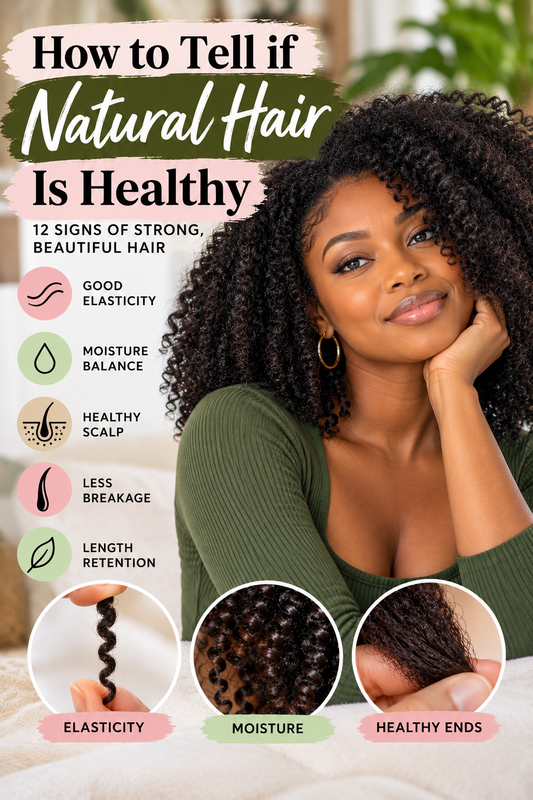
Natural hair comes in many beautiful textures, from loose curls and waves to tight coils and 4C hair. But one question many people ask during their natural hair journey is: How can I tell if my natural hair is actually healthy?
You might have thick, beautiful hair that looks amazing in a twist-out but constantly breaks during detangling. Or perhaps your hair feels soft and moisturized, yet you struggle to retain length. You may even notice that your scalp feels uncomfortable despite using expensive hair products.
The truth is that healthy natural hair isn't determined by how long, shiny, thick, or curly it looks.
Healthy hair is about the overall condition of your scalp and strands, including strength, flexibility, moisture balance, manageable shedding, and resistance to excessive breakage.
Understanding these characteristics can help you recognize whether your current hair care routine is working or whether your hair needs additional attention.
In this complete guide, we'll explore 12 signs of healthy natural hair, how to recognize damaged strands, simple ways to evaluate your hair at home, and practical steps to maintain strong, beautiful natural hair.
Whether you have 3A curls, 4A coils, 4B hair, or tightly coiled 4C hair, these tips can help you understand what healthy hair looks and feels like.
What Does Healthy Natural Hair Look Like?
Healthy natural hair generally has several important characteristics.
It maintains reasonable flexibility, responds well to appropriate conditioning, experiences manageable shedding, and doesn't constantly snap during normal handling.
Your scalp should also be relatively comfortable, without persistent inflammation, pain, or unusual irritation.
However, healthy hair doesn't always look perfectly smooth.
Natural curls and coils naturally create volume, shrinkage, frizz, and texture. These characteristics are normal and shouldn't automatically be mistaken for damage.
Someone with tightly coiled 4C hair may have strands that appear less shiny than straight hair because the curves reflect light differently.
Likewise, someone with fine natural hair may have less volume than someone with high-density hair.
Neither characteristic means the hair is unhealthy.
The most useful approach is to evaluate how your hair behaves over time rather than comparing its appearance with someone else's.
12 Signs Your Natural Hair Is Healthy
1. Your Hair Has Good Elasticity
One important characteristic of healthy natural hair is elasticity.
Elasticity describes how a hair strand responds to stretching and whether it can return toward its original shape without breaking.
Natural hair needs enough flexibility to tolerate everyday movement, detangling, styling, and manipulation.
Hair that snaps immediately under gentle tension may be experiencing excessive dryness, damage, or structural weakness.
How to Check Hair Elasticity
Take a naturally shed strand of hair.
Wet it slightly and hold it gently between your fingers.
Apply a small amount of tension and observe how it behaves.
A strand in good condition may stretch somewhat before returning toward its original shape.
However, different curl patterns and strand diameters naturally respond differently.
Don't pull hard enough to force the strand to break.
Also, remember that a simple home elasticity test cannot definitively diagnose hair damage.
Signs of Potential Elasticity Problems
-
Hair snaps with very little tension.
-
Strands feel unusually brittle.
-
Hair breaks repeatedly during gentle styling.
-
Previously heat-damaged sections don't behave like newer growth.
-
Hair feels excessively weak after chemical processing.
If these problems occur frequently, your hair may benefit from gentler handling, appropriate conditioning, and less exposure to damaging styling practices.
2. Your Natural Hair Feels Soft and Manageable
Softness is another encouraging sign that your hair care routine may be working.
Healthy natural hair often feels reasonably comfortable to touch and becomes easier to manipulate after proper conditioning.
However, softness doesn't mean your hair must feel silky or completely smooth.
Coarse strands naturally have a different texture from fine strands.
Tightly coiled hair may also feel different from loosely curled hair even when both are healthy.
What matters is whether your hair feels conditioned and manageable relative to its natural characteristics.
Signs Your Hair Is Properly Conditioned
Your strands may:
-
Feel softer after washing and conditioning.
-
Separate without excessive pulling.
-
Respond well to moisturizing products.
-
Maintain reasonable flexibility.
-
Feel less rough after detangling.
-
Remain manageable between wash days.
If your hair feels soft but continues breaking, softness alone isn't enough to confirm good hair condition.
Other factors, including damaged ends, rough detangling, and previous heat exposure, may contribute.
Learn more in our article, Why Is My Hair Soft but Still Breaking?.
3. Your Hair Doesn't Experience Excessive Breakage
One of the strongest practical indicators of healthy natural hair is the absence of persistent, excessive breakage.
All hair experiences some wear over time.
However, if you constantly notice short broken pieces in your sink, comb, brush, or clothing, your strands may be experiencing unnecessary damage.
How to Recognize Hair Breakage
Broken hairs often appear as:
-
Short strands of different lengths.
-
Tiny pieces without a visible root bulb.
-
Frayed or split ends.
-
Uneven sections throughout your hair.
-
Short hairs accumulating during detangling.
Breakage can happen when hair is exposed to more force than the strands can withstand.
Common causes include aggressive brushing, excessive heat, chemical processing, friction, tight hairstyles, and damaged ends.
Breakage vs. Normal Shedding
Shedding occurs when a hair naturally releases from its follicle as part of the hair growth cycle.
A shed hair may have a small, pale club-shaped end.
Breakage occurs when a strand snaps somewhere along its length.
Some daily shedding is expected, although the amount varies between individuals and may be more noticeable when hair is washed or detangled infrequently.
If your hair is consistently breaking during ordinary handling, consider adjusting your routine.
For additional information, read How to Stop Natural Hair From Breaking.
4. Your Scalp Looks and Feels Healthy
Healthy natural hair begins with paying attention to the scalp.
The scalp contains the follicles responsible for producing hair.
Although hair products can improve the appearance and manageability of existing strands, maintaining a healthy scalp is important for supporting normal hair growth.
Signs of a Healthy Scalp
A comfortable scalp generally has:
-
No persistent itching.
-
No unusual redness or inflammation.
-
No painful bumps or sores.
-
No excessive scaling.
-
No ongoing burning sensations.
-
No unexplained bald patches.
A little dryness or occasional itching doesn't automatically indicate a serious problem.
However, persistent irritation should never be ignored.
Common Scalp Problems
Scalp discomfort may result from several conditions, including dandruff, seborrheic dermatitis, contact irritation, psoriasis, or reactions to hair products.
Repeatedly applying oils over an irritated scalp may not solve the underlying problem.
In some situations, certain oils or fragranced products can make irritation worse.
Cleanse your scalp appropriately, avoid products that cause discomfort, and seek professional advice for persistent symptoms.
Supporting Scalp Comfort
A consistent scalp routine may include gentle cleansing, avoiding excessive product buildup, and minimizing tension from hairstyles.
For people who enjoy oil-based scalp care, Hairobics Hair & Scalp Booster contains a blend of botanical oils designed for scalp conditioning.
Use it according to the product directions, patch-test before use, and discontinue application if irritation develops.
Remember that scalp-conditioning products are not substitutes for medical treatment when hair loss or scalp disease is present.
5. Your Hair Retains Length Over Time
Hair growth and length retention are two different things.
Hair grows from follicles beneath the scalp.
Length retention describes how much of that growth remains after accounting for breakage, trimming, and normal wear.
Someone may experience regular hair growth but struggle to notice longer hair because the ends repeatedly break.
Signs of Good Length Retention
You may notice:
-
Your stretched hair gradually becomes longer.
-
Your twists or braids show more length over time.
-
Your ends remain relatively full.
-
You experience less breakage during styling.
-
Your hair maintains length between trims.
-
Previously shorter sections gradually catch up.
Natural hair shrinkage can make length changes difficult to recognize.
Tightly coiled hair may appear much shorter in its natural state than when gently stretched.
This doesn't mean your hair has stopped growing.
How to Track Your Progress
Choose a consistent section of hair.
Every four to six weeks, gently stretch that section and record its length.
Use the same measuring technique each time.
Photographs can also help you observe changes.
If you notice steady growth near the roots but little overall length retention, examine your ends and styling practices.
For more techniques, explore How to Retain Length and Avoid Breakage on Natural Hair.
6. Your Hair Responds Well to Moisture and Conditioning
Healthy natural hair should respond reasonably well to an appropriate cleansing and conditioning routine.
This doesn't mean your hair must remain moisturized for an exact number of days.
Moisture behavior varies depending on porosity, strand thickness, density, climate, and product selection.
Some people need to refresh their hair more frequently than others.
Signs Your Moisture Routine Is Working
-
Hair becomes easier to detangle after conditioning.
-
Strands feel more flexible.
-
Hair doesn't constantly feel brittle.
-
Products distribute reasonably well.
-
Your hair maintains softness for a period appropriate to its needs.
-
Your ends don't repeatedly feel extremely rough.
One important distinction is that oil and water aren't the same thing.
Water provides hydration, while conditioning ingredients and certain oils can help improve lubrication, reduce friction, and influence moisture loss.
Applying more oil to dry hair doesn't automatically increase its water content.
Understanding Hair Porosity
Hair porosity describes how hair interacts with water.
Low-porosity hair may resist becoming saturated initially.
High-porosity hair may wet easily but sometimes lose moisture more rapidly.
Neither classification automatically determines whether your hair is healthy.
To understand how moisture behaves in your strands, read How to Determine Hair Porosity.
7. Your Ends Are in Good Condition
Your ends are among the oldest and most weathered parts of your hair.
They experience repeated washing, styling, brushing, detangling, environmental exposure, and friction.
Over time, this accumulated wear can make the ends more vulnerable to damage.
Signs of Healthy-Looking Ends
-
Minimal visible splitting.
-
Relatively consistent fullness.
-
Manageable tangling.
-
No constant snapping.
-
Ends that respond to conditioner.
-
Less roughness and snagging during styling.
A few single-strand knots are common in tightly coiled hair.
They don't automatically mean your entire head of hair is damaged.
However, excessive knots, persistent splitting, or ends that continually catch on neighboring strands may indicate that additional care is needed.
Can Split Ends Be Repaired?
Conditioning products may temporarily smooth damaged ends and improve their appearance.
However, they cannot permanently reconnect a strand that has physically split.
When ends become severely damaged, trimming is often the most practical solution.
You don't necessarily need to cut your hair according to a rigid calendar.
Instead, consider the condition of your ends, your styling routine, and the amount of wear your hair experiences.
Read our detailed guide on How to Protect Your Natural Hair Ends.
8. Your Hair Has Natural Shine or Luster
Healthy hair often reflects some light, but the amount of visible shine depends heavily on texture.
Straight hair typically reflects light differently from tightly coiled hair.
With natural curls and coils, light reflects from many different angles.
As a result, healthy 4C hair may have a softer, more subtle luster rather than a glossy appearance.
What Can Affect Natural Hair Shine?
Several factors influence shine:
-
Curl pattern.
-
Surface condition of the strand.
-
Product buildup.
-
Hair color.
-
Lighting.
-
Conditioning products.
-
Environmental exposure.
Shine can be encouraging, but it shouldn't be your primary measurement of hair health.
Hair can look glossy because of oils or styling products while still experiencing significant breakage.
Likewise, healthy coily hair may appear relatively matte.
Focus on strength, manageability, and breakage patterns rather than chasing excessive shine.
9. Your Hair Doesn't Tangle Excessively
Natural hair naturally tangles because curls and coils can wrap around neighboring strands.
Some tangling is normal.
However, constantly battling severe knots may indicate that your hair needs a different detangling routine or additional attention to damaged ends.
Signs of Manageable Tangling
-
Knots can be separated without excessive force.
-
Conditioner improves detangling.
-
Hair doesn't immediately form severe tangles after every wash.
-
Your ends don't constantly snag.
-
Detangling doesn't regularly produce large amounts of broken hair.
How to Reduce Unnecessary Tangling
Begin by dividing your hair into manageable sections.
Apply a conditioner or detangling product that provides adequate slip.
Use your fingers to loosen large knots before introducing a comb.
Start near the ends and gradually work upward.
Avoid pulling forcefully through resistance.
For more guidance, read Why Does My Hair Break When Detangling?.
10. Your Hair Maintains Its Natural Curl Pattern
Healthy natural hair often maintains a recognizable curl or coil pattern.
However, curl definition varies significantly between individuals.
Some people have clearly defined ringlets.
Others have tight zigzag patterns, small coils, or less visibly defined curls.
All these patterns can be healthy.
When Curl Pattern Changes May Indicate Damage
Pay attention if sections that previously curled begin remaining unusually straight after repeated heat styling.
You may also notice:
-
Limp sections after flat ironing.
-
Ends that no longer coil as they previously did.
-
Different texture in chemically processed areas.
-
Increased breakage in previously straightened sections.
These changes may indicate heat or chemical damage.
However, temporary changes in curl appearance can also result from styling methods, product buildup, or the way hair dries.
Not every change means permanent damage.
Can Damaged Curls Recover?
Conditioning can improve the appearance and manageability of damaged hair.
However, severe structural heat damage cannot always be reversed.
In some cases, gradually trimming damaged sections while allowing new growth to develop is the most practical approach.
11. Your Hair Has Consistent Fullness
Healthy natural hair doesn't have to be extremely thick.
Hair density varies naturally.
Some people have low-density hair, while others have high-density hair.
Fine hair can be perfectly healthy.
Coarse hair can also be healthy.
The important thing is understanding your normal hair density and noticing meaningful changes.
Signs Worth Monitoring
Pay attention to:
-
A widening part.
-
New visible scalp areas.
-
Sudden thinning around the edges.
-
Unexplained bald patches.
-
Noticeable loss of ponytail fullness.
-
Persistent thinning at the crown.
A gradual or sudden change in density may have causes unrelated to your hair products.
These can include genetics, hormonal changes, nutritional deficiencies, medical conditions, and traction from tight hairstyles.
If you experience unexplained thinning, a dermatologist can help determine the cause.
To understand how fullness differs from strand diameter, read Hair Density vs. Hair Thickness.
12. Your Hair Handles Everyday Styling Without Constant Damage
Healthy natural hair should generally tolerate appropriate everyday styling.
That doesn't mean you can repeatedly pull, brush, straighten, or manipulate it without consequences.
Every hair fiber has limits.
But with gentle techniques and appropriate conditioning, your hair should be manageable without excessive snapping.
Signs Your Styling Routine Is Working
-
Twist-outs don't cause substantial breakage.
-
Braids can be installed without scalp pain.
-
Detangling is manageable.
-
Hair remains reasonably flexible.
-
You don't notice increasing damage after each style.
-
Your edges aren't constantly under tension.
Be Careful With Protective Styles
Protective hairstyles can help reduce daily manipulation.
However, a style isn't automatically protective simply because the hair is braided, twisted, or tucked away.
Tight braids, heavy extensions, and repeated pulling can place excessive tension on follicles.
Over time, this may contribute to traction alopecia.
Choose comfortable styles that don't pull painfully on the scalp.
How to Test Whether Your Natural Hair Is Healthy at Home
You don't need expensive equipment to begin evaluating your hair.
A simple home assessment can help you identify patterns.
Step 1: Examine Your Scalp
Part your hair in several locations.
Look for unusual redness, scaling, sores, irritation, or areas of thinning.
Your scalp should generally feel comfortable.
Step 2: Check Your Ends
Gently stretch a small section of hair.
Inspect the ends for visible splitting, excessive knots, or obvious fraying.
Compare different areas of your head.
Step 3: Observe Your Hair During Detangling
Pay attention to the amount and type of hair released.
Long shed strands and short broken pieces may indicate different processes.
Avoid judging your hair from one detangling session alone.
Step 4: Evaluate Softness and Flexibility
After washing and conditioning, notice how your hair feels.
Does it become manageable?
Can you separate strands without excessive pulling?
Does it feel unusually brittle?
Step 5: Check Your Moisture Routine
Observe how your hair responds to your usual products.
Does your leave-in conditioner improve manageability?
Do heavy products leave buildup?
Does your hair become extremely dry shortly after washing?
These observations can help you make adjustments.
Step 6: Track Changes Over Time
Take photographs every month under similar lighting conditions.
Monitor your length, ends, scalp, and breakage patterns.
A consistent record is usually more useful than a single home test.
Healthy Natural Hair vs. Damaged Natural Hair
| Healthy Hair Characteristics | Possible Signs of Damage |
|---|---|
| Reasonable flexibility | Frequent snapping |
| Manageable detangling | Excessive knots and breakage |
| Comfortable scalp | Persistent irritation or inflammation |
| Relatively intact ends | Extensive splitting and fraying |
| Gradual length retention | Continued length loss from breakage |
| Consistent natural texture | New uneven texture after heat damage |
| Appropriate softness after conditioning | Persistent brittleness |
| Normal shedding pattern | Sudden or unusual hair loss |
Remember that these are general observations, not definitive medical tests.
A person may have healthy hair with some dryness, frizz, shrinkage, or tangling.
The overall pattern matters more than any single characteristic.
How to Keep Natural Hair Healthy
Once you understand the signs of healthy hair, the next step is building a routine that supports your strands.
1. Cleanse Your Hair Regularly
A clean scalp helps remove sweat, oils, dead skin, and product residue.
The ideal washing frequency depends on your scalp condition, hairstyle, activity level, and product use.
Some people benefit from weekly washing.
Others may need a different schedule.
The goal is to prevent excessive buildup without making your hair unnecessarily difficult to manage.
2. Condition After Shampooing
Conditioning helps improve lubrication and reduce friction between strands.
This is particularly important for curly and coily hair.
Focus on distributing conditioner through your lengths and ends.
Use a product that makes detangling easier without leaving excessive residue.
3. Use Leave-In Treatments When Needed
A leave-in product can help maintain manageability between wash days.
Choose one that works with your hair's texture and styling needs.
For example, Hairobics Leave-In Treatment is a water-based treatment containing botanical ingredients and conditioning oils.
It can be incorporated into a natural hair routine according to its directions.
Patch-test new products and avoid applying them to irritated skin.
A leave-in treatment may improve softness and manageability, but it cannot permanently repair severely damaged hair fibers.
4. Protect Your Hair at Night
Nighttime friction can contribute to tangling and wear.
Consider using a satin bonnet, satin scarf, or smooth pillowcase.
Loose twists or braids may also help keep your hair organized while sleeping.
Avoid tying your hair too tightly.
5. Reduce Excessive Heat
Occasional heat styling doesn't automatically mean your hair is unhealthy.
However, repeated high-temperature styling can damage the hair fiber.
When using heated tools, choose appropriate temperature settings, use a suitable heat protectant, and minimize repeated passes.
If your curls no longer return to their usual pattern, consider reducing heat exposure.
6. Avoid Tight Hairstyles
Braids, ponytails, buns, and extensions should never cause persistent scalp pain.
Excessive tension can damage hair and, in some cases, contribute to permanent hair loss.
Rotate styles and give sensitive areas relief from pulling.
7. Trim Damaged Ends When Necessary
Trimming doesn't make hair grow faster from the scalp.
However, removing severely damaged ends can reduce tangling and prevent further mechanical problems.
The right trimming schedule depends on your hair's condition.
8. Support Hair Health Through Nutrition
Hair growth depends partly on overall health.
Adequate protein, calories, iron, and other nutrients help support normal hair production.
Severe dietary restriction or nutritional deficiencies may contribute to hair shedding.
Supplements aren't automatically beneficial when no deficiency exists.
If you suspect a nutritional problem, speak with a healthcare professional before taking high-dose supplements.
9. Maintain a Simple, Consistent Routine
You don't need fifteen different products to maintain healthy natural hair.
A practical routine may include:
-
An appropriate shampoo.
-
A rinse-out conditioner.
-
A leave-in treatment when needed.
-
A moisturizer or styling product suited to your hair.
-
Gentle detangling tools.
-
Comfortable protective styles.
-
Nighttime protection.
Consistency and technique often matter more than the number of products you own.
Common Mistakes That Make Healthy Natural Hair Look Damaged
Sometimes hair appears unhealthy because of styling or product issues rather than severe structural damage.
Using Too Many Heavy Products
Excessive layering of oils, creams, gels, and butters may leave hair coated.
This can make strands feel sticky, dull, or weighed down.
Try simplifying your routine before purchasing additional products.
Detangling Too Aggressively
Even well-conditioned hair can break when pulled forcefully.
Use smaller sections and adequate slip.
Ignoring Your Ends
You may spend time caring for your scalp while overlooking the oldest sections of your strands.
Give your ends appropriate attention.
Comparing Your Hair to Other Textures
Healthy 4C hair doesn't need to resemble 3B curls.
Healthy fine hair doesn't need to look as full as high-density hair.
Your hair's natural characteristics should guide your expectations.
Constantly Changing Products
Switching products every few days makes it difficult to identify what works.
Unless a product causes irritation or another problem, give your routine a reasonable period of consistent use while monitoring the results.
Frequently Asked Questions About Healthy Natural Hair
How do I know if my 4C hair is healthy?
Healthy 4C hair generally experiences manageable breakage, responds to appropriate conditioning, maintains its natural coil pattern, and grows from a relatively comfortable scalp.
Shrinkage, frizz, and less visible shine are normal characteristics of many tightly coiled textures.
Can natural hair be healthy even if it's dry?
Yes. Occasional dryness doesn't automatically mean your hair is severely damaged.
However, persistent brittleness, roughness, and frequent breakage may indicate that your routine needs adjustment.
Does healthy natural hair always grow fast?
No. Hair growth rates vary.
Genetics, age, nutrition, health, and the hair growth cycle influence growth.
Healthy hair care primarily helps maintain the condition of existing strands and reduce avoidable breakage.
Can healthy natural hair have split ends?
Yes. Even generally healthy hair can develop split ends through normal wear.
A few damaged ends don't mean your entire head of hair is unhealthy.
However, extensive splitting may require trimming and changes to your styling routine.
Is shiny natural hair always healthy?
No. Oils and styling products can create shine even when strands are damaged.
Shine alone isn't a reliable measure of hair health.
How often should I check my natural hair for damage?
You can observe your hair during regular wash days.
A more detailed monthly assessment of your ends, scalp, and length retention can help identify gradual changes.
Does healthy natural hair shed?
Yes. Shedding is part of the normal hair growth cycle.
However, sudden, excessive, or patchy hair loss deserves professional evaluation.
Can damaged natural hair become healthy again?
Some forms of dryness and manageability problems improve with appropriate cleansing, conditioning, and gentler styling.
Severely damaged hair fibers cannot fully regenerate because the visible hair shaft is not living tissue.
In those cases, reducing further damage and gradually removing affected sections may be necessary.
What is the biggest sign of healthy natural hair?
There isn't one perfect sign.
A combination of manageable breakage, good scalp condition, reasonable flexibility, intact ends, and consistent length retention provides a more useful picture.
Final Thoughts: How to Tell if Your Natural Hair Is Truly Healthy
Healthy natural hair isn't about achieving a particular curl pattern, having extremely long hair, or making every strand perfectly shiny.
It's about understanding your hair and maintaining the conditions that help it remain strong, flexible, manageable, and protected.
Pay attention to how your hair behaves during washing, detangling, moisturizing, and styling.
Watch for excessive breakage, persistent scalp irritation, unusual shedding, or increasingly damaged ends.
At the same time, appreciate the characteristics that make natural hair unique.
Shrinkage is normal.
Frizz is normal.
Different curl patterns are normal.
And healthy natural hair doesn't have to look exactly like anyone else's.
With consistent cleansing, appropriate conditioning, gentle handling, scalp care, and protection from unnecessary damage, you can build a routine that supports healthier-looking hair over time.
At Hairobics All Natural, we believe that caring for your natural hair should be about understanding what your strands need rather than chasing unrealistic beauty standards.
Explore our Hair & Scalp Booster and Leave-In Treatment as options for your regular scalp and hair-conditioning routine.
Healthy natural hair starts with understanding your scalp, protecting your strands, and being consistent with the care you provide.